Problem 1
Andy and Betsy both live in Mathville. Andy leaves Mathville on his bicycle at $1: 30$, traveling due north at a steady 8 miles per hour. Betsy leaves on her bicycle from the same point at $2: 30$, traveling due east at a steady 12 miles per hour. At what time will they be exactly the same distance from their common starting point?
(A) $3: 30$
(B) $3: 45$
(C) $4: 00$
(D) $4: 15$
(E) $4: 30$
Answer:
(E) $4: 30$
Problem 2
A box contains 10 pounds of a nut mix that is 50 percent peanuts, 20 percent cashews, and 30 percent almonds. A second nut mix containing 20 percent peanuts, 40 percent cashews, and 40 percent almonds is added to the box resulting in a new nut mix that is 40 percent peanuts. How many pounds of cashews are now in the box?
(A) 3.5
(B) 4
(C) 4.5
(D) 5
(E) 6
Answer:
(B) 4
Problem 3
How many isosceles triangles are there with positive area whose side lengths are all positive integers and whose longest side has length 2025 ?
(A) 2025
(B) 2026
(C) 3012
(D) 3037
(E) 4050
Answer:
(D) 3037
Problem 4
A team of students is going to compete against a team of teachers in a trivia contest. The total number of students and teachers is 15 . Ash, a cousin of one of the students, wants to join the contest. If Ash plays with the students, the average age on that team will increase from 12 to 14 . If Ash plays with the teachers, the average age on that team will decrease from 55 to 52 . How old is Ash?
(A) 28
(B) 29
(C) 30
(D) 32
(E) 33
Answer:
(A) 28
Problem 5
Consider the sequence of positive integers
$$
1,2,1,2,3,2,1,2,3,4,3,2,1,2,3,4,5,4,3,2,1,2,3,4,5,6,5,4,3,2,1,2 \ldots
$$
What is the 2025th term in the sequence?
(A) 5
(B) 15
(C) 16
(D) 44
(E) 45
Answer:
(E) 45
Problem 6
In an equilateral triangle each interior angle is trisected by a pair of rays. The intersection of the interiors of the middle $20^{\circ}$-angle at each vertex is the interior of a convex hexagon. What is the degree measure of the smallest angle of this hexagon?
(A) 80
(B) 90
(C) 100
(D) 110
(E) 120
Answer:
(C) 100
Problem 7
Suppose $a$ and $b$ are real numbers. When the polynomial $x^{3}+x^{2}+a x+b$ is divided by $x-1$, the remainder is 4 . When the polynomial is divided by $x-2$, the remainder is 6 . What is $b-a$ ?
(A) 14
(B) 15
(C) 16
(D) 17
(E) 18
Answer:
(E) 18
Problem 8
Agnes writes the following four statements on a blank piece of paper.
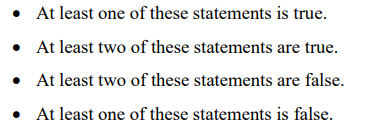
Each statement is either true or false. How many false statements did Agnes write on the paper?
(A) 0
(B) 1
(C) 2
(D) 3
(E) 4
Answer:
(B) 1
Problem 9
Let $f(x)=100 x^{3}-300 x^{2}+200 x$. For how many real numbers $a$ does the graph of $y=f(x-a)$ pass through the point $(1,25)$ ?
(A) 1
(B) 2
(C) 3
(D) 4
(E) more than 4
Answer:
(C) 3
Problem 10
A semicircle has diameter $A B$ and chord $C D$ of length 16 parallel to $A B$. A smaller circle with diameter on $A B$ and tangent to $C D$ is cut from the larger semicircle, as shown below.
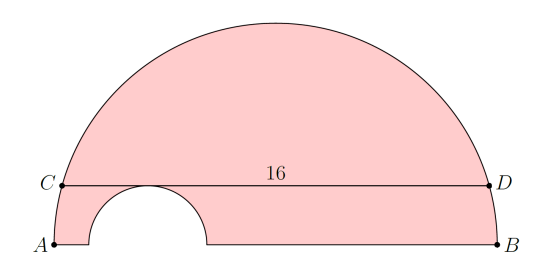
What is the area of the resulting figure, shown shaded?
(A) $16 \pi$
(B) $24 \pi$
(C) $32 \pi$
(D) $48 \pi$
(E) $64 \pi$
Answer:
(C) $32 \pi$
Problem 11
The sequence $1, x, y, z$ is arithmetic. The sequence $1, p, q, z$ is geometric. Both sequences are strictly increasing and contain only integers, and $z$ is as small as possible. What is the value of $x+y+z+p+q$ ?
(A) 66
(B) 91
(C) 103
(D) 132
(E) 149
Answer:
(E) 149
Problem 12
Carlos uses a 4-digit passcode to unlock his computer. In his passcode, exactly one digit is even, exactly one (possibly different) digit is prime, and no digit is 0 . How many 4 -digit passcodes satisfy these conditions?
(A) 176
(B) 192
(C) 432
(D) 464
(E) 608
Answer:
(D) 464
Problem 13
In the figure below, the outside square contains infinitely many squares, each of them with the same center and sides parallel to the outside square. The ratio of the side length of a square to the side length of the next inner square is $k$, where $0<k<1$. The spaces between squares are alternately shaded, as shown in the figure (which is not necessarily drawn to scale).

The area of the shaded portion of the figure is $64 \%$ of the area of the original square. What is $k$ ?
(A) $\frac{3}{5}$
(B) $\frac{16}{25}$
(C) $\frac{2}{3}$
(D) $\frac{3}{4}$
(E) $\frac{4}{5}$
Answer:
(D) $\frac{3}{4}$
Problem 14
Six chairs are arranged around a round table. Two students and two teachers randomly select four of the chairs to sit in. What is the probability that the two students will sit in two adjacent chairs and the two teachers will also sit in two adjacent chairs?
(A) $\frac{1}{6}$
(B) $\frac{1}{5}$
(C) $\frac{2}{9}$
(D) $\frac{3}{13}$
(E) $\frac{1}{4}$
Answer:
(B) $\frac{1}{5}$
Problem 15
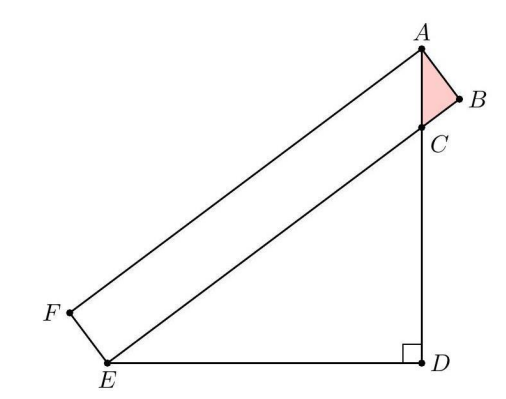
In the figure below, $A B E F$ is a rectangle, $\quad \overline{A D} \perp \overline{D E} \quad, \quad A F=7 \quad, \quad A B=1 \quad$, and $\quad A D=5 \quad$. What is the area of $\triangle A B C$ ?
(A) $\frac{3}{8}$
(B) $\frac{4}{9}$
(C) $\frac{1}{8} \sqrt{13}$
(D) $\frac{7}{15}$
(E) $\frac{1}{8} \sqrt{15}$
Answer:
(A) $\frac{3}{8}$
Problem 16
There are three jars. Each of three coins is placed in one of the three jars, chosen at random and independently of the placements of the other coins. What is the expected number of coins in a jar with the most coins?
(A) $\frac{4}{3}$
(B) $\frac{13}{9}$
(C) $\frac{5}{3}$
(D) $\frac{17}{9}$
(E) 2
Amswer:
(D) $\frac{17}{9}$
Problem 17
Let $N$ be the unique positive integer such that dividing 273436 by $N$ leaves a remainder of 16 and dividing 272760 by $N$ leaves a remainder of 15 . What is the tens digit of $N$ ?
(A) 0
(B) 1
(C) 2
(D) 3
(E) 4
Answer:
(E) 4
Problem 18
The harmonic mean of a collection of numbers is the reciprocal of the arithmetic mean of the reciprocals of the numbers in the collection. For example, the harmonic mean of $4,4,5$ is
$$
\frac{1}{\frac{1}{3}\left(\frac{1}{4}+\frac{1}{4}+\frac{1}{5}\right)}=\frac{30}{7} .
$$
What is the harmonic mean of all the real roots of the $4050{ }^{\text {th }}$ degree polynomial
$$
\prod_{k=1}^{2025}\left(k x^{2}-4 x-3\right)=\left(x^{2}-4 x-3\right)\left(2 x^{2}-4 x-3\right)\left(3 x^{2}-4 x-3\right) \cdots\left(2025 x^{2}-4 x-3\right) ?
$$
(A) $-\frac{5}{3}$
(B) $-\frac{3}{2}$
(C) $-\frac{3}{5}$
(D) $-\frac{5}{6}$
(E) $-\frac{2}{3}$
Answer:
(B) $-\frac{3}{2}$
Problem 19
An array of numbers is constructed beginning with the numbers $-1 \quad 3 \quad 1$ in the top row. Each adjacent pair of numbers is summed to produce a number in the next row. Each row begins and ends with -1 and 1 , respectively.
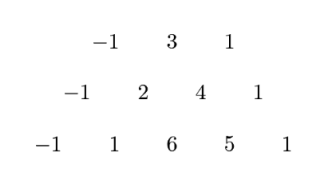
If the process continues, one of the rows will sum to 12,288 . In that row, what is the third number from the left?
(A) -29
(B) -21
(C) -14
(D) -8
(E) -3
Answer:
(A) -29
Problem 20
A silo (right circular cylinder) with diameter 20 meters stands in a field. MacDonald is located 20 meters west and 15 meters south of the center of the silo. McGregor is located 20 meters east and $g>0$ meters south of the center of the silo. The line of sight between MacDonald and McGregor is tangent to the silo. The value of $g$ can\
be written as $\frac{a \sqrt{b}-c}{d}$, where $a, b, c$, and $d$ are positive integers, $b$ is not divisible by the square of any prime, and $d$ is relatively prime to the greatest common divisor of $a$ and $c$. What is $a+b+c+d$ ?
(A) 119
(B) 120
(C) 121
(D) 122
(E)123
Answer:
(A) 119
Problem 21
A set of numbers is called sum-free if whenever $x$ and $y$ are (not necessarily distinct) elements of the set, $x+y$, is not an element of the set. For example, ${1,4,6}$ and the empty set are sum-free, but ${2,4,5}$ is not. What is the greatest possible number of elements in a sum-free subset of ${1,2,3, \ldots, 20}$.
(A) 8
(B) 9
(C) 10
(D) 11
(E) 12
Answer:
(C) 10
Problem 22
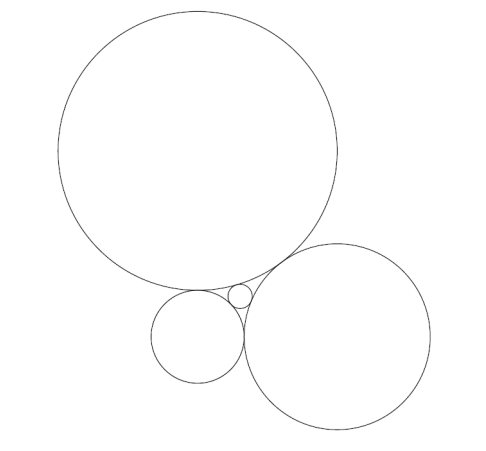
A circle of radius $r$ is surrounded by three circles, whose radii are 1,2 , and 3 , all externally tangent to the inner circle and to each other, as shown.
What is $r$ ?
(A) $\frac{1}{4}$
(B) $\frac{6}{23}$
(C) $\frac{3}{11}$
(D) $\frac{5}{17}$
(E) $\frac{3}{10}$
Answer:
(B) $\frac{6}{23}$
Problem 23
Triangle $\triangle A B C$ has side lengths $A B=80, B C=45$, and $A C=75$. The bisector $\angle B$ and the altitude to side $\overline{A B}$ intersect at point $P$. What is $B P$ ?
(A) 18
(B) 19
(C) 20
(D) 21
(E) 22
Answer:
(D) 21
Problem 24
Call a positive integer fair if no digit is used more than once, it has no 0 s , and no digit is adjacent to two greater digits. For example, 196,23 and 12463 are fair, but 1546,320 , and 34321 are not. How many fair positive integers are there?
(A) 511
(B) 2584
(C) 9841
(D) 17711
(E) 19682
Answer:
(C) 9841
Problem 25
A point $P$ is chosen at random inside square $A B C D$. the probability that $\overline{A P}$ is neither the shortest nor the longest side of $\triangle A P B$ can be written
$$
\frac{a+b \pi-c \sqrt{d}}{e}
$$
, where $a, b, c, d, \quad$ and $\quad e \quad$ are positive integers, $\operatorname{gcd}(a, b, c, e)=1$, and $d$ is not divisible by the square of a prime. What is $a+b+c+d+e$ ?
(A) 25
(B) 26
(C) 27
(D) 28
(E) 29
Answer:
(A) 25