The magnitude of electrostatic force between two tiny spherical balls carrying charge $\mathrm{q}_{1}$ and $\mathrm{q}_{2}$ separated by a distance r in free space is given by $\mathrm{F}=\mathrm{K} \frac{\mathrm{q}_{1} \mathrm{q}_{2}}{\mathrm{r}^{2}}$ where the constant $\mathrm{K}=9 \times 10^{9}$ in SI units Two tiny spherical balls of carbon $\left({ }_{6}^{12} \mathrm{C}\right)$ weighing 1 g each are kept 1 cm apart in free space. The two spheres carry equal and opposite charges. The magnitude of electrostatic force of attraction between the two charged spheres is $\mathrm{F}=1.0 \times 10^{-5} \mathrm{ N}$. The ratio of the number of excess electrons to total number of atoms in the negatively charged sphere is
On Fahrenheit scale of temperature, the freezing point of water is marked as $32^{\circ} \mathrm{F}$ and the boiling point of water is marked as $212^{\circ} \mathrm{F}$. While the freezing point and boiling point of water on the Celsius scale are marked as $0^{\circ} \mathrm{C}$ and $100^{\circ} \mathrm{C}$ respectively. During the routine checkup of some patient, a doctor measures the temperature of the patient as $102.6^{\circ} \mathrm{F}$. The temperature of patient on Celsius scale is
Which of the following is the strongest material (in terms of tensile strength)?
Which of the following motions has largest magnitude of acceleration? Assume that all objects are moving in straight line with constant acceleration.
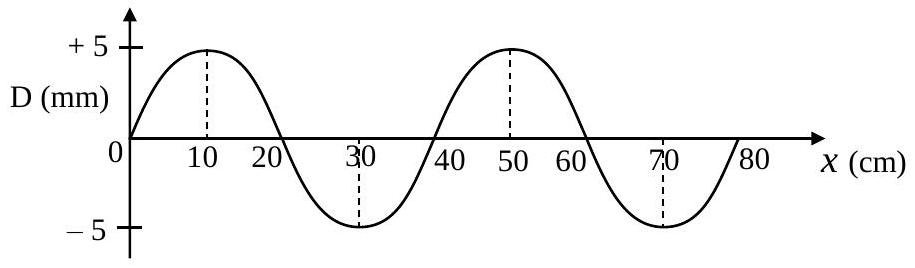
A sound wave is propagating in a medium in the $+x$ direction at a speed of $360 \mathrm{ m} / \mathrm{s}$. At a given instant, a snap shot of the plot of displacement (D) of various particles of medium from their equilibrium position (taken along y axis) vs the position ( $x$ ) of particle on $x$ axis, is shown in figure below. The incorrect option is
When placed inside a liquid of density $\mathrm{d}_{1}$, a sphere sinks, as shown in figure (i). When placed inside a liquid of density $\mathrm{d}_{2}$, the same sphere floats with half of its volume appearing above the liquid surface, as shown in figure (ii). Given that the density of the sphere is d
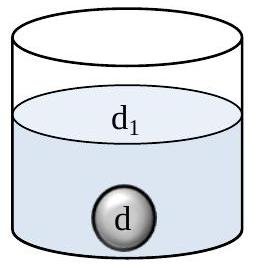
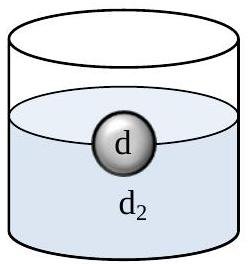
If $F_{1}$ and $F_{2}$ are buoyant forces acting on the sphere in the two situations (i) and (ii) respectively due to the two liquids, then the ratio $\frac{F_{1}}{F_{2}}$ equals
A car is moving on a horizontal cement road with uniform velocity $90 \mathrm{ km} / \mathrm{hr}$. Read the following statements regarding motion of car. $\mathrm{S}_{1}$ : The acceleration of car is zero $\mathrm{S}_{2}$ : No force is acting on the car $\mathrm{S}_{3}$ : Kinetic energy and linear momentum of car are constant during this motion $\mathrm{S}_{4}$ : Engine of car is doing no work Now choose the correct option
A particle is moving along circular path of diameter $\mathrm{D}=14 \mathrm{ cm}$ with constant speed $v$. It takes 0.02 second to complete an arc which subtends an angle of $45^{\circ}$ at the center. If $f$ is its frequency of revolution, then the correct option is
The same liquid is filled in vessels of three different shapes up to the same height, as shown in figures (a), (b) and (c). Each vessel has equal base area.
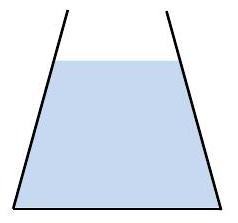
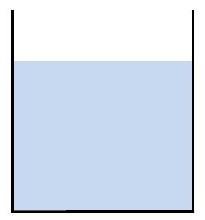
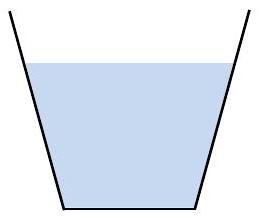
Let $\mathrm{P}_{\mathrm{a}}, \mathrm{P}_{\mathrm{b}}$ and $\mathrm{P}_{\mathrm{c}}$ are the values of liquid pressure on the base of vessels in figure (a), (b) and (c) respectively. $\mathrm{W}_{\mathrm{a}}, \mathrm{W}_{\mathrm{b}}$ and $\mathrm{W}_{\mathrm{c}}$ are the weights of liquid contained in vessels in figure (a), (b) and (c) respectively. Choose the correct option
An ant moves at constant speed on the principal axis of concave mirror of focal length $f$, from a point at distance $5 f$ from the pole of the mirror to the focus F of the mirror. During the motion of the ant (consider the ant as a point), its image formed by the mirror Statement $\mathrm{S}_{1}$ : moves with constant speed Statement $\mathrm{S}_{2}$ : has same velocity as that of the ant when the ant is at center of curvature C of the mirror Statement $\mathrm{S}_{3}$ : moves slower in the beginning and faster towards the end Statement $\mathrm{S}_{4}$ : moves faster in the beginning and slower towards the end Now, choose the correct option:
Which of the following cannot be used as a unit of electric current (i)?
From the famous Einstein mass-energy equivalence relation, energy equivalent to one atomic mass unit (u) (given that $1 \mathrm{u}=1.6605 \times 10^{-27} \mathrm{ kg}$ and the speed of light in vacuum $\mathrm{c}=2.9979 \times 10^{8} \mathrm{ m} / \mathrm{s}$ ) is close to
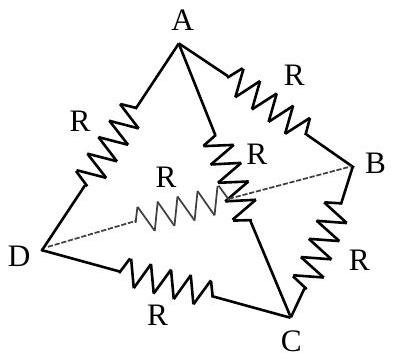
Each resistance in the electrical network shown as a tetrahedron in the adjacent figure is $\mathrm{R}=12 \Omega$. The electrical resistance between any two vertices of tetrahedron must be
Two particles of mass 1 kg and 4 kg are moving with equal kinetic energy. Ratio of magnitudes of their linear momenta is (Assume nonrelativistic velocity)
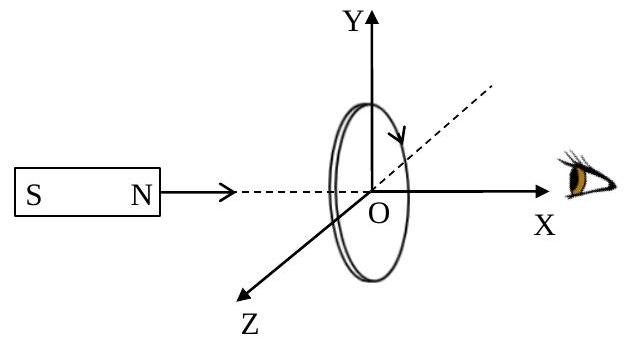
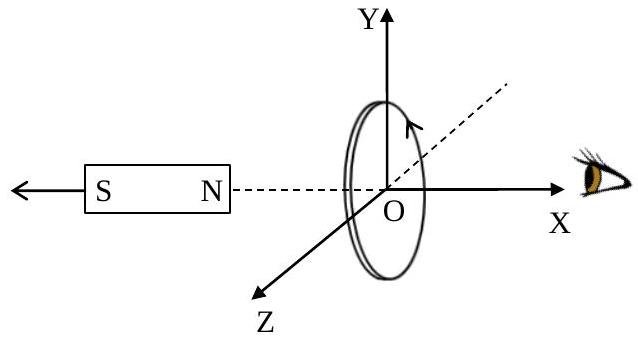
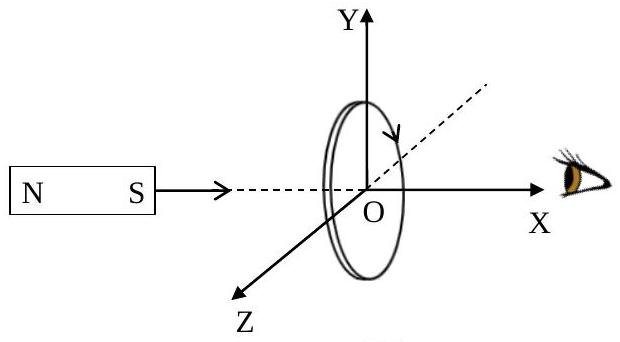
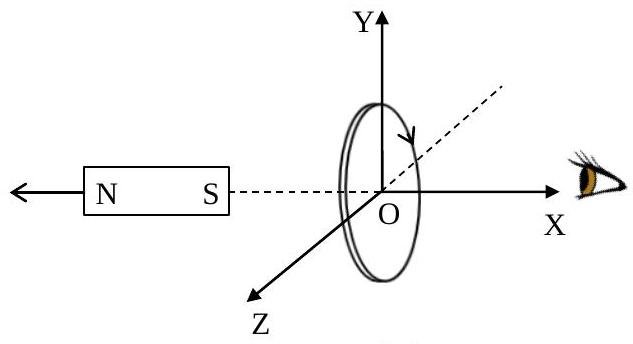
In the following figures, all the conducting coils are in $\mathrm{Y}-\mathrm{Z}$ plane. The magnet is moved along +X axis or -X axis with a constant speed $v$. The direction of induced current in the coils has been shown, as viewed from +X axis. Identify the diagram/diagrams which show correct direction of induced current.
The heater filament of an electric kettle is made up of a conducting wire of length L and diameter D . When connected to a line voltage source, it takes 6 minute to raise the temperature of 500 ml of water by $40^{\circ} \mathrm{C}$. If the heater filament is replaced by a new one of same material but length 2 L and diameter 2D, the time taken for heating the same quantity of water through the same temperature difference will be (Assume that entire system is thermally insulated)
On straight rails a train is moving with constant velocity $v$. Suddenly a wagon breaks away from train. The train continues to move with same velocity while the wagon moves with constant retardation. After breaking away from train, the wagon covers distance $d_{1}$ before coming to rest and the train covers distance $d_{2}$ in the same duration, $\frac{d_{1}}{d_{2}}$ is
A person with short-sightedness (myopia) cannot see objects clearly, beyond 2.5 meter. The power of lens required to correct his vision is
The mass and radius of the planet-one are M and R respectively. The mass and radius of planet-two are 2 M and 2 R respectively. Assume that both the planets have spherical shape. Acceleration due to gravity on the surface of planet-one and planet-two are $g_{1}$ and $g_{2}$ respectively. $\frac{g_{1}}{g_{2}}$ must be
In the following questions any number of options 4,3,2, or 1 may be correct.
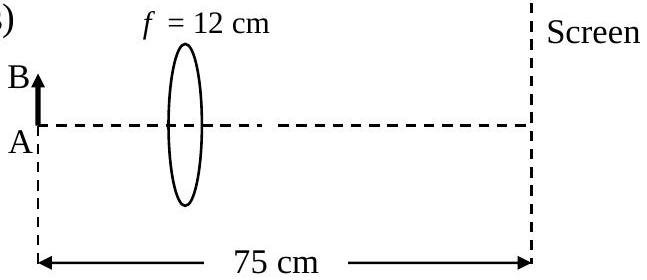
The screen S is placed at a distance of 75 cm in front of an illuminated object AB . A thin convex lens of focal length $f=12 \mathrm{ cm}$ is placed somewhere between the object and the screen so as to obtain a real image of the object on the screen. Choose the correct option(s)
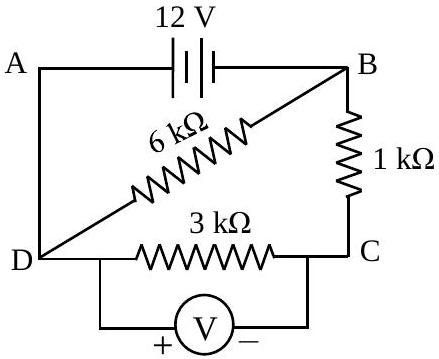
In the circuit shown in adjacent figure, a voltmeter of resistance $6000 \Omega$ has been connected across $3 \mathrm{k} \Omega$ resistor. Internal resistance of battery is negligible. Choose the correct option(s)
A train, moving on a straight horizontal track with constant speed of $108 \mathrm{ km} /$ hour, approaches a hill. When the engine of train is at distance 1200 m from hill, it produces a whistle of frequency 550 Hz . Assuming that the speed of sound in air is $330 \mathrm{ m} / \mathrm{s}$, the correct option(s) is/are
Velocity-time graphs of three athletes Ramesh, Naresh and Dinesh for a given duration (0-30 Minute) are given below.
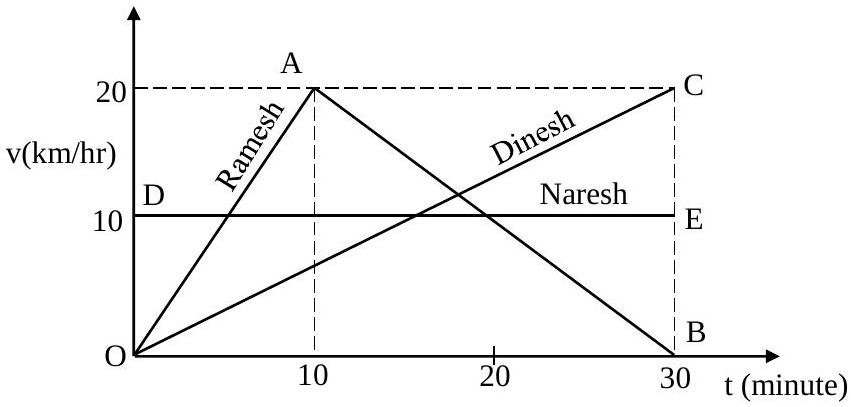
Graph OAB is v-t graph for athlete Ramesh, graph DE is v-t graph for athlete Naresh and graph OC is v-t graph for athlete Dinesh. The graphs are linear. Which of the following option(s) is/are correct during given interval of time?

Publishing original scientific research in a peer-reviewed journal is an achievement many scholars work toward for years. Achieving this feat early in one's academic journey requires exceptional intellectual rigor, creativity, and persistence. Aaditya Punatar and Muskan Sadana have reached this remarkable milestone, successfully publishing their collaborative research paper in the prestigious Journal of Emerging Investigators […]

Her project on quantum-accelerated Steiner trees for 15-minute cities earned a place among the finalists at the world's largest pre-college STEM competition. Prishaa Shrimali of Marymount School of New York, was selected as a Grand Finalist at the 2026 Regeneron International Science and Engineering Fair (ISEF) in Phoenix, Arizona. Her project was Optimizing Urban Accessibility: […]

In 2026, the following Cheenta students have been successful for Indian Statistical Institute's M.Stat Entrance. They ranked within the first 50 in the entire country in these entrances. I.S.I. M.Stat Entrance
In 2026, the following Cheenta students have been successful for Indian Statistical Institute's B.Stat Entrance and Chennai Mathematical Institute's B.Sc. Math Entrance. They ranked within the first 200 in the entire country in these entrances. Most of these students attended the problem solving workshops regularly, which happen 5 days every week. CMI B.Sc. Math Entrance […]