In Summer of 2025, Cheenta Research School worked with research groups from schools in India, USA, UK and Switzerland.
Students from Grade 8 to 12 produced outstanding research papers.
Research Resources
Student Talks... exciting research
Exploring Cubic Reciprocity
Abstract: This presentation, delivered by high school student Samara Mukharji, explores the potential of Cubic Reciprocity to address systemic vulnerabilities in modern cryptography. Current cryptographic systems heavily rely on integer factorization (such as in RSA), which are threatened by the emergence of quantum computing. The goal is to move beyond quadratic-based security and migrate foundations to the cubic domain using the ring of Eisenstein Integers. The presentation covers the Cubic Reciprocity Problem (CRP) and the Cubic Reciprocity Assumption (CRA), which provide a theoretical basis for security independent of quadratic weaknesses.
A Three-Dimensional Farey Graph
Abstract: This research presentation introduces a three-dimensional generalization of the Farey graph, a mathematical construct traditionally used to organize rational numbers in two dimensions. The 3D Farey graph uses primitive integer triples as vertices. Two vertices are connected if their determinant against a fixed anchor vector. A linear condition is derived which makes checking for edges in the 3D graph much more efficient. A major result is the discovery that vertices are either isolated (having no neighbors) or have infinitely many neighbors.

Markov Decision Process for Portfolio Optimization
Abstract: This research presentation explores the use of Markov chains to improve portfolio optimization by accounting for different market regimes. Led by Siddhik, Arnav, and Ayan, the team argues that single-regime models often fail to capture changing market dynamics. The model identifies six market regimes (ranging from highly bearish to highly bullish) based on asset returns relative to mean and standard deviation.
Transition Matrix: They use historical data and maximum likelihood estimation to calculate the probability of moving between these states, ensuring the market model evolves dynamically. Optimization Strategy: Instead of standard return maximization, they frame the problem as distribution matching using divergence metrics like Jensen-Shannon.
Transition Matrix: They use historical data and maximum likelihood estimation to calculate the probability of moving between these states, ensuring the market model evolves dynamically. Optimization Strategy: Instead of standard return maximization, they frame the problem as distribution matching using divergence metrics like Jensen-Shannon.
AI Driven Essay Grading and Tutor
Abstract: Automated Essay Scoring (AES) has advanced significantly with the rise of transformer-based language models, yet a persistent gap remains between high predictive accuracy and pedagogical interpretability. This work introduces DeLi-Net, an automated essay scoring system that fuses hierarchical frozen DeBERTa-v3 embeddings with handcrafted linguistic features to improve interpretability and provide personalised feedback. In addition to having a high QWK against the Kaggle AES 2.0 dataset, DeLi-Net also provides actionable feedback by highlighting the low-scoring regions of each essay.
Markov Decision Process for Quantitative Trading
Abstract: This study proposes a data-driven framework for optimising state transition thresholds in Markov Chain based stock market models. Unlike conventional approaches that define price movements into fixed up, down and no change states using zero-based thresholds, this work introduces backtesting and statistically grounded methods to determine adaptive thresholds.
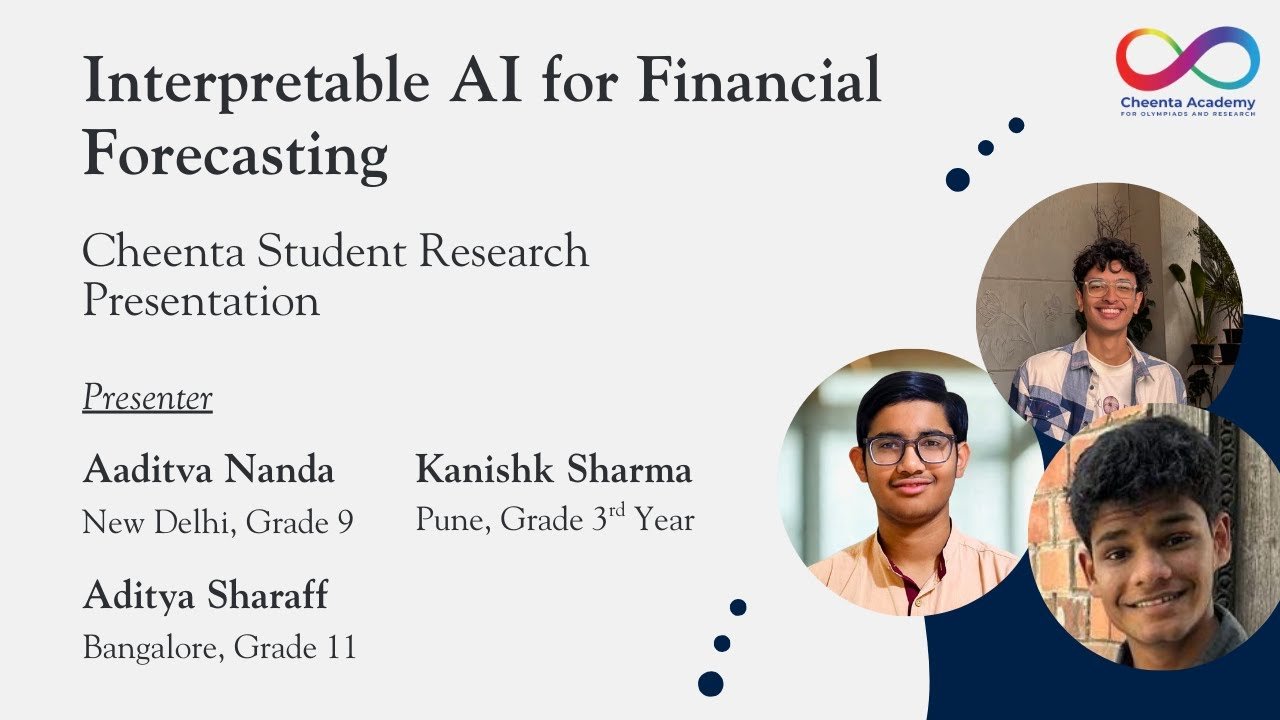
Interpretable AI for Financial Forecasting
Abstract: The complexity of the cryptocurrency market paired with it’s volatility make it very challenging for investors to utilize this market. Further the "black-box" like nature of Deep Learning models make it even more difficult for this market to be studied. This paper proposes a unified deep learning pipeline for multi-class regime prediction in cryptocurrency markets, with a focus on BTC-USD as a liquid benchmark asset. A key contribution of this work is a comprehensive interpretability layer that include SHAP, Integrated Gradients, Attention visualization and Surrogate Logistic Regression that provides an insight into the most important features that drive the model’s decisions. Moreover a comparison between deep and classical models is also discussed to show how deep models are superior and more interpretable.
Why Research?
Advanced students apply for research projects. It helps them learn more, improve their CV and gives them an edge in university applications.
Talk to Advisor