Select the correct order of dielectric constant, refractive index and intermolecular forces for water $\left(\mathrm{H}_{2} \mathrm{O}\right)$ and heavy water $\left(\mathrm{D}_{2} \mathrm{O}\right)$ at 293 K respectively among those given below
Among the elements of atomic number (Z) from 1 to 92 (i.e., from H to U), the elements having atomic number ____ and ____ are not found in nature.
Which state of matter exists at very high temperature and at very low temperature (near absolute zero) respectively? BEC stands for Bose Einstein Condensate.
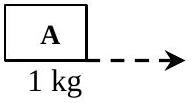
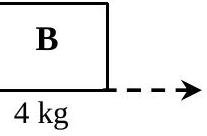
Two blocks A and B of masses 1 kg and 4 kg respectively are moving with equal kinetic energies Read the following statements $\mathrm{S}_{1}$ and $\mathrm{S}_{2}$ Statement $\mathrm{S}_{1}$ : Ratio of speed of the block A to that of B is $1: 2$ Statement $S_{2}$ : Ratio of magnitude of linear momentum of $A$ to that of $B$ is $1: 2$ Now choose the correct option:
The mass of a straight copper wire is 20.95 g and its electrical resistance is $0.065 \Omega$. If the density and resistivity of copper are $\mathrm{d}=8900 \mathrm{ kg} / \mathrm{m}^{3}$ and $\rho=1.7 \times 10^{-8}$ ohm-meter respectively, the length of the copper wire is
It is known that the speed of sound in a gas is directly proportional to square root of its absolute temperature T measured in Kelvin i.e. $v \propto \sqrt{T}$ Speed of sound in air at $0^{\circ} \mathrm{C}$ is $332 \mathrm{ m} / \mathrm{s}$. On a hot day, the speed of sound was measured $360 \mathrm{ m} / \mathrm{s}$ in NCR Delhi, the temperature of air in Delhi on that very day must have been close to
A small bar magnet is allowed to fall vertically through a metal ring lying in a horizontal plane. During its fall, the acceleration of the magnet in the region close to the ring must be (g is the acceleration due to gravity)
An object pin is placed at a distance 10 cm from first focus of a thin convex lens on its principal axis, the lens forms a real and inverted image of this object pin at a distance 40 cm beyond the second focus. The focal length of the lens is
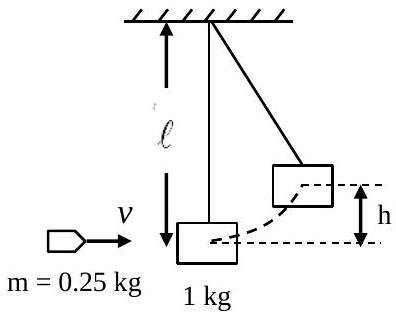
A bullet of mass 0.25 kg moving horizontally with velocity $v(\mathrm{ m} / \mathrm{s})$ strikes a stationary block of mass 1.00 kg suspended by a long inextensible string of negligible mass and length $\ell$. The bullet gets embedded in the block and the system rises up to maximum height $\mathrm{h}=19.6 \mathrm{ cm}$ (as shown in the figure. The string still remains taut). The value of initial speed $v$ of the bullet is
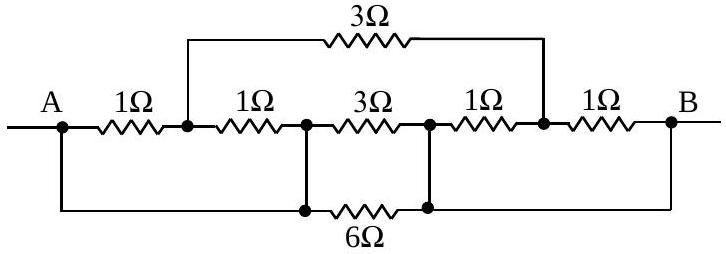
The equivalent resistance between points A and B in the following electrical network is
The order of magnitude of the pressure (in pascal) exerted by an adult human on the Earth when he stands bare footed on the Earth on both of his legs, is
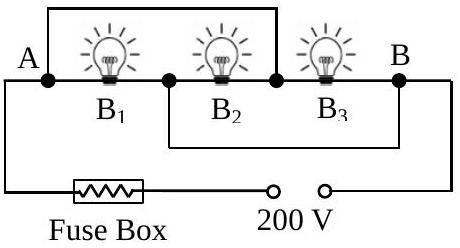
On the board of an experiment, three bulbs $\mathrm{B}_{1}(100 \mathrm{ W}, 200 \mathrm{ V})$, $\mathrm{B}_{2}(60 \mathrm{ W}, 200 \mathrm{ V})$ and $\mathrm{B}_{3}(40 \mathrm{ W}, 200 \mathrm{ V})$ are connected to a 200 V fluctuating supply with a fuse in series as shown in the figure. The electric current rating of the fuse required in the circuit to protect all the three bulbs must be
An ant is sitting on the principal axis of a convex mirror of focal length f , at a distance 2 f from the pole in front of the mirror. It starts moving on principal axis towards the mirror. During the course of motion, the distance between the ant and its image
You are given three resistance of values $2 \Omega, 4 \Omega$ and $6 \Omega$. Which of the following values of equivalent resistance is not possible to get by using/arranging these three resistors in any circuit?
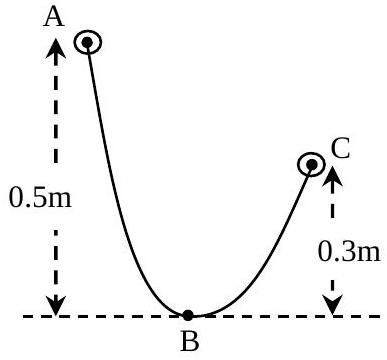
ABC is a 0.8 meter long curved wire track in a vertical plane. A bead of mass 3 g is released from rest at A . It slides along the wire and comes to rest at C . The average frictional force opposing the motion in a single trip from A to C is
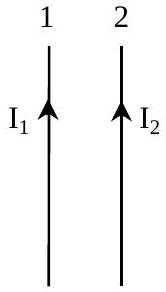
Two long straight conductors 1 and 2, carrying parallel currents $\mathrm{I}_{1}$ and $\mathrm{I}_{2}$ in the same direction, are lying parallel and close to each other, as shown in the figure. $\mathrm{F}_{\mathrm{e}}$ and $\mathrm{F}_{\mathrm{m}}$ respectively represent the electric and the magnetic forces, applied by conductor 1 on conductor 2 . Choose the correct alternative regarding nature of $\mathrm{F}_{\mathrm{e}}$ and $\mathrm{F}_{\mathrm{m}}$
A doctor measures the temperature of a patient by a digital thermometer as $37.3^{\circ} \mathrm{C}$. As a Physics student you will record his temperature in Kelvin as
Two planets $P_{1}$ and $P_{2}$ are moving around the Sun, in circular orbits of radii $10^{13} \mathrm{ m}$ and $10^{12} \mathrm{ m}$ respectively. The ratio of the orbital speeds of planets $\mathrm{P}_{1}$ and $\mathrm{P}_{2}$ in their respective orbits is
Select the correct statement(s) pertaining to Bohr model of an atom.
The correct order(s) of first ionization energy for the following pairs is/are:
Crane A and crane B take 1 minute and 2 minute respectively to lift a car of mass 2 ton ( 2000 kg ) upward through a vertical height $h=3$ meter. If the efficiencies of the engines (defined as the ratio of work output to fuel energy input) of both the cranes are equal, your inference is that
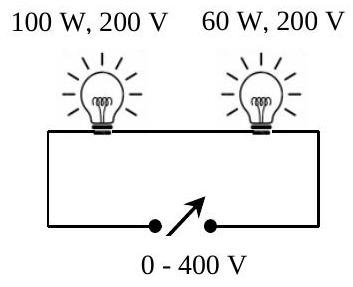
Two tungsten filament bulbs with rating 100 watt, 200 volt and 60 watt, 200 volt are connected in series with a variable supply of $0-400 \mathrm{ V}$ range, as shown. The supply voltage is gradually increased from 0 to 400 V . Choose the correct statement(s).
A solid sphere of radius $R=10 \mathrm{ cm}$ floats in water with $60 %$ of its volume submerged. In an oil, this sphere floats with $80 %$ of its volume submerged. If the density of water is $1000 \mathrm{ kg} / \mathrm{m}^{3}$. The correct statement(s) is/are that
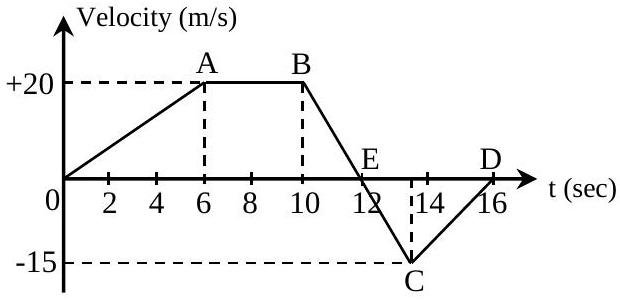
A particle starts moving from origin O along $x$ axis. The velocity-time graph of motion of particle is given below. The positive values of $v$ refer to direction of motion along $+x$ axis, the negative values of $v$ refer to direction of motion along $-x$ direction. Choose the correct statement(s).

Publishing original scientific research in a peer-reviewed journal is an achievement many scholars work toward for years. Achieving this feat early in one's academic journey requires exceptional intellectual rigor, creativity, and persistence. Aaditya Punatar and Muskan Sadana have reached this remarkable milestone, successfully publishing their collaborative research paper in the prestigious Journal of Emerging Investigators […]

Her project on quantum-accelerated Steiner trees for 15-minute cities earned a place among the finalists at the world's largest pre-college STEM competition. Prishaa Shrimali of Marymount School of New York, was selected as a Grand Finalist at the 2026 Regeneron International Science and Engineering Fair (ISEF) in Phoenix, Arizona. Her project was Optimizing Urban Accessibility: […]

In 2026, the following Cheenta students have been successful for Indian Statistical Institute's M.Stat Entrance. They ranked within the first 50 in the entire country in these entrances. I.S.I. M.Stat Entrance
In 2026, the following Cheenta students have been successful for Indian Statistical Institute's B.Stat Entrance and Chennai Mathematical Institute's B.Sc. Math Entrance. They ranked within the first 200 in the entire country in these entrances. Most of these students attended the problem solving workshops regularly, which happen 5 days every week. CMI B.Sc. Math Entrance […]