Kaprekar Contest 2023 (NMTC SUB-JUNIOR LEVEL - VII & VIII Grades) - Problems and Solution
 Join Trial or Access Free ResourcesJoin Trial or Access Free Resources
The value of $(\sqrt{2023 \sqrt{2022 \sqrt{(2021 \times 2019)+1}+1}+1})$ is
(a) 2023
(b) 2022
(c) 2021
(d) $(\sqrt{2023 \times 2022})$
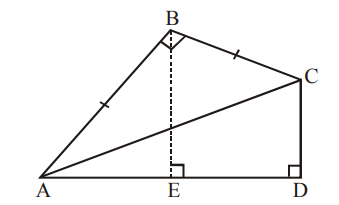
In the adjoining figure, $(\triangle \mathrm{ABC})$ is an isosceles right-angled triangle. $(\mathrm{BE})$ is perpendicular to $(\mathrm{AD})$. If $(\mathrm{BE}=1 \mathrm{~cm})$, then the area in $(\mathrm{cm}^2) )$ of the quadrilateral $(\mathrm{ABCD})$ is
(a) 1
(b) $(\frac{3}{2})$
(c) 2
(d) $(\frac{4}{3})$
If (a+b+c=0), then the value of $(\frac{\left(a^2+b^2+c^2\right)^2}{a^4+b^4+c^4})$ is
(a) 1
(b) 2
(c) 3
(d) 4
Ram, Rahim, Robin and Ria are four children, the product of whose ages is 5040 . Ram is older than Rahim by one year, older then Robin by two years and older than by Ria by three years. The age of Ram (in years) is
(a) 15
(b) 7
(c) 12
(d) 10
A fruit-seller sells apples, oranges and pineapples. In his stock, (20 \%) are pineapples and (60 \%) are oranges. There are 40 apples. If half the oranges are replaced by pineapples, how many pineapples are there in the shop now?
(a) 40
(b) 60
(c) 80
(d) 100
A carpenter can repair 4 tables in 5 hours. The time (in hours) for him to Repair (at the same rate) 7 tables is
(a) 8
(b) 7
(c) 7 $\dfrac{1}{2}$
(d) 8 $\dfrac{3}{4}$
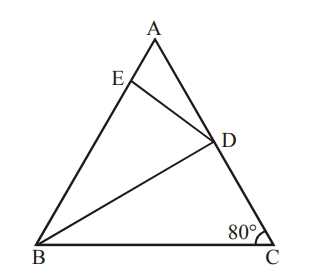
In the adjoining figure, $(\mathrm{AB}=\mathrm{AC}, \angle \mathrm{C}=80^{\circ})$ and $(\mathrm{BC}=\mathrm{BD}=\mathrm{DE})$. Then the measure (in degrees) of angle $(\mathrm{ADE})$ is
(a) 9
(b) 35
(c) 15
(d) 40
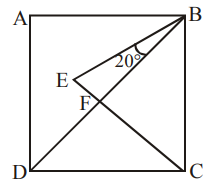
In the adjoining figure, $(\mathrm{ABCD})$ is a Square. Given $(\mathrm{BE}=\mathrm{AB})$. If the measure of $(\angle \mathrm{DFC})$ (in degrees) is $(\mathrm{x}^{\circ})$ then the value of $(2 \mathrm{x})$ (in degrees) is
(a) 205
(b) 190
(c) 200
(d) 215
Two real numbers $(\mathrm{a}, \mathrm{b})$ where $(\mathrm{a}>\mathrm{b}) $ are given such that their sum is equal to 4 times their difference. The value of $(\frac{2 a b}{3\left(a^2-b^2\right)})$ is
(a) $(\frac{2}{3})$
(b) $(\frac{1}{2})$
(c) 1
(d) $(\frac{5}{8})$
The average of three numbers is $(\mathrm{x})$. Two of the three numbers are $(\mathrm{y})$ and $(\mathrm{z})$. Then, the third number is
(a) (3 x+y+z)
(b) (y+z+3 x)
(c) (3 x-y-z)
(d) $(\frac{y+z}{3})$
From a natural number 3 is subtracted, then the result is divided by 4 and the outcome is increased by 4 and the whole result is then divided by 5 . The final resulting number is 2 . Then the natural number taken in the beginning is
(a) a perfect square
(b) a perfect cube
(c) an even number
(d) divisible by 13
For all permissible natural numbers ' (n) ', the number $(\frac{9 n^2-64}{n-1-\frac{1}{1-\frac{n}{n+4}}})$ is
(a) a proper fraction
(c) a natural number divisible by 4
(b) an improper fraction
(d) an odd integer
The number of solutions of the equation $(\sqrt{\mathrm{x}+5}+\sqrt{3 \mathrm{x}+4}=\sqrt{12 \mathrm{x}+1})$ is
(a) 0
(b) 1
(c) 2
(d) 3
If $(\frac{1}{1 \times 3}+\frac{1}{2 \times 4}+\frac{1}{3 \times 5}+\ldots \ldots \ldots+\frac{1}{n(n+2)}=\frac{3553}{4830})$, then $(n=)$
(a) 68
(b) 65
(c) 73
(d) 90
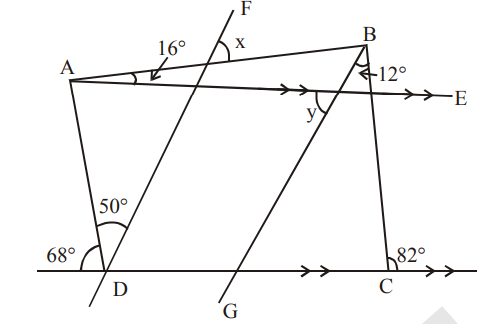
In the adjoining figure, $(\angle \mathrm{BAE}=16^{\circ})$ and $(\angle \mathrm{CBG}=12^{\circ})$. Then the measure of $(\mathrm{x}+\mathrm{y})$ (in degrees) is
(a) $(116^{\circ})$
(b) $(123^{\circ})$
(c) $(114^{\circ})$
(d) $(122^{\circ})$
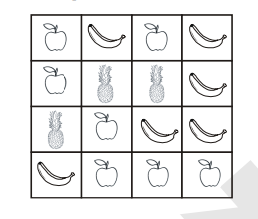
There are 3 pineapples, 6 bananas and 7 apples. Each fruit of the same category is of same price. The total amount of the fruits of the 1st row is ₹44, that of the 3rd row is ₹54 and that of the 1st column is ₹72. Then the total amount (in Rupees) of the fruits in the 2 nd row is \(\rule{1cm}{0.15mm}\) .
If $2^{2^{x^2-1}}=16$, then the value of $x^4$ is \(\rule{1cm}{0.15mm}\) .
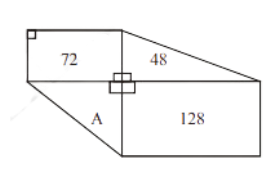
In the adjoining figure, two rectangles and two right-angled triangles are arranged as shown. The numbers shown inside each are their respective areas. Then the area of $\mathrm{A}$ is \(\rule{1cm}{0.15mm}\) .
The sum of the length and breadth of a rectangle is $6 \mathrm{~cm}$. A square is constructed whose side is equal to the diagonal of the rectangle. If the ratio of the areas of the square and the rectangle is $5: 2$, then the area of the square $\left(\right.$ in $\left.\mathrm{cm}^2\right)$ is \(\rule{1cm}{0.15mm}\) .
If the area of a circle of radius 5 is numerically $x \%$ of its circumference, then $x=$ \(\rule{1cm}{0.15mm}\) .
There are 3 real positive numbers. The second is greater than the first by the amount the third is greater than the second. The product of the two smaller numbers is 85 and that of the two bigger numbers is 115 . Then the difference between the smallest and the greatest numbers is \(\rule{1cm}{0.15mm}\) .
The numbers $1,3,6,10, \ldots$ are called triangular numbers. The nth triangular number $T_n=\frac{n(n+1)}{2}$. Then the value of $T_{3 n+1}-9 T_n$ is equal to \(\rule{1cm}{0.15mm}\) .
I read $\frac{3}{8}$ of a book on one day and $\frac{4}{5}$ of the remainder on another day. If 30 pages are still unread, then the total number of pages in the book is \(\rule{1cm}{0.15mm}\) .
Three persons A, B, C participate in a running race for $1 \mathrm{~km}$ distance. When A and B run, A wins by 60 seconds; when A, C run, A wins by 375 metres. When B and C run, B wins by 30 seconds. If the time taken by $\mathrm{B}$ to run the $1 \mathrm{~km}$ distance is $\mathrm{x}$ minutes and 30 seconds, then $\mathrm{x}=$ \(\rule{1cm}{0.15mm}\) .
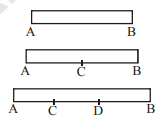
A ruler with no mark on it can measure its own length $\mathrm{AB}$. A ruler with only one mark on it can measure 3 lengths $\mathrm{AB}, \mathrm{AC}, \mathrm{BC}$. A ruler with two marks on it can measure 6 lengths $\mathrm{AB}, \mathrm{AC}, \mathrm{CD}, \mathrm{DB}, \mathrm{AD}$ and CB. Then the number of lengths a ruler with 4 marks on it can measure is \(\rule{1cm}{0.15mm}\) .
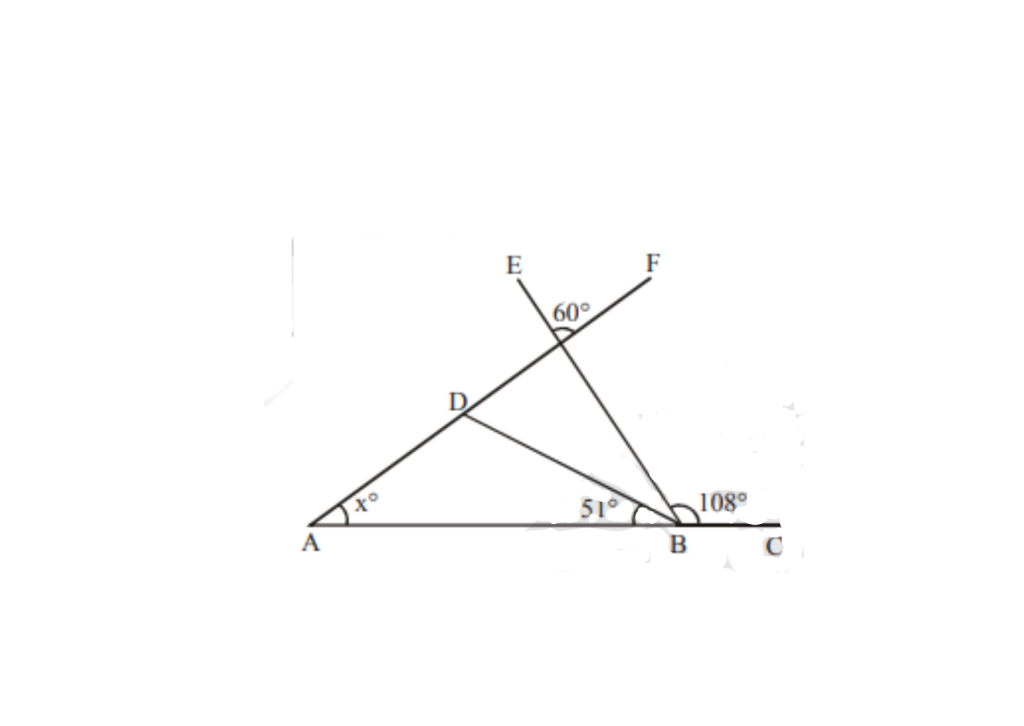
In the adjoining figure, The value of $\mathrm{x}$ (in degrees) is \(\rule{1cm}{0.15mm}\) .
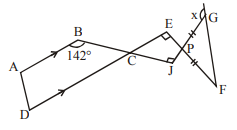
In the adjoining figure, $\mathrm{AB} || \mathrm{DC}$. Also, $\mathrm{PG}=\mathrm{PF}$. The measure of angle $\mathrm{x}$ (in degrees) is \(\rule{1cm}{0.15mm}\) .
The sum of the first and last of four consecutive odd integers is 52 . The sum of all of them is \(\rule{1cm}{0.15mm}\) .
The square root of a number plus 2 gives the number itself. Then the number is \(\rule{1cm}{0.15mm}\) .
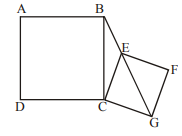
$\mathrm{ABCD}$ and CEFG are two squares such That the extension of GE (diagonal Of CEFG passes through B. Given $\mathrm{BE}=6 \mathrm{~cm}$ and $\mathrm{CG}=4 \sqrt{2} \mathrm{~cm}$. Then the area of square $\mathrm{ABCD}\left(\mathrm{in} \mathrm{~cm}^2\right)$ is \(\rule{1cm}{0.15mm}\) .

Publishing original scientific research in a peer-reviewed journal is an achievement many scholars work toward for years. Achieving this feat early in one's academic journey requires exceptional intellectual rigor, creativity, and persistence. Aaditya Punatar and Muskan Sadana have reached this remarkable milestone, successfully publishing their collaborative research paper in the prestigious Journal of Emerging Investigators […]
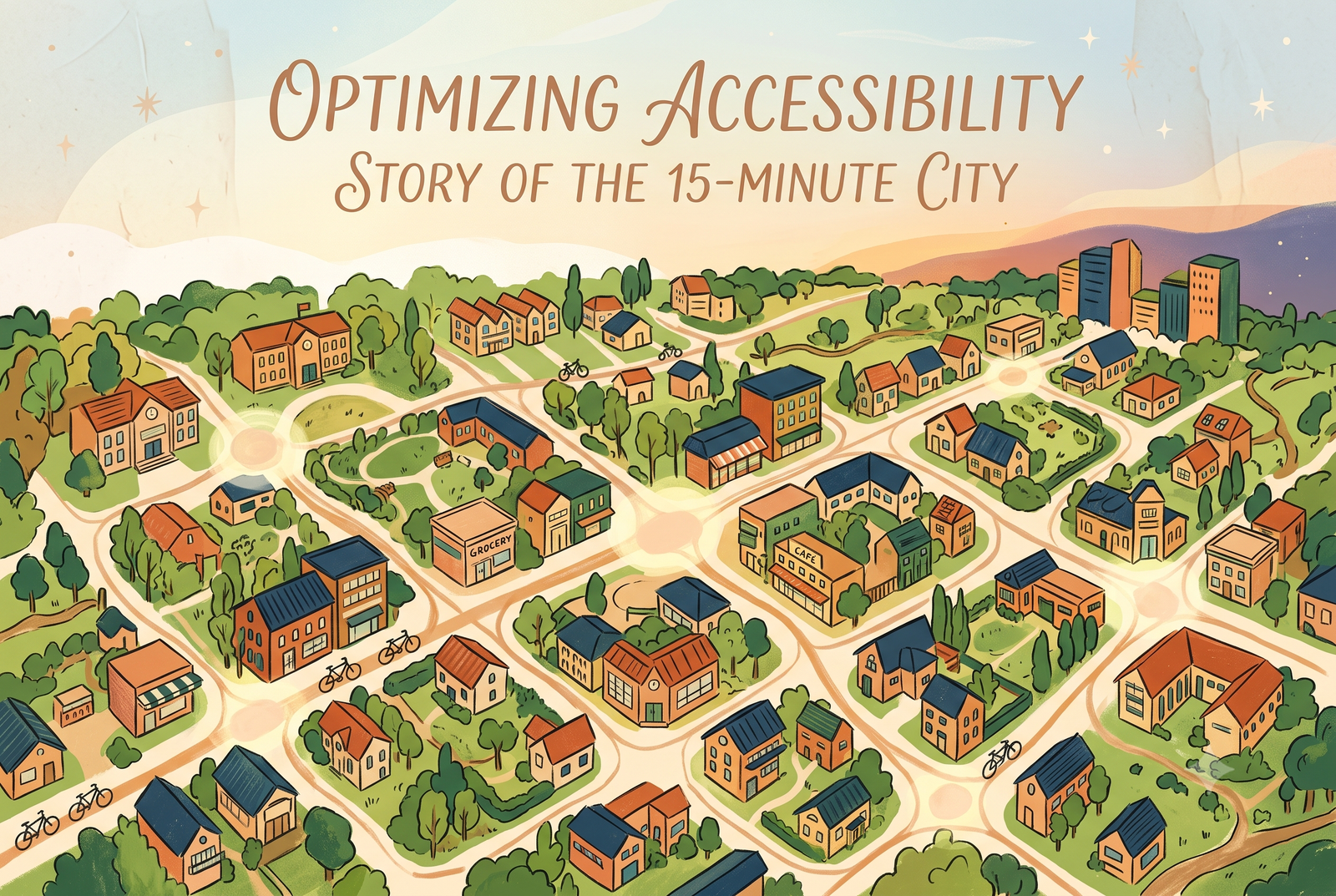
Her project on quantum-accelerated Steiner trees for 15-minute cities earned a place among the finalists at the world's largest pre-college STEM competition. Prishaa Shrimali of Marymount School of New York, was selected as a Grand Finalist at the 2026 Regeneron International Science and Engineering Fair (ISEF) in Phoenix, Arizona. Her project was Optimizing Urban Accessibility: […]

In 2026, the following Cheenta students have been successful for Indian Statistical Institute's M.Stat Entrance. They ranked within the first 50 in the entire country in these entrances. I.S.I. M.Stat Entrance
In 2026, the following Cheenta students have been successful for Indian Statistical Institute's B.Stat Entrance and Chennai Mathematical Institute's B.Sc. Math Entrance. They ranked within the first 200 in the entire country in these entrances. Most of these students attended the problem solving workshops regularly, which happen 5 days every week. CMI B.Sc. Math Entrance […]
I WANT THE PYQ OF NMTC
I want to total solutions
I want 2024 nmtc