Gauss Contest (NMTC PRIMARY LEVEL- V and VI Grades) 2022 - Problems and Solution
 Join Trial or Access Free ResourcesJoin Trial or Access Free Resources
If $\left(8^* 4\right)+6-(10 \div 5)=8$, then * stands for the operation.
a) $+$
b) $\times$
c) $\div$
d) $-$
$20 \%$ of a number is equal to $30 \%$ of another number. Six times the bigger of these numbers added to the smaller number is 2000 . Then $10 \%$ of the smallest number is
a) 10
b) 20
c) 30
d) 25
Samrud chooses a two-digit number. He subtracts it from 200 and doubles the result. The largest number he can get is
a) 390
b) 380
c) 400
d) 370
The least number which leaves 2 as remainder when divided by $5,6,8,9$ and 12 is
a) 362
b) 342
c) 332
d) 322
Saket takes the number 2021. There are two $2 \mathrm{~s}$, one 0 and one 1.
Using these numbers, he makes 3 -digit numbers, the sum of all these number is
a) 1488
b) 150
c) 1409
d) 1610
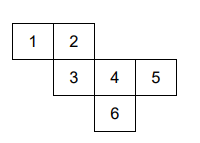
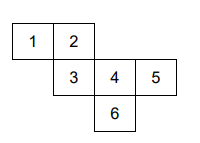
In the net of the adjoining figure numbers 1 to 6 are marked. The net is folded to form a cube The number that appears on the opposite face of 6 is
a) 4
b) 3
c) 2
d) 1
$10^{2021}-1$ is written as an integer in the usual decimal form. The sum of all digits of this written number is
a) 18189
b) 18187
c) 18199
d) 19189
August $15^{\text {th }} 1992$ was a Saturday. What day was $15^{\text {th }}$ August 1991 ?
a) Monday
b) Wednesday
c) Thursday
d) Sunday
Two thirds of the students in a class room are seated in three fourths of the chairs. The rest of the students are punished for not submitting the homework and hence asked to stand. There are 6 empty chairs. The number of persons (that is the number of students including the teacher) in the classroom.
a) 27
b) 28
c) 31
d) 32
Three are 24 four digit numbers with different digits, formed by $2,4,5$ and 7 . One of these four-digit number is a multiple of another.
Which one of the following is it?
a) 7245
b) 7542
c) 7254
d) 7425
Twelve friends went to a restaurant to have lunch. They ordered for 12 meals. When they were served, they found that the food was too much which can be shared by 18 people. The number of meals they would order to cater to only 12 is $ \rule{2cm}{0.5mm} $
The least multiple of 23 which when divided by 18,21 and 24 leaves the remainders 7,10 and 13 respectively is $ \rule{2cm}{0.5mm} $
The value of $\sqrt{\frac{(0.1)^2+(0.01)^2+(0.008)^2}{(0.01)^2+(0.001)^2+(0.0008)^2}}$ is $ \rule{2cm}{0.5mm} $
Two numbers are respectively $20 \%$ and $50 \%$ of a third number. The percentage of the first number to the second is $ \rule{2cm}{0.5mm} $.
Water flows through a rectangular opening $3 \mathrm{~m} \times 2 \mathrm{~m}$ with a speed of $1.5 \mathrm{~km} / \mathrm{hr}$. The amount of water that passes through the opening in 5 minutes is $\mathrm{x}^3$. Then the value of $\mathrm{x}$ is $ \rule{2cm}{0.5mm} $
If $A=\frac{1111+3333+5555}{222+333+444}, B=\frac{555+222}{1111+2222+4444}$, then $A \times B=$ is \(\rule{1cm}{0.15mm}\) .
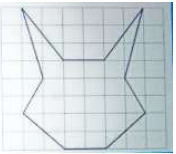
In the adjoining figure of a cat, each small square is $1 \mathrm{~cm}^2$. The area of the cat (in $\mathrm{cm}^2$ ) is \(\rule{1cm}{0.15mm}\) .
The sum of the digits of the number given by the product $\frac{666 \ldots \ldots \ldots . .666}{2021 \text { digits }} \times \frac{999 \ldots \ldots \ldots \ldots . .999}{2021 \text { digits }}$ is \(\rule{1cm}{0.15mm}\) .
Two buses $X, Y$ started from two different places $P_1$ and $P_2$ respectively, moving towards each other. The ratio of the speed of bus $X$ to that of bus $Y$ was $5: 4$ after they meet, the speed of bus $X$ was reduced by $20 \%$ and the speed of $Y$ was increased by $20 \%$. When bus $X$ arrived at $P_2$, bus $Y$ was still $10 \mathrm{~km}$ away from $P_1$ The distance between the places $P_1$ and $P_2$ (in kilometers) is \(\rule{1cm}{0.15mm}\) .
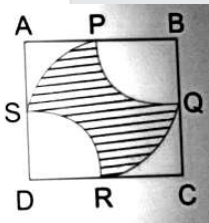
In the adjoining diagram, $A B C D$ is a square $P, Q, R, S$ are the mid points of sides $A B, B C, C D$ and DA respectively. PQ and SR are quadrants of circles with $B, D$ as centres and $B P$ as radius. PS and $R Q$ are part of the circle passing through $P, Q, R$ and $S$. If $A B=20 \mathrm{~cm}$, the area of the shaded region $\left(\right.$ in $\left.\mathrm{cm}^2\right)$ is $\rule{1cm}{0.15mm}$ .

Publishing original scientific research in a peer-reviewed journal is an achievement many scholars work toward for years. Achieving this feat early in one's academic journey requires exceptional intellectual rigor, creativity, and persistence. Aaditya Punatar and Muskan Sadana have reached this remarkable milestone, successfully publishing their collaborative research paper in the prestigious Journal of Emerging Investigators […]
Her project on quantum-accelerated Steiner trees for 15-minute cities earned a place among the finalists at the world's largest pre-college STEM competition. Prishaa Shrimali of Marymount School of New York, was selected as a Grand Finalist at the 2026 Regeneron International Science and Engineering Fair (ISEF) in Phoenix, Arizona. Her project was Optimizing Urban Accessibility: […]

In 2026, the following Cheenta students have been successful for Indian Statistical Institute's M.Stat Entrance. They ranked within the first 50 in the entire country in these entrances. I.S.I. M.Stat Entrance
In 2026, the following Cheenta students have been successful for Indian Statistical Institute's B.Stat Entrance and Chennai Mathematical Institute's B.Sc. Math Entrance. They ranked within the first 200 in the entire country in these entrances. Most of these students attended the problem solving workshops regularly, which happen 5 days every week. CMI B.Sc. Math Entrance […]
I want to join trial class for NMTC 2024
Solution
Please let us know when your NMTC classes start and we would like to take a trial class.
The problems are too hard and that's a good thing to improve children's mental ability