This is a very subtle sample problem from ISI MStat PSB 2006 Problem 2. After seeing this problem, one may think of using Lagrange Multipliers, but one can just find easier and beautiful way, if one is really keen to find one. Can you!
Maximize \(x+y\) subject to the condition that \(2x^2+3y^2 \le 1\).
Cauchy-Schwarz Inequality
Tangent-Normal
Conic section
This is a beautiful problem, but only if one notices the trick, or else things gets ugly.
Now we need to find the maximum of \(x+y\) when it is given that \(2x^2+3y^2 \le 1\). Seeing the given condition we always think of using Lagrange Multipliers, but I find that thing very nasty, and always find ways to avoid it.
So let's recall the famous Cauchy-Schwarz Inequality, \((ab+cd)^2 \le (a^2+c^2)(b^2+d^2)\).
Now, lets take \(a=\sqrt{2}x ; b=\frac{1}{\sqrt{2}} ; c= \sqrt{3}y ; d= \frac{1}{\sqrt{3}} \), and observe our inequality reduces to,
\((x+y)^2 \le (2x^2+3y^2)(\frac{1}{2}+\frac{1}{3}) \le (\frac{1}{2}+\frac{1}{3})=\frac{5}{6} \Rightarrow x+y \le \sqrt{\frac{5}{6}}\). Hence the maximum of \(x+y\) with respect to the given condition \(2x^2+3y^2 \le 1\) is \(\frac{5}{6}\). Hence we got what we want without even doing any nasty calculations.
Another nice approach for doing this problem is looking through the pictures. Given the condition \(2x^2+3y^2 \le 1\) represents a disc whose shape is elliptical, and \(x+y=k\) is a family of straight parallel lines passing passing through that disc.
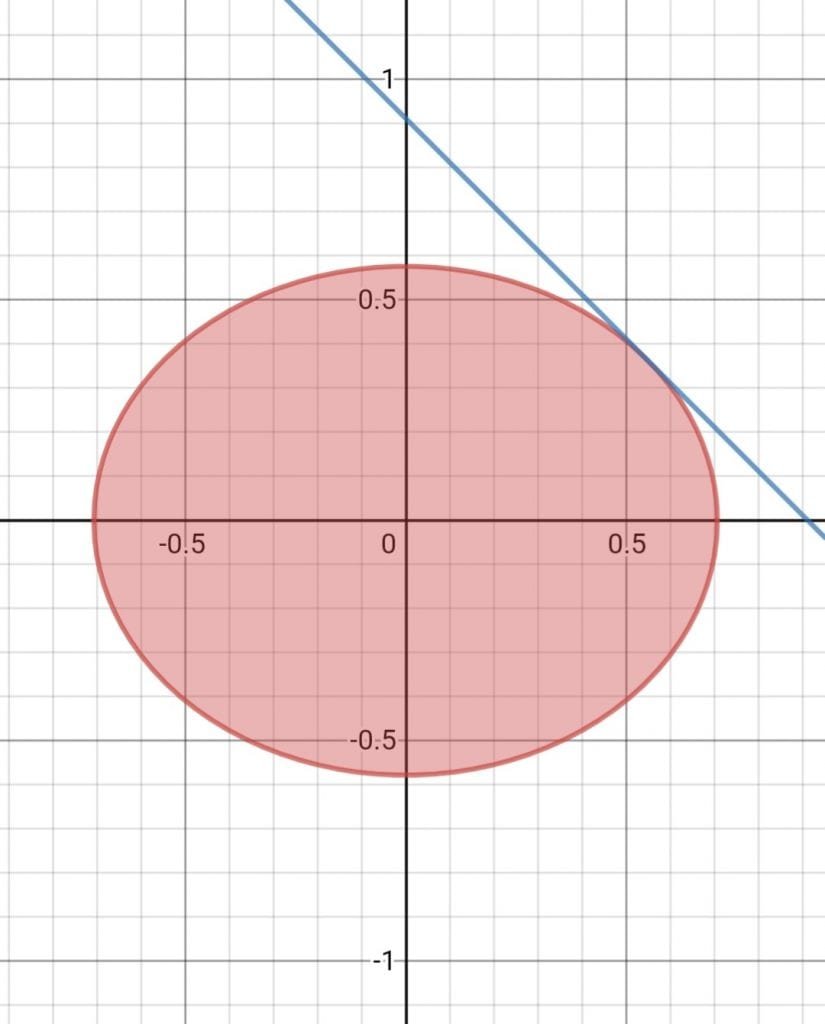
Hence the line with the maximum intercept among all the lines passing through the given disc represents the maximized value of \(x+y\). So, basically if a line of form \(x+y=k_o\) (say), is a tangent to the disc, then it will basically represent the line with maximum intercept from the mentioned family of line. So, we just need to find the point on the boundary of the disc, where the line of form \(x+y=k_o\) touches as a tangent. Can you finish the rest and verify weather the maximum intercept .i.e. \(k_o= \sqrt{\frac{5}{6}}\) or not.
Can you show another alternate solution to this problem ? No, Lagrange Multiplier Please !! How would you like to find out the point of tangency if the disc was circular ? Show us the solution we will post them in the comment.
Keep thinking !!


Publishing original scientific research in a peer-reviewed journal is an achievement many scholars work toward for years. Achieving this feat early in one's academic journey requires exceptional intellectual rigor, creativity, and persistence. Aaditya Punatar and Muskan Sadana have reached this remarkable milestone, successfully publishing their collaborative research paper in the prestigious Journal of Emerging Investigators […]

Her project on quantum-accelerated Steiner trees for 15-minute cities earned a place among the finalists at the world's largest pre-college STEM competition. Prishaa Shrimali of Marymount School of New York, was selected as a Grand Finalist at the 2026 Regeneron International Science and Engineering Fair (ISEF) in Phoenix, Arizona. Her project was Optimizing Urban Accessibility: […]

In 2026, the following Cheenta students have been successful for Indian Statistical Institute's M.Stat Entrance. They ranked within the first 50 in the entire country in these entrances. I.S.I. M.Stat Entrance
In 2026, the following Cheenta students have been successful for Indian Statistical Institute's B.Stat Entrance and Chennai Mathematical Institute's B.Sc. Math Entrance. They ranked within the first 200 in the entire country in these entrances. Most of these students attended the problem solving workshops regularly, which happen 5 days every week. CMI B.Sc. Math Entrance […]

The alternate solution can be using parametric representation of an Ellipse as it's evident that max(x+y) will be attained on the boundary points i.e on the ellipse itself. This reduces the bivariate function (x+y) into a single variate of \theta which makes the solution easy.