This is a very beautiful sample problem from ISI MStat PSB 2013 Problem 10. It's based mainly on counting and following the norms stated in the problem itself. Be careful while thinking !
There are 10 empty boxes numbered 1,2,......,10 placed sequentially on a circle as shown in the figure,
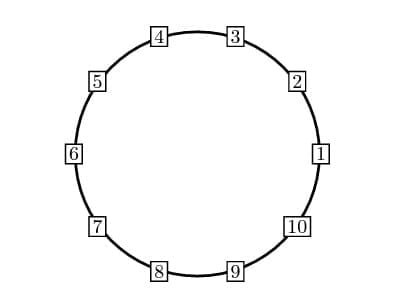
We perform 100 independent trials. At each trial one box is selected with probability \(\frac{1}{10}\) and a ball is placed in each of the two neighboring boxes of the selected one.
Define \(X_k\) be the number of balls in the \(k^{th}\) box at the end of 100 trials.
(a) Find \(E(X_k)\) for \( 1 \le k \le 10\).
(b) Find \(Cov(X_k, X_5)\) for \(1 \le k \le 10 \).
Counting principles
Binomial Distribution
Independence of Events
At first this problem may seem a bit of complex, but when one get to see the pattern it starts unfolding. For his types of problem, I find a useful technique is to follow the picture, in this case the picture is being provided, (if not draw it yourself !!)
Given, \(X_k\) : # balls in the \(k^{th}\) box at the end of 100 trials.
So, the possible values of \(X_k\) are 0,1,2,.....,100. and the probability that at the jth trial a ball will added to the kth box is \(\frac{1}{10}\) , (why??) .
Now, \(P(X_k=x)\)= \({100 \choose x}\)\( (\frac{1}{5})^{x}\) \( (\frac{4}{5})^{100-x} \) \( x=0,1,......,100\)
Clearly, \( X_k \sim binomial( 100, \frac{1}{5})\), from here one can easily find out the the expectation of \(X_k\). But have you thought like this ??
Now, notice that after every slelection of box, 2 balls are added in the system, so at the end of the 10th trial, there will be 200 balls distributed in the system.
So, \(X_1 +X_2 +.......+ X_{100} =200 \), which implies \( \sum_{k} E(X_k)=200\), due to symmetry \(E(X_k)=E(X_l) \forall k \neq l \), So, \(E(X_k)=20\).
(b) Now this part is the cream of this problem, first notice that number of balls in kth box, is dependent on the number of balls in the (k-2)th and (k+2)th box, and vice versa, So, \(Cov( X_k, X_l)=0\) if \(|k-l|\neq 2\).
So, \(Cov(X_k, X_5)= 0 \forall k \neq 3,5 \&\ 7 \), so we just need to find the \(Cov(X_7,X_5)\) and \(Cov(X_3,X_5)\), and \(Cov(X_5,X_5)=Var(X_5)\) .
Now it is sufficient to find the covariance of any of the the above mentioned covariances, as both are symmetric and identical to each other. But for the finding say \(Cov(X_3,X_5)\), lets look whats happening in each trial more closely,
let, \(X_k= i_{k_1} +i_{k_2}+......+i{k_{100}} \) where , \( i_{k_j} = \begin{cases} 1 & if\ a\ ball\ added\ to\ the\ kth\ box\ at\ the\ jth\ trial\ \\ 0 & otherwise \end{cases}\)
So, clearly, \(P(i_{k_j}=1)=\frac{1}{5} \) ; j=1,2,....,100.
So, \(Cov(X_3,X_5)=Cov( i_{3_1}+i_{3_2}+.....+i_{3_{100}},i_{5_1}+i_{5_2}+....+i_{5_{100}})=\sum_{j=1}^{100} Cov(i_{3_j},i_{5_j})\), [\(Cov(i_{3_j},i_{5_j*})=0 \forall j\neq j*\), why ?? ].
So, \(Cov(X_3,X_5)= 100 Cov(i_{3_1},i_{5_1})=100( E(i_{3_1}i_{5_1})-E(i_{3_1})E(i_{5_1}))=100(P(i_{3_1}=1, i_{5_1}=1)-P(i_{3_1}=1)P(i_{5_1}=1))=100(\frac{1}{10}- \frac{1}{5}\frac{1}{5})=6\).
similarly, \(Cov(X_7,X_5)=6\) also, and its easy to find \(Var(X_5)\) , so I leave it as an exercise. So, \(Cov(X_k,X_5)= \begin{cases} 6 & k=3,7 \\ Var(X_5) & k=5 \\ 0 & k\neq 3,5 \or\ 7\end{cases}\). Hence we are done !!
Wait, lets imagine, these boxes are interchanged in such a way that the hth box is replaced with the kth (\(\neq h\)) box, this has been done for all possible pairs of (h,k), Now can you show that all there are precisely \( 10!\sum_{i+2j=10}(i!j!2^j)^{-1}\) number of arrangements possible ?
Now imagine, in a game there are 1 balls each in every box( boxes are arranged identically as shown in the question), you pick up the ball from the first box and put it into the 2nd one, now you can't take out any ball from a box in which you just put a ball, so you pick a ball from the 3rd box and put it into the 4th and you go on like this, taking a ball frim the ith box and put it into the (i+1)th box, but cant empty the box you just filled. Now, again after the first round you remove the empty boxes and do the same thing again and again, till all the balls are not accumulated in a single box. Which box you think will contain all the balls after you run this process finitely many time ?? If you are in this lottery and you are to choose a bix before this game begin, which box you must choose ??
if the coordinator of the game, starts with any ith box how should your strategy change ?? Give it a thought !!
For help, look for Josephus Problem, you may be moved by it's beauty !


Publishing original scientific research in a peer-reviewed journal is an achievement many scholars work toward for years. Achieving this feat early in one's academic journey requires exceptional intellectual rigor, creativity, and persistence. Aaditya Punatar and Muskan Sadana have reached this remarkable milestone, successfully publishing their collaborative research paper in the prestigious Journal of Emerging Investigators […]

Her project on quantum-accelerated Steiner trees for 15-minute cities earned a place among the finalists at the world's largest pre-college STEM competition. Prishaa Shrimali of Marymount School of New York, was selected as a Grand Finalist at the 2026 Regeneron International Science and Engineering Fair (ISEF) in Phoenix, Arizona. Her project was Optimizing Urban Accessibility: […]

In 2026, the following Cheenta students have been successful for Indian Statistical Institute's M.Stat Entrance. They ranked within the first 50 in the entire country in these entrances. I.S.I. M.Stat Entrance

In 2026, the following Cheenta students have been successful for Indian Statistical Institute's B.Stat Entrance and Chennai Mathematical Institute's B.Sc. Math Entrance. They ranked within the first 200 in the entire country in these entrances. Most of these students attended the problem solving workshops regularly, which happen 5 days every week. CMI B.Sc. Math Entrance […]