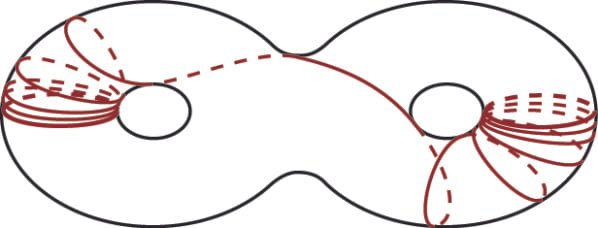
The term double torus is occasionally used to denote a genus 2 surface.
We are interested to understand the structure of a group G (is it abelian, or a product of abelian groups, or a free group of some kind etc.). In general, this is a (very) hard question. One strategy is to let G act on some well known (topological) space. Often by studying the effect of this group action on the space, it is possible to comment on the algebraic structure of the group.
Why this ‘indirect’ method should be regarded as ‘natural’? It is useful to think about elements of groups as ‘actors’. Their true color is revealed, only when they are unleashed in a stage (topological space).
However, we have to find the right space on which the group under scanner is to be let loose. A lot of effort goes into the construction (and investigation) of topological spaces which will be effective stages for group action.
Bass Serre theory produced a wonderful (topological) space that produces important information about groups acting on them. They are cleverly designed simplicial trees. We look at the stabilizers of vertices and edges of this tree. This process reveals a lot of information about the structure of the group.
Simplicial trees are different from (non-simplicial) R-trees (real trees). The key distinction is: R-trees have non-discrete branching points. There is an interesting construction in this context. Let G act isometrically (preserving distances), on a sequence of negatively curved spaces. Then we have a natural isometric action of G on an R-tree in the Gromov Hausdorff limit.
This makes R-trees the final destination space of the isometric Group action. It makes sense to study the R-trees. After all, they are stage of action of the Group that is our ultimate object of interest. A process of resolution leads us from R-trees to (measured) laminated 2-complexes.
(Ref: Bestvina; 1999)
(Image: https://conan777.wordpress.com/tag/measured-lamination/)

Publishing original scientific research in a peer-reviewed journal is an achievement many scholars work toward for years. Achieving this feat early in one's academic journey requires exceptional intellectual rigor, creativity, and persistence. Aaditya Punatar and Muskan Sadana have reached this remarkable milestone, successfully publishing their collaborative research paper in the prestigious Journal of Emerging Investigators […]
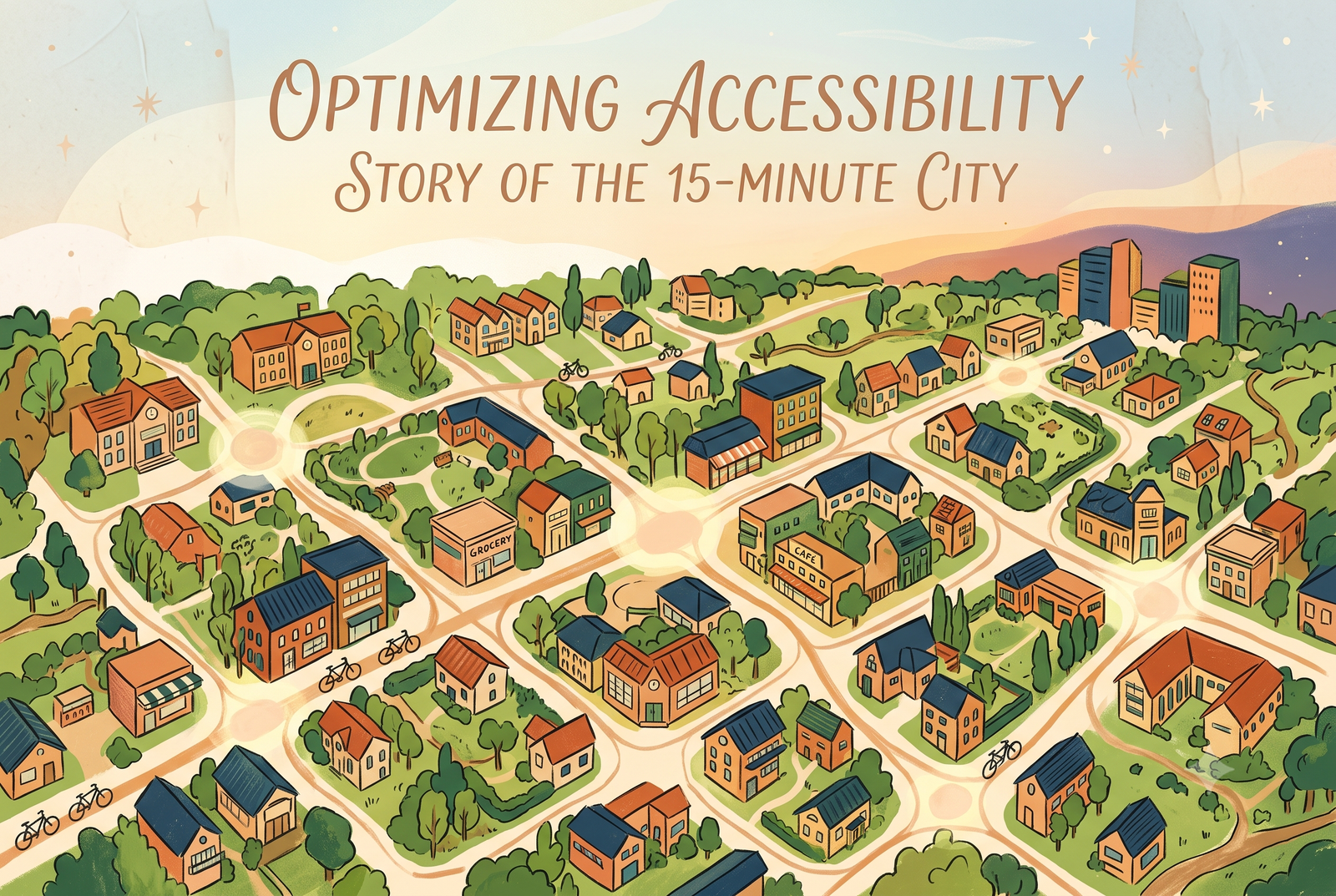
Her project on quantum-accelerated Steiner trees for 15-minute cities earned a place among the finalists at the world's largest pre-college STEM competition. Prishaa Shrimali of Marymount School of New York, was selected as a Grand Finalist at the 2026 Regeneron International Science and Engineering Fair (ISEF) in Phoenix, Arizona. Her project was Optimizing Urban Accessibility: […]
In 2026, the following Cheenta students have been successful for Indian Statistical Institute's M.Stat Entrance. They ranked within the first 50 in the entire country in these entrances. I.S.I. M.Stat Entrance
In 2026, the following Cheenta students have been successful for Indian Statistical Institute's B.Stat Entrance and Chennai Mathematical Institute's B.Sc. Math Entrance. They ranked within the first 200 in the entire country in these entrances. Most of these students attended the problem solving workshops regularly, which happen 5 days every week. CMI B.Sc. Math Entrance […]
Though I am B.Tech (Mechanical Engineering) graduate having interest in Mathematics. I had taken Mathematical Engineering subjects like Boundary Value Problems;Elasticity:Fluid Mechanics; Mechanics of Solids;Vibrations;Engineering Mathematics ;Calculus of Variations etc-etc.
Things mentioned above by you is bit of pure Mathematics.I appreciate the beauties In diagram but I have To do some serious beginning for this in my leisure hours as I have not made any systematic study of them.
Anyway Very Impressive Illustration by you.
Debjyoti, some of the most interesting mathematical innovations were part of engineering investigations.