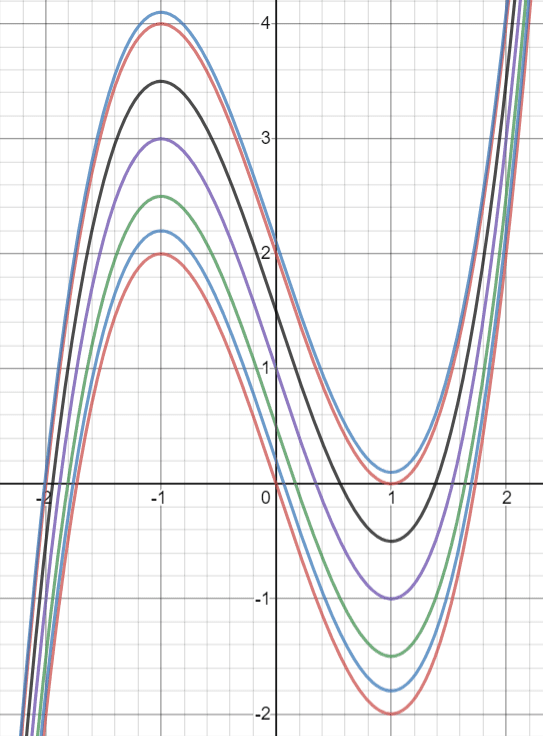
This problem is an easy application in calculus using the basic ideas of curve sketching. This is the problem 1 from ISI MStat 2019 PSB.
Let \(f(x) = x^{3}-3 x+k,\) where \(k\) is a real number. For what values of
\(k\) will \(f(x)\) have three distinct real roots?
Science is all about asking proper questions. So, \(k\) is the variable here. So, ask the following question,
What role is \(k\) playing here? Let's take \( k = 0\) and see what happens.
\( g(x) = x^{3}- 3x = x(x-\sqrt{3})(x+\sqrt{3})\).
We can easily draw the graph of this \(g(x)\). Let's draw it. So, \(g(x)\) has roots as {\(-\sqrt{3}, 0, \sqrt{3}\)}.

Great, so addding \(k\) to \(g(x)\) will shift the graph upwards right?

Observe that if \(k\) \(\geq\) |lowest value of \(g(x)\) at the bump|, then \(f(x)\) will have less than three roots.
Similarly, observe that if \(k\) \(\leq\) - highest value of \(g(x)\) at the bump, then \(f(x)\) will have less than three roots.

So, let's find them out. So, what is the mathematical significance of these bumps? They are the local maximum and minimum. How do we find them?
\(g'(x) = 0\), where \(g(x) = x^{3}- 3x\).
\( \Rightarrow 3x^2 - 3 = 0 \Rightarrow x = \pm 1\).
So, the minimum and the maximum values of \(g(x)\) are \(g(-1) = 2\) and \(g(1) = -2\).
Hence \( -2 < k < 2\).
Let's see what happens at \( k = \pm 2\).

It is just that point, where the transitition for three roots to two roots occur and then to one root.
Observe that since, it is an odd degree, there will always be a reall root of the curve.
Stay Tuned! Stay Blessed!
Stay Tuned! Stay Blessed!
In 2026, the following Cheenta students have been successful for Indian Statistical Institute's M.Stat Entrance. They ranked within the first 50 in the entire country in these entrances. I.S.I. M.Stat Entrance
In 2026, the following Cheenta students have been successful for Indian Statistical Institute's B.Stat Entrance and Chennai Mathematical Institute's B.Sc. Math Entrance. They ranked within the first 200 in the entire country in these entrances. Most of these students attended the problem solving workshops regularly, which happen 5 days every week. CMI B.Sc. Math Entrance […]

In 2025, 8 students from Cheenta Academy cracked the prestigious Regional Math Olympiad. In this post, we will share some of their success stories and learning strategies. The Regional Mathematics Olympiad (RMO) and the Indian National Mathematics Olympiad (INMO) are two most important mathematics contests in India.These two contests are for the students who are […]
Cheenta Academy proudly celebrates the success of 27 current and former students who qualified for the Indian Olympiad Qualifier in Mathematics (IOQM) 2025, advancing to the next stage — RMO. This accomplishment highlights their perseverance and Cheenta’s ongoing mission to nurture mathematical excellence and research-oriented learning.