A target of ${ }^{7} \mathrm{Li}$ is bombarded with a proton beam of current $10^{-4}$ ampere for 1 hour to produce ${ }^{7} \mathrm{Be}$ of activity $1.8 \times 10^{8}$ disintegrations per second. Assuming that bombarding of 1000 protons produces one ${ }^{7} \mathrm{Be}$ radioactive nucleus, the half-life of ${ }^{7} \mathrm{Be}$ is estimated to be approximately
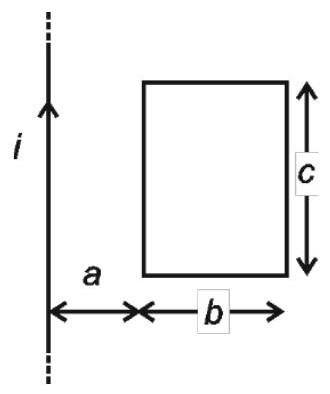
A long straight wire carrying a current $i=10 A$ and a rectangular metallic loop of dimensions $b \times c$ lie in the same plane as shown in the figure. The parameters are $a=10 \mathrm{ cm}, b=30 \mathrm{ cm}$ and $c=50 \mathrm{ cm}$. The mutual inductance of the system is nearly
Impedance of a given series LCR circuit, fed with alternating current, is the same for two frequencies $f_{1}$ and $f_{2}$. The resonance frequency $f_{R}$ of the circuit is
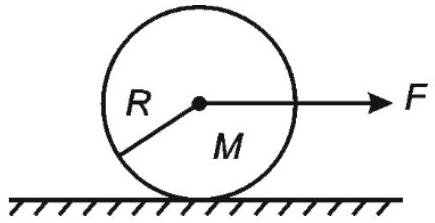
A lawn roller is a solid cylinder of mass $M$ and radius $R$. As shown in the figure, it is pulled at its center by a horizontal force $F$ and rolls without slipping on a horizontal surface. Then the
A hydrogen atom ( $M_{\mathrm{H}}=1.67 \times 10^{-27} \mathrm{ kg}$ ), initially at rest, emits a photon and goes from the excited state $n=5$ to the ground state. The recoil speed of the atom is nearly
Two nuclides $A$ and $B$ are isotopes. The nuclides $B$ and $C$ are isobars. All the three nuclides $A, B$ and $C$ are radioactive. You may then conclude that
Numerical aperture of an optical fibre is a measure of
Heavy stable nuclei have more neutrons than protons. This is because of the fact that
An equi-concave lens of radii of curvature of the two surfaces numerically equal to 7 cm and refractive index $\mu=1.5$ has a small silver dot on the rear surface. As a result of this, a ray of light incident parallel to the principal axis gets reflected from its rear surface and then reflected also from the inner front surface. The ray after the second reflection emerges out of the thin lens and appears to focus at a point $P$ on the principal axis. The point $P$ lies
Light emerges out uniformly from a point source placed at the focus of a concave mirror to give out a spherical wave front. As a result of reflection of the paraxial rays from the concave mirror, according to Huygen's theory the reflected light is in the form of a
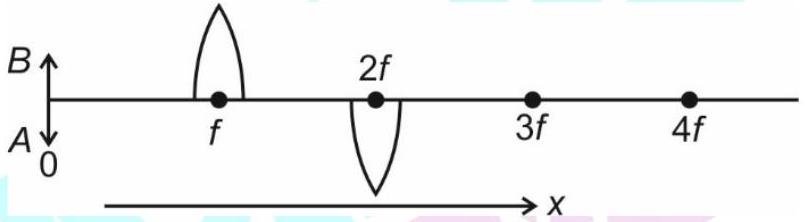
An equi-convex lens of focal length ' $f$ ' is cut along a diameter, in two halves (pieces). The two identical pieces of the lens are now arranged as shown in the figure on a common axis at a separation $f$ between the two. The image of an object $A B$ placed at $x=0$ cannot be formed at the distance $x=\xi$ from the object along the axis, for the value of $\xi$ as
During the processes of annihilation of a stationary electron of mass $m_{0}$ with a stationary positron of equal mass, a radiation is emitted. The wavelength of the resulting radiation is
The convex surface of a concavo-convex lens of refractive index 1.5 and radii of curvature $R_{1}=20 \mathrm{ cm}$ and $R_{2}=40 \mathrm{ cm}$ has been silvered so as to make it reflecting. The distance of a luminous object from the reflecting system when placed in front of it on its principal axis, so that the image coincides with the object is
Two balls are projected from the top of a cliff with equal initial speed $u$. One starts at angle $\theta$ above the horizontal while the other starts at angle $\theta$ below. Difference in their ranges on ground is
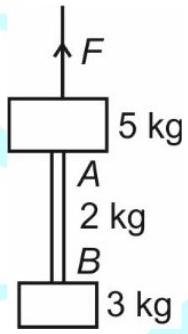
A solid block of mass 3 kg is suspended from the bottom of a 5 kg block with the help of a rope $A B$ of mass 2 kg as shown in the figure. When pulled by an upward force $F$, the whole system experiences an upward acceleration $a=2.19 \mathrm{ ms}^{-2}$. Choose the correct option
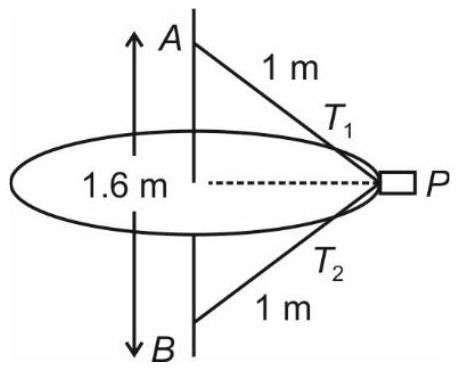
A block $P$ of mass 0.4 kg is attached to a vertical rotating spindle by two strings $A P$ and $B P$ of equal length 1.0 m as shown in the figure. The period of rotation is 1.2 s . Tensions $T_{1}$ and $T_{2}$ in string $A P$ and $B P$ are
A particle of mass $m$ moves in a straight line under the influence of a certain force such that the power ( $P$ ) delivered to it remains constant. Starting from rest, the straight-line distance travelled by the moving particle in time $t$ is
A bullet is fired vertically up with half the escape speed from the surface of the Earth. The maximum altitude reached by it (ignore the effect of rotation of the Earth) in terms of radius of Earth $R$ is
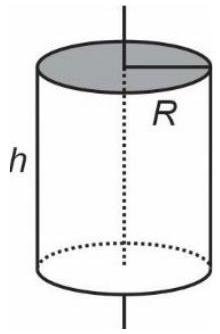
A can is a hollow cylinder of radius $R$ and height $h$. Its ends are sealed with circular sheets of the same material. The can is made of thin sheet metal of areal mass density $\sigma\left(\mathrm{kg} / \mathrm{m}^{2}\right)$. Moment of inertia of this closed can about its vertical axis of symmetry is
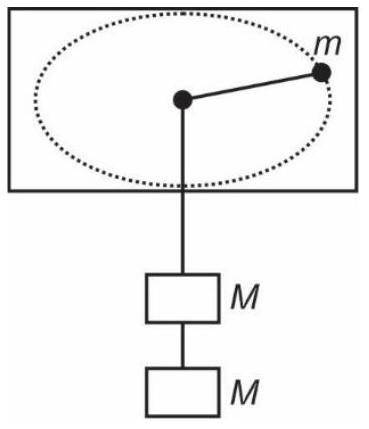
A particle of mass $m$ is revolving in a horizontal circle on a frictionless horizontal table with the help of a string tied to it and passing through a hole at the center of the table. Two equal masses $M$ are attached to the other end of the string as shown. If one of the hanging masses $M$ is removed gently, the radius of the circular motion of $m$
Three stars of equal mass $M$ rotate in a circular path of radius $r$ about their center of mass such that the stars always remain equidistant from each other. The common angular speed ( $\omega$ ) of rotation of the stars can be expressed as
The density of a liquid is $\rho$ at the surface. The bulk modulus of the liquid is $B$. The increase $\Delta \rho$ in the density of the liquid at a depth $h$ from the surface is (with $\Delta \rho \ll \rho$ )
Water flows at $1.2 \mathrm{ m} / \mathrm{s}$ through a hose of diameter 1.59 cm . The time required to fill a cylindrical container of radius 2 m to a height of $h=1.25 \mathrm{ m}$ will be nearly
A police car, moving at speed of $108 \mathrm{ km} / \mathrm{hour}$, approaches a truck moving at $72 \mathrm{ km} /$ hour in opposite direction. The natural frequency of the siren of the car is 800 Hz and the surrounding temperature is $27^{\circ} \mathrm{C}$. The frequency heard by the truck driver as the car passes him
A rope of mass $M$ and length $L$ hangs vertically. Time needed for a transverse pulse to travel from its bottom end to the support is
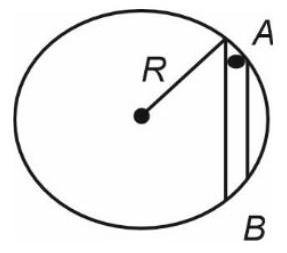
The figure shows a smooth tunnel $A B$ (length $=2 \ell$ ) in a uniform density planet (say Earth) of mass $M$ and radius $R$. A small ball of mass $m$ is released from rest at the end $A$ of the tunnel. Acceleration due to gravity at surface of the planet is $g$. Time taken by the ball to reach the end $B$ is
When the speaker $S_{1}$ is switched ON , the sound intensity at a point $P$ in a room is 80 dB . But when the speaker $S_{2}$ is switched ON ( $S_{1}$ is switched OFF ), the sound intensity at the same point $P$ in the room is 85 dB . The sound intensity level (in dB ) at the same point $P$ in the room, if the two speakers $S_{1}$ and $S_{2}$ are simultaneously switched ON , is (consider the speakers to be incoherent)
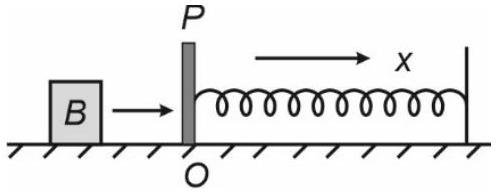
A block $B$ of mass 0.5 kg moving, on a horizontal frictionless table at $2.0 \mathrm{ ms}^{-1}$, collides with a massless pan $P$ (at origin $O$ ) and sticks to it. The pan is connected at the end of a horizontal un-stretched (relaxed) spring of force constant $K=32 \mathrm{Nm}^{-1}$ as shown in figure. After the block collides, the displacement $x(t)$ of the block as a function of time $t$ is given by
Which of the following functions does not represent a traveling wave?
Two Carnot heat engines are connected in series such that the sink of the first engine is heat source of the second. Efficiency of the engines are $\eta_{1}$ and $\eta_{2}$ respectively. Net efficiency $\eta$ of the combination is given by
An air bubble of radius 2 mm at a depth 12 m below the surface of water at temperature of $8^{\circ} \mathrm{C}$, rises to the surface where the temperature is $16^{\circ} \mathrm{C}$. Neglecting the effect of Surface Tension, the radius of the bubble at the surface is estimated to be
Two soap bubbles of radii $a$ and $b$ coalesce to form a single bubble of radius $c$ under isothermal conditions. If the external pressure is $P_{A}$, then the Surface Tension ( $T$ ) of the soap solution is
An open-end organ pipe 30 cm in length and a closed-end organ pipe 23 cm in length, both of equal diameter, are each sounding their first overtone and both are in unison at 1100 Hz . The speed of sound in air, is estimated to be nearly
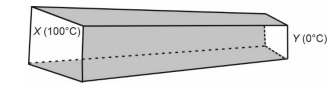
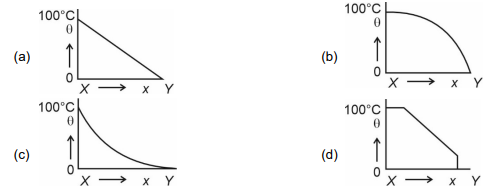
The figure shows a lagged bar $X Y$ of non-uniform cross section. One end $X$ of the bar is maintained at $100^{\circ} \mathrm{C}$ and the other end $Y$ at $0^{\circ} \mathrm{C}$. The variation of temperature along its length from $X$ to $Y$ in steady state is best represented by the curve.
An ideal gas ( $n$ moles) is initially at pressure $P$ and temperature $T$. It is cooled isochorically to a pressure $\frac{P}{4}$. The gas is then expanded at a constant pressure so as to attain back its initial temperature $T$. Work done by gas during the entire process is
Assuming the Sun to be a spherical body (radius $R_{S}$ ) of surface temperature $T$, the total radiation power received by Earth (radius $R_{E}$ ) at a distance $r$ from Sun is
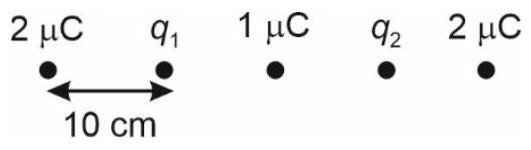
The figure shows five point-charges on a straight line. Separation between successive charges is 10 cm . For what values of $q_{1}$ and $q_{2}$ would the net force on each of the other three charges be zero?
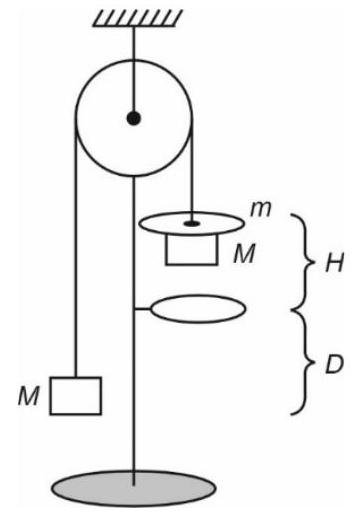
Two equal blocks, each of mass $M$, hang on either side of a frictionless light pulley with a light string. A rider of mass $m$ is placed on one of the blocks (as shown). When the system is released, the block with rider descends a distance $H$ till the rider is caught by a ring that allows the block to pass through. The system moves a further distance $D$ taking time $t$. In such a situation, the acceleration due to gravity is
A very small electric dipole of dipole moment $\vec{p}$ lies along the $x$ axis (i.e. $\vec{p}=p \hat{i}$ ) in a non-uniform electric field $\vec{E}=\frac{c}{x} \hat{i}$ (where $c$ is a constant). The force on the dipole is
A conducting thick spherical shell of radii $a$ and $b(b>a)$ has been charged with uniform surface charge density $-\sigma \mathrm{C} / \mathrm{m}^{2}$ on the inner and $+\sigma \mathrm{C} / \mathrm{m}^{2}$ on the outer surface. Then
A spherical conductor is charged up to a potential of 450 V . The potential outside, at a distance 15 cm from the surface, is 300 V . Then
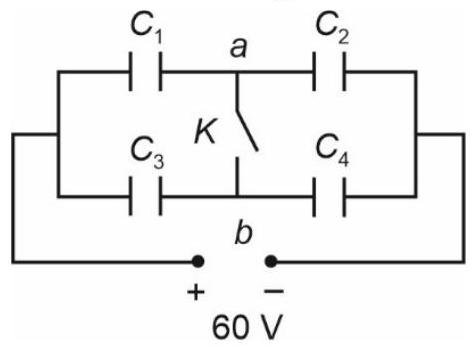
Capacitors $C_{1}=3 \mu \mathrm{ F}, C_{2}=6 \mu \mathrm{ F}, C_{3}=4 \mu \mathrm{ F}$ and $C_{4}=1 \mu \mathrm{ F}$ are connected in a circuit as shown to a battery of 60 V . Now if key $K$ is closed, the charge that will flow through $K$ is
The electrical conductivity of a sample of semiconductor is found to increase when the electromagnetic radiation of wave length just shorter than 2480 nm is incident normally on its surface. The band gap of the semiconductor is
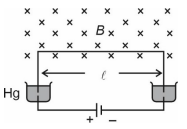
A U-shaped conducting wire of mass $m=10 \mathrm{ g}$, having length of its horizontal section as $\ell=20 \mathrm{ cm}$, is free to move vertically up and down. The two ends of the wire are immersed in mercury for proper electrical contact. The wire is in a homogenous field of magnetic induction $B=0.1 \mathrm{ T}$ as shown. The wire jumps up to a height $h=3 \mathrm{ m}$ when a charge $q$, in the form of a current pulse, is sent through the wire. Considering that the duration of the current pulse is very small compared to the time of flight, the charge $q$ passed through the wire is estimated to be nearly
A direct vision spectroscope has been designed to obtain dispersion without deviation by arranging alternate inverted thin prisms of crown glass (refractive index $\mu_{1}=\sqrt{2}$ ) and flint glass ( $\mu_{2}=\sqrt{3}$ ) with refracting angle $\theta_{\text {flint }}=3^{\circ}$. The refracting angle $\theta_{\text {crown }}$ of the crown glass prism is
Continuous and characteristic X-rays are produced when electron beam accelerated by a high potential difference of V volt (say) is made to hit the metallic target such as Molybdenum in a modern Coolidge tube. Let $\lambda_{\text {min }}$ be the smallest possible wavelength of continuous X-rays and $\lambda_{L \alpha}$ be the maximum wavelength of the characteristic X-rays. Then
While performing an experiment for determining the focal length of a concave mirror by u-v method, a student recorded the given sets of the positions (in cm ) of the object and the corresponding image on the bench as (12, $51),(18,54),(30,50),(48,34),(42,42)$ and $(78,98)$. She used an optical bench of length 1.5 m and the mirror is fixed at the 90 cm mark on the bench. The maximum acceptable error in the location of the image is 0.2 cm . The reading (observation) that cannot be obtained from experimental measurement and has been incorrectly recorded, for a mirror of focal length $=24 \mathrm{ cm}$, is
A parallel beam, of 6.0 mW radiation of wavelength 200 nm and of area of cross-section $1.0 \mathrm{ mm}^{2}$, falls normally on a plane metallic surface. If the radiations are completely reflected, the pressure exerted by the radiations on the metallic surface is estimated to be
IN THE FOLLOWING QUESTIONS ANY NUMBER OF OPTIONS 4, 3, 2 OR 1 MAY BE CORRECT
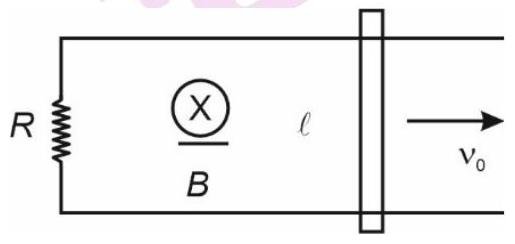
A metal rod of mass $m$ and length $\ell$ slides on frictionless parallel metal rails of negligible resistance. A resistance $R$ is connected between the rails at their ends as shown in the figure. A uniform magnetic field $B$ is directed into the plane of paper perpendicular to the plane of rails throughout the space. The rod is given an initial velocity vo (towards right). No other force acts on the rod. Then
The magnetic field $\vec{B}=2 \times 10^{-5} \sin \left\{\pi\left(0.5 \times 10^{3} x+1.5 \times 10^{11} t\right)\right\} \hat{j} T$ represents a plane electromagnetic wave travelling in space with $x$ in meter and $t$ in second. The correct statement(s) are
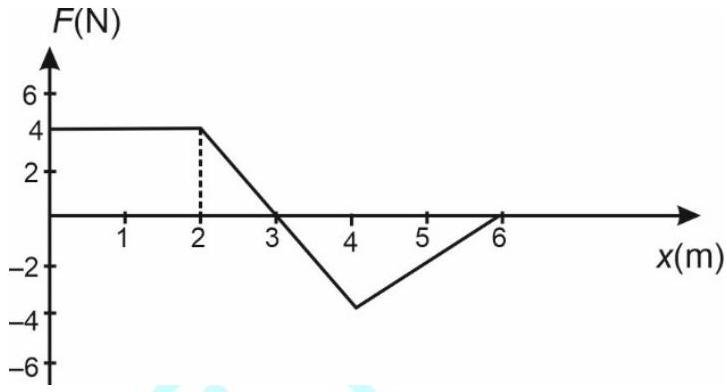
The force $F(x)$ acting on a body of mass m changes with position $x$ (in meter) as shown. It is given that the potential energy $U(x)=0$ at $x=0$ Choose correct option(s).
A deuteron of mass $M$ moving at speed $v$ collides elastically with an $\alpha$-particle of mass $2 M$, initially at rest. The deuteron is scattered through $90^{\circ}$ from initial direction of its motion with speed $V_{d}$ while the $\alpha$-particle is scattered with speed $V_{\alpha}$ at an angle $\theta$ from the initial direction of motion of deuteron. Then
Two plane progressive waves travelling on a string as
$Y_{1}=2.5 \times 10^{-3} \sin (30 x-420 t)$
$Y_{2}=2.5 \times 10^{-3} \sin (30 x+420 t)$
Superimpose to produce a standing wave. The variables $x$ and $y$ are in meter and $t$ is in second. Then
Two moles of nitrogen in a container, of negligible thermal capacity, are initially at $17^{\circ} \mathrm{C}$. The gas is compressed adiabatically from an initial volume of 120 liter to 80 liter. The correct option(s) is/are
A small dipole is placed at the origin with its dipole moment $\vec{P}=p \hat{i}$ oriented along $x$ axis. $E$ and $V$, are respectively, the electric field and potential at point $A(x, y)$. The observations at the Point $A(x, y)$ which is at a large distance $r$ from the origin, show that
Two equal positive charges $+Q$ each lie on $y$ axis at ( $0, a$ ) and ( $0,-a$ ). The electric field strength $E$ at a point $(x, 0)$ satisfies:
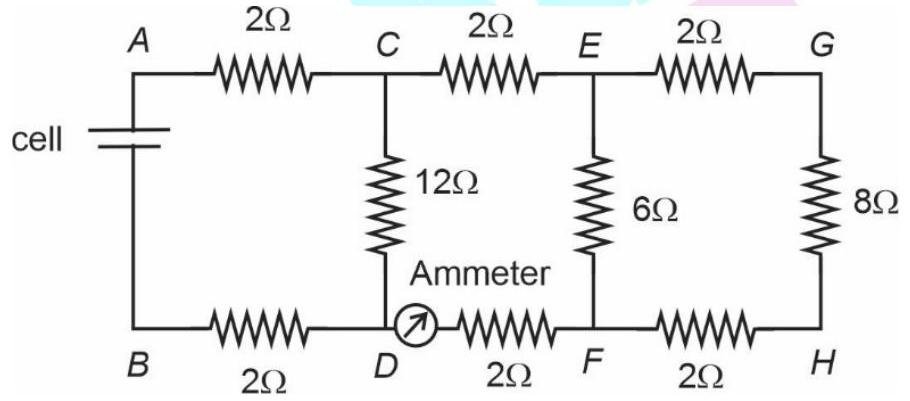
In the circuit shown, the current in the $8 \Omega$ resistance across $G$ and $H$ is $i=0.5$ ampere. The ammeter is ideal. The internal resistance of the cell is $0.8 \Omega$. Choose the correct option(s).
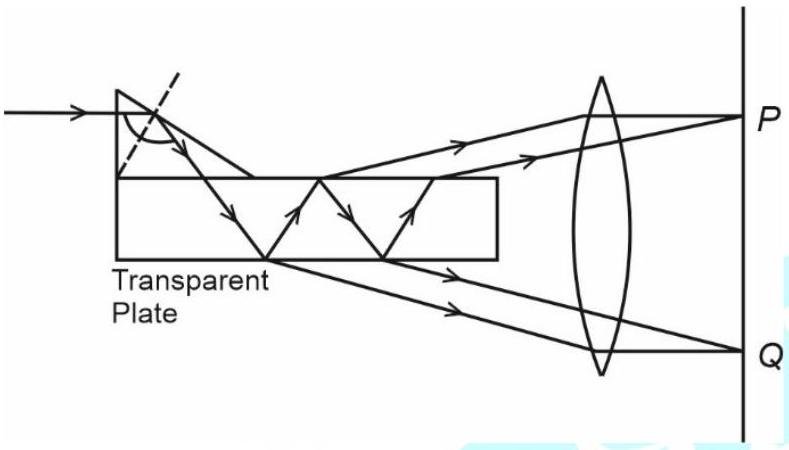
In an experiment with Lummer Gehrcke plate, the two coherent beams of light, caused by multiple reflections inside the transparent plate of refractive index $\mu=1.54$, reach the points $P$ and $Q$ on the screen. The net path difference between the two beams reaching either at $P$ or $Q$ is $\Delta \mathrm{x}=5000 \mathrm{ nm}$. Which of the wavelengths in the visible range ( $\lambda=390 \mathrm{ nm}$ to $\lambda=780 \mathrm{ nm}$ ) is/are most likely to produce a constructive interference (a maximum) at the point $P$ as well as at $Q$ on the screen?
Two identical transparent solid cylinders, each of radius 10 cm and refractive index $\mu=\sqrt{3}$, lie horizontally parallel to each other on a horizontal plane mirror with a separation $x$ between their horizontal axes. A ray of light is incident horizontally on the cylinder A at a height $h$ above the plane mirror so as to emerge from this cylinder at a height $h_{1}=0.1 \mathrm{ m}$ above the plane mirror. The ray emerging out from the first cylinder $A$ is reflected from the horizontal plane mirror to enter the second parallel cylinder $B$ at a height $h_{2}$ and then this ray emerges out of the second cylinder, parallel and in-line with the original incident ray. The correct statement(s) is/are:
In the working of a $p-n$ junction

Publishing original scientific research in a peer-reviewed journal is an achievement many scholars work toward for years. Achieving this feat early in one's academic journey requires exceptional intellectual rigor, creativity, and persistence. Aaditya Punatar and Muskan Sadana have reached this remarkable milestone, successfully publishing their collaborative research paper in the prestigious Journal of Emerging Investigators […]

Her project on quantum-accelerated Steiner trees for 15-minute cities earned a place among the finalists at the world's largest pre-college STEM competition. Prishaa Shrimali of Marymount School of New York, was selected as a Grand Finalist at the 2026 Regeneron International Science and Engineering Fair (ISEF) in Phoenix, Arizona. Her project was Optimizing Urban Accessibility: […]

In 2026, the following Cheenta students have been successful for Indian Statistical Institute's M.Stat Entrance. They ranked within the first 50 in the entire country in these entrances. I.S.I. M.Stat Entrance

In 2026, the following Cheenta students have been successful for Indian Statistical Institute's B.Stat Entrance and Chennai Mathematical Institute's B.Sc. Math Entrance. They ranked within the first 200 in the entire country in these entrances. Most of these students attended the problem solving workshops regularly, which happen 5 days every week. CMI B.Sc. Math Entrance […]