NMTC 2026 Comes to Kolkata: Cheenta Hosts the Preliminary Round at Mitra Institution
 Join Trial or Access Free ResourcesJoin Trial or Access Free Resources
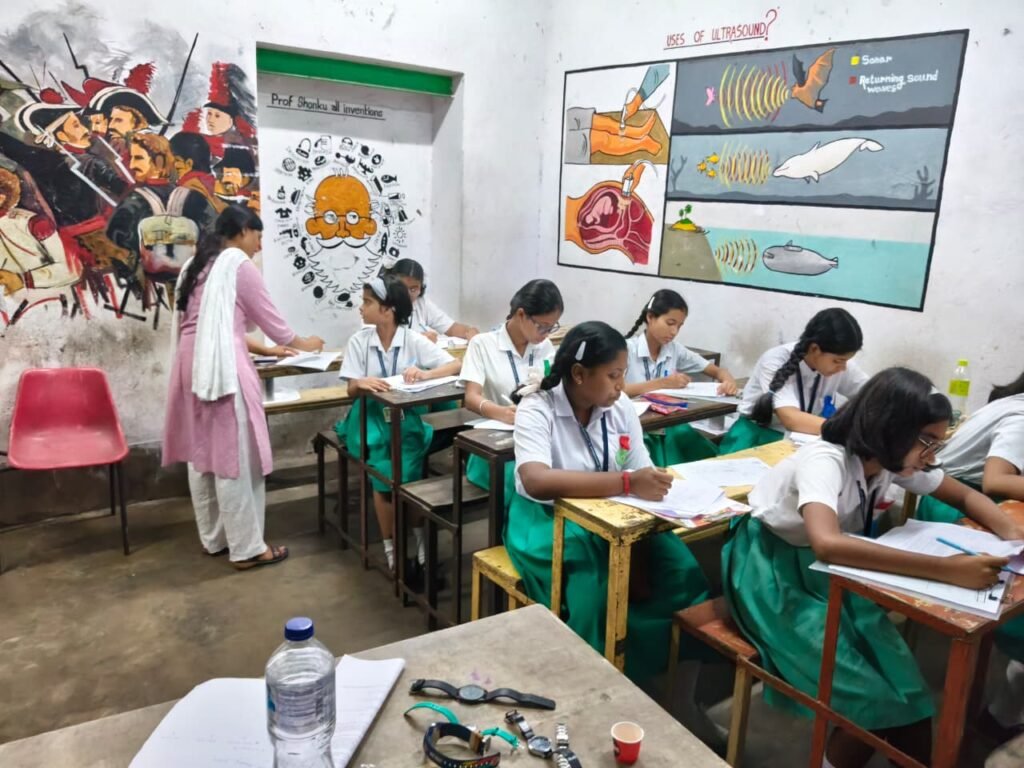
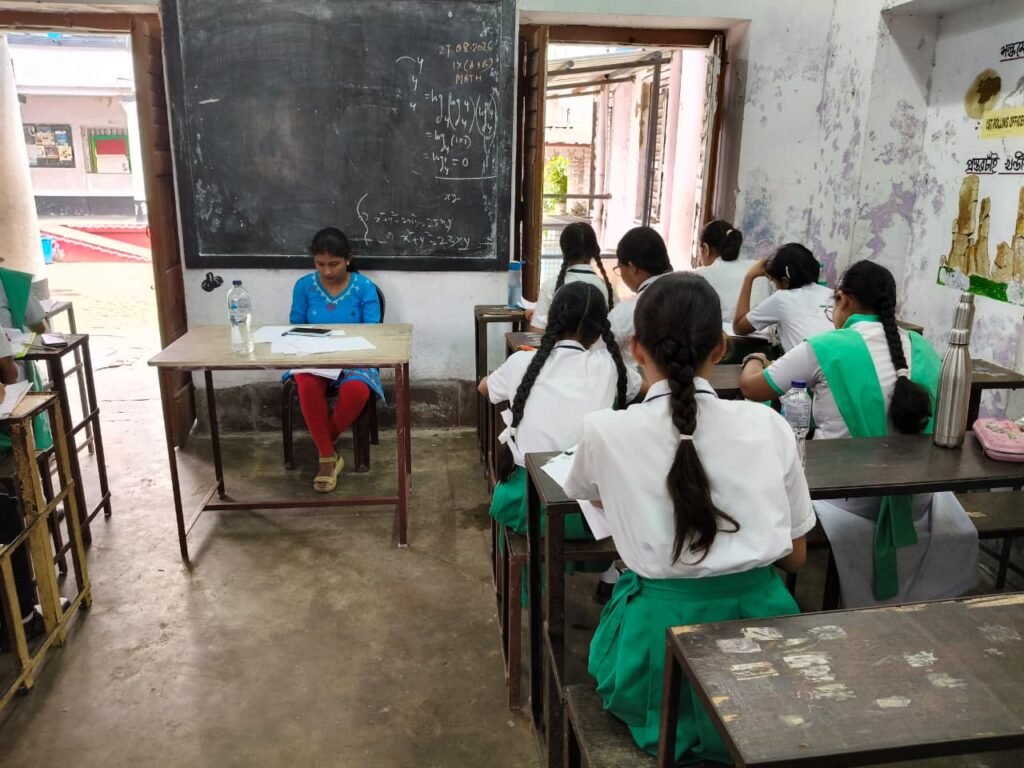
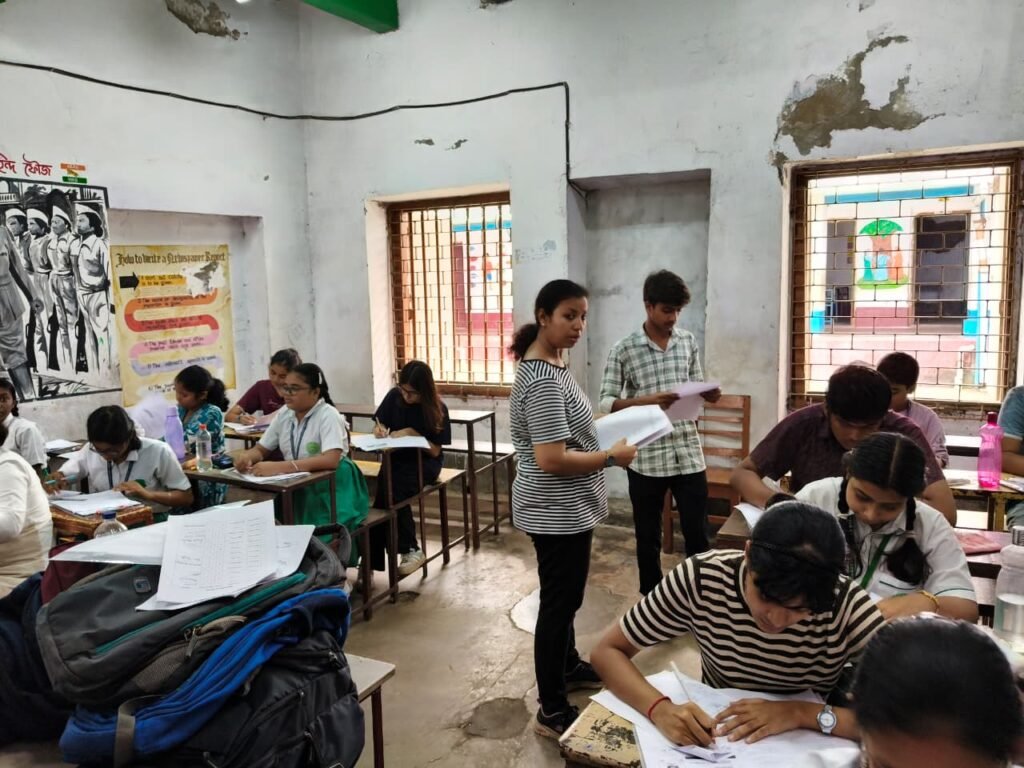
On 30th August 2026, young mathematics enthusiasts across Kolkata gathered at Mitra Institution (Main) for the preliminary round of the National Mathematics Talent Contest (NMTC) — one of India's longest-running mathematical olympiads. Cheenta took charge of conducting the exam in the city, with invigilation handled by Deepan Dutta, Raghunath J V, Shilpa Bera, Taniya Das and Sukdeb Mahato.
NMTC is organised annually by the Association of Mathematics Teachers of India (AMTI), founded in 1965 to strengthen mathematics teaching and spot young talent nationwide. The contest itself has run since 1968, making 2026 roughly its 58th edition. What began as a regional initiative out of Tamil Nadu has grown into a national event, with well over a hundred thousand students from hundreds of schools sitting the screening test each year.
Over the decades, NMTC has become a recognised stepping stone in India's olympiad pipeline. Strong performers, especially at the Junior and Inter levels, often go on to represent their states at the Indian National Mathematics Olympiad (INMO), and from there to India's international olympiad teams.
NMTC is split into five age-based categories, each named after a mathematician: Primary (Gauss), Sub-Junior (Kaprekar), Junior (Bhaskara), Inter (Ramanujan), and Senior (Aryabhata), covering students from Standard V all the way through undergraduate level. The Preliminary Test — the round held this weekend — is a two-hour paper mixing multiple-choice and fill-in-the-blank questions, deliberately weighted toward difficulty: roughly a fifth of the questions are straightforward, while the rest demand real problem-solving. Only the top tenth of performers make it through to the Final Test, a longer three-hour paper that pushes further into advanced territory.
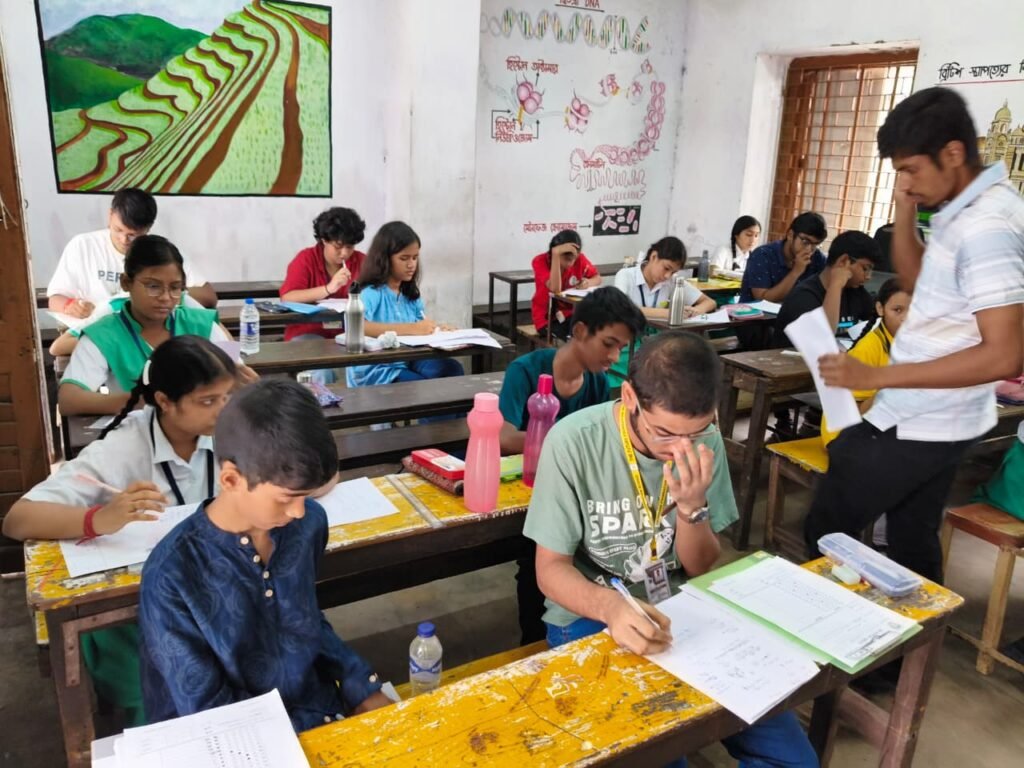
Kolkata's leg of this national exercise played out at Mitra Institution (Main), with Cheenta's invigilators ensuring the paper ran smoothly for the city's participating students.
The exam day itself was only the visible part of a longer effort. In the weeks leading up to it, Cheenta ran a series of offline workshops at its Lake Place centre, giving students structured practice with the kind of unconventional, creative problems NMTC is built around — quite different from the routine drilling most school classrooms focus on.
This reflects Cheenta's broader approach to olympiad training: mathematical creativity is a skill that has to be practised through discussion, mistakes, and mentor feedback, not just picked up from a textbook. Through small-group problem-solving sessions at Lake Place, Cheenta has been helping students build the instincts they need — not just for NMTC, but for the longer olympiad journey that follows it, from RMO to INMO and beyond.
NMTC draws its syllabus from pre-degree college mathematics, organised broadly around four areas: Algebra, Geometry, Number Theory, and Graph Theory & Combinatorics. Algebra questions typically involve polynomials, equations, inequalities, and complex numbers. Geometry centres on triangles and circles, and can often be approached through trigonometric, vector, complex-number, or transformation methods — giving students room to choose the technique that suits them best. Number theory and combinatorics round out the paper, rewarding pattern recognition and clean logical argument over formula recall.
With the preliminary round complete, Kolkata's NMTC aspirants now wait for results, while qualifiers begin preparing for the Final Test. For Cheenta, the Lake Place workshops and the exam day at Mitra Institution are two halves of the same effort — helping local students engage with mathematics as a creative pursuit, one contest at a time.

Publishing original scientific research in a peer-reviewed journal is an achievement many scholars work toward for years. Achieving this feat early in one's academic journey requires exceptional intellectual rigor, creativity, and persistence. Aaditya Punatar and Muskan Sadana have reached this remarkable milestone, successfully publishing their collaborative research paper in the prestigious Journal of Emerging Investigators […]

Her project on quantum-accelerated Steiner trees for 15-minute cities earned a place among the finalists at the world's largest pre-college STEM competition. Prishaa Shrimali of Marymount School of New York, was selected as a Grand Finalist at the 2026 Regeneron International Science and Engineering Fair (ISEF) in Phoenix, Arizona. Her project was Optimizing Urban Accessibility: […]
In 2026, the following Cheenta students have been successful for Indian Statistical Institute's M.Stat Entrance. They ranked within the first 50 in the entire country in these entrances. I.S.I. M.Stat Entrance
In 2026, the following Cheenta students have been successful for Indian Statistical Institute's B.Stat Entrance and Chennai Mathematical Institute's B.Sc. Math Entrance. They ranked within the first 200 in the entire country in these entrances. Most of these students attended the problem solving workshops regularly, which happen 5 days every week. CMI B.Sc. Math Entrance […]