Cheenta, with the zeal of a child, has a dream of training a perfect IMO team someday in the recent future.
Also, the day, 22nd December is very special to Mathematics, which saw the birth of Ramanujan and is a very romantic day for every math-loving person.
With that romanticism and the zeal, I took the challenge of solving the Problem 6 of IMO, 2018.
Also Visit: Math Olympiad Program
Let's go straight to the problem first.
For some time, remove the tag "problem 6 of IMO" and focus on the problem only.
There are two pieces of information:
A Simple "WHY"
The first two natural questions that occurred are "Why such an X exists?" and "Even if such an X exists, then why is it unique?".
Aren't these questions natural?
I absolutely love this journey in Mathematics, where by the art of simple questioning we discover new things with new perspectives. Believe me this is as beautiful and mesmerizing as listening to your favorite Ragas.
Let's discover the answers to these questions. But I prefer you to think about this problem before you scroll down. We would love to hear your way of approach and thought.
Let's Proceed
Geometry without Diagrams is like Cheenta without Mathematics. So, let's talk through pictures.
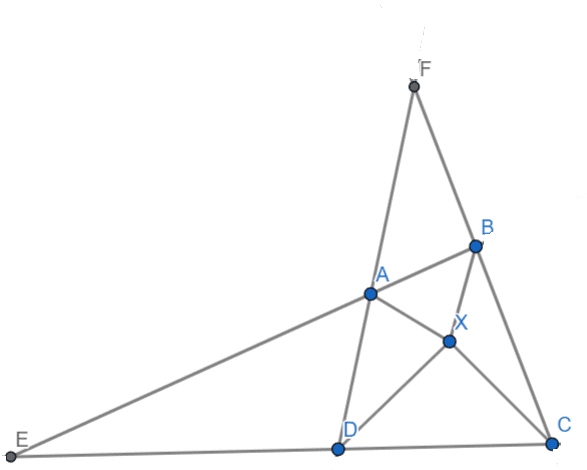
Ok, that looks like a promising picture. Let's get back to the given condition that \(\angle XAB = \angle XCD\) and \(\angle XBC = \angle XDA\)
Before diving into complicacy, we want to answer a simple question as follows:
Given two line segments AB and CD, what is the locus of all such points X such that \(\angle XAB = \angle XCD \)?
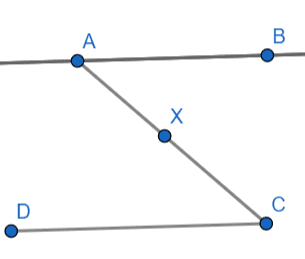
That looks easy if AB and CD are parallel to each other. Then the Locus of such X is AC due to the Alternate Angle Theorem.
Now let's explore what happens if AB and CD are not parallel. Already at the back of the mind questions started to crop up!
Will it be so simple? Will it be a straight line? No, No it can't be a straight line. Will it be a circle then? A circle isn't that too simple? ... A parabola may be! Who knows ? ...
"Let's draw!" my mind exclaimed!
If AB and CD are not parallel then they must be intersecting somewhere. Yes, let's draw that keeping that in mind. Let me borrow the diagram I have used before for the actual problem.
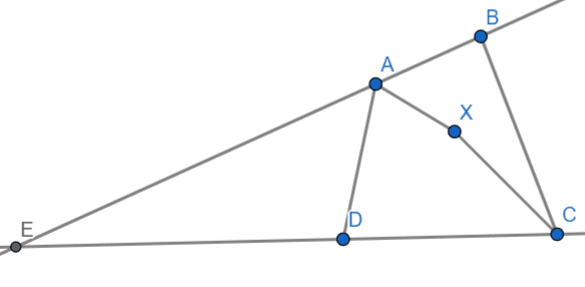
Observe that we have assumed \(\angle XAB = \angle XCD\). Something seems familiar? Huh! Yes, you are right! Cyclic Quadrilaterals!
Observe that \(\angle XAE + \angle XAB = 180^\circ\) and if X is such a special point, then \(\angle XAE + \angle XCE = 180^\circ\). Yaay! Cyclic Quadrilateral!
So, the locus of such X is a circle, seriously that simple? Oh! yes, the math doesn't lie. We got that XAEC will form a cyclic quadrilateral for X to be a special point. Let's see how it looks!
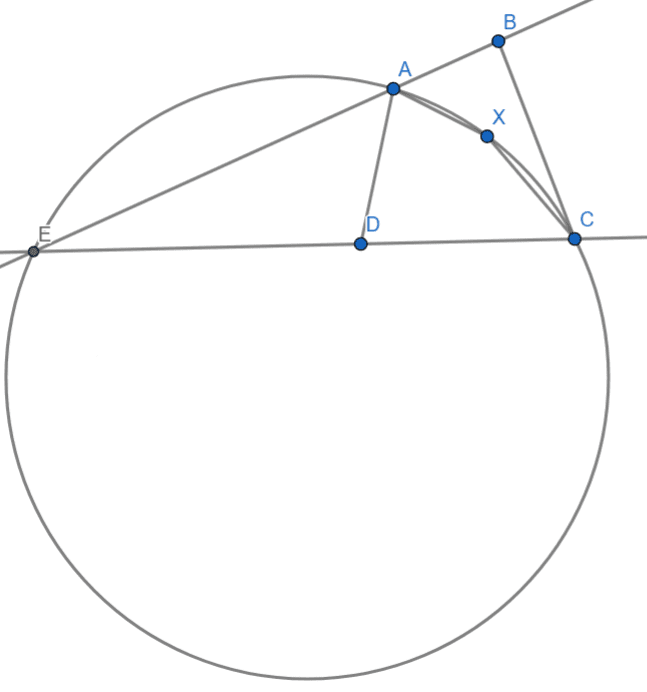
Construction: So, given AB and CD pair we extend them to meet each other at E and then form the circumcircle of \(\triangle AEC \) and the corresponding part inside the quadrilateral is the locus of X as we require.
Nice! Let's return to the actual question if that special property holds both for the pairs (AB, CD) and also for (CB, DA).
Till now, we have learned how to find X for one pair (AB, CD) with the given property. Let's do the same for (CB, DA) too.
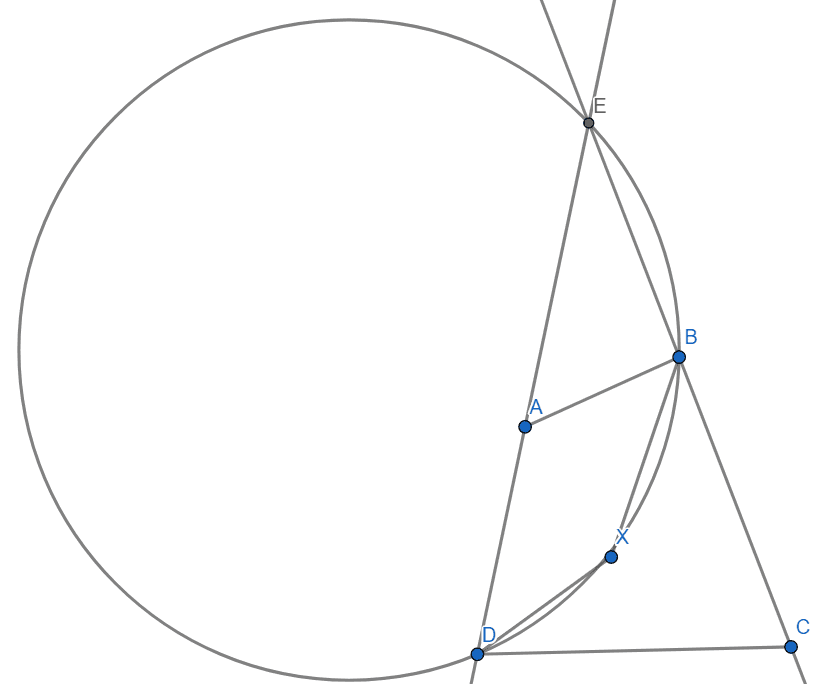
Ok, now we want both of these to happen, right? Let's see, what we get, in fact we will get the intersection point of these two circles. Let's see this for the above example.
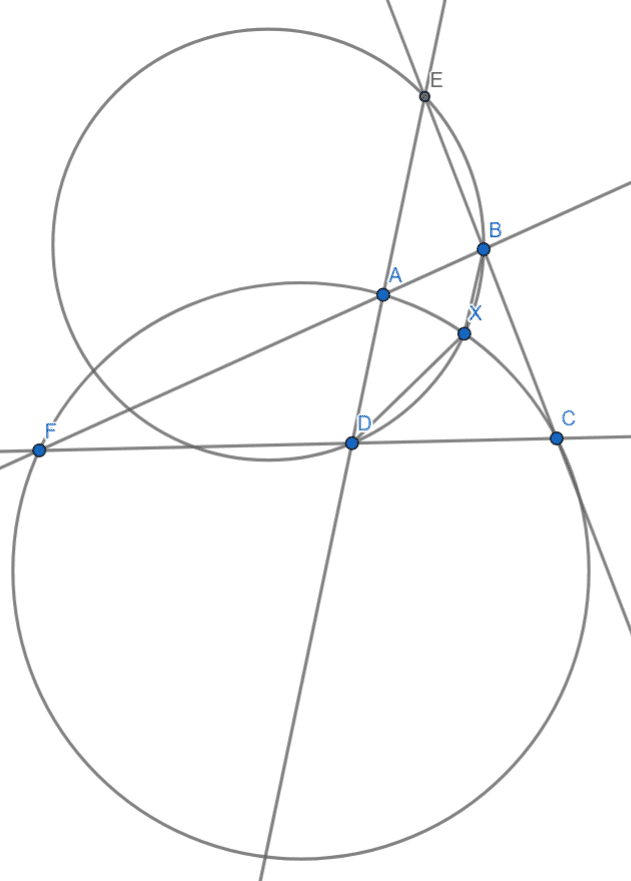
Booyah! So, we got the required point. There always exist such a point and it is always unique, right because it is the intersection of two circles.
So, see how long we came from the actual problem to discover some beautiful truth to a beautiful simple question!
But, the next obvious question is:
'Does this understanding really help in solving the actual problem?'
Let's leave it to the second part of this post to discover the power of such simple questions!
Remember there is one more information, which we haven't used. We surely need that piece of information to solve the problem!
Now I leave the thoughts and ideas to you. See you in the next post. Till then, we would love to hear from your side, your ideas, your approach, your way of thought, Your Own Mathematics.
Please mention them in the comments. See you soon!
[/et_pb_text][/et_pb_column][/et_pb_row][/et_pb_section]
Publishing original scientific research in a peer-reviewed journal is an achievement many scholars work toward for years. Achieving this feat early in one's academic journey requires exceptional intellectual rigor, creativity, and persistence. Aaditya Punatar and Muskan Sadana have reached this remarkable milestone, successfully publishing their collaborative research paper in the prestigious Journal of Emerging Investigators […]

Her project on quantum-accelerated Steiner trees for 15-minute cities earned a place among the finalists at the world's largest pre-college STEM competition. Prishaa Shrimali of Marymount School of New York, was selected as a Grand Finalist at the 2026 Regeneron International Science and Engineering Fair (ISEF) in Phoenix, Arizona. Her project was Optimizing Urban Accessibility: […]

In 2026, the following Cheenta students have been successful for Indian Statistical Institute's M.Stat Entrance. They ranked within the first 50 in the entire country in these entrances. I.S.I. M.Stat Entrance
In 2026, the following Cheenta students have been successful for Indian Statistical Institute's B.Stat Entrance and Chennai Mathematical Institute's B.Sc. Math Entrance. They ranked within the first 200 in the entire country in these entrances. Most of these students attended the problem solving workshops regularly, which happen 5 days every week. CMI B.Sc. Math Entrance […]

nice discussion.
will not \( \angle XBA \) be equal to \( \angle XDC .. ?? for the same reason?
I thought of rotation and imposing... hv to think more i guess.
ok.. no... the question specifies only one way... not both way...
"In a cyclic quadrilateral, the ratio of the diagonals equals the ratio of the sum of products of the sides that share the diagonal's end points."-- in specific words, Each Diagonal of a cyclic quadrilateral has its own specific sum of products of the side-pairs which share its individual endpoints.
Ratio of these two sums for the two diagonals, equals the ratio of the diagonals.
--- can this be used...