How to Measure the Length of your Earphone from a Pic?| Cheenta Probability Series
 Join Trial or Access Free ResourcesJoin Trial or Access Free Resources
This is our 5th post in the Cheenta Probability Series. This article teaches how to mathematically find the length of an earphone wire by its picture.
Let's explore some truths.
This article is all about connecting these three truths to a topic in Probability Theory \( \cap \) Geometry, which is not so famous among peers, yet its' usefulness has led one to make an app in Google Play Store, which has only one download (by me). The sarcasm is towards the people, who didn't download. (obviously).
Today is the day for Cauchy Crofton's Formula, which can measure the length of any curve using random straight lines by counting points. It is all encoded in the formula.
\( L(c)= \frac{1}{2} \times \iint n(p, \theta) dp d \theta \)
This is the begining of a topic called Integral Geometry.
This formula intuitively speaks the truth
The Length of a Curve is the Expected Number of Times a "Random" Line Intersects it.
I mean a "Random" Line.
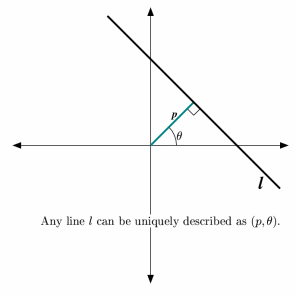
Thus the Space of all Lines in \( \mathbf{R}^2 \) can be represented in "kinda" polar coordinates S = {\({(\theta, p) \mid 0 \leq \theta \leq 2 \pi, p \geq 0},\)} where \(p, \theta\) are as indicated.
Now, we are now uniformly selecting this \( (\theta, p) \) over S. This is how we select a "Random" Line.
If C is the curve, whose length we are interested to measure. Then, \( L(C)= \frac{1}{2} \times \iint n(p, \theta) dp d \theta \).
\( L(C) \) = The Length of the curve
\( n(\theta, p) \) = The Number of times "Random Line" corresponding to \( (\theta, p) \) intersects C.
Crofton meant the following on a pretty, differentiable, and cute (regular) curve C that:
\( L(C)= \frac{1}{2} \times E_{(p, \theta)} [n(p, \theta)] \)

Here, we will find the length of a Line using "Random Lines". We will see, how counting points on the line, can help us find the length of a line.
Here, we choose C = Line.
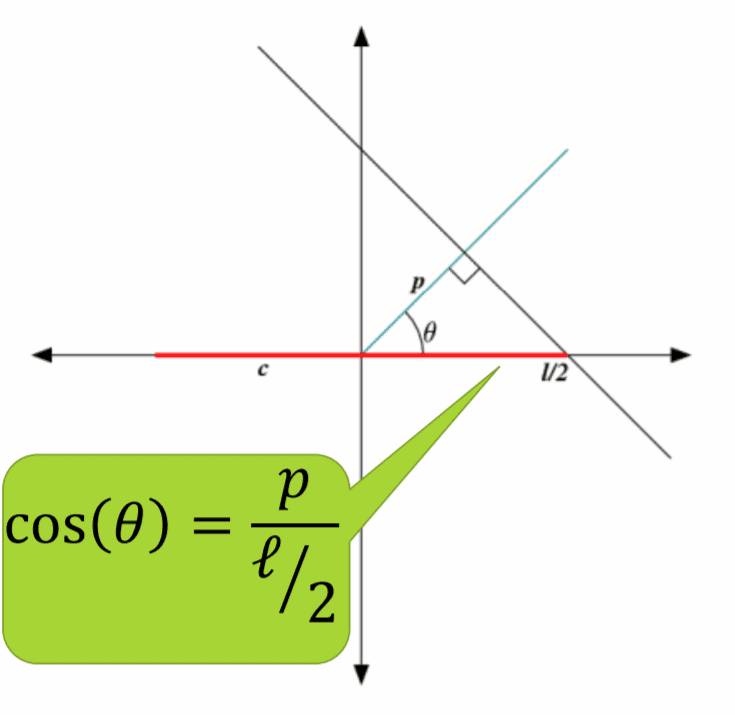
A Line intersects another Line exactly once. \( n(p, \theta) = 1 \). Hence,
\( L(C)= \frac{1}{2} \times \iint n(p, \theta) dp d \theta = \frac{1}{2} \times \iint dp d\theta = \frac{1}{2} \times \int_{0}^{2 \pi}\left(\int_{0}^{|\cos \theta|(1 / 2)} d p\right) d \theta = \frac{1}{2} \times \int_{0}^{2 \pi} l / 2|\cos \theta| d \theta= l \)
Approximate Curves by Lines.
Refer to Approximation of Curves by Line Segments by Henry Stone.
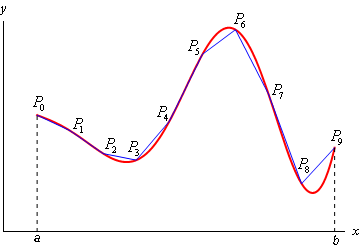
Now, take apply the result on these lines. By linearity of expectation and the uniform convergence of the Lines to the Curve, we get the same for the curve.
Suppose that the curve c is parameterized on the interval [a,b]. Define a partition \( P \) to be a collection of points that subdivides the interval, say { \( a = a_0, a_1, a_2, ..., a_n = b\) }.
Define \( L_{r}(c)=\sum_{i=1}^{n} |c\left({a}_{i-1}\right)-c\left({a}_{i}\right)| \)
Then \( L(c)= sup_{r} L{r}(c) \)
Now, each of the \( |c\left({a}_{i-1}\right)-c\left({a}_{i}\right)|\) are approximated by the Crofton's Formula. Now, taking the limit gives ust eh required result. QED.
Create a Mesh of Lines (Coordinate System) - A Fixed Sample representing the Population of the Random Lines. Then count the number of intersections using those mesh of lines only and add it up.
The mathematics of the above argument is as follows.
\( L(c)= \frac{1}{2} \times \iint n(p, \theta) dp d \theta \cong \frac{1}{2} \times n r \times \frac{\pi}{3} \)
An example is show below. This is done in the app named Cauchy-Crofton App, which unfortunately is not working now and I have reported.


There are lots of corollaries coming up like Isoperimetric Inequality, Barbier's Result, etc. I will discuss these soon. Till then,
Stay Tuned!
Stay Blessed!


Publishing original scientific research in a peer-reviewed journal is an achievement many scholars work toward for years. Achieving this feat early in one's academic journey requires exceptional intellectual rigor, creativity, and persistence. Aaditya Punatar and Muskan Sadana have reached this remarkable milestone, successfully publishing their collaborative research paper in the prestigious Journal of Emerging Investigators […]

Her project on quantum-accelerated Steiner trees for 15-minute cities earned a place among the finalists at the world's largest pre-college STEM competition. Prishaa Shrimali of Marymount School of New York, was selected as a Grand Finalist at the 2026 Regeneron International Science and Engineering Fair (ISEF) in Phoenix, Arizona. Her project was Optimizing Urban Accessibility: […]
In 2026, the following Cheenta students have been successful for Indian Statistical Institute's M.Stat Entrance. They ranked within the first 50 in the entire country in these entrances. I.S.I. M.Stat Entrance
In 2026, the following Cheenta students have been successful for Indian Statistical Institute's B.Stat Entrance and Chennai Mathematical Institute's B.Sc. Math Entrance. They ranked within the first 200 in the entire country in these entrances. Most of these students attended the problem solving workshops regularly, which happen 5 days every week. CMI B.Sc. Math Entrance […]