Did you know that there exists a whole set of seven axioms of Origami Geometry just like that of the Euclidean Geometry?

Instead of being very mathematically strict, today we will go through a very elegant result that arises organically from Origami.
Before that, let us travel through some basic terminologies. Be patient for a few more minutes and wait for the gem to arrive.
In case you have forgotten what Origami is, the following pictures will remove the dust from your memories.

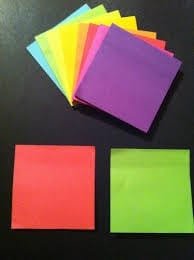
Origami (from the Japanese oru, “to fold,” and kami, “paper”) is a traditional Japanese art of folding a sheet of paper, usually square, into a representation of an object such as a bird or flower.
Flat origami refers to configurations that can be pressed flat, say between the pages of a book, without adding any new folds or creases.


When an origami object is unfolded, the resulting diagram of folds or creases on the paper square is called a crease pattern.
We denote mountain folds by unbroken lines and valley folds by dashed
lines. A vertex of a crease pattern is a point where two or more folds intersect, and a flat vertex fold is a crease pattern with just one vertex.

In a crease pattern, we see two types of folds, called mountain folds and valley folds.


Now, if you get to play with your hands, you will get to discover a beautiful pattern.
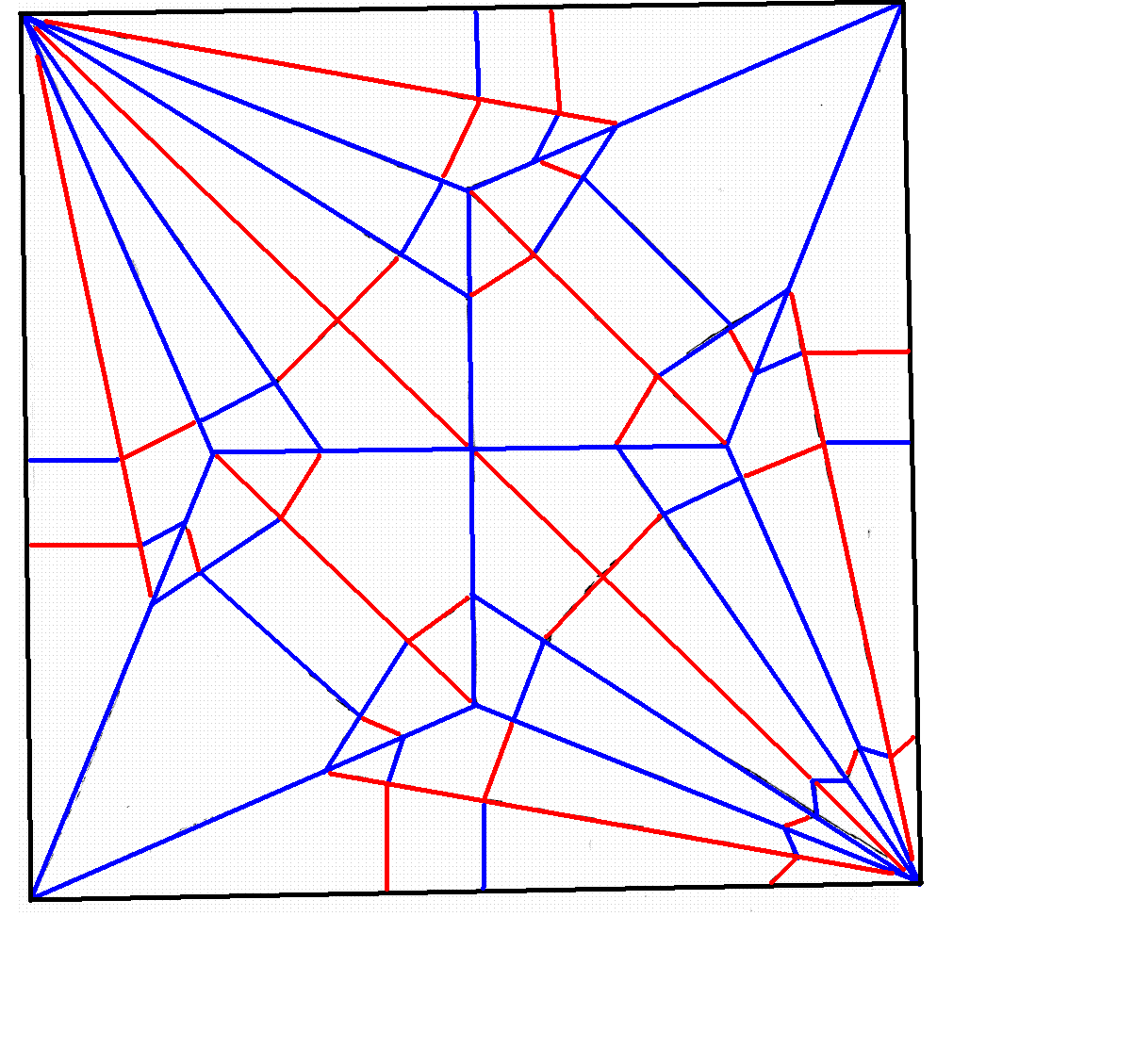
The positive difference between the dotted lines and the full lines is always 2 at a given vertex. The dotted line denotes the mountain fold and the full line denotes the valley fold.
This is encoded in the following theorem.
Maekawa's Theorem: The difference between the number of mountain
folds and the number of valley folds in a flat vertex fold is two.
Isn't it strange ?
Those who are familiar graph theory may think it is related to the Euler Number.
We will do the proof step by step but you will weave together the steps to understand it yourself. The proof is very easy.
Step 1:
Let n denote the number of folds that meet at the vertex, m of which
are mountain folds and v that are valley folds, so that n = m + v. (m for mountain folds and v for valley folds.)
Step 2:
Consider the cross section of a flat vertex.

Step 3:
Consider the creases as shown and fold it accordingly depending on the type of fold - mountain or valley.
Step 4:
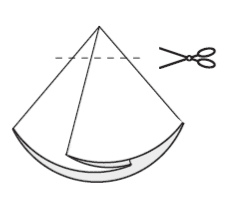
Now observe that we get the following cross section. Observe that the number of sides of the formed polygon is n = m + v.
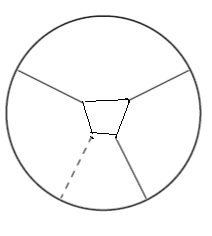
Step 5:
We will also count the angle sum of the n sided polygon in the following way. Consider the polygon formed.


Observe that the vertex 2 is the Valley Fold and other vertices are Mountain Fold. Also the angle subtended the vertex due to valley fold is 360 degrees and that of due to the mountain fold is 0 degrees.
Therefore, the sum of the internal angles is v.360 degrees.
Step 6:
Now we also know that the sum of internal angles formed by n vertices is 180.(n-2), which is = v.360.
Hence we get by replacing n by m+v, that m - v = 2.
QED
So simple and yet so beautiful and magical right?
But it is just the beginning!
There are lot more to discover ...
Do you observe any pattern or any different symmetry about the creases or even in other geometry while playing with just paper and folding them?
We will love to hear it from you in the comments.
Do you know Cheenta is bringing out their third issue of the magazine "Reason, Debate and Story" this summer?
Do you want to write an article for us?
Email us at babinmukherjee08@gmail.com.

Publishing original scientific research in a peer-reviewed journal is an achievement many scholars work toward for years. Achieving this feat early in one's academic journey requires exceptional intellectual rigor, creativity, and persistence. Aaditya Punatar and Muskan Sadana have reached this remarkable milestone, successfully publishing their collaborative research paper in the prestigious Journal of Emerging Investigators […]

Her project on quantum-accelerated Steiner trees for 15-minute cities earned a place among the finalists at the world's largest pre-college STEM competition. Prishaa Shrimali of Marymount School of New York, was selected as a Grand Finalist at the 2026 Regeneron International Science and Engineering Fair (ISEF) in Phoenix, Arizona. Her project was Optimizing Urban Accessibility: […]

In 2026, the following Cheenta students have been successful for Indian Statistical Institute's M.Stat Entrance. They ranked within the first 50 in the entire country in these entrances. I.S.I. M.Stat Entrance

In 2026, the following Cheenta students have been successful for Indian Statistical Institute's B.Stat Entrance and Chennai Mathematical Institute's B.Sc. Math Entrance. They ranked within the first 200 in the entire country in these entrances. Most of these students attended the problem solving workshops regularly, which happen 5 days every week. CMI B.Sc. Math Entrance […]