In a counting problem, you may need to stabilize the number of cases. This means, by letting some of the variables change, one may fix the remaining cases.
This is the central idea in the following problem from American Mathematical Contest 8 (AMC 8, 2018, Problem 9).
Also see
Advanced Math olympiad program
In a sign pyramid a cell gets a "+" if the two cells below it have the same sign, and it gets a "-" if the two cells below it have different signs. The diagram below illustrates a sign pyramid with four levels. How many possible ways are there to fill the four cells in the bottom row to produce a "+" at the top of the pyramid?

(How to use this discussion: Do not read the entire solution at one go. First, read more on the Key Idea, then give the problem a try. Next, look into Step 1 and give it another try and so on.)
Start from the top! Fix the + sign at the top of the pyramid and try filling in the second row from left. Do you see any pattern?
(What happens if you plugin a + sign in the left most block of second row from top?)
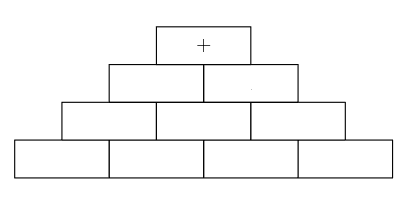
If we fix a + sign in the left most block of second row from top, the other box must contain a + sign. (Why?)
On the other hand fixing a - sign in the left most block of second row from top will force the remaining block to contain - sign.
Thus by varying the left most block of the second row, we can fix the entire row.
Will this work for the third row?

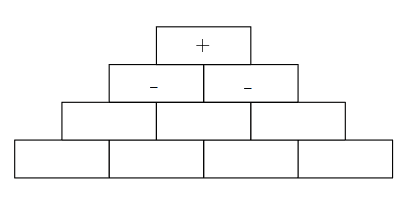
In fact the same trick will work for third row.
Try this. Fix a plus sign in the first row. Then fix second row as well ( plus, plus or minus, minus).
Then try to plugin some sign in the third row's first block. And check that the remaining two blocks get automatically fixed. This is precisely known as stabilization.
Thus, we should only worry about the first block of second, third and fourth. Fixing them fixes the entire row.
There are 2 choices for the first block of second row, 2 choices for first block of third row and 2 choices for first block of third row. Hence in total we have \( 2 \times 2 \times 2 = 8 \) cases.
Recommended book
Principles and Techniques in Combinatorics Kindle Edition by Chen Chuan-Chong
Try chapter 1.

Publishing original scientific research in a peer-reviewed journal is an achievement many scholars work toward for years. Achieving this feat early in one's academic journey requires exceptional intellectual rigor, creativity, and persistence. Aaditya Punatar and Muskan Sadana have reached this remarkable milestone, successfully publishing their collaborative research paper in the prestigious Journal of Emerging Investigators […]

Her project on quantum-accelerated Steiner trees for 15-minute cities earned a place among the finalists at the world's largest pre-college STEM competition. Prishaa Shrimali of Marymount School of New York, was selected as a Grand Finalist at the 2026 Regeneron International Science and Engineering Fair (ISEF) in Phoenix, Arizona. Her project was Optimizing Urban Accessibility: […]

In 2026, the following Cheenta students have been successful for Indian Statistical Institute's M.Stat Entrance. They ranked within the first 50 in the entire country in these entrances. I.S.I. M.Stat Entrance
In 2026, the following Cheenta students have been successful for Indian Statistical Institute's B.Stat Entrance and Chennai Mathematical Institute's B.Sc. Math Entrance. They ranked within the first 200 in the entire country in these entrances. Most of these students attended the problem solving workshops regularly, which happen 5 days every week. CMI B.Sc. Math Entrance […]