IX-X
Analytical Questions
Q1
500 kg ভরের একটি কামান থেক 5 kg ভরের একটি গোলা ছোঁড়ায় কামানটি 1ms-1 বেগে পিছনে ছিটকে আসে । যদি গোলাটি 1000 kg ভরের একটি স্থির ঘোড়ার গাড়ির উপর আঘাত হেনে এতে গতির সঞ্চার করে তাহলে গাড়ির ও ঘোড়ার সম্মিলিত বেগ কত ? (অভিকর্ষ, বাতাসের বাধা, ঘর্ষণ ইত্যাদির প্রভাব উপেক্ষণীয়)
A cannon of mass 500 kg shoots a fireball of mass 5 kg and because of doing so the cannon springs backward with a velocity of 1ms-1. If the fireball hits a horse-carriage of mass 1000 kg which was initially at rest and brings motion to it, then find the combined velocity of the carriage and the fireball. (Effects from gravitation, air resistance, friction etc are negligible)
Q2
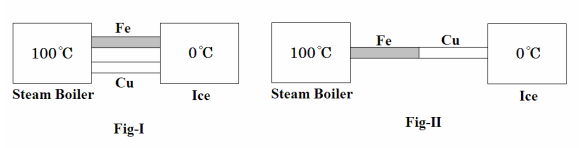
একটি লোহার দণ্ডের দৈর্ঘ্য 1m ও প্রস্থচ্ছেদের ব্যাসার্ধ 1cm । একই রকম আরেকটি দণ্ড নেওয়া হল যেটা তামা দিয়ে তৈরী । অতঃপর তাদের দ্বারা একটি ষ্টীম বয়লার ও একখণ্ড বরফের মাঝে তাপীয় সংযোগ স্থাপন করা হল ।
(a) তাপীয় সংযোগ যদি সমান্তরাল হয় (চিত্র- I), তাহলে 1kg বরফ গলতে কতক্ষন সময় লাগবে ? (লোহা ও তামার তাপ পরিবাহকত্ব যথাক্রমে 80 ও 300 Wm-1K-1 এবং বরফ গলনের আপেক্ষিক সুপ্ততাপ 336000 Jkg-1 )
(b) তাপীয় সংযোগ যদি সিরিজে হয় (চিত্র- II), তাহলে 1kg বরফ গলতে কতক্ষন সময় লাগবে ?
লোহা ও তামার দণ্ডদুটির সন্ধিস্থলের তাপমাত্রাও নির্ণয় কর ।
A rod made of iron has a length of 1m and a cross-sectional radius of 1cm. Another similar rod is taken which is made of copper. Then these two rods are taken in establishing thermal connection between a steam boiler and a lump of ice.
(a) If the thermal connection is in parallel (Fig-I) then how much time will ice of mass 1kg take to melt? (Thermal conductivities of iron and copper are 80 and 300 Wm-1K-1 and specific latent heat of fusion for ice is 336000 Jkg-1 )
(b) If the thermal connection is in series (Fig-II) then how much time will ice of mass 1kg take to melt? Also find out the temperature at the joint between the two rods.
Q3
একটি উত্তল লেন্সের 20cm সামনে একটি লক্ষ্যবস্তু রাখলে লেন্সটি বস্তুর সমান আকারের বিম্ব সৃষ্টি করে ।
a) লেন্সটির ফোকাস দূরত্ব নির্ণয় কর ।
(b) এখন, লেন্স ও বস্তু উভয়কেই তাদের আপেক্ষিক অবস্থান পরিবর্তন না করে পানিতে ডোবানো হয়। এতে বস্তুর বিম্ব পর্দার অবস্থান হতে সরে যায়। কারণ ব্যাখ্যা কর ।
(c) বিম্বটিকে পূর্বের অবস্থানে ফিরিয়ে আনার জন্য একই রকম আরেকটি লেন্স এনে তা পূর্বের লেন্সটির সঙ্গে যুক্ত করা হল। পানিতে লেন্সের ফোকাস দূরত্ব নির্ণয় কর ।
An object is held in front of a convex lens with a distance of 20cm in between. The lens produces an image of the same size as the object.
(a) Find the focal length of the lens.
(b) Now, both the lens and the object are immersed under water without changing their relative positions. But, under water the image shifts away from its previous position. Explain why.
(c) In order to restore the image to its previous position, another convex lens of the same type is brought in and is attached to the previous one. Find the focal length of the lens under water.
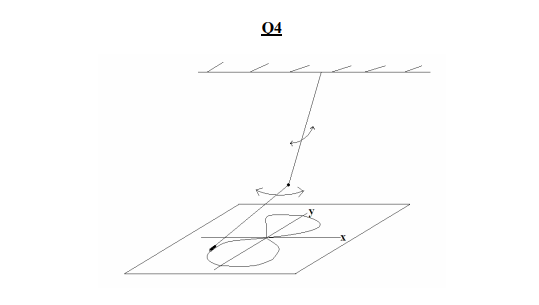
চিত্রে দুটি সরল দোলক এমনভাবে যুক্ত করা আছে যেন একটির বব অপরটির ঝুলনবিন্দু; নিচের দোলকটি কেবল x অক্ষ বরাবর ও উপরের দোলকটি কেবল y অক্ষ বরাবর দুলতে পারে এবং নিচের দোলকটির বব হিসেবে একটি ছোট পেন্সিল লাগানো আছে যা নিচে বিছানো সাদা কাগজে দাগ কাটতে পারে ।
(a) দোলকদুটিকে এমনভাবে দুলতে দেওয়া হল যেন পেন্সিলটি সাদা কাগজে ‘৪’ আকৃতির নকশা কাটে । নিচের দোলকটির কার্যকরী দৈর্ঘ্য 10 cm হলে উপরের দোলকটির কার্যকরী দৈর্ঘ্য নির্ণয় কর ।
(b) যদি তাদের কার্যকরী দৈর্ঘ্য সমান রেখে দুলতে দেওয়া হয়, তবে কাগজে কিরকম নকশা পাওয়া সম্ভব ?
In the figure, two simple pendulums are connected in such a way that bob of one pendulum is the suspension point of the other. The pendulum below can swing only along the x axis direction while the pendulum above can swing only along the y axis direction. Also, a pencil nib is attached to the bob of the lower pendulum so that it can sketch curves on the piece of paper laid underneath.
(a) The two pendulums are set to swing in such a way that a figure of ‘৪’ is sketched on the paper. If the effective length of lower pendulum is 10cm, determine that of the upper pendulum.
(b) If they are allowed to swing while keeping their effective lengths equal to each
other, then what sort of figure one expects to see on the paper?
Q5
(a) V আয়তনের একখণ্ড বরফকে পানিতে ছেড়ে দিলে বরফটি এর v আয়তন পানিতে নিমজ্জিত রেখে পানিতে ভাসতে থাকে । যদি বরফের ঘনত্ব ρᵢ এবং পানির ঘনত্ব ρ𝑤 হয়, তবে প্রমাণ কর যে:

(b) এখন বরফখণ্ডটি যদি গলে যায়, তাহলে প্রমাণ কর যে, বরফ গলার পূর্বে ও পরে পানির লেভেলের উচ্চতা একই থাকে ।
(a) If a lump of ice with volume V is put on water, then it floats keeping some of its volume, say v, completely submerged under water. If density of ice is ρᵢ and density of water is ρ𝑤, then prove that:

(b) Now if the ice melts, then prove that the water level before and after the melting remains the same.
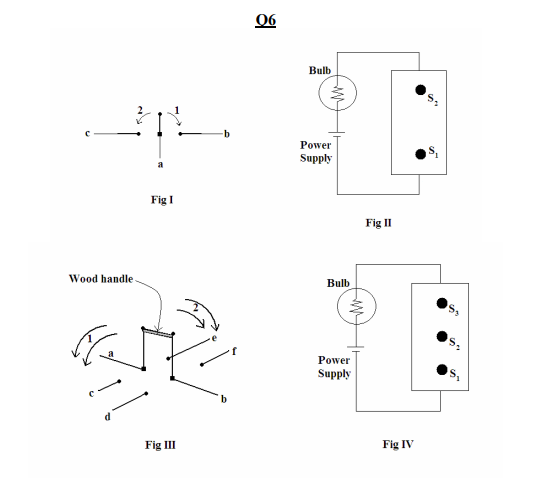
চিত্র-I এ এক বিশেষ ধরনের সুইচ দেখানো হয়েছে যা ১ নং অবস্থানে থাকলে ab পথে ও ২ নং অবস্থানে থাকলে ac পথে বিদ্যুৎ প্রবাহ হতে দেয় । এ ধরনের সুইচকে বলা হয় Single Pole Double Throw সুইচ (সংক্ষেপে SPDT সুইচ) ।
(a) ধর, একটি দোতলা বাসার সিঁড়িঘরে একটি লাইট বাল্ব আছে । স্বাভাবিকভাবেই, নিচতলা বা উপরের তলা, যেকোনো তলা থেকেই বাল্বটি ON বা OFF করার দরকার হতে পারে । তোমার কাজ হচ্ছে এমন একটি বর্তনী তৈরি করা (চিত্র-II), যাতে দুটি সুইচ S₁ ও S₂ থাকবে এবং যাদের দ্বারা স্বাধীনভাবে বাল্বটি জ্বালানো বা নেভানো যাবে । অর্থাৎ যদি বাল্বটি ON থাকে, তাহলে S₁ বা S₂ যেকোনো সুইচ চাপলেই তা OFF হয়ে যাবে অথবা যদি বাল্বটি OFF থাকে, তাহলে S₁ বা S₂ যেকোনো সুইচ চাপলেই তা ON হয়ে যাবে । (এ কাজের জন্য তুমি SPDT সুইচ ব্যবহার করতে পার)
চিত্র-III এ আরেক ধরনের সুইচ দেখানো হয়েছে যাকে বলা হয় Double Pole Double Throw সুইচ (সংক্ষেপে DPDT সুইচ) । এটি যদি 1 নং অবস্থানে থাকে তবে ac ও bd পথে বিদ্যুৎ প্রবাহিত হয় আর যদি 2 নং অবস্থানে থাকে তবে ae ও bf পথে বিদ্যুৎ প্রবাহিত হয়।
(b) এখন সিঁড়িঘরের বাল্ব জ্বালানোর সমস্যাটিতে ফিরে আসা যাক । ধর, তুমি S₁ ও S₂ সুইচ দিয়ে বর্তনী আঁকতে সক্ষম হয়েছ । অতঃপর তোমাকে তাতে আরেকটি সুইচ S₃ দিতে বলা হল (চিত্র-IV), যেটি বাসার ছাদে থাকবে এবং S₁ ও S₂-এর মতই বাল্ব জ্বালানো-নিভানোর কাজটি করবে । বর্তনীটি আঁক । (এ কাজের জন্য তুমি DPDT সুইচ ব্যবহার করতে পার)
In figure I, a special type of switch is shown which lets current flow along the path ab if it is in position 1 or along the path ac if it is in position 2. This type of switch is known as a Single Pole Double Throw switch (shortly an SPDT switch).
(a) Now consider a two storied building. It has a single light bulb in its staircase room. Now, one may wish to turn the bulb ON or OFF both from the ground floor and the first floor. Your job is to design a circuit (fig-II) consisting of two switches S1 and S2, which can independently turn the light ON or OFF. That is, if the light is ON, then clicking either S1 or S2 will turn it OFF. Conversely, if the light is OFF, clicking either of them will turn it ON. (You may use SPDT switch)
Figure III shows another type of switch which is called a Double Pole Double Throw (DPDT) switch. If in position 1, it lets currents to flow along path ac and bd while in position 2, it lets them to flow along path ae and bf.
(b) Now, return to the lighting problem of the staircase. Once you managed to design the circuit consisting of the switch S1 and S2, you are again asked to augment your design with an additional switch S3 (Fig-IV), which will be at the rooftop of the building, having the same functionality as S1 and S2. (You may use DPDT switch)

Publishing original scientific research in a peer-reviewed journal is an achievement many scholars work toward for years. Achieving this feat early in one's academic journey requires exceptional intellectual rigor, creativity, and persistence. Aaditya Punatar and Muskan Sadana have reached this remarkable milestone, successfully publishing their collaborative research paper in the prestigious Journal of Emerging Investigators […]
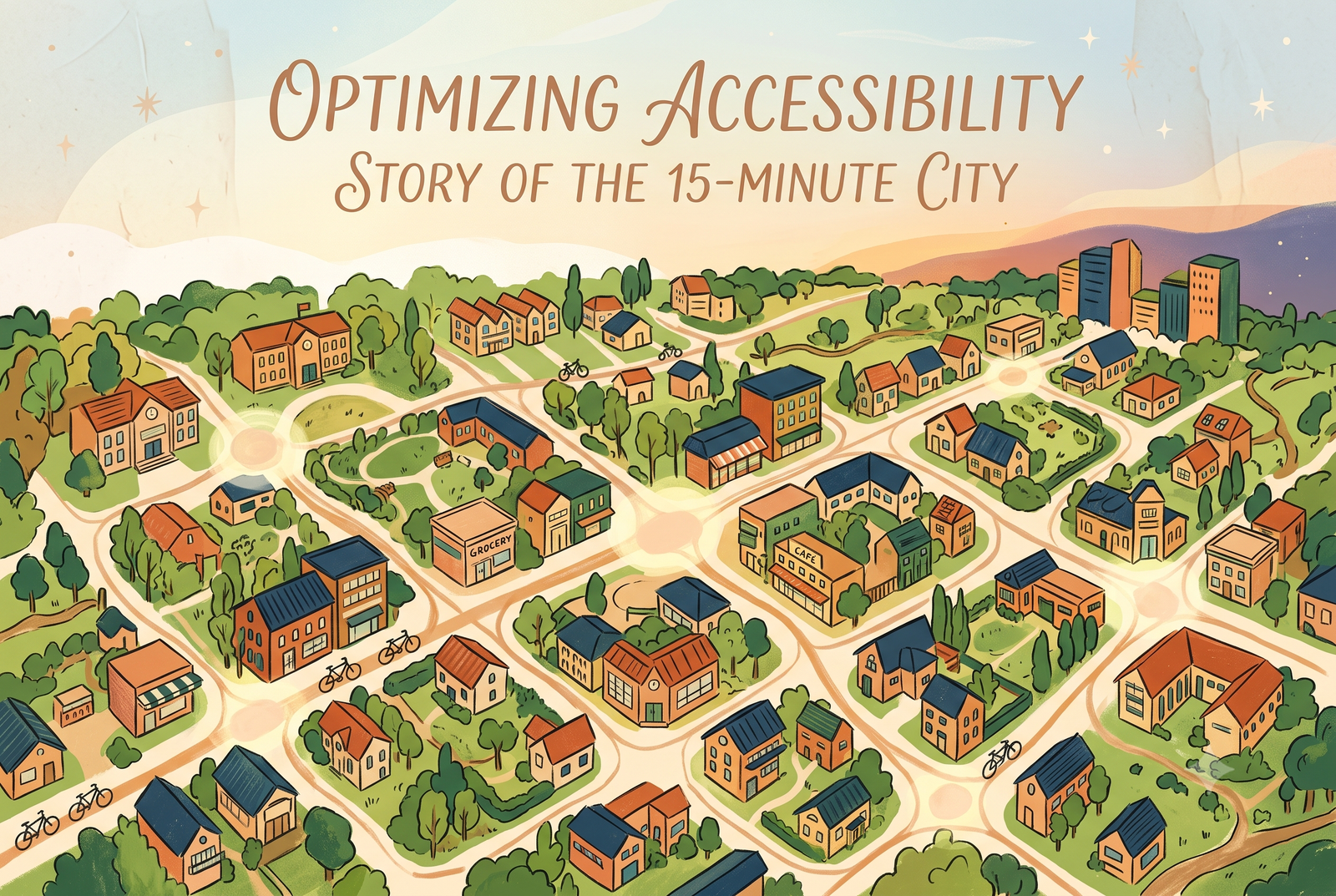
Her project on quantum-accelerated Steiner trees for 15-minute cities earned a place among the finalists at the world's largest pre-college STEM competition. Prishaa Shrimali of Marymount School of New York, was selected as a Grand Finalist at the 2026 Regeneron International Science and Engineering Fair (ISEF) in Phoenix, Arizona. Her project was Optimizing Urban Accessibility: […]

In 2026, the following Cheenta students have been successful for Indian Statistical Institute's M.Stat Entrance. They ranked within the first 50 in the entire country in these entrances. I.S.I. M.Stat Entrance
In 2026, the following Cheenta students have been successful for Indian Statistical Institute's B.Stat Entrance and Chennai Mathematical Institute's B.Sc. Math Entrance. They ranked within the first 200 in the entire country in these entrances. Most of these students attended the problem solving workshops regularly, which happen 5 days every week. CMI B.Sc. Math Entrance […]