Indian National Mathematical Olympiad (INMO) 2025 Problem and Solution
 Join Trial or Access Free ResourcesJoin Trial or Access Free Resources
The Indian National Mathematical Olympiad (INMO) is the third level of Math Olympiad in India.
Consider the sequence defined by $a_1=2, a_2=3$, and
$$ a_{2 k+2}=2+a_k+a_{k+1} \quad $$
$$ and \quad a_{2 k+1}=2+2 a_k $$
for all integers $k \geqslant 1$. Determine all positive integers $n$ such that $\frac{a_n}{n}$ is an integer.
Let $n \geq 2$ be a positive integer. The integers $1,2, \cdots, n$ are written on a board. In a move, Alice can pick two integers written on the board $a \neq b$ such that $a+b$ is an even number, erase both $a$ and $b$ from the board and write the number $\frac{a+b}{2}$ on the board instead. Find all $n$ for which Alice can make a sequence of moves so that she ends up with only one number remaining on the board.
Note. When $n=3$, Alice changes $(1,2,3)$ to $(2,2)$ and can't make any further moves.
Euclid has a tool called splitter which can only do the following two types of operations:
Suppose Euclid is only given three non-collinear marked points $A, B, C$ in the plane. Prove that Euclid can use the splitter several times to draw the centre of the circle passing through $A, B$, and $C$.
Let $n \geqslant 3$ be a positive integer. Find the largest real number $t_n$ as a function of $n$ such that the inequality
$$
\max \left(\left|a_1+a_2\right|,\left|a_2+a_3\right|, \ldots,\left|a_{n-1}+a_n\right|,\left|a_n+a_1\right|\right)$$
$$ \geqslant t_n \cdot \max \left(\left|a_1\right|,\left|a_2\right|, \cdots,\left|a_n\right|\right)
$$
holds for all real numbers $a_1, a_2, \cdots, a_n$.
Greedy goblin Griphook has a regular 2000 -gon, whose every vertex has a single coin. In a move, he chooses a vertex, removes one coin each from the two adjacent vertices, and adds one coin to the chosen vertex, keeping the remaining coin for himself. He can only make such a move if both adjacent vertices have at least one coin. Griphook stops only when he cannot make any more moves. What is the maximum and minimum number of coins that he could have collected?
Let $b \geqslant 2$ be a positive integer. Anu has an infinite collection of notes with exactly $b-1$ copies of a note worth $b^k-1$ rupees, for every integer $k \geqslant 1$. A positive integer $n$ is called payable if Anu can pay exactly $n^2+1$ rupees by using some collection of her notes. Prove that if there is a payable number, there are infinitely many payable numbers.
Publishing original scientific research in a peer-reviewed journal is an achievement many scholars work toward for years. Achieving this feat early in one's academic journey requires exceptional intellectual rigor, creativity, and persistence. Aaditya Punatar and Muskan Sadana have reached this remarkable milestone, successfully publishing their collaborative research paper in the prestigious Journal of Emerging Investigators […]

Her project on quantum-accelerated Steiner trees for 15-minute cities earned a place among the finalists at the world's largest pre-college STEM competition. Prishaa Shrimali of Marymount School of New York, was selected as a Grand Finalist at the 2026 Regeneron International Science and Engineering Fair (ISEF) in Phoenix, Arizona. Her project was Optimizing Urban Accessibility: […]
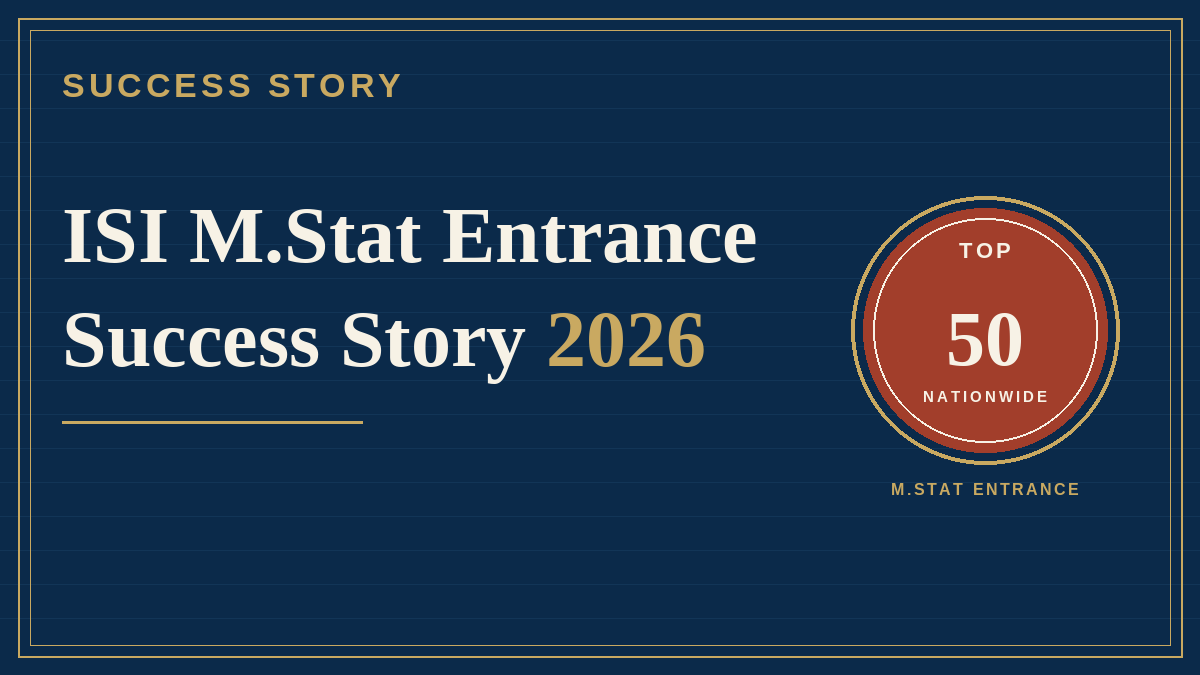
In 2026, the following Cheenta students have been successful for Indian Statistical Institute's M.Stat Entrance. They ranked within the first 50 in the entire country in these entrances. I.S.I. M.Stat Entrance
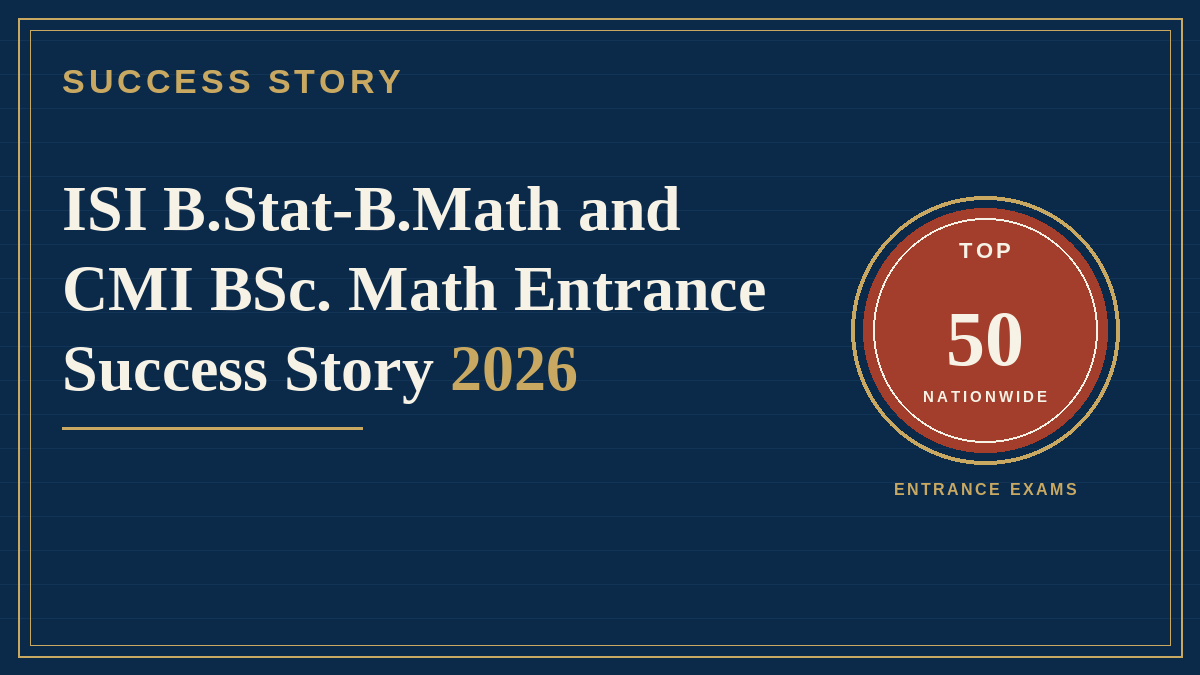
In 2026, the following Cheenta students have been successful for Indian Statistical Institute's B.Stat Entrance and Chennai Mathematical Institute's B.Sc. Math Entrance. They ranked within the first 200 in the entire country in these entrances. Most of these students attended the problem solving workshops regularly, which happen 5 days every week. CMI B.Sc. Math Entrance […]