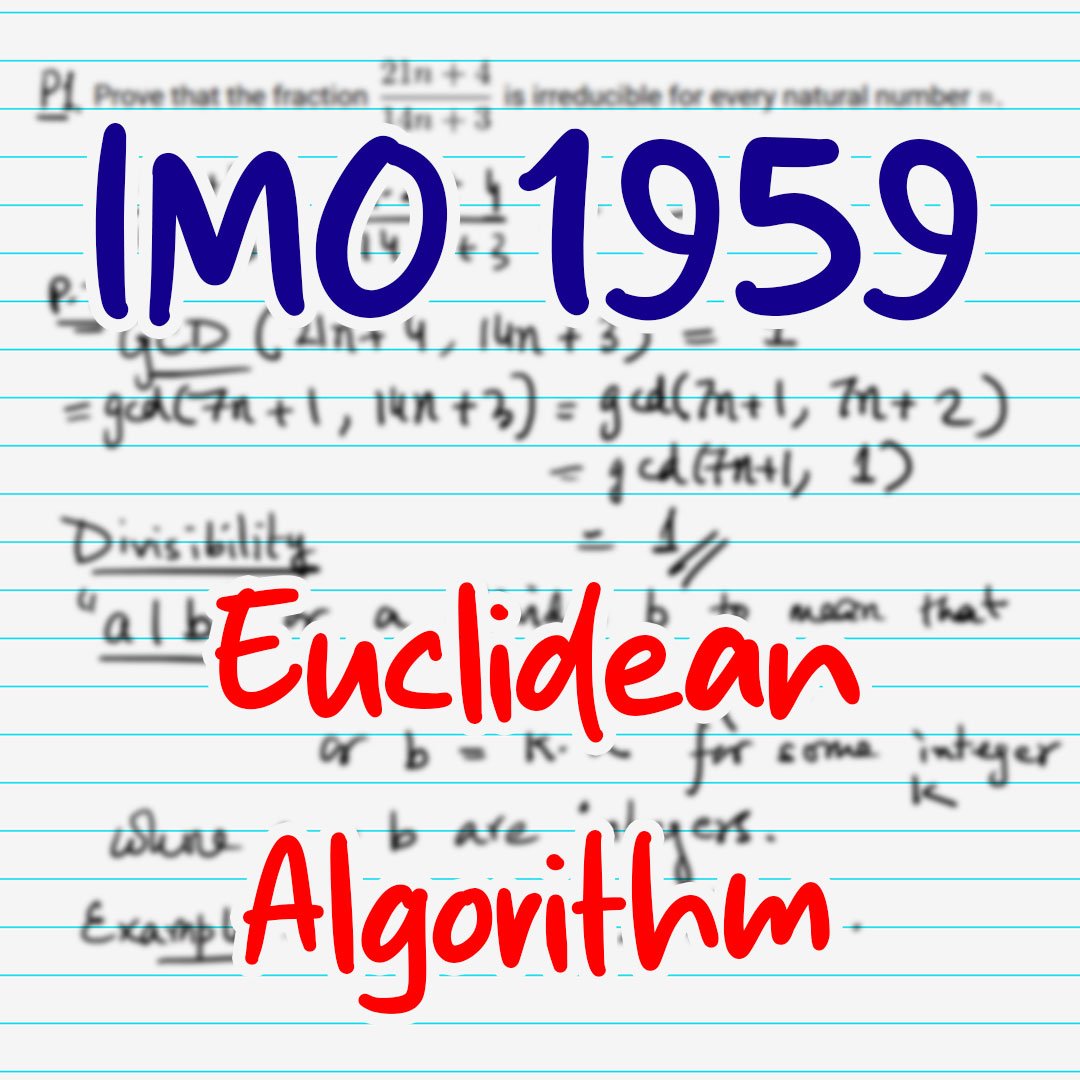
Exploring Number Theory: Understand Euclidean Algorithm with IMO 1959 Problem 1
 Join Trial or Access Free ResourcesJoin Trial or Access Free Resources
Number Theory is one of the most fascinating and ancient branches of mathematics. In this post, we'll delve into a classic problem from the International Mathematical Olympiad (IMO) 1959, exploring fundamental concepts such as divisibility, greatest common divisors (gcd), and the Euclidean algorithm. This will serve as a strong foundation for understanding more advanced topics in Number Theory.
The problem asks us to prove that the fraction:
is irreducible for every natural number $n$. In other words, we need to show that the greatest common divisor (gcd) of the numerator $21 n+4$ and the denominator $14 n+3$ is always 1, meaning these two terms share no common factors for any natural number $n$.
A fraction is irreducible if its numerator and denominator share no common factors other than 1. For example, the fraction $\frac{10}{14}$ is reducible because both 10 and 14 share the factor 2. After dividing both by their gcd (2), we get $\frac{5}{7}$, which is the irreducible form of $\frac{10}{14}$.
In this problem, we're asked to show that no matter which $n$ is chosen, the fraction $\frac{21 n+4}{14 n+3}$ cannot be reduced, meaning the gcd of $21 n+4$ and $14 n+3$ is 1 for all $n$.
To solve this, we can use the Euclidean algorithm, a systematic method for finding the gcd of two numbers by repeatedly applying the division lemma. Let's walk through the key steps to understand the solution.
The division lemma states that for any two integers $a$ and $b$, there exist integers $q$ and $r$ such that:
$$
b=a q+r
$$
where $r$ is the remainder when $b$ is divided by $a$. This allows us to express any number as a multiple of another, plus a remainder.
We want to compute the gcd of $21 n+4$ and $14 n+3$ by performing successive subtractions, which is at the heart of the Euclidean algorithm.
First, compute the difference between the numerator and the denominator:
$$
(21 n+4)-(14 n+3)=7 n+1
$$
So, we now need to find the gcd of $14 n+3$ and $7 n+1$. Applying the Euclidean algorithm again:
$$
(14 n+3)-2(7 n+1)=1
$$
Now, we see that the gcd of $7 n+1$ and 1 is clearly 1 . Hence, the gcd of $21 n+4$ and $14 n+3$ is also 1 . This confirms that the fraction is irreducible for any $n$.
This problem provides a beautiful introduction to Number Theory by illustrating how simple concepts like gcd, divisibility, and the Euclidean algorithm can be used to solve complex problems. It opens the door to deeper explorations into prime numbers, modular arithmetic, and advanced number-theoretic functions.
The IMO 1959 problem showcases the elegance and depth of Number Theory. By understanding the fundamental ideas of gcd and using the Euclidean algorithm, we can solve challenging problems and gain a deeper appreciation for the mathematical structures that govern numbers.
For those interested in diving deeper, there are excellent resources and courses available online to further explore Number Theory. Whether you're preparing for mathematical competitions or simply want to expand your knowledge, mastering these basic ideas will provide a strong foundation for future mathematical adventures.

Publishing original scientific research in a peer-reviewed journal is an achievement many scholars work toward for years. Achieving this feat early in one's academic journey requires exceptional intellectual rigor, creativity, and persistence. Aaditya Punatar and Muskan Sadana have reached this remarkable milestone, successfully publishing their collaborative research paper in the prestigious Journal of Emerging Investigators […]

Her project on quantum-accelerated Steiner trees for 15-minute cities earned a place among the finalists at the world's largest pre-college STEM competition. Prishaa Shrimali of Marymount School of New York, was selected as a Grand Finalist at the 2026 Regeneron International Science and Engineering Fair (ISEF) in Phoenix, Arizona. Her project was Optimizing Urban Accessibility: […]

In 2026, the following Cheenta students have been successful for Indian Statistical Institute's M.Stat Entrance. They ranked within the first 50 in the entire country in these entrances. I.S.I. M.Stat Entrance
In 2026, the following Cheenta students have been successful for Indian Statistical Institute's B.Stat Entrance and Chennai Mathematical Institute's B.Sc. Math Entrance. They ranked within the first 200 in the entire country in these entrances. Most of these students attended the problem solving workshops regularly, which happen 5 days every week. CMI B.Sc. Math Entrance […]