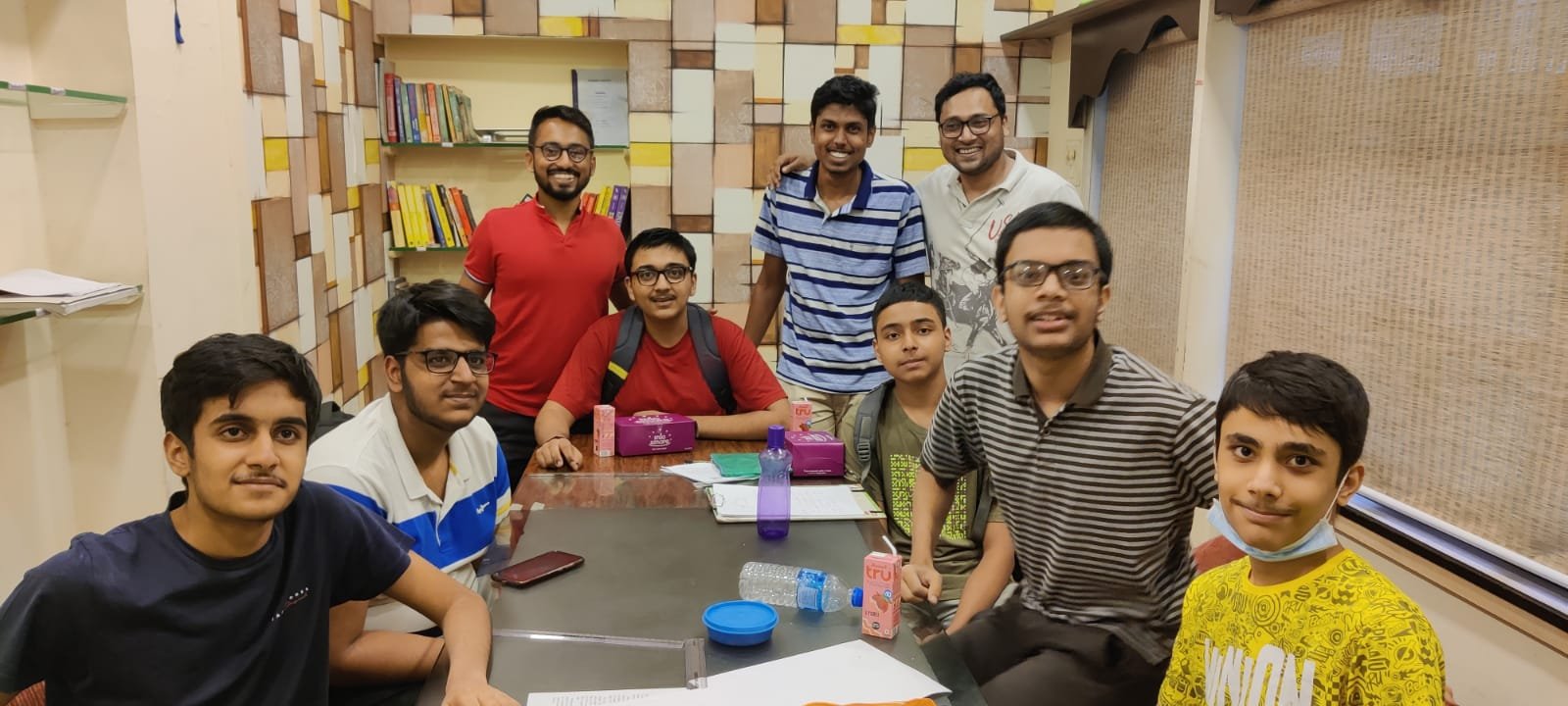
A Major Milestone in Young Research: Aaditya Punatar and Muskan Sadana Publish in JEI
Publishing original scientific research in a peer-reviewed journal is an achievement many scholars work toward for years. Achieving this feat early in one's academic journey requires exceptional intellectual rigor, creativity, and persistence.
Aaditya Punatar and Muskan Sadana have reached this remarkable milestone, successfully publishing their collaborative research paper in the prestigious Journal of Emerging Investigators (JEI).
Understanding the Significance: What is JEI?
Founded by graduate students and postdocs at Harvard University, the Journal of Emerging Investigators (JEI) is an open-access, peer-reviewed journal dedicated to publishing original research led by middle and high school scientists.
Unlike standard student showcases, JEI models the exact peer-review pipeline used by leading scientific journals worldwide. Submitted manuscripts undergo rigorous evaluation by university scientists and subject-matter experts, who review the work for methodological soundess, clarity, and mathematical validity. To earn a spot in JEI, authors must refine their work through technical revisions, proving both the originality of their ideas and their ability to defend them scientifically.
The Breakthrough: Geometry Meets Econometric Forecasting
The co-authored paper, titled "Testing the Impact of a Geometric Curvature Variable on the Accuracy of Econometric Forecasting Models," addresses a long-standing challenge in quantitative finance.
Standard econometric tools often fail to capture the unpredictable, highly volatile dynamics of financial markets because they rely on linear or simplified statistical assumptions. Aaditya and Muskan approached this issue by introducing concepts from differential geometry directly into time-series analysis.
- The Problem: Financial price movements are non-linear, making traditional forecasting models susceptible to lag or significant error during market shifts.
- The Innovation: The authors conceptualized financial data as geometric trajectories, incorporating a geometric curvature variable into predictive forecasting algorithms.
- The Outcome: By measuring how the "shape" of data changes over time, their hybrid model aims to enhance forecasting accuracy, bridging complex abstract geometry with applied economic modeling.
This interdisciplinary approach demonstrates a sophisticated grasp of both advanced mathematics and practical data analysis.
Celebrating a Standout Achievement
Aaditya Punatar and Muskan Sadana have demonstrated what is possible when curiosity meets sustained effort. Pushing a project from an initial theoretical question all the way through dataset selection, model validation, draft writing, and reviewer rounds demands an extraordinary work ethic.
Congratulations to Aaditya and Muskan on this outstanding publication! Navigating the academic review process and contributing genuine value to applied mathematics is an inspiration to aspiring young researchers everywhere.
The full paper can be accessed directly via the Journal of Emerging Investigators.