This is a beautiful sample problem from ISI MStat 2016 PSB Problem 1. This is based on finding the minimum value of a function subjected to the restriction.
Let \( x, y\) be real numbers such that \( x y=10 \) . Find the minimum value of \(|x+y|\) and all also find all the points \((x, y)\) where this minimum value is achieved.
Justify your answer.
(a) Using graph
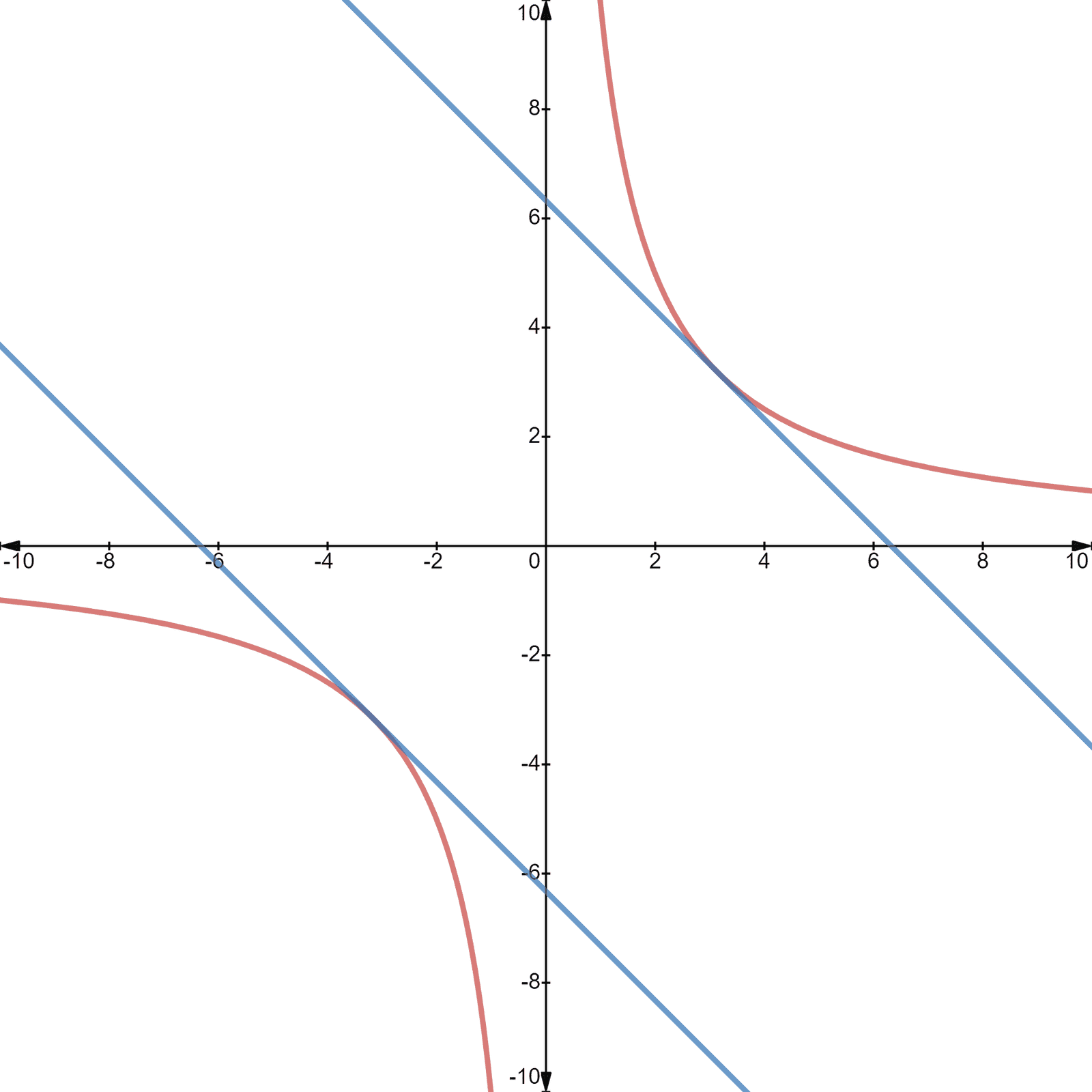
The equation \( xy=10={(\sqrt{10})}^2 \) represents the equation of rectangular hyperbola with foci are \( (- \sqrt{10},- \sqrt{10}) \) and \( (\sqrt{10}, \sqrt{10} ) \) .

Now , \( |x+y|=c \Rightarrow \) \( x+y=\pm c \) , which looks somewhat like this ,

we have to find the the minimum value of \(|x + y|\) subject to the restriction that \( xy=10 \) . If we move \( |x+y|=c \) along \( xy =10 \) by varying c , then local minimum can occur at the points where the level curve \( |x+y|=c \) touch \( xy =10 \) . Now as both the rectangular hyperbola and |x+y|=c are symmetric about \( x+y=0 \) for \( c \ne 0 \) and \(x=y\) , the level curve will touch \( xy =10 \) when x+y=c and x+y=-c both are tangent to the curve \( xy =10 \) . And tangents occurs at the foci of \( xy =10 \) i.e at \( (- \sqrt{10},- \sqrt{10}) \) and \( (\sqrt{10}, \sqrt{10} ) \) .

Hence , the minimum value of \(|x + y|\) are \(|\sqrt{10} +\sqrt {10} |\) and \(|-\sqrt{10}- \sqrt{10}|\) both gives the same value \( 2 \sqrt{10} \) .
Therefore , the minimum value of \(|x + y|\) is \( 2 \sqrt{10}\) and it attains it's minimum at \( (\sqrt{10} , \sqrt{10} ) \) and \( ( - \sqrt{10} , -\sqrt{10}) \) .
(b) Using Derivative test
\( |x+y|= |x+ \frac{10}{x} |\) as we are given that \( xy=10 \)
Let, \( f(x) =|x+ \frac{10}{x}|\) then we have to find the minimum value of f(x)
Now ,as the function is not defined at x=0 and also x=0 can't give the minimum value of |x+y| due to the condition that xy=10. So, we will study f(x) for two cases when x>0 and when x<0 .
\( f(x) = \begin{cases} x+ \frac{10}{x} & ,x > 0 \\ -(x+ \frac{10}{x} ) & ,x < 0 \end{cases} \)
\( f'(x)=\begin{cases} 1- \frac{10}{x^2} & ,x > 0 \\ -(1- \frac{10}{x^2} ) & ,x < 0 \end{cases} \)
\( f'(x)=0 \Rightarrow \) \( x= \pm \sqrt{10} \)
\( f''(x)= \begin{cases} \frac{20}{x^3} & ,x > 0 \\ -\frac{20}{x^3} & ,x < 0 \end{cases} \)
So,\( f''(x) >0\) for \( x= \pm \sqrt{10} \)
Hence f(x) attains it's minimum value at \( (\sqrt{10} , \sqrt{10} ) \) and \( - \sqrt{10} , -\sqrt{10}) \) and minimum value is \( 2 \sqrt{10} \).
Let \( x_1, x_2 ,..., x_n \) be be positive real numbers such that \( \prod_{i=1}^{n} x_{i} = 10 \) . Find the minimum value of \( \sum_{i=1}^{n} x_{i} \).

Publishing original scientific research in a peer-reviewed journal is an achievement many scholars work toward for years. Achieving this feat early in one's academic journey requires exceptional intellectual rigor, creativity, and persistence. Aaditya Punatar and Muskan Sadana have reached this remarkable milestone, successfully publishing their collaborative research paper in the prestigious Journal of Emerging Investigators […]

Her project on quantum-accelerated Steiner trees for 15-minute cities earned a place among the finalists at the world's largest pre-college STEM competition. Prishaa Shrimali of Marymount School of New York, was selected as a Grand Finalist at the 2026 Regeneron International Science and Engineering Fair (ISEF) in Phoenix, Arizona. Her project was Optimizing Urban Accessibility: […]

In 2026, the following Cheenta students have been successful for Indian Statistical Institute's M.Stat Entrance. They ranked within the first 50 in the entire country in these entrances. I.S.I. M.Stat Entrance
In 2026, the following Cheenta students have been successful for Indian Statistical Institute's B.Stat Entrance and Chennai Mathematical Institute's B.Sc. Math Entrance. They ranked within the first 200 in the entire country in these entrances. Most of these students attended the problem solving workshops regularly, which happen 5 days every week. CMI B.Sc. Math Entrance […]
Yeah, I went through your process and this was absolutely right. Couldn't it be solved without Calculus? I approached in another way. We have the identity (x+y)2 - (x-2)2 = 4xy. Then (x+y)2>= 4xy. that is |x+y|>= 2 root(xy). in our problem, |x+y|>= 2root(10). That is min|x+y| = 2root(10). Equality will occur iff x=y. then, 2|x|= 2root(10) which gives, |x|=root(10). then also |y|=root(10). Remembering the restriction, x=y, we have the required pairs (x,y) as (root10, root10), (-root10, -root10).
I think this process is quite elegant and Time Saving!
Please let me know if I've made some mistakes. 🙂
Yeah, this one is great and crispy too. 😀 Thanks
Can't we just do am-gm? Wlog we can assume x,y>0
Then do x+10/x>=2(10)^(1/2)?