Author: Kazi Abu Rousan
Where are the zeros of zeta of s?
G.F.B. Riemann has made a good guess;
They're all on the critical line, saith he,
And their density's one over 2 p log t.
Source https://www.physicsforums.com/threads/a-poem-on-the-zeta-function.16280/
If you are a person who loves to read maths related stuff then sure you have came across the words Riemann Zeta function and Riemann Hypothesis at least once. But today we are not going into the Riemann Hypothesis, rather we are going into the Zeta Function. To be more specific, we will see how to calculate the value of zeta function using a simple Julia Program only for $Re(input)>1$.
What is the Zeta Function?
The Riemann zeta function $\zeta (s)$ is a function of a complex variables $z = \sigma + i t $. When $Re(z) = \sigma >1$, we can define this as a converging summation given by,
$$ \zeta(z) = \sum_{n = 1}^{\infty} \frac{1}{n^z} = \frac{1}{1^z} + \frac{1}{2^z} + \frac{1}{3^z} +\cdots $$
This definition is so simple right?, Here $z$ is a complex number. If it is taken as real, then we will get many famous series like,
Harmonic Series(Diverge as $Re(z)=1$): $H = \zeta(1) = \frac{1}{1} + \frac{1}{2} + \frac{1}{3} + \frac{1}{4} + \cdots$
Basel problem Series(Converges): $ \zeta(2) = \frac{1}{1^2} + \frac{1}{2^2} + \frac{1}{3^2} + \frac{1}{4^2} + \cdots = \frac{\pi^2}{6}$
and many more.
There are many methods to calculate the values of this function for each value of $n$. You can surely do this by hand although I can't suggest that. The easiest way will be to utilize program.
Before writing the code, you should remember that the sum is actually infinite. Hence, our function will give us more and more fine result as we include more and more terms.
function ζ(z,limit=1000)
    result = 0
    for i in 1:limit
        result += (1/i)^z
    end
    return result
end
This is the function. How simple!!.. and If we use julia as you can see, we can actually use $\zeta $ symbol. Pretty cool right?
ζ(2,10_0000_000)
#Output: 1.644934057834575
#where pi^2/6 = 1.6449340668482264
#pretty close
It's not all. We can actually apply this function to find the value of zeta function for complex inputs too.
ζ(2+5im)
#Output: 0.8510045028264933 + 0.09880538410302253im
When we use complex inputs, there is a beautiful hidden beauty. Let's see that using a plotting library called Plots and we also have to rewrite our function a little bit.
function ζ(z,limit=1000;point_ar = false)
    points = ComplexF64[0]
    result = 0
    for i in 1:limit
        result += (1/i)^z
        if point_ar
            push!(points,result)
        end
    end
    return result, points
end
Now, we can use this to plot.
z = 2+5im
result, points = ζ(z;point_ar = true)
plot((points),color=:blue,width=3, title="Zeta function spiral",framestyle= :origin,label="$z")
scatter!((points),color=:red, label="Points")S
The output is:

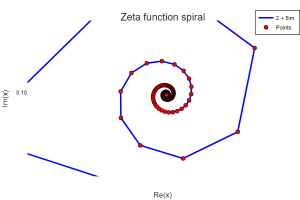
Who would have thought that there will be something like this hidden.
Now, If we apply this function to all possible points of the NumberPlane, then we will get a mesmerizing pattern.
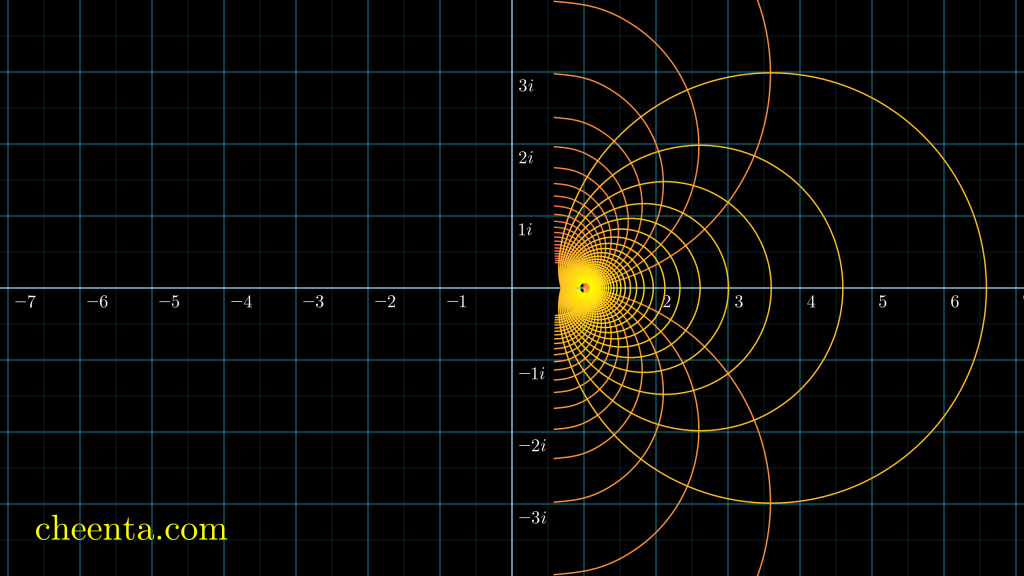
Looking at the image it feels like It's begging to be extended to the other portion. This extension is done using something we called Analytic Continuation. We will not go into much detail here.
If you want to know about the remaining story visit by lecture here:
This is all for today. Why not try to extend the idea to the other side?
Hope you learnt something new.

Publishing original scientific research in a peer-reviewed journal is an achievement many scholars work toward for years. Achieving this feat early in one's academic journey requires exceptional intellectual rigor, creativity, and persistence. Aaditya Punatar and Muskan Sadana have reached this remarkable milestone, successfully publishing their collaborative research paper in the prestigious Journal of Emerging Investigators […]

Her project on quantum-accelerated Steiner trees for 15-minute cities earned a place among the finalists at the world's largest pre-college STEM competition. Prishaa Shrimali of Marymount School of New York, was selected as a Grand Finalist at the 2026 Regeneron International Science and Engineering Fair (ISEF) in Phoenix, Arizona. Her project was Optimizing Urban Accessibility: […]

In 2026, the following Cheenta students have been successful for Indian Statistical Institute's M.Stat Entrance. They ranked within the first 50 in the entire country in these entrances. I.S.I. M.Stat Entrance
In 2026, the following Cheenta students have been successful for Indian Statistical Institute's B.Stat Entrance and Chennai Mathematical Institute's B.Sc. Math Entrance. They ranked within the first 200 in the entire country in these entrances. Most of these students attended the problem solving workshops regularly, which happen 5 days every week. CMI B.Sc. Math Entrance […]
