[et_pb_section fb_built="1" _builder_version="4.0"][et_pb_row _builder_version="3.25"][et_pb_column type="4_4" _builder_version="3.25" custom_padding="|||" custom_padding__hover="|||"][et_pb_text _builder_version="3.27.4" text_font="Raleway|300|||||||" text_text_color="#ffffff" header_font="Raleway|300|||||||" header_text_color="#e2e2e2" background_color="#0c71c3" custom_padding="20px|20px|20px|20px" border_radii="on|5px|5px|5px|5px" box_shadow_style="preset3"]What are we learning ?
[/et_pb_text][et_pb_text _builder_version="4.1" text_font="Raleway||||||||" text_font_size="20px" text_letter_spacing="1px" text_line_height="1.5em" background_color="#f4f4f4" custom_margin="10px||10px" custom_padding="10px|20px|10px|20px" box_shadow_style="preset2"]Competency in Focus: Limit and Differentiability of a functionThis problem from I.S.I. B.Stat. Entrance 2017 , it is based on simple manipulations, differentiation from first principles and squeeze theorem.
[/et_pb_text][et_pb_text _builder_version="3.27.4" text_font="Raleway|300|||||||" text_text_color="#ffffff" header_font="Raleway|300|||||||" header_text_color="#e2e2e2" background_color="#0c71c3" custom_padding="20px|20px|20px|20px" border_radii="on|5px|5px|5px|5px" box_shadow_style="preset3"]First look at the knowledge graph.
[/et_pb_text][et_pb_image src="https://cheenta.com/wp-content/uploads/2020/01/ISI-BSTAT-entrance-2017-UGA-problem-5-1.png" align="center" force_fullwidth="on" _builder_version="4.1" hover_enabled="0"][/et_pb_image][et_pb_text _builder_version="3.27.4" text_font="Raleway|300|||||||" text_text_color="#ffffff" header_font="Raleway|300|||||||" header_text_color="#e2e2e2" background_color="#0c71c3" custom_padding="20px|20px|20px|20px" border_radii="on|5px|5px|5px|5px" box_shadow_style="preset3"]Next understand the problem
[/et_pb_text][et_pb_text _builder_version="4.1" text_font="Raleway||||||||" text_font_size="20px" text_letter_spacing="1px" text_line_height="1.5em" background_color="#f4f4f4" custom_margin="10px||10px" custom_padding="10px|20px|10px|20px" box_shadow_style="preset2"]Let f : R → R be a continuous function such that for any two real
numbers x and y, \( |f(x)-f(y)| \le {|x-y|}^{201} \).
Then,[/et_pb_text][/et_pb_column][/et_pb_row][et_pb_row _builder_version="4.0"][et_pb_column type="4_4" _builder_version="3.25" custom_padding="|||" custom_padding__hover="|||"][et_pb_accordion open_toggle_text_color="#0c71c3" _builder_version="4.1" toggle_font="||||||||" body_font="Raleway||||||||" text_orientation="center" custom_margin="10px||10px"][et_pb_accordion_item title="Source of the problem" open="on" _builder_version="4.1"]I.S.I. B.Stat. Entrance 2017, UGA Problem 5[/et_pb_accordion_item][et_pb_accordion_item title="Key Competency" _builder_version="4.1" open="off"]Differentiation from first principles and squeeze (or sandwich) theorem [/et_pb_accordion_item][et_pb_accordion_item title="Difficulty Level" _builder_version="4.1" open="off"]7/10[/et_pb_accordion_item][et_pb_accordion_item title="Suggested Book" _builder_version="4.0.9" open="off"]Challenges and Thrills in Pre College MathematicsExcursion Of Mathematics [/et_pb_accordion_item][/et_pb_accordion][et_pb_text _builder_version="4.1" text_font="Raleway|300|||||||" text_text_color="#ffffff" header_font="Raleway|300|||||||" header_text_color="#e2e2e2" background_color="#0c71c3" custom_margin="48px||48px" custom_padding="20px|20px|0px|20px||" border_radii="on|5px|5px|5px|5px" box_shadow_style="preset3"]Start with hints
[/et_pb_text][et_pb_tabs _builder_version="4.1"][et_pb_tab title="HINT 0" _builder_version="4.1"]Do you really need a hint? Try it first![/et_pb_tab][et_pb_tab title="HINT 1" _builder_version="4.1"]Given that \( |f(x)-f(y)| \le {|x-y|}^{201} \) for any two real number x and y . So we can replace x by y+h for any real number y and h .Then we have , \( |f(y+h)-f(y)| \le {|(y+h)-y|}^{201} \implies |f(y+h)-f(y)| \le {|h|}^{201} \) . Now, what can we use ?[/et_pb_tab][et_pb_tab title="HINT 2" _builder_version="4.1"]See that we can write \(\frac{ |f(y+h)-f(y)|}{h} \le {|h|}^{200} \implies -{h}^{200} \le \frac {|f(y+h)-f(y)|}{h} \le h^{200}\) . Now taking limit h tends to 0 on both sides gives what ?[/et_pb_tab][et_pb_tab title="HINT 3" _builder_version="4.1"]
| See that \(\lim_{h \to 0} -{h}^{200}=\lim_{h \to 0} {h}^{200}=0 \) and differentiation from first principles say's \(\lim_{h \to 0} \frac{f(y+h)-f(y)}{h} =f'(y) \) . |
[/et_pb_tab][et_pb_tab title="HINT 4" _builder_version="4.1"]Now we know the the squeeze theorem, stated as follows Let I be an interval having the point a as a limit point. Let g, f, and h be functions defined on I, except possibly at a itself. Suppose that for every x in I not equal to a, we have
and also suppose that
Then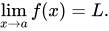 So, what we have ?[/et_pb_tab][et_pb_tab title="HINT 5" _builder_version="4.1"]f'(y)=0 for all y belongs to real . Thus integrating both sides we have f(y)=c ( constant ) for all y belongs to real . Therefore , f(101)=f(202)=f(200).[/et_pb_tab][/et_pb_tabs][et_pb_text _builder_version="3.27.4" text_font="Raleway|300|||||||" text_text_color="#ffffff" header_font="Raleway|300|||||||" header_text_color="#e2e2e2" background_color="#0c71c3" min_height="12px" custom_margin="50px||50px" custom_padding="20px|20px|20px|20px" border_radii="on|5px|5px|5px|5px" box_shadow_style="preset3"]
Connected Program at Cheenta
[/et_pb_text][et_pb_blurb title="Amc 8 Master class" url="https://cheenta.com/matholympiad/" url_new_window="on" image="https://cheenta.com/wp-content/uploads/2018/03/matholympiad.png" _builder_version="4.0.9" header_font="||||||||" header_text_color="#0c71c3" header_font_size="48px" body_font_size="20px" body_letter_spacing="1px" body_line_height="1.5em" link_option_url="https://cheenta.com/matholympiad/" link_option_url_new_window="on"]Cheenta AMC Training Camp consists of live group and one on one classes, 24/7 doubt clearing and continuous problem solving streams.[/et_pb_blurb][et_pb_button button_url="https://cheenta.com/amc-8-american-mathematics-competition/" url_new_window="on" button_text="Learn More" button_alignment="center" _builder_version="4.0.9" custom_button="on" button_bg_color="#0c71c3" button_border_color="#0c71c3" button_border_radius="0px" button_font="Raleway||||||||" button_icon="%%3%%" background_layout="dark" button_text_shadow_style="preset1" box_shadow_style="preset1" box_shadow_color="#0c71c3"][/et_pb_button][et_pb_text _builder_version="3.27.4" text_font="Raleway|300|||||||" text_text_color="#ffffff" header_font="Raleway|300|||||||" header_text_color="#e2e2e2" background_color="#0c71c3" custom_margin="50px||50px" custom_padding="20px|20px|20px|20px" border_radii="on|5px|5px|5px|5px" box_shadow_style="preset3"]
Similar Problems
[/et_pb_text][et_pb_post_nav in_same_term="off" _builder_version="4.0.9"][/et_pb_post_nav][et_pb_divider _builder_version="3.22.4" background_color="#0c71c3"][/et_pb_divider][/et_pb_column][/et_pb_row][/et_pb_section]  Join Trial or Access Free Resources