A particle moves along a straight line. Its displacement S varies with time t according to the law $s^{2}=a t^{2}+2 b t+c$ ( $\mathrm{a}, \mathrm{b}$ and c are constants). The acceleration of this particle varies as
A ball A (mass $m_{1}$ ) moving with velocity v experiences an elastic collision with another stationary ball B (mass $m_{2}$ ). Each ball flies apart symmetrically relative to the initial direction of motion of ball A, at an angle $\theta$. Ratio of the masses of balls $\frac{m_{1}}{m_{2}}$ is
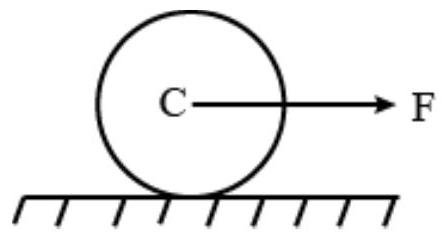
A solid cylinder of mass $m$ is rolling without slipping on a rough horizontal surface, under the action of a horizontal force $F$ such that the line of action of $F$ passes through centre $C$ of the cylinder. Choose the correct alternative.
A motor pump is used to deliver water at a certain rate $r$ from a given pipe. To obtain thrice as much water from the same pipe in the same time, the power of the motor has to be increased to
Two small solid balls of masses $m$ and $8 m$ made up of same material are tried at the two ends of a thin weightless thread. They are dropped from a balloon in air. The tension T of thread during fall, after the motion of balls has reached steady state is
Obtain the value of $\frac{e^{2}}{2 \varepsilon_{0} h c}$
A sound source of fix frequency is in unison with an open end organ pipe of length 30.0 cm and a close end organ pipe of length 23.0 cm (both of same diameter). Both pipes are sounding their first overtone. If velocity of sound is $340 \mathrm{ ms}^{-1}$, frequency of sound source is nearly
Solar constant for Earth is 2.0 cal per $\mathrm{cm}^{2}$ per minute. [ $1 \mathrm{cal}=4.2 \mathrm{ J}$ ]. Angular diameter of the Sun (as seen from the Earth) is $\frac{1}{2}$ (= half a degree). Treating Sun as a black body, its surface temperature is estimated to be nearly
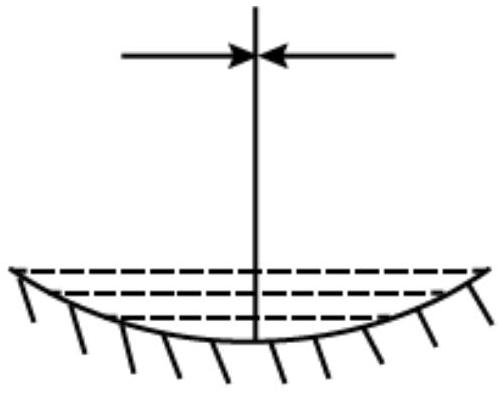
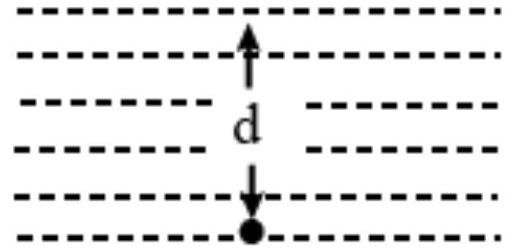
A concave mirror when placed in air has a focal length $f=20 \mathrm{ cm}$. The mirror is now placed horizontally and filled with a thin layer of water having refractive index $\frac{4}{3}$. The object is placed horizontally near the principal axis at a distance $d$ from the mirror such that a real, inverted image is formed at the same plane as the object, as shown in the figure. What is the value of $d$ ?
When a sample of atoms is irradiated by neutrons, radioactive atoms are produced at a constant rate $R$, which decay with decay constant $\lambda$. The number of radioactive atoms accumulated after an irradiation time $t$ is given by
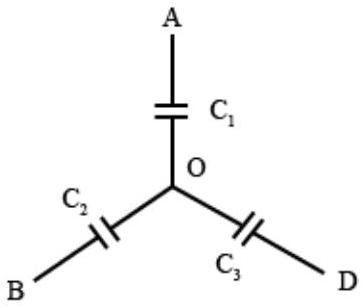
Three uncharged capacitors $C_{1}=2 \mu F, C_{2}=3 \mu F$ and $C_{3}=5 \mu F$ are connected as shown in figure to one another at O and to points $\mathrm{A}, \mathrm{B}$ and D at potentials $V_{A}=300 \mathrm{ V}, V_{B}=200 \mathrm{ V}$ and $V_{D}=400 \mathrm{ V}$ respectively the potential $V_{o}$ at O is
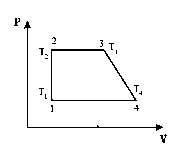
A cyclic process $1-2-3-4-1$ consisting of two isobars $2-3$ and $4-1$, an isochor $1-2$ and a process $3-4$ represented by straight line on a $\mathrm{P}-\mathrm{V}$ diagram, as shown in figure, involves n moles of an ideal gas. The gas temperatures at states $1,2,3$ and $4$ are $T_{1}, T_{2}, T_{3}$ and $T_{4}$ respectively. Also points 3 and 4 lie on the same isotherm. The work done by gas during the cycle is
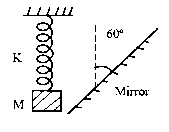
An insect of negligible mass is sitting on a block of mass M , tied with a spring of force constant K . The block performs simple harmonic motion vertically with amplitude A in front of a mirror which is include at $60^{\circ}$ with the vertical as shown. The maximum speed of insect relative to its image will be
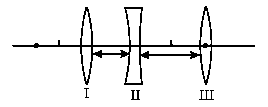
A concave lens of focal length 10 cm is placed between two convex lenses of focal length 10 cm and 20 cm at a separation of 5 cm between the first and second lens and 10 cm between the second and third lens. An object is placed at 30 cm in front of the first convex lens. The final image is formed beyond the third lens at a distance v from it. Then
A point source $S$ of light is placed at a depth $d$ below the surface of water in a large and deep lake. Fraction of light that escapes in space above directly from water (refractive index $=\mu$ ) surface is given by
A convex lens is held 45 cm above the bottom of an empty tank. The image of a point object at bottom of tank is formed $36 c m$ above the lens. Now a liquid is poured into the tank upto a height of $40 c m$ above the bottom. It is found that distance of image of same point object at the bottom of the tank is 60 cm above the lens. Refractive index of liquid is
A potential of 5 V is applied across the face of a pure germanium plate of area $2 \times 10^{-4} \mathrm{ m}^{2}$ and of thickness $1.2 \times 10^{-3} \mathrm{ m}$. Concentration of carriers in germanium at room temperature is $1.6 \times 10^{6} \mathrm{ m}^{-3}$, Mobility of electrons and holes are $0.4 \mathrm{ m}^{2} \mathrm{ V}^{-1} \mathrm{ s}^{-1}$ and $0.2 \mathrm{ m}^{2} \mathrm{ V}^{-1} \mathrm{ S}^{-1}$ respectively. The current produced in germanium plate at room temperature,
Fission of one nucleus of. ${ }^{235} U$ releases 200 MeV energy in average. Minimum amount of. ${ }^{235} U$ required to run 1000 MW reactor per year of continuous operation (assuming $30 %$ efficiency) is
In a young's double slit experiment distance between slits is $d=1 \mathrm{ mm}$, Wavelength of light used is 600 nm and distance of screen from the plane of slits is $D=1 \mathrm{ m}$. the minimum distance between two points on the screen where intensity falls to $75 %$ of maximum intensity will be (Assume both sources of equal power).
A ball is projected from horizontal ground. It attains a maximum height $H$ on its projectile path and there after strikes a stationary smooth vertical wall and falls on ground vertically below the point of maximum height. Assume the collision with wall to be perfectly elastic, the height of the point on the wall where the ball strikes is
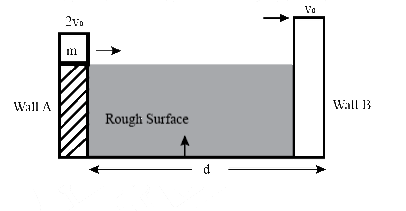
As shown in figure, a block of mass $m$ is projected from wall A with velocity $2 v_{0}$, on the rough surface with constant sliding friction to hit the wall B with velocity $v_{0}$. With what velocity same mass $m$ should be projected to hit the wall B with same velocity $v_{0}$ if the surface is now moving upward with an acceleration of $a=4 g$
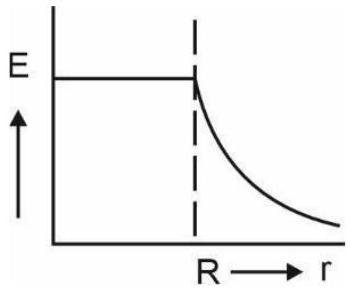
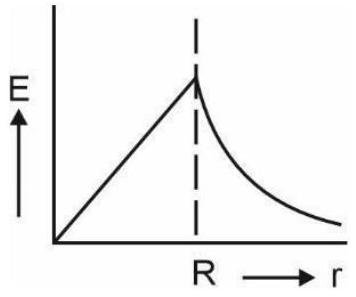
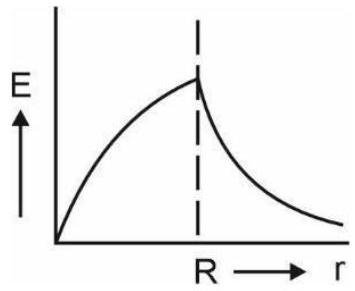
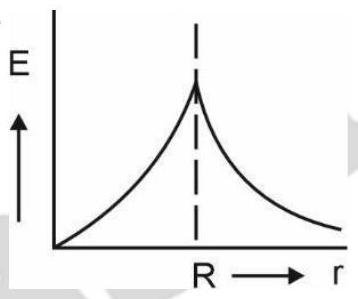
A sphere of radius $R$, is charged with volume charge density $\rho$ such that $\rho \propto r$ ( $r$ is distance from Centre). Variation of electric field $E$ with $r$ (For all values of $r: r \leq R$ and $r>R$ ) is best represented by
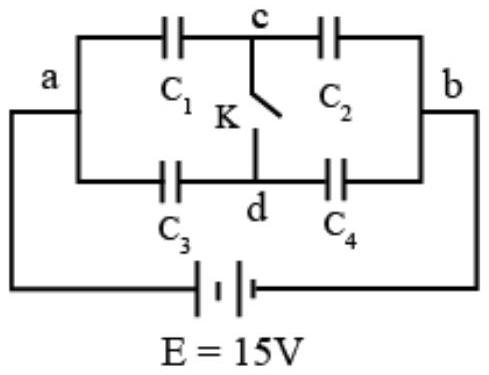
A system of capacitors $C_{1}=4 \mu F, C_{2}=1 \mu F, C_{3}=2 \mu F$ and $C_{4}=3 \mu F$ connected across a battery of emf $\mathrm{E}=15$ V is shown in figure. The charge that will flow, through the switch K , when it is closed, is
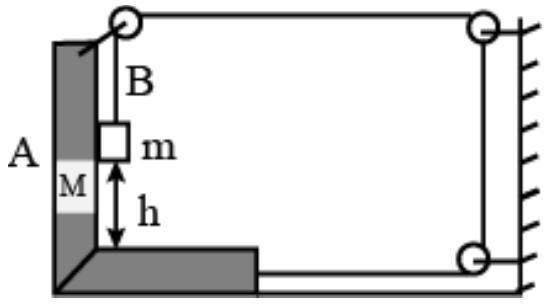
A simplification of a kind of interlock is shown in figure. All surfaces are smooth and frictionless. The body $m$ has a mass $\mathrm{m}=1 \mathrm{ kg}$ and the block $M=15 \mathrm{ kg}$. The time ' m ' takes to reach the base if it is released at height $\mathrm{h}=4$ meter above the base of M , is [ use $\mathrm{g}=10 \mathrm{ ms}^{-2}$ ]
A number $n$ of identical balls, each of mass m and radius $r$ are stringed like beads at random and at rest along smooth, rigid horizontal rod of length $L$ mounted between immovable supports; $\frac{r}{L}$ is small but not negligible.
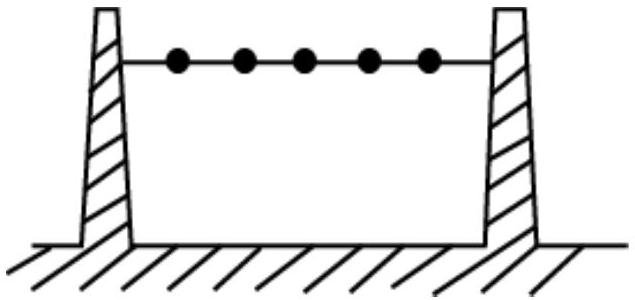
Collision between balls, or between balls and supports, are perfectly elastic. One of the balls is struct horizontally so as to acquire a speed $v$. Resulting outward force felt by supports, averaged over a long time, is
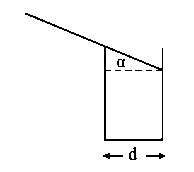
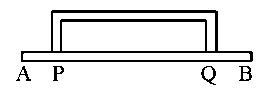
A cylindrical tumbler of diameter $d$ has smooth sides and smooth edge. A thin of length $L$ is balanced on the edge of the tumbler as shown in figure. The angle $\alpha$ that the rod makes with horizontal for this trick to work is
End A of a uniform thin rod of length $2 L$ is in boiling water $\left(100^{\circ} \mathrm{C}\right)$ and end B is in melting ice $\left(0^{\circ} \mathrm{C}\right) . \mathrm{P}$ and Q are two points at distance $\frac{L}{2}$ from A and B respectively. A similar bent rod of length $\frac{3 L}{2}$ of same material and equal cross section is joined to rod $A B$ between points $P$ and $Q$ as shown in figure. Then
Two stars of masses $M$ and $m(M=2 m)$ separated by a distance $d=3$ astronomical unit, revolve in circular orbit about their centre of mass with a period of 2 years. If $M_{s}$ is mass of Sun then
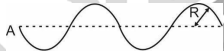
A thin uniform rod of mass $M$ is bent into four adjacent semicircles of radius of curvature $R$ lying in same plane. Moment of inertia of the bent rod about an axis through one end A and perpendicular to plane of the rod is
Three point charges $+q,-2 q$ and $+q$ are placed on $x$-axis at $x=-d, x=0$ and $x=+d$ respectively. The value of electric field at a point P on x axis at $x=r(r \gg d)$ is given by $E=\frac{1}{4 \pi \varepsilon_{0}} \frac{a Q}{r^{n}}$ (Here $Q=2 q d^{2}$ ). Then
The frequency of the transverse oscillations of a proton (mass M ) trapped in a cylindrical relativistic electron beam of circular cross section of radius R and current $/$ is given by [assume that speed v of relativistic electrons $\approx \mathrm{c}$ (the speed of light in vacuum) and ignore magnetic effect
Current $I$ flows through a long thin-walled metallic cylinder of radius $R$ with a thin longitudinal slit of width $\xi(\xi \ll R)$ running parallel to the axis of the cylinder. The magnetic induction $B$ produced at any point on the axis of the cylinder is approximately
The reading of the ammeter, used in the electrical network shown below, is $20 m A$, a long time after the key $K$ is closed
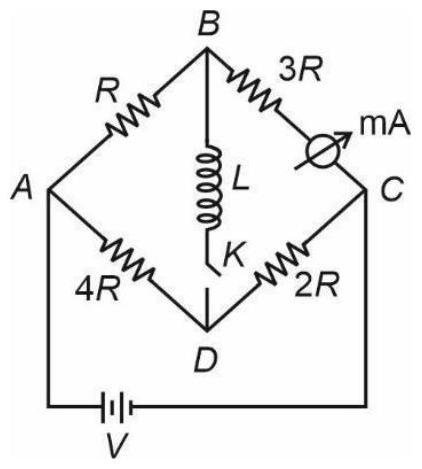
The reading of the same ammeter, immediately after the key was closed was
At the Earth's surface, a projectile is launched straight up at a speed of $10.0 \mathrm{ km} / \mathrm{s}$. Height to which it will rise is $[g$ at surface of Earth $=9.8 \mathrm{ ms}^{-2}$ and radius of earth $\mathrm{R}=6400 \mathrm{ km}$ ]
A small sphere of mass 2.00 g is released from rest in a large cylindrical vessel filled with oil. The resistive force due to viscosity of oil acting on sphere is proportional to its velocity. Sphere approaches a terminal speed of 5.00 $\mathrm{cm} / \mathrm{s}$. The time it takes the sphere to reach $90.0 %$ of its terminal speed is approximately.
A static point charge $Q$ is located just above the centre $C(\delta 0)$ of a horizontal circle of radius $R$ on its geometric axis, as shown in figure. The magnitude of electric flux through this circle is
Three small identical neutral metal balls are at the vertices of an equilateral triangle. The balls are in turn touched to an isolated large charged conducting sphere whose centre is on a line perpendicular to the plane of triangle and passing through its centre. As a result the first and second balls have acquired charges $q_{1}$ and $q_{2}$ respectively. The charge acquired by the third ball is [Assume that charge and potential of large spherical conductor change insignificantly in charging od the balls and that charges on balls are spherically symmetric]
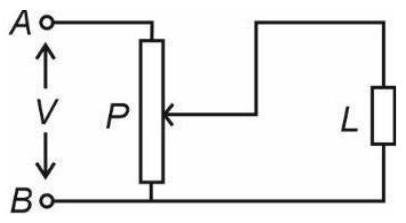
Voltage across the load L is controlled by using circuit as shown in figure. P is a potentiometer. Resistance $R_{L}$ of the load and $R_{P}$ of the potentiometer are equal to R . Load L is connected to the middle of potentiometer. Input voltage V is constant. If now $R_{L}$ is doubled, the voltage across load will change by a factor
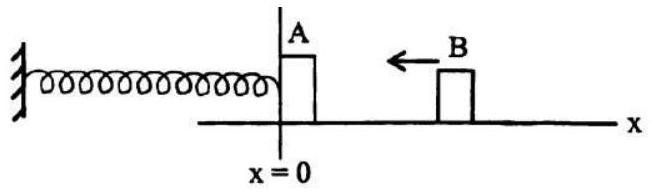
A small block A of mass 2 kg is attached to a spring of force constant $1200 \mathrm{Nm}^{-1}$, and rests on a smooth horizontal surface at $\mathrm{x}=0$ as shown in figure. A second block B of mass 1 kg slides along the surface towards A at $6 m s^{-1}$ and sticks to it. Assuming that the collision occurs at $t=0$, position $x$ (in meter) of block $A$ as a function of time $t$ is expressed as
Two plane glass testing slides each of surface area A are stuck with each other by a small water drop squeezed between them as an extremely thin film of thickness $d$. If the surface tension of water be $T$ and the contact be zero, then the force required to pull apart the two glass plates will be
The rate of flow of a certain liquid of viscosity $\eta$ through a horizontal capillary of length $l$ and radius $r$ is $Q$ when the pressure head at the inlet is just twice the atmospheric pressure. The rate of flow of the same liquid through another capillary of length $2 l$ and radius $2 r$ when the inlet pressure head is 4 times the atmospheric pressure will be (The outlet being open to atmosphere in each case)
A uniform rod of the material of Young's modulus $Y$ is pushed over a smooth horizontal surface by a constant horizontal force F . The area of cross-section of the rod is A . The compressional strain in the rod is
A total charge $Q$ is uniformly distributed over a non - conducting ring of radius $r$. There is a time varying magnetic field perpendicular to its plane and changing at the uniform rate of $\frac{d B}{d t}$. The magnitude of induced tangential electric field $E$ on ring is
DC emf of 15 V is applied to a circuit containing 5 H inductance and $10 \Omega$ resistance in series at $\mathrm{t}=0$. The ratio of the currents in the circuit at $t=0.5 \mathrm{sec}$ and at $t=1.0 \mathrm{sec}$ is
An insulating rod of length/ carries charge $q$ distributed uniformly II over its length. The rod is pivoted at its midpoint and is rotated at a frequency f (in Hz ) about an axis perpendicular to the rod passing through the point at the pivot. The magnetic moment of the system is
A circular loop of radius $r$ is placed inside another circular loop of radius $R(R \gg r)$. The loops are coplanar and concentric. The manual inductance $(\mathrm{M})$ of the system is proportional to
The amplitude of the electric and magnetic fields associated with a beam of light of intensity $477.9 \mathrm{ W} / \mathrm{m}^{2}$ are, respectively,
Given that the critical angle of incidence for total internal reflection within a transparent material when placed in air is $45^{\circ}$. The Brewster's angle of incidence for light propagating from air to the transparent material will be
A hydrogen atom is in ground state ( $n=1$ ). The magnetic field produced by revolving electron, at centre of atom is $B_{0}$. Atom is excited to state ${ }_{n=4}$. According to Bohr model, the correct alternative(s) is/are
In an experimental set up to study the photoelectric effect a point source of light of power 3.2 mW is used. The source emits mono energetic photons of energy 5 eV and is located at a distance $\mathrm{d}=0.8 \mathrm{ m}$ from centre of a stationary metallic sphere of work function $\mathrm{W}=3.0 \mathrm{eV}$. The radius of the sphere is $\mathrm{R}=8 \mathrm{ mm}$. Assume that the sphere is isolated and photo electrons are instantly swept away after emission. Also assume that the efficiency off photoelectric emission is one for every $10^{6}$ photons. In the present set up
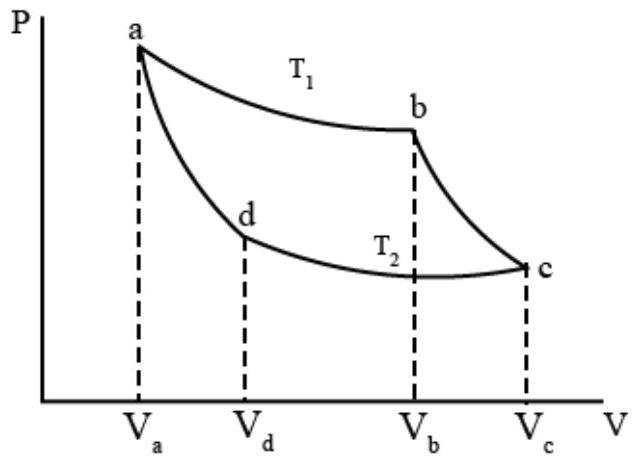
Two identical Carnot (cycles) engines operate between maximum and minimum temperatures $T_{1}$ and $T_{2}$ and volume limits, $V_{a}, V_{b}, V_{c},$ and $V_{d}$ as shown in figure. Given that $\frac{V_{c}}{V_{a}}=e^{3}$ and $\frac{T_{1}}{T_{2}}=e$ (e is the base of natural logarithm). Engine 1 operates on mono atomic gas while engine 2 on diatomic gas. Choose correct alternatives
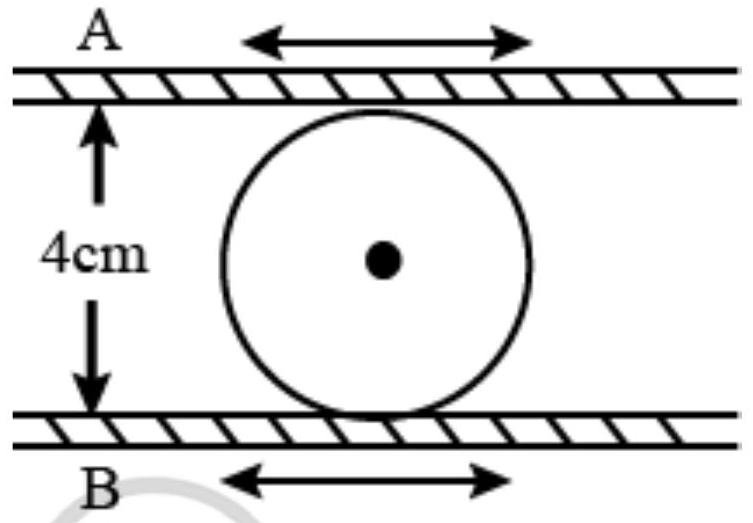
In a certain machine two steel plates are separated by a hardened steel cylindrical roller (see fig). In operation, the plates move back and forth horizontally, perpendicular to the axis of roller, and the roller rolls freely between plates without slipping on either one. At a particular instant plate A is moving with a speed of $18 \mathrm{ cm} \mathrm{sec}{ }^{-1}$ to the right and an acceleration of $30 \mathrm{ cm} \mathrm{sec}^{-2}$ to the left, and the plate B is moving with a speed of $6 \mathrm{ cm} \mathrm{sec}{ }^{-1}$ to the right and an acceleration of $8 \mathrm{ cm} \mathrm{sec}^{-2}$ to the left. At that instant, for the roller
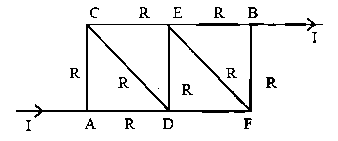
Each of 9 sides of frame ACDEF b has resistance R (Nine in all) A current $I$ enters at A and leaves at B. Choose the correct alternatives.
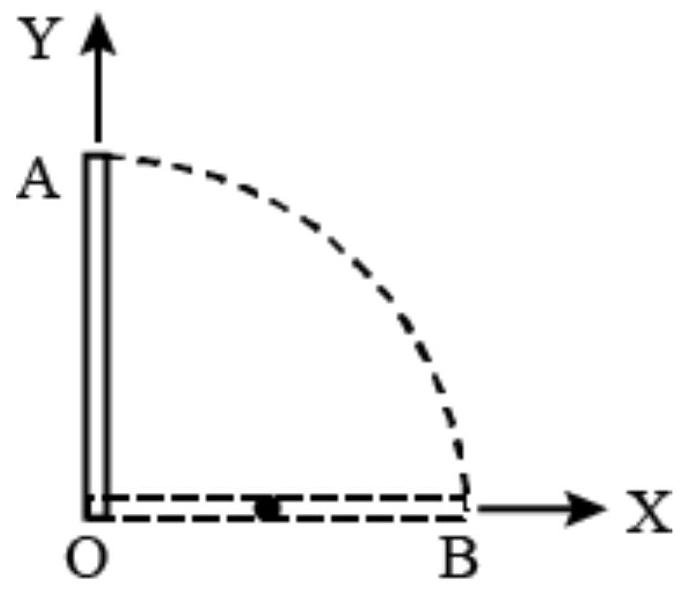
A long uniform rod of length $L$ and mass $M$ is pivoted vertically on a horizontal, friction less pivot at its lower end. The rod is released from rest in its vertical position OA (see figure). It falls off without slipping at O . At the instant the rod is horizontal,
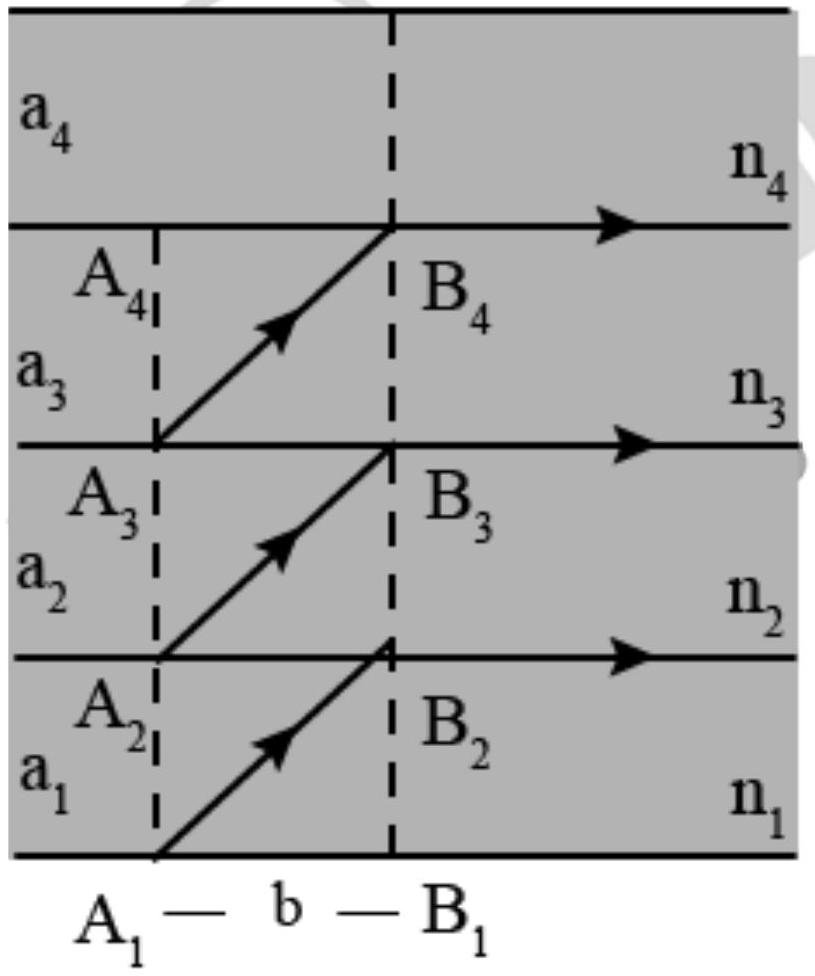
There are four layers of glass plates, placed on top of each other such that bottom one has thickness $a_{1}$ and refractive index $n_{1}=2.7$. Next one has thickness $a_{2}$ and refractive index $n_{2}=2.43$. The third one and the top one has thickness $a_{3}$ and $a_{4}$ and refractive indices $n_{3}$ and $n_{4}$ respectively. Three rays starting at the same moment from $A_{1}, A_{2}$ and $A_{3}$ reach pints $B_{2}, B_{3}, B_{4}$ at the same time, with their angles of incidence being critical angle. You are given $A_{1} B_{1}=A_{2} B_{2}=A_{3} B_{3}=A_{4} B_{4}=b=10 \mathrm{ mm}$. Choose correct statement (s).
In an isolated asteroid of radius $R$ and uniform density $\rho$, a spherical cavity of diameter $A C=R$ is excavated,
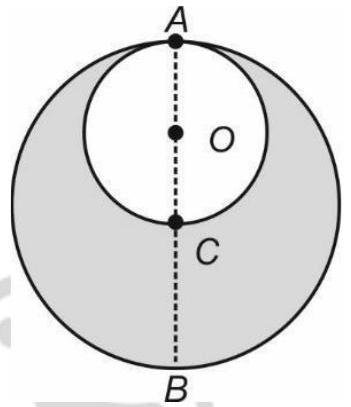
where $C$ is centre of asteroid. Choose correct alternative(s)
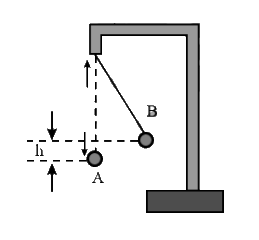
A small positively charged ball of mass $m$ is suspended by a long insulating thread of negligible mass. Other positively charged small ball is oved very slowly from a large distance (along horizontal direction) until it is at original position A of first ball. As a result, the first ball rises by $h$ to position B such that $h \ll l$. Choose the correct statement(s).
A rope of mass $m$ and length $L$ is suspended vertically. A mass $M$ is suspended from bottom of the rope. A transverse wave is produced on the rope, which travels the length of rope in time $t$ choose the correct statement(s)
A long solenoid having 1000 turns per meter carries a current of 1 A . It has a soft iron core of $\mu_{r}=1000$. The core is heated beyond the Curie temeperature ( $T_{c}$ ). Then
A thin infinitely long metal sheet of appreciable finite width b carrying current $I$ (distributed uniformly through out of its cross section) parallel to its length is placed in an external magnetic field $B_{e}$ Parallel to its plane and perpendicular to the direction of current

In 2026, the following Cheenta students have been successful for Indian Statistical Institute's M.Stat Entrance. They ranked within the first 50 in the entire country in these entrances. I.S.I. M.Stat Entrance
In 2026, the following Cheenta students have been successful for Indian Statistical Institute's B.Stat Entrance and Chennai Mathematical Institute's B.Sc. Math Entrance. They ranked within the first 200 in the entire country in these entrances. Most of these students attended the problem solving workshops regularly, which happen 5 days every week. CMI B.Sc. Math Entrance […]

In 2025, 8 students from Cheenta Academy cracked the prestigious Regional Math Olympiad. In this post, we will share some of their success stories and learning strategies. The Regional Mathematics Olympiad (RMO) and the Indian National Mathematics Olympiad (INMO) are two most important mathematics contests in India.These two contests are for the students who are […]

Cheenta Academy proudly celebrates the success of 27 current and former students who qualified for the Indian Olympiad Qualifier in Mathematics (IOQM) 2025, advancing to the next stage — RMO. This accomplishment highlights their perseverance and Cheenta’s ongoing mission to nurture mathematical excellence and research-oriented learning.