A tiny ball of mass $m$ is initially at rest at height $H$ above a cake of uniform thickness $h$. At some moment the particle falls freely, touches the cake surface and then penetrates in it at such a constant rate that its speed becomes zero on just reaching the ground (bottom of the cake). Speed of the ball at the instant it touches the cake surface and its retardation inside the cake are respectively
Two sound waves in air have wavelengths differing by 2 m at a certain temperature $T$. Their notes have musical interval 1.4. Period of the lower pitch note is 20 ms . Then, speed of sound in air at this temperature ( $T$ ) is
Two plane mirrors $\mathrm{M}_{1}$ & $\mathrm{M}_{2}$ have their reflecting faces inclined at $\theta$. Mirror $\mathrm{M}_{1}$ receives a ray $A B$, reflects it at $B$ and sends it as BC . It is now reflected by mirror $\mathrm{M}_{2}$ along CD, as shown in the figure. Total angular deviation $\delta$ suffered by the incident ray AB is: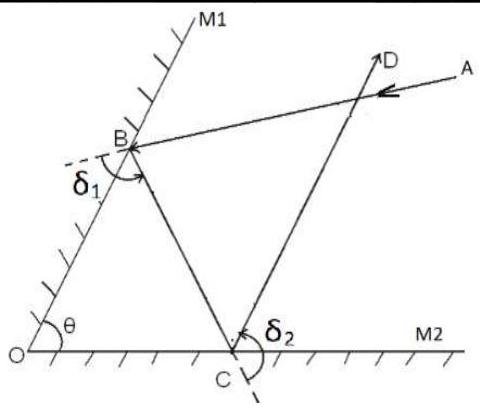
In the adjacent figure, line AB is parallel to screen S . A linear obstacle PQ between the two is also parallel to both. $\mathrm{AB}, \mathrm{PQ}$ and screen S are coplanar. A point source is carried from A to B , along the line AB . What will happen to the size of the shadow of PQ (cast due to the point source) on the screen S ?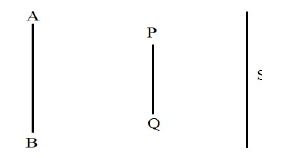
Two particles $\mathrm{P}_{1}$ and $\mathrm{P}_{2}$ move towards origin O , along X and Y -axes at constant speeds $u_{1}$ and $u_{2}$ respectively as shown in the figure. At $t=0$, the particles $\mathrm{P}_{1}$ and $\mathrm{P}_{2}$ are at distances $a$ and $b$ respectively from O . Then the instantaneous distance $s$ between the two particles is given by the relation: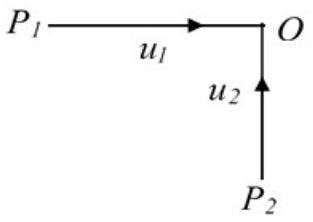
An electric generator consumes some oil fuel and generates output of 25 kW . Calorific value (amount of heat released per unit mass) of the oil fuel is $17200 \mathrm{kcal} / \mathrm{kg}$ and efficiency (output to input ratio) of the generator is 0.25 . Then, mass of the fuel consumed per hour and electric energy generated per ton of fuel burnt are respectively
Image is obtained on a screen by keeping an object at 25 cm and at 40 cm in front of a concave mirror. Image in the former case is four times bigger than in the latter. Focal length of the mirror must be ____
A glass cube of refractive index 1.5 and edge 1 cm has a tiny black spot at its center. A circular dark sheet is to be kept symmetrically on the top surface so that the central spot is not visible from the top. Minimum radius of the circular sheet should be (Given: $\frac{1}{\sqrt{2}}=0.707, \frac{1}{\sqrt{3}}=0.577, \frac{1}{\sqrt{5}}=0.447$ )
A metal rod of length $L$ at temperature $T$, when heated to temperature $T^{\prime}$, expands to new length $L^{\prime}$. These quantities are related as $L^{\prime}=L\left(1+\alpha\left[T^{\prime}-T\right]\right)$ where $\alpha$ is a constant for that material and called as coefficient of linear expansion. Correct SI unit of $\alpha$ is ____
A paramedical staff nurse improvises a second's pendulum (time period 2 s ) by fixing one end of a string of length $L$ to a ceiling and the other end to a heavy object of negligible size. Within 60 oscillations of this pendulum, she finds that the pulse of a wounded soldier beats 110 times. A symptom of bradycardia is pulse $<60$ per minute and that of tachycardia is $>100$ per minute. Then the length of the string is nearly ____ and soldier has symptoms of ____
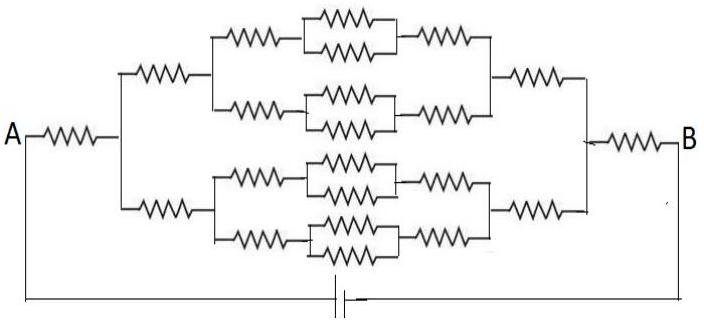
Each resistance in the adjacent circuit is $R \Omega$. In order to have an integral value for equivalent resistance between $\mathrm{A}$ & $\mathrm{ B}$, the minimum value of $R$ must be:
A block of wood floats on water with $\left(\frac{3}{8}\right)^{\text {th }}$ of its volume above water. It is now made to float on a salt solution of relative density 1.12 . The fraction of its volume that remains above the salt solution now, is nearly ____
Suppose our scientific community had chosen force, speed and time as the fundamental mechanical quantities instead of length, mass and time respectively and they chose the respective units of magnitudes $10 \mathrm{ N}, 100 \mathrm{ m} / \mathrm{s}$ and $\frac{1}{100} \mathrm{ s}$. Then the unit of mass in their system is equivalent to ____ in our system.
Two equally charged identical pith balls are suspended by identical massless strings as shown in the adjacent figure. If this set up is on Mercury ( $g=3.7 \mathrm{ m} / \mathrm{s}^{2}$ ), Earth ( $g=9.8 \mathrm{ m} / \mathrm{s}^{2}$ ) and Jupiter ( $g=24.5 \mathrm{ m} / \mathrm{s}^{2}$ ), then angle $2 \theta$ will be ____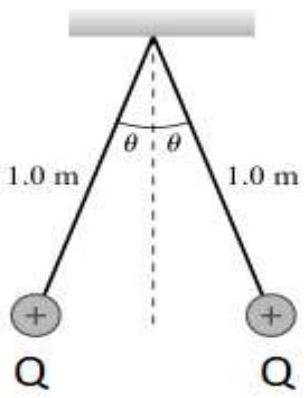
Three objects of the same material coloured white, blue and black can withstand temperatures up to $2000^{\circ} \mathrm{C}$. All these are heated to $1500^{\circ} \mathrm{C}$ and viewed in dark. Which option is correct?
A car running with a velocity of $30 \mathrm{ m} / \mathrm{s}$ reaches midway between two vertical parallel walls separated by 360 m , when the driver sounds the horn for a moment. Speed of sound in air is $330 \mathrm{ m} / \mathrm{s}$. After blowing horn, the first three echoes will be heard by the driver respectively at ____
Choose correct option from the following statements from electrostatics:
(I) If two copper spheres of same radii, one hollow and the other solid are charged to the same
electrical potential, the solid sphere will have more charge.
(II) A charged body can attract another uncharged body.
(III) Electrical lines of force originating from like charges will exert a lateral force on each other,
while those originating from opposite charges can intersect each other.
Refer the adjacent circuit. The voltmeter reads 117 V and ammeter reads 0.13 A . If the resistance of voltmeter and ammeter are $9 \mathrm{k} \Omega$ and $0.015 \Omega$ respectively, the value of $R$ is ____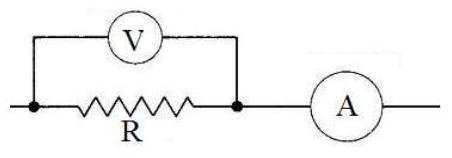
A bar magnet is allowed to fall freely from the same height towards a current carrying loop along its axis, as shown in the four situations I to IV. Arrows show direction of conventional current. Choose the situations in which the potential energy of the magnet coil interaction is maximum _____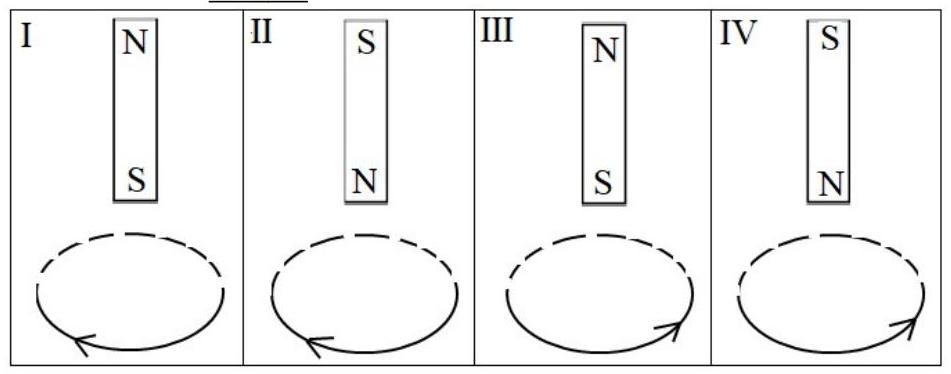
A beaker is completely filled with water at $4^{\circ} \mathrm{C}$. Consider the following statements:
(I) Water will overflow if the beaker is cooled for some time.
(II) Water will overflow if the beaker is heated for some time.
Select correct option regarding (I) and (II).
When a surface tension experiment with capillary tube is performed, water rises up to 0.1 m . If the experiment is carried out in space, water will rise in capillary tube ____
Let AB be a diameter of a circle $\mathrm{C}_{1}$ of radius 30 cm and with center O . Two circles $\mathrm{C}_{2}$ and $\mathrm{C}_{3}$ of radii 15 cm and 10 cm touch $\mathrm{C}_{1}$ internally at A and B respectively. A fourth circle $\mathrm{C}_{4}$ touches $\mathrm{C}_{1}, \mathrm{C}_{2}$ and $\mathrm{C}_{3}$. What is the largest possible radius of $\mathrm{C}_{4}$ ?
A $5 \times 5 \times 5$ cube is built using unit cubes. How many different cuboids (that differ in at least one unit cube) can be formed using the same number of unit cubes?
What is the largest value of the positive integer $k$ such that $k$ divides $n^{2}\left(n^{2}-1\right)\left(n^{2}-n-2\right)$ for every natural number $n$ ?
A person kept rolling a regular (six faced) die until one of the numbers appeared third time on the top. This happened in $12^{\text {th }}$ throw and the sum of all the numbers in 12 throws was 46 . Which number appeared least number of times?
In a square ABCD , a point P is inside the square such that ABP is an equilateral triangle. The segment AP cuts the diagonal BD in E . Suppose $\mathrm{AE}=2$. The area of ABCD is
Let $n$ be a positive integer not divisible by 6 . Suppose $n$ has 6 positive divisors. The number of positive divisors of $9 n$ is
The value of $\frac{\sqrt{a+x}-\sqrt{a-x}}{\sqrt{a+x}+\sqrt{a-x}}$, when $x=\frac{2 a}{b^{2}+1}$ is:
Two regular polygons of different number of sides are taken. In one of them, its sides are coloured red and diagonals are coloured green; in the other, sides are coloured green and diagonals are coloured red. Suppose there are 103 red lines and 80 green lines. The total number of sides the two polygons together have is:
A box contains some red and some yellow balls. If one red ball is removed, one seventh of the remaining balls would be red; if one yellow ball is removed, one-sixth of the remaining balls would be red. If $n$ denotes the total number of balls in the box, then the sum of the digits of $n$ is
Let $A B C D$ be a rectangle. Let $X$ and $Y$ be points respectively on $A B$ and $C D$ such that $\mathrm{AX}: \mathrm{XB}=1: 2=\mathrm{CY}: \mathrm{YD}$. Join AY and CX ; let BY intersect CX in K ; let DX intersect AY in L . If $m / n$ denotes the ratio of the area of XKYL to that of ABCD , then $m+n$ equals
Let ABC be an equilateral triangle. The bisector of $\angle \mathrm{BAC}$ meets the circumcircle of ABC in D . Suppose $\mathrm{DB}+\mathrm{DC}=4$. The diameter of the circumcircle of ABC is
Let $T_{k}$ denote the $k$-th term of an arithmetic progression. Suppose there are positive integers $m \neq n$ such that $T_{m}=1 / n$ and $T_{n}=1 / m$. Then $T_{m n}$ equals
In a triangle ABC , let AD be the median from A ; let E be a point on AD such that $\mathrm{AE}: \mathrm{ED}=1: 2$; and let BE extended meets AC in F . The ratio of $\mathrm{AF} / \mathrm{FC}$ is
If $\sin \theta$ and $\cos \theta$ are roots of the equation $p x^{2}+q x+r=0$, then:
For a regular $k$-sided polygon, let $\alpha(k)$ denotes its interior angle. Suppose $\mathrm{n}>4$ is such that $\alpha(n-2), \alpha(n), \alpha(n+3)$ forms an arithmetic progression. The sum of digits of $n$ is
The sum of 5 numbers in geometric progression is 24 . The sum of their reciprocals is 6 . The product of the terms of the geometric progression is
Digits $a$ and $b$ are such that the product $\overline{4 a 1} \times \overline{25 b}$ is divisible by 36 (in base 10). The number of ordered pairs ( $a, b$ ) is
The integer closest to $\sqrt{111 \ldots 1-222 \ldots 2}$, where there are 2018 ones and 1009 twos, is
In a triangle ABC , a point D on AB is such that $\mathrm{AD}: \mathrm{AB}=1: 4$ and DE is parallel to BC with E on AC . Let M and N be the mid points of DE and BC respectively. What is the ratio of the area of the quadrilateral BNMD to that of triangle ABC ?
The number of distinct integers in the collection $\left[\frac{10^{2}}{1}\right],\left[\frac{10^{2}}{2}\right],\left[\frac{10^{2}}{3}\right], \ldots \ldots,\left[\frac{10^{2}}{20}\right]$, where $[x]$ denotes the largest integer not exceeding $x$, is

In 2026, the following Cheenta students have been successful for Indian Statistical Institute's M.Stat Entrance. They ranked within the first 50 in the entire country in these entrances. I.S.I. M.Stat Entrance
In 2026, the following Cheenta students have been successful for Indian Statistical Institute's B.Stat Entrance and Chennai Mathematical Institute's B.Sc. Math Entrance. They ranked within the first 200 in the entire country in these entrances. Most of these students attended the problem solving workshops regularly, which happen 5 days every week. CMI B.Sc. Math Entrance […]

In 2025, 8 students from Cheenta Academy cracked the prestigious Regional Math Olympiad. In this post, we will share some of their success stories and learning strategies. The Regional Mathematics Olympiad (RMO) and the Indian National Mathematics Olympiad (INMO) are two most important mathematics contests in India.These two contests are for the students who are […]

Cheenta Academy proudly celebrates the success of 27 current and former students who qualified for the Indian Olympiad Qualifier in Mathematics (IOQM) 2025, advancing to the next stage — RMO. This accomplishment highlights their perseverance and Cheenta’s ongoing mission to nurture mathematical excellence and research-oriented learning.