The axes of a coordinate system $\mathrm{S}_{2}$ are inclined at an angle $\theta$ to those of another coordinate system $\mathrm{S}_{1}$. The origins of both the systems are coinciding. A particle $\mathrm{P}_{1}$ at rest in system $\mathrm{S}_{1}$, starts from point ($-2,0$) and travels along positive direction of $\mathrm{X}_{1}$ axis with uniform acceleration of $1.25 \mathrm{ m} / \mathrm{s}^{2}$ for 4 s and stops. In system $\mathrm{S}_{2}$, particle $\mathrm{P}_{2}$, starts from rest from the origin and travels for 2 s along positive direction of $\mathrm{X}_{2}$ axis with uniform acceleration $5 \mathrm{ m} / \mathrm{s}^{2}$ and stops. If the final distance between $P_{1}$ and $P_{2}$ is 6 m , then the angle between $+\mathrm{Y}_{1}$ axis and $+\mathrm{X}_{2}$ axis is
The variation of a certain physical parameter $Z$ with variable $u$ is given by the relation $\mathrm{Z}=A\left(\frac{R}{R+u}\right)^{3}$, where $R$ and $A$ are constants and the maximum value of $u \ll R$. Then to find $R$, a student plots a graph of variation of $Z$ ( Y axis) against $u$ ( X axis). The graph is a
A submarine $S_{1}$ is parked at a depth of 200 m in an ocean on earth. Assume oceans exist on Mars. At about what depth a submarine $\mathrm{S}_{2}$ has to be parked in an ocean on Mars so that $\mathrm{S}_{2}$ will experience same pressure as that of $\mathrm{S}_{1}$ ? Acceleration due to gravity on Mars is $3.7 \mathrm{ m} / \mathrm{s}^{2}$. (Assume that sea water density on Earth and Mars is same, $\rho=1.03 \times 10^{3} \mathrm{ kg} / \mathrm{m}^{3}$ )
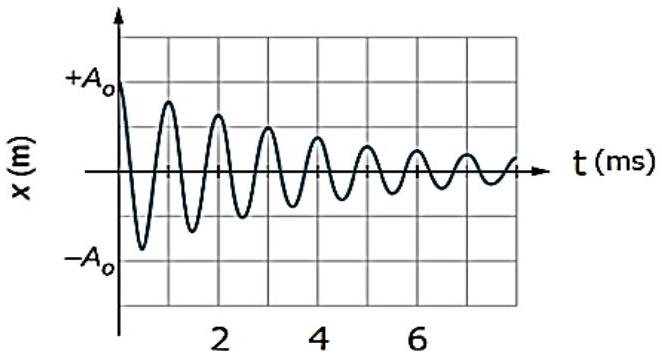
In an oscillating system, damping results in dissipation of the stored energy. The following figure shows the variation of displacement x with time t for an oscillating system. Which of the following statements best describes this physical phenomenon.
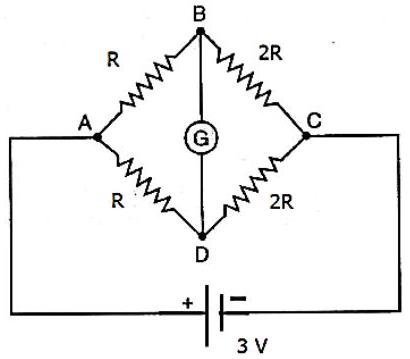
In the adjacent circuit, the galvanometer $G$ does not show any deflection. If $R=2 \Omega$, the current drawn from the cell is
'Gear' is a mechanical system used to transfer mechanical and rotary motion from one mechanical system to another. As shown in the figure below the driving wheel A drives the driven wheel B without slipping and thus forms the gear system. The wheel A has 16 teeth and B has 24 teeth. Wheel B has a projection (shown by white ring in Fig. 1 and also in the side view of Fig. 2) of radius $\frac{14}{11} \mathrm{ cm}$.
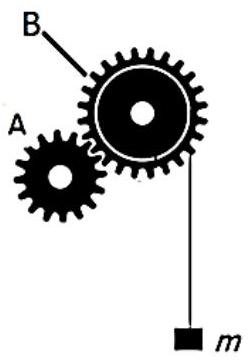
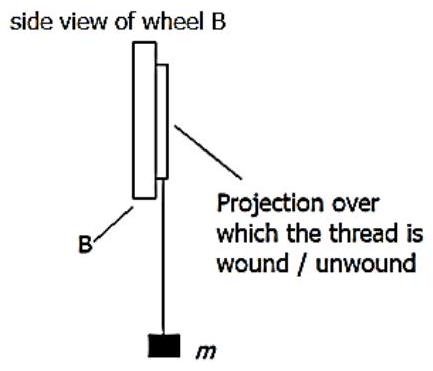
A long massless, inextensible string can be wound / unwound over this circular projection. A mass $m$ is attached to the free end of this long string. If the wheel A makes 6 revolutions per second in the clockwise direction, without slipping, then in $\frac{1}{2}$ second the potential energy of the mass $m$ in CGS unit
Canopus is the second brightest star in the night sky. It is about 300 light years away. The energy is produced inside the star through nuclear reactions. If we receive $5.0 \times 10^{-8} \mathrm{ W} / \mathrm{m}^{2}$ energy from Canopus, how much mass does it lose per second?
An average human adult radiates about 100 W energy mainly in infra-red region of the electromagnetic spectrum. 50 persons are sitting in a hall with an air conditioning system which is $50 %$ efficient. How much electricity must be used to maintain temperature of the hall at $25^{\circ} \mathrm{C}$ for 4 hours?
ANY NUMBER OF OPTIONS 4, 3, 2 or 1 MAY BE CORRECT IN THE FOLLOWING QUESTIONS.
According to Einstein's theory, light can be assumed to be in the form of a large number of discrete energy packets called 'photons'. In case of light of frequency $v$, each photon carries energy $E=h v$. In a certain surgical procedure a surgeon uses LASER beam of wavelength 650 nm in pulses of 30.0 ms duration. The average power of each pulse is 0.6 W . Here h is Planck's constant. Then
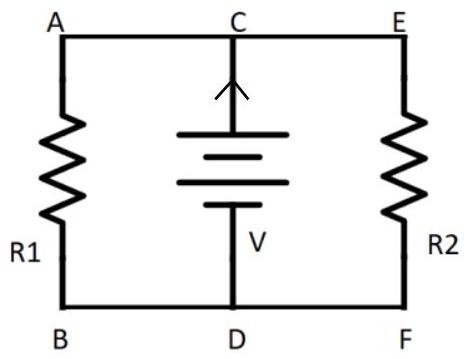
In the following circuit, $\mathrm{R}_{1}=6 \Omega, \mathrm{R}_{2}=12 \Omega, \mathrm{ V}=16 \mathrm{ V}$. The currents $\mathrm{I}_{1}$ and $\mathrm{I}_{2}$ flow through the resistances $\mathrm{R}_{1}$ and $\mathrm{R}_{2}$ respectively
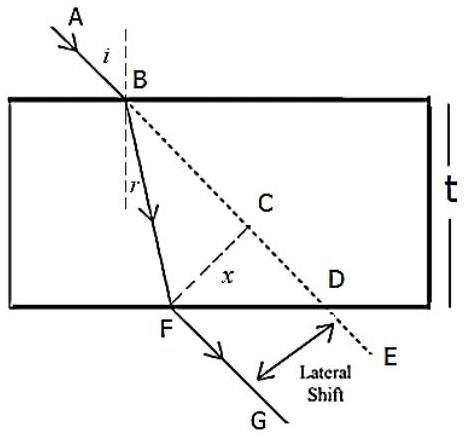
A glass plate of uniform thickness $t$ and refractive index $\mu$ is as shown in the diagram. AB is the incident ray and FG is the emergent ray. The angles of incidence and refraction are $i$ and $r$ respectively. The perpendicular distance $\mathrm{FC}=x$ between the incident and the emergent rays is called the lateral shift. Then

In 2026, the following Cheenta students have been successful for Indian Statistical Institute's M.Stat Entrance. They ranked within the first 50 in the entire country in these entrances. I.S.I. M.Stat Entrance

In 2026, the following Cheenta students have been successful for Indian Statistical Institute's B.Stat Entrance and Chennai Mathematical Institute's B.Sc. Math Entrance. They ranked within the first 200 in the entire country in these entrances. Most of these students attended the problem solving workshops regularly, which happen 5 days every week. CMI B.Sc. Math Entrance […]

In 2025, 8 students from Cheenta Academy cracked the prestigious Regional Math Olympiad. In this post, we will share some of their success stories and learning strategies. The Regional Mathematics Olympiad (RMO) and the Indian National Mathematics Olympiad (INMO) are two most important mathematics contests in India.These two contests are for the students who are […]

Cheenta Academy proudly celebrates the success of 27 current and former students who qualified for the Indian Olympiad Qualifier in Mathematics (IOQM) 2025, advancing to the next stage — RMO. This accomplishment highlights their perseverance and Cheenta’s ongoing mission to nurture mathematical excellence and research-oriented learning.