Presently I am active in learning and teaching mathematics. This series of articles is intended for recording my experiences in this profession.
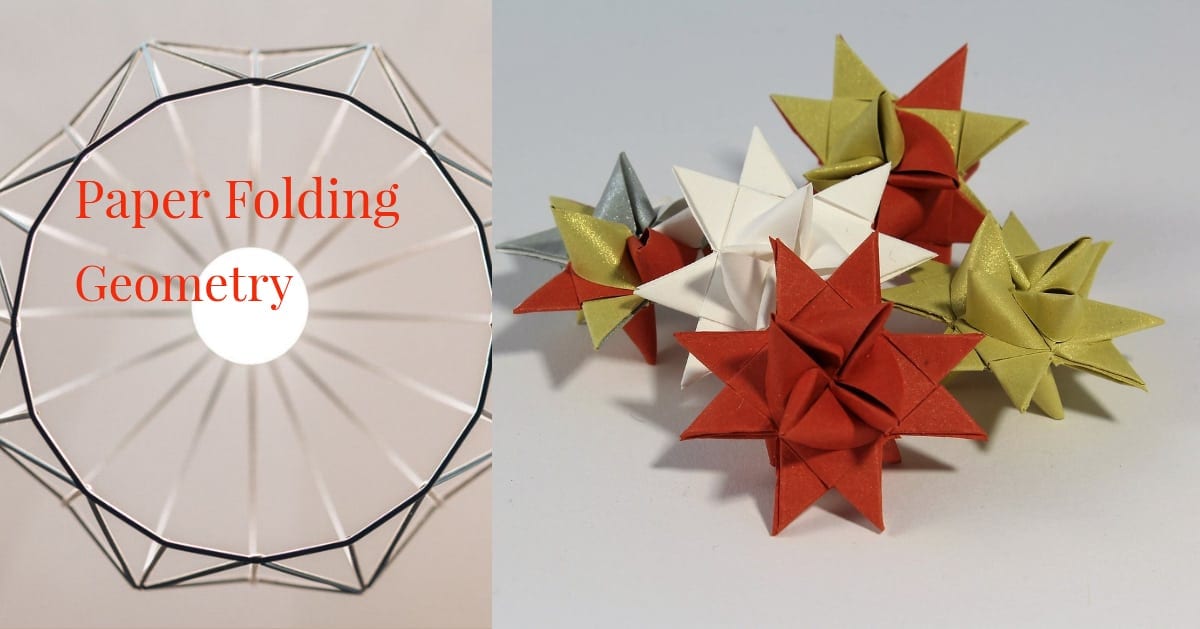
Today, in Math Olympiad training session, we discussed paper folding geometry. Historically, art and mathematics of paper folding flourished in Japan where it is popularly known as origami. In the last decade of 19th century, an Indian mathematician from Harvard University wrote a survey paper on this topic. That led to increased activity in this area of mathematics.
In today's class, we discussed the construction of rational numbers by folding a square sheet of paper.
Given a square sheet of paper, mark it's four corners as shown in the diagram below.

Clearly length of AD is 1 unit starting from A (0 point) and ending at D (1 point). Our objective is to mark all rational numbers from 0 to 1, on the line segment AD. But this must be achieved without using a straight edge (by paper folding alone).
It is east to mark the 1/2 point. Place A on D and B on C. A crease will be formed at the middle of this paper. This crease is named EF where F is the desired 1/2 mark on segment AD.

In fact, this trivial technique can be employed to mark off $latex left ( dfrac{1}{2^n}, 0 right ) $ on AD. For example, the point 1/4 can be found easily by placing B on E and A on F and so on.
Tricky part is to find an algorithm to construct $latex dfrac{1}{n} $ given any natural number n. Fortunately, this is not hard either.
Consider the two equations:
$latex y = x $
$latex y = -nx + 1 $
Solution to these two equations is $latex left ( dfrac{1}{n+1},dfrac{1}{n+1} right ) $
Thus, if we know how to construct 1/n, we found a method to construct $latex left ( dfrac{1}{n+1},dfrac{1}{n+1} right ) $. Since we know how to construct 1/2, by induction the rest follows. Following diagram describes construction of (1/3, 1/3).

Finally, we get (1/3, 0) by folding through (1/3, 1/3) and making sure B falls on BC segment and A falls on AD segment. The crease E'F' gives F' which is (1/3, 0) point on AD.
Again by joining BF' we can find (1/4, 1/4) and so on.

One may easily construct any rational between 0 and 1 after all the 1/n's are constructed. To construct a rational number p/q (between 0 and 1), first, construct 1/q, then fold it p times.
In fact, we have technically constructed ALL rational numbers. To construct a rational bigger than 1, just take a bigger square.
The discussion session concluded with a search for a similar algorithm to construct $latex sqrt n $ where n is not a perfect square. We noted (without proof or illustration) that this method of geometric construction has a distinct advantage over compass-straight edge construction. Galois Theory confirms that it is impossible to construct cube root of certain numbers using compass and unmarked straightedge. However using paper folding techniques one may achieve that feat quite easily.
Later I was personally working on Algebraic Topology problems. An assignment problem asked this:

After the arduous development of point set topology, my Ph.D. coursework has now turned to relatively more appealing stuff: interaction of algebra and topology. In fact, this portion of the course is in some sense 'easier' than the initial program. We are following Aspects in Topology by Christenson.
The main objective of algebraic topology is, in author's words: answer topological questions by translating them into algebraic ones.
The author begins quickly by introducing Fundamental Group (or first homotopy group).
Visually speaking a loop is NOT exactly what 'sounds' like. Note that in the figure below f(I) 'looks' like a loop, where f is the loop. There is no way to 'visualize' the function (or loop). Often we visualize it's image only.

Next, we develop equivalence classes of the family of loops. Such an equivalence relation is induced by the notion of 'homotopy'. A loop f is homotopic to another loop g if one's image can be continuously shrunk to the image of the other. An illustration is given in the following image:

To formalize the idea, we develop a series of easy definitions and theorems.
Notation:

(This diagram is partly inspired by author, though I have added little tidbits. It should self-explanatory)
Application in above context: Here $latex J = X times I, A = X times [0, frac{1}{2} ], B = X times [frac{1}{2}, 1] $
Set A = {0,1}, X = [0,1], Y to be an arbitrary space and B = {y}. Clearly all maps from (X, A) to (Y, B) are the loops that we discussed earlier.
We know that equivalence relation on a set (in this case set of loops), creates equivalence classes. We will write the equivalence class of 'f' as [f].
Next, we want to impose a group structure on the family of equivalence classes (of loops ). Hence, we need:
Both of these are achieved very easily and in an obvious way:
(to be continued)

Publishing original scientific research in a peer-reviewed journal is an achievement many scholars work toward for years. Achieving this feat early in one's academic journey requires exceptional intellectual rigor, creativity, and persistence. Aaditya Punatar and Muskan Sadana have reached this remarkable milestone, successfully publishing their collaborative research paper in the prestigious Journal of Emerging Investigators […]

Her project on quantum-accelerated Steiner trees for 15-minute cities earned a place among the finalists at the world's largest pre-college STEM competition. Prishaa Shrimali of Marymount School of New York, was selected as a Grand Finalist at the 2026 Regeneron International Science and Engineering Fair (ISEF) in Phoenix, Arizona. Her project was Optimizing Urban Accessibility: […]
In 2026, the following Cheenta students have been successful for Indian Statistical Institute's M.Stat Entrance. They ranked within the first 50 in the entire country in these entrances. I.S.I. M.Stat Entrance
In 2026, the following Cheenta students have been successful for Indian Statistical Institute's B.Stat Entrance and Chennai Mathematical Institute's B.Sc. Math Entrance. They ranked within the first 200 in the entire country in these entrances. Most of these students attended the problem solving workshops regularly, which happen 5 days every week. CMI B.Sc. Math Entrance […]