Screening Test – Ramanujan Contest NMTC at Inter Level – XI & XII Standards 2024 – 2025
 Join Trial or Access Free ResourcesJoin Trial or Access Free Resources
Let $1+\frac{1}{2}+\frac{1}{3}+\frac{1}{4}+\frac{1}{5}+\frac{1}{6}=\frac{m}{n}$, where $m$ and $n$ are positive integers with no common divisors other than 1 . The highest power of 7 that divides $m$ is
A. 0
B. 1
C. 2
D. 3
Five spherical balls of diameter 10 cm each fit inside a closed cylindrical tin with internal diameter 16 cms . What is the smallest height of the tin can be?
A. 39
B. 42
C. 45
D. 48
The expression $\frac{7 n+18}{2 n+3}$ takes integer values for certain integer values of $n$. The sum of all such values of the expression is
A. 14
B. 21
C. 24
D. 28
$P$ is a point inside $A B C D$ such that $P A=2, P B=4, P C=5$ and $P D=6$. The maximum area of the quadrilateral $A B C D$ is
A. 30
B. 33
C. 35
D. 38
The value of
$$ \left(3^{4 / 3}-3^{1 / 3}\right)^3+\left(3^{5 / 3}-3^{2 / 3}\right)^3+\left(3^{6 / 3}-3^{3 / 3}\right)^3+\cdots+\left(3^{10 / 3}-3^{7 / 3}\right)^3$$ is
A. $12\left(3^7-1\right)$
B. $12\left(3^7+1\right)$
C. $6\left(3^7-1\right)$
D. $6\left(3^7+1\right)$
One hundred people are standing in a line and they are required to count off in fives as "one, two, three, four, five" and so on from the first person in the line. Anyone who counts "five" walks out of the line. Those remaining repeat this procedure until only four people remain in the line. What was the original position in the line of the last person to leave?
A. 94
B. 96
C. 97
D. 98
The number of values of positive integers $n$ for which $1!+2!+\cdots+n$ ! is a perfect square is
A. 0
B. 1
C. 2
D. Infinitely many
When $2025^{2026}-2025$ is divided by $2025^2+2026$, the remainder is
A. 0
B. 2025
C. 2026
D. None of these
For a real number $x$, let $\lfloor x\rfloor$ denote the largest integer $\leq x$. For example, $\lfloor 3.4\rfloor=2$ and $\lfloor 4.9\rfloor=4$. Let $N=\left\lfloor(\sqrt{27}+\sqrt{23})^6\right\rfloor$. The remainder when $N$ is divided by 1000 is
A. 799
B. 599
C. 399
D. 199
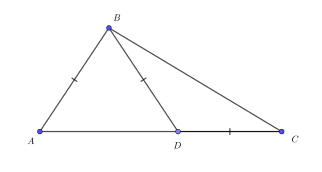
$A B C$ is a triangle. $D$ lies on $A C$ such that $A B=B D=C D$. All the angles in the diagram are a positive whole number of degrees. The largest possible size, in degrees of $\angle A B C$ is
A. 171
B. 173
C. 175
D. 177
The side lengths of a right angled triangle are in geometric progression and the smallest side has length 2 units. The length of the hypotenuse is
A. $1+\sqrt{5}$
B. $\sqrt{10}$
C. $3 \sqrt{2}-1$
D. $\sqrt{11}$
In a regular polygon there are two diagonals that intersect inside the polygon at an angle $50^{\circ}$. The least number of sides of the polygon for which this is possible is
A. 12
B. 18
C. 24
D. 36
In triangle $P Q R, \angle R=2 \angle P, P R=5$ and $Q R=4$. The length of $P Q$ is
A. $2 \sqrt{10}$
B. 6
C. 7
D. $2 \sqrt{7}$
Each of ten people around a circle chooses a number and tells it to the neighbor on each side. Thus each person gives out one number and receives two numbers. The players then announce the average of the two numbers they received. The announced numbers, in order around the circle were $1,2,3,4,5,6,7,8,9,10$. The number chosen by the person who announced the number 6 is
A. 7
B. 5
C. 3
D. 1
A regular octagon is formed by cutting off four equal isosceles right angled triangles from the corners of a square of side length 1 . The area of the octagon is
A. $2(\sqrt{2}-1)$
B. $4 \sqrt{2}-3$
C. $\sqrt{2}-1$
D. $3 \sqrt{2}-2$
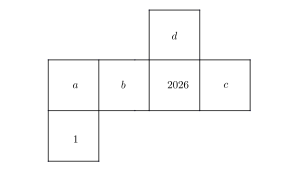
The diagram shows the net of a cube, that is, we can fold along the edges of the squares to make a cube from this net. On each face there is an integer written - $1, a, b, c, d, 2026$. If each of the four numbers $a, b, c, d$ equals the average of the numbers on the four faces of the cube adjacent to it, the value of $a$ is $\rule{2cm}{0.2mm}$
Let $S={1,2,3, \ldots, 15}$. The number of subsets $A$ of $S$ containing four elements such that any two elements of $A$ differ by at least 2 is $\rule{2cm}{0.2mm}$
Given a deck of 52 cards with numbers $1,2, \ldots, 52$ written on them, one number per card. The deck is shuffled and 13 cards are chosen at random form the shuffled deck and thrown away, without noting the numbers on them. From the remaining 39 cards, one card is chosen at random. If the probability that the number on this card is a multiple of 13 is $\frac{m}{n}$, where $m, n$ are integers with no common divisor other than 1 , then $m+n$ equals $\rule{2cm}{0.2mm}$
Suppose 10 objects are placed along a circle at equal distances. The number of ways can three objects be chosen from among them so that no two of the chosen objects are adjacent or diametrically opposite is $\rule{2cm}{0.2mm}$
For a positive integer $n$, let $n \bmod 13$ denote the remainder $r, 0 \leq r<13$ when divided by 13. If $a, b, c$ are integers such that
$$
\begin{array}{rr}
4 a+5 b+6 c=1 & \bmod 13 \
a-b-7 c=3 & \bmod 13 \
3 a-4 b+5 c=9 & \bmod 13
\end{array}
$$
then $a+b+c \bmod 13$ is $\rule{2cm}{0.2mm}$
The sum of all positive integers $N$ less than 2024 such that $N$ equals 13 times the sum of digits of $N$ (when $N$ is written in base 10 ) is $\rule{2cm}{0.2mm}$
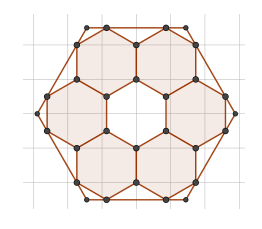
Six identical regular hexagons are arranged inside a larger hexagon as shown in the Figure. The outer hexagon has area 900 square units. The area of the shaded region (the total area contained in the smaller hexagons) is $\rule{2cm}{0.2mm}$ square units.
A positive integer is said to be special if the sum of the remainders obtained when it is divided by five consecutive positive integers is 32 . For example, 24 is special since when divided by $11,12,13,14,15$ the remainders are $2,0,11,10,9$ and these add up to 32 . The smallest positive integer that is special is $\rule{2cm}{0.2mm}$
The largest three digit number with the property that the number is equal to the sum of the hundreds digit, the square of its tens digit and the cube of its units digit is $\rule{2cm}{0.2mm}$
It is a surprising fact that $1 \times 2 \times 3 \times 4 \times 5 \times 6=8 \times 9 \times 10$. It is more surprising that $$8 \times 9 \times 10 \times 11 \times 12 \times 13 \times 14$$ can be written as a product of consecutive positive integers. The smallest number in the product is $\rule{2cm}{0.2mm}$
There are 100 points $P_1, P_2, \ldots, P_{100}$ placed on a line such that the distance between $P_i$ and $P_{i+1}$ is $\frac{1}{i}$ for $1 \leq i \leq 99$. The sum of the distances between every pair of these points is $\rule{2cm}{0.2mm}$
For any positive integer $n$, let $d(n)$ denote the number of divisors of $n$. For example, $d(4)=3$, since the divisors of 4 are $1,2,4$. The smallest positive integer $n$ for which $d(n-2)+d(n)+d(n+2)=21$ is $\rule{2cm}{0.2mm}$
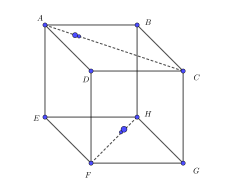
Two bugs sit at the vertices $A$ and $H$ of a cube $A B C D E F G H$ with edge length $4 \sqrt{110}$ units. The bugs start moving simultaneously along $A C$ and $H F$ with the speed of the first bug twice that of the other one. The shortest distance between the bugs is $\rule{2cm}{0.2mm}$
The smallest positive integer $n$ for which it is possible to draw an $n$-gon whose vertex angles all measure $163^{\circ}$ or $171^{\circ}$ is $\rule{2cm}{0.2mm}$
Let $P(x)=a x^3+b x^2+c x+d$ be a cubic polynomial such that $P(2)=7, P(3)=13$ and $P(5)=7$. If the sum of the three roots of $P(x)=0$ is 40 , the value of $P(35)$ is $\rule{2cm}{0.2mm}$

Publishing original scientific research in a peer-reviewed journal is an achievement many scholars work toward for years. Achieving this feat early in one's academic journey requires exceptional intellectual rigor, creativity, and persistence. Aaditya Punatar and Muskan Sadana have reached this remarkable milestone, successfully publishing their collaborative research paper in the prestigious Journal of Emerging Investigators […]

Her project on quantum-accelerated Steiner trees for 15-minute cities earned a place among the finalists at the world's largest pre-college STEM competition. Prishaa Shrimali of Marymount School of New York, was selected as a Grand Finalist at the 2026 Regeneron International Science and Engineering Fair (ISEF) in Phoenix, Arizona. Her project was Optimizing Urban Accessibility: […]

In 2026, the following Cheenta students have been successful for Indian Statistical Institute's M.Stat Entrance. They ranked within the first 50 in the entire country in these entrances. I.S.I. M.Stat Entrance
In 2026, the following Cheenta students have been successful for Indian Statistical Institute's B.Stat Entrance and Chennai Mathematical Institute's B.Sc. Math Entrance. They ranked within the first 200 in the entire country in these entrances. Most of these students attended the problem solving workshops regularly, which happen 5 days every week. CMI B.Sc. Math Entrance […]