$\mathrm{n}, \mathrm{a}$ are natural numbers each greater than 1 . If $a+a+a+a+\ldots+a=2010$, and there are $n$ terms on the left hand side, then the number of ordered pairs $(a, n)$ is
Value of $a$ will be greater than $1$. So first we can find out the factors of $2010$.
So, $2010= 2\times 3 \times 5\times 67$
When the value of $a$ is $2$, value of $n$ is $1005$ and when the value of $a$ is 3 then the value of n is $670$ and vice versa.
So the ordered pairs will be, $(2,1005), (3,670), (5, 402), (6, 335), (10, 201), (15, 134), (30, 67), (67,30), (134, 15), (201, 10), (6, 335), (402, 5), (670, 3), (1005, 2)$
So the number of ordered pairs $(a, n)$ is $14$.
The number of times the digit occurs in the result of $1+11+111+\ldots .+111$
111 (100digits) is $\ldots \ldots .$
sum is
$(123456790) (123456790)\ldots (123456790) (1234567890)$
there are $11$ brackets
so $1$ comes $11$ times
Let us call a sum of integers a cool sum if the first and last terms are 1 and each term differs from its neighbours by at most. For example, $1+2+2+3+3+2+1$ and $1+2+3+4+3+2+1$ are cool sums. The minimum number of terms required to write 2019 as a cool sum is ……
Sequence is
$$
\begin{aligned}
1+2+3+\ldots . .+19+20+21 &+22+23+\ldots \ldots +39+39+40+41+42+43+44+44+43+42+\ldots \ldots+3+2+1
\end{aligned}
$$
So minimum number of terms is $89$.
For each positive integer $n$ let $f(n)=n^{4}-3 n^{2}+9$. Then the sum of all $f(n)$ which are prime is
$f(n)=n^{4}-3 n^{2}+9$
$=n^{4}+6 n^{2}-9 n^{2}+9$
$=\left(n^{2}+3\right)^{2}-(3 n)^{2}$
$=\left(n^{2}+3 n+3\right)\left(n^{2}-3 n+3\right)$
$f(n)$ is prime $\Rightarrow n^{2}-3 n+3=1 \Rightarrow n=1,2$
$f(1)=7, f(2)=13$
sum of values $=7+13=20$
The product of four positive integers $a, b, c$ and $d$ is 9 ! The number $a, b, c, d$ satisfy $a b+a+b=$ 1224, $b c+b+c=549$ and $c d+c+d=351$. The $a+b+c+d=\ldots \ldots$
$$
\text { abcd }=\angle 9=9 \times 8 \times 7 \times 6 \times 5 \times 4 \times 3 \times 2 \times 1
$$
given $a b+a+b=1224 \quad \Rightarrow(1+a)(1+b)=49 \times 25=1225$
Therefore $b c+b+c=549 \quad \Rightarrow(1+b)(1+c)=25 \times 22=550$
and $c d+c+d=351 \Rightarrow(1+c)(1+d)=352=22 \times 16$
So $1+a=49,1+b=25,1+c=22,1+d=16$
$$
a=48, b=24, c=21, d=15
$$
The number of 6 digit numbers of the form "ABCABC", which are divisible by 13 , where $A, B$ and $C$ are distinct digits, $A$ and $C$ being even digits is
$1001 \times \mathrm{ABC}=\mathrm{ABCABC}$ where $1001=13 \times 7 \times 11$ Now $\mathrm{A}$ and $\mathrm{C}$ are even digits and $\mathrm{A}, \mathrm{B}, \mathrm{C}$ are different digits .
Case-I: When $\mathrm{C}$ is zero
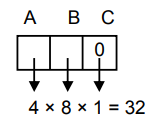
Case-II : When $\mathrm{C}$ is not zero
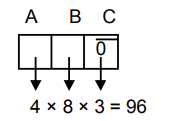
Total number of $6$ digits
Number possible $= 32 + 96 = 128$
In the sequence $1,4,8,10,16,21,25,30$ and 43 , the number of blocks of consecutive terms whose sums are divisible by 11 is
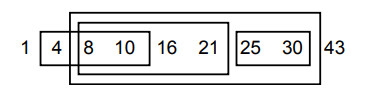
$4+8+10=22$
$8+10+16+21=55$
$8+10+16+21+25+30=110$
$25+30=55$
Exactly four
In the subtraction below, what is the sum of the digits in the result ? $111 \ldots \ldots \ldots . .111$ (100 digits) $-222 \ldots . . .222$ (50 digits)
$1111 \ldots \ldots \ldots \ldots \ldots \ldots .111 \ldots \ldots \ldots \ldots 111$
$\quad \quad \quad \quad \quad \quad \quad \quad \quad \quad 222 \ldots \ldots \ldots \ldots .222$
---------------------------------------------
$1111 \ldots \ldots \ldots \ldots \ldots \ldots .108 \ldots \ldots \ldots \ldots .889$
49 times 1,49 times 8 and 1 times 0 and 9
Sum $=49 \times 1+8 \times 49+9$
Therefore
$\Rightarrow \quad 49+392+9=450 .$
The least odd prime factor of $2019^{8}+1$ is
Let $P$ be an odd prime which divides $2019^{8}+1$
So $2019^{8} \equiv-1(\bmod P)$
$\Rightarrow \quad 2019^{16} \equiv 1(\bmod P)$
Now by Euler's theorem
$2019^{P-1} \equiv 1(\bmod \mathrm{P})$
So $P-1$ should be divisible by $16$
Where $P$ is a prime
First two prime numbers which gives remainder $1$ when divided by $16$ is $17$ and $97$
Case-1 $\quad \mathrm{P}=17$
$2019^{8}+1 \equiv 13^{8}+1 \equiv 4^{8}+1 \equiv 16^{4}+1 \equiv 2 $(mode $17$)
While
$2019^{8}+1=79^{8}+1=18^{8}+1=324^{4}+1=33^{4}+1=1089^{2}+1=22^{2}+1=485=0$ (mod $97$)
So the answer is $97$ .
Let $a, b, c$ be positive integers each less than 50 , such that $a^{2}-b^{2}=100 c$. The number of such triples $(a, b, c)$ is
$a^{2}-b^{2}=100 c$
As $a^{2}-b^{2}$ is a multiple of $100 .$
So it means the last $2$ digit of $a^{2}$ and $b^{2}$ is same.
So $(a, b)$ can be $(49,1)(48,2)(47,3) \ldots \ldots \ldots \ldots .(26,24)$ .
So there are $24$ such pairs .
One more pair for $(a, b)$ is $(25,15)$ .
So total $25$ pairs are possible.
If $4921 \times D=A B B B D$, then the sum of the digits of $A B B B D \times D$ is
4-digit no. (4921) is multiplied by a single digit no. (D) \& result is five digit no., so definitely $D>2$
So by hit \& trial we put the values of D from 3 to 9 .
at $\mathrm{D}=7$
$4921 \times 7=34447$
$(\mathrm{ABBBD})$
So $\mathrm{A}=3, \quad \mathrm{~B}=4, \mathrm{D}=7$
Now ABBBD $(34447) \times 7=241129$
Sum of digits $=2+4+1+1+2+9=19$
What is the $2019^{\text {th }}$ digit to the right of the decimal point, in the decimal representation of $\frac{5}{28}$ ?
$$
\frac{5}{28}=\cdot 17 \overline{857142}
$$
$\Rightarrow \quad 2019=2+336 \times 6+1$ [2 for $17 \& 336$ pairs of 6 repeating number]
$2019^{\text {th }}$ digit from right side to decimal is first digit in repetition
So correct answer is $8$.
If $\mathrm{X}$ is a 1000 digit number, $Y$ is the sum of its digits, $Z$ the sum of the digits of $Y$ and $W$ the sum of the digits of $Z$, then the maximum possible value of $W$ is
$\mathrm{X} \rightarrow 1000$ digit no. If all digit are ' 9 ' so that maximum sum of digit of ' $\mathrm{X}$ ' is 9000 So maximum value of $Y$ is 9000
But for maximum sum of digit of $Y$ is 35 for number (8999) So $Z$ is maximum 35 .
Now for maximum sum of digit of $Z$ is 11 for number $29 .$ So $W=11$. Practical example: if $\quad X=\underbrace{99 \ldots 9}_{333 \text { times }} \quad \underbrace{000 \ldots 0}_{666 \text { times }} 2$ Sum of digit of $X=Y=2999$ Sum of digit of $Y=Z=29$ Sum of digit of $Z=W=11$
Let $x$ be the number $0.000$. 001 which has 2019 zeroes after the decimal point. Then which of the following numbers is the greatest?
(A) $10000+x$, (B) $10000 \cdot x$, (C) $\frac{10000}{x}$, (D) $\frac{1}{x^{2}}$
$$
x=\cdot 000 \ldots 01=10^{-2020}
$$
From option $(A)=10000+x=1000+10^{-2020}=10000 \cdot \underbrace{000 \ldots .01}_{2019 \text { times }}$
From option $(\mathrm{B})=10000 \times \mathrm{x}=10^{4} \times 10^{-2020}=10^{-2016}$
From option $(C)=\frac{10000}{x}=\frac{10^{4}}{10^{-2020}}=10^{2024}$
From option $(D)=\frac{1}{x^{2}}=\frac{1}{\left(10^{-2020}\right)^{2}}=10^{4040}$
So from options $\frac{1}{x^{2}}$ is greatest.
$A B C$
then the number of possible values for $A, B, C, D, E$ satisfying this equation where
If $\frac{C \mathrm{CBA}}{\mathrm{DEDD}}$ then the number of $\mathrm{A}, \mathrm{B}, \mathrm{C}, \mathrm{D}$ and $\mathrm{E}$ are distinct digits is
$\quad \quad ABC$
$+\quad CBA$
_________
$\quad DEDD$
$D \rightarrow$ must be $1$
Means $C+A=1$ or 11
$So \quad$ Sum of $B+B$ is even $\& D$ is $1 .$
So possible values of B is 0 or 5 .
But if we take $B$ as ' 0 ' so there is no carry forward \& Sum of $A \& C$, did not get different digit from D.
So B must be 5 .
Sum is convert into
$A 5 C$
$C 5 A$
_____
$1211$
Now possible pairs of $(A, C)$ are $(3,8)(4,7)(7,4)(8,3)$
So total 4 possible solutions are there.
$\mathrm{R} A \mathrm{~T}$
If $+\mathrm{MAC}$ and each alphabet represents a different digit, what is the maximum possible value $+\frac{\mathrm{VAT}}{\mathrm{FLAT}}$
of FLAT?
T should be 0 or 5
But if we take $T$ as ' 5 ' sum is $15 \& 1$ carry is forward and sum of 3 'A' and '1' never give unit digit 'A' So T must be '0'
Now again possible values of $A$ are $' 0 ' \& 5$ but alphabet represents different digits so $\mathrm{A}$ is 5 . For maximum value of FLAT, we take maximum value of $R, M \& V$ as $9,8 \& 7$, but sum is $25 \& 5$ is repeat.
So by taking $R, M \& V$ as $9,8 \& 6$. We get maximum value of FLAT.
$$
$\ \ 9 5 0 $
$\ \ 8 5 0 $
$\ \ 6 5 0 $
______
$ 2 4 5 0 $
$FLAT \Rightarrow 2450$
There are exactly 5 prime numbers between 2000 and 2030 . Note: $2021=43 \times 47$ is not a prime number. The difference between the largest and the smallest among these is
Prime no's between $2000 \& 2030$ are $2003,2011,2017,2027,2029$
Difference between $2029 \& 2003$ is
$$
2029-2003=26
$$
A teacher asks 10 of her students to guess her age. They guessed it as $34,38,40,42,46,48,51$, 54,57 and 59 . Teacher said "At least half of you guessed it too low and two of you are off by one. Also my age is a prime number". The teacher's age is
Age of teacher is greater than $46$ .
Again according to questions two of them are off by one.
So there are two possibilities $47 \&\ 58$
$47$ from $(46 \&\ 48)$
$58$ from $(57 \&\ 59)$
But $58$ is not a prime so age of teacher in $47$ .
The sum of 8 positive integers is 22 and their LCM is 9 . The number of integers among these that are less than 4 is
L.C.M. is 9 , so all numbers are from $1,3 \&\ 9$. If we take 2 times 9 sum as 22 is not possible so, 9 will come only one time $\&$ remaining 7 numbers are from $1 \&\ 3$.
So 4 times $1 \&\ 3$ times 3 will come.
$$
1+1+1+1+3+3+3+9=22
$$
So numbers less than 4 is 7
The number of natural numbers $n \leq 2019$ such that $\sqrt[3]{48 n}$ is an integer is
So $\mathrm{n}$ should be multiple of $2^{2} \times 3^{2}=36$ for integer value.
$\mathrm{n} \leq 2019$ $\sqrt[3]{48 \mathrm{n}}=$ integer $\sqrt[3]{2^{4} \times 3 \times n}=$ integer $2 \times \sqrt[3]{2 \times 3 n}=$ integer.
So $\mathrm{n}$ should be multiple of $2^{2} \times 3^{2}=36$ for intege So, possible 'n' are $=2^{2} \times 3^{2}=36<2019$
$=2^{2} \times 3^{2} \times 2^{3}=288<2019$
$=2^{2} \times 3^{2} \times 3^{3}=972<2019$
$=2^{2} \times 3^{2} \times 4^{3}=2304>2019$ (reject)
So only three values of $n$ are possible $36,288,972$
The number of perfect cubes that lie between $2^{9}+1$ and $2^{18}+1$ is
$\left(2^{3}\right)^{3}+1$ and $\left(2^{6}\right)^{3}+1$ $8^{3}+1$ and $64^{3}+1$
Numbers lies between $9,10,11, \ldots \ldots \ldots .64$ Total perfect cubes number $64-8=56$.

Publishing original scientific research in a peer-reviewed journal is an achievement many scholars work toward for years. Achieving this feat early in one's academic journey requires exceptional intellectual rigor, creativity, and persistence. Aaditya Punatar and Muskan Sadana have reached this remarkable milestone, successfully publishing their collaborative research paper in the prestigious Journal of Emerging Investigators […]
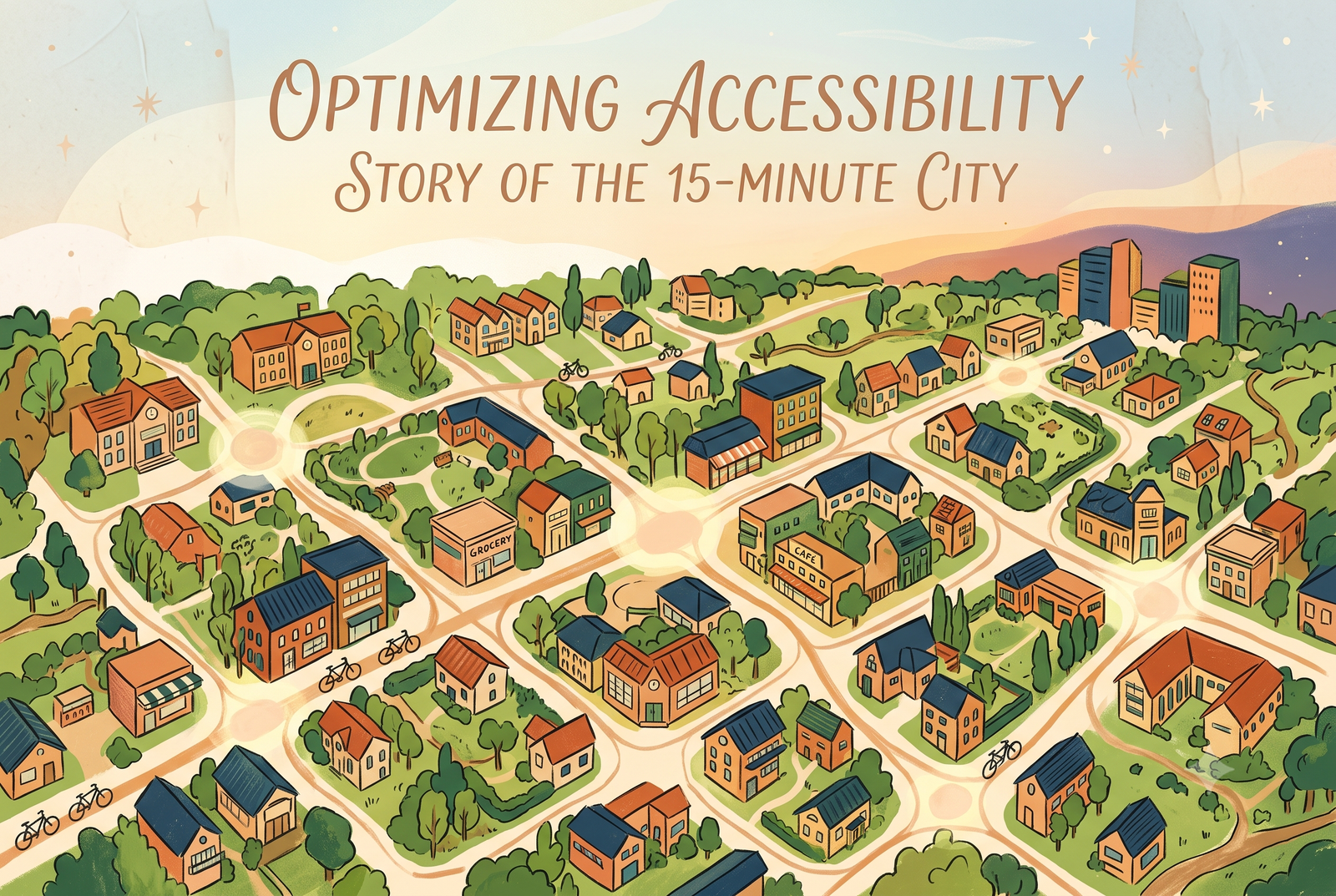
Her project on quantum-accelerated Steiner trees for 15-minute cities earned a place among the finalists at the world's largest pre-college STEM competition. Prishaa Shrimali of Marymount School of New York, was selected as a Grand Finalist at the 2026 Regeneron International Science and Engineering Fair (ISEF) in Phoenix, Arizona. Her project was Optimizing Urban Accessibility: […]
In 2026, the following Cheenta students have been successful for Indian Statistical Institute's M.Stat Entrance. They ranked within the first 50 in the entire country in these entrances. I.S.I. M.Stat Entrance
In 2026, the following Cheenta students have been successful for Indian Statistical Institute's B.Stat Entrance and Chennai Mathematical Institute's B.Sc. Math Entrance. They ranked within the first 200 in the entire country in these entrances. Most of these students attended the problem solving workshops regularly, which happen 5 days every week. CMI B.Sc. Math Entrance […]