This problem based on Central Limit Theorem gives a detailed solution to ISI M.Stat 2018 PSB Problem 7, with a tinge of simulation and code.
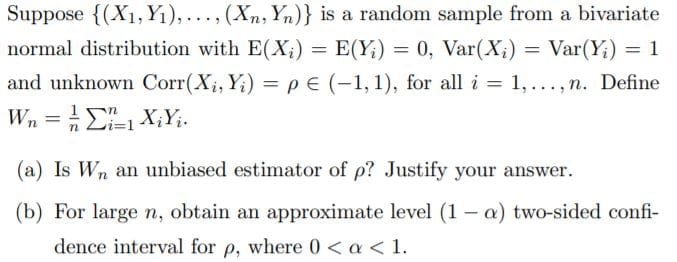
Suppose \(\left(X_{1}, Y_{1}\right), \ldots,\left(X_{n}, Y_{n}\right)\) is a random sample from a bivariate normal distribution with \(\mathrm{E}\left(X_{i}\right)=\mathrm{E}\left(Y_{i}\right)=0, Var\left(X_{i}\right)=Var\left(Y_{i}\right)=1\)
and unknown \(Corr\left(X_{i}, Y_{i}\right)=\rho \in(-1,1),\) for all \(i=1, \ldots, n .\) Define \(W_{n}=\frac{1}{n} \sum_{i=1}^{n} X_{i} Y_{i}\) a) Is \(W_{n}\) an unbiased estimator of \(\rho ?\) Justify your answer.
(b) For large \(n,\) obtain an approximate level \((1-\alpha)\) two-sided confi-
dence interval for \(\rho,\) where \(0<\alpha<1\).
(a)
Just compute the \(E(W_{n}\)).
\(E(W_{n})\) = \(\frac{1}{n} \sum_{i=1}^{n} E(X_{i} Y_{i})\) = \(\frac{1}{n} \sum_{i=1}^{n} \rho = \rho \).
\( \rho = E(X_{i} Y_{i}) - E(X_{i})E(Y_{i}) \overset{E(X_{i}) = E(Y_{i}) = 0}{=} E(X_{i} Y_{i})\).
So, \(W_{n}\) is unbiased for \( \rho \).
(b)
Observe that \(\left(X_{i}, Y_{i}\right)\) and \(\left(X_{j}, Y_{j}\right)\) are independent sample and therefore iid.
So, \(\left(X_{i}Y_{i}\right)\) and \(\left(X_{j}Y_{j}\right)\) are also iid.
Hence, computing the limiting distribution of \(W_{n}\), flashes in our minds, the Central Limit Theorem. So, let's dig into it. But, for that we need the following:
So, how to calculate the \({E((X_{1}Y_{1})^2)}\). For that
Two random variables \(X\) and \(Y\) are said to be jointly normal if they can be expressed in the form \(X = aU + bV, Y = cU + dV \), where \(U\) and \(V\) are independent standard normal random variables.
Alternate Definition of Bivariate Normal
Why do we need this? Because, \(X\) and \(Y\) are not independent and they have a correlation coefficient between them.
Assume, \((X, Y)\) ~ \((X_1, Y_1)\).
Exercise: Using the above result, prove that \(Y\) can be written as \( Y = \rho X + \sqrt{(1-\rho^2)}V\), where \(V\) ~ N(0,1) and \(V\) is independent of \(X\).
\(Y^2 = \rho^2X^2 + (1-\rho^2)V^2 + 2\rho\sqrt{(1-\rho^2)}XV\)
\(E(X^2Y^2) = E(\rho^2 X^4 + (1-\rho^2)X^2V^2 + 2\rho\sqrt{(1-\rho^2)}X^3V ) = \\ \rho^2E(X^4) + (1-\rho^2)E(X^2V^2) = \rho^2E(X^4) + (1-\rho^2)E(X^2)E(V^2) = 3\rho^2 + (1-\rho^2) = 1 + 2\rho^2\).
Exercise: Justify the above steps, using the independence of \(X\) and \(V\).
We used the fact that \(E(X^4) = 3\) if \(X\) ~ N(0,1). Instead of computing the whole we will use the fact that \( E(Z) = n\) and \(Var(Z) = 2n\) if \(Z\) ~ \( {{\chi}_n}^2\).
Exercise: Prove that \(E(X^4) = 3\) if \(X\) ~ N(0,1) using the above hint that \( X^2\) ~ \({{\chi}_1}^2\).
The final result, we got is the following:
\(Var(W_{n}) = \frac{1 + 2\rho^2}{n}\).
\(E(W_{n}) = \rho\).
Now use Central Limit Theorem.
\( \frac{\sqrt{n}(W_{n} - \rho)}{\sqrt{1 + 2\rho^2}} \to N(0, 1)\)
Therefore, \( P( |\frac{\sqrt{n}(W_{n} - \rho)}{\sqrt{1 + 2\rho^2}}| \leq z_{\alpha / 2} ) = (1-\alpha)\).
So, \( P(\left[W_{n} - z_{\alpha / 2} \left(\frac{\sqrt{1 + 2\rho^2}}{\sqrt{n}}\right) \leq \rho \leq W_{n} +z_{\alpha / 2} \left( \frac{\sqrt{1 + 2\rho^2}}{\sqrt{n}} \right) \right]) = (1-\alpha)\). Now, you have to square it to get a confidence interval for \(\rho^2\).
But, we can use variance stablizing transformation (pivotal method).
Observe that \(f(x) = \int \frac{1}{\sqrt{1+2u^2}} = ln|x+\sqrt{\frac{1}{2} + x^2} |\), which is an increasing and hence bijective function.
\( {\sqrt{n}(f(W_{n}) - f(\rho))} \to N(0, c)\). Calculate this constanc \( c = f'(\rho)^2.{\sqrt{1 + 2\rho^2}} \)
Now, try to find a confidence interval for \(f(\rho)\) based on this. Then take the inverse of \(f(x)\) to get a confidence interval for \(\rho\).
N <- 2000 # Number of random samples
# Target parameters for univariate normal distributions
v = NULL
rho <- 0.5
mu1 <- 0; s1 <- 1
mu2 <- 0; s2 <- 1
mu <- c(mu1,mu2) # Mean
sigma <- matrix(c(s1^2, s1*s2*rho, s1*s2*rho, s2^2),
                2) # Covariance matrix
library(MASS)
for (i in 1:1000) {
bvn1 <- mvrnorm(N, mu = mu, Sigma = sigma ) # from MASS package
W = bvn1[,1]*bvn1[,2]
Wbar = mean(W)
v = c(v, Wbar)
}
hist(v, freq =  F)
sigma2 = sqrt(1 + 2*rho^2)/sqrt(N)
x = seq(0.4, 0.6, 0.00001)
curve(dnorm(x, rho, sigma2), from = 0, col = "red", add = TRUE)
This problem was a bit more mathematical and technical, but still, I hope that the simulation along with the proofs gave you a good reading experience. Stay Tuned!

Publishing original scientific research in a peer-reviewed journal is an achievement many scholars work toward for years. Achieving this feat early in one's academic journey requires exceptional intellectual rigor, creativity, and persistence. Aaditya Punatar and Muskan Sadana have reached this remarkable milestone, successfully publishing their collaborative research paper in the prestigious Journal of Emerging Investigators […]

Her project on quantum-accelerated Steiner trees for 15-minute cities earned a place among the finalists at the world's largest pre-college STEM competition. Prishaa Shrimali of Marymount School of New York, was selected as a Grand Finalist at the 2026 Regeneron International Science and Engineering Fair (ISEF) in Phoenix, Arizona. Her project was Optimizing Urban Accessibility: […]

In 2026, the following Cheenta students have been successful for Indian Statistical Institute's M.Stat Entrance. They ranked within the first 50 in the entire country in these entrances. I.S.I. M.Stat Entrance

In 2026, the following Cheenta students have been successful for Indian Statistical Institute's B.Stat Entrance and Chennai Mathematical Institute's B.Sc. Math Entrance. They ranked within the first 200 in the entire country in these entrances. Most of these students attended the problem solving workshops regularly, which happen 5 days every week. CMI B.Sc. Math Entrance […]
The confidence interval contains the unknown parameter i.e. correlation coefficient(row). How?
First of all, this is a large sample confidence interval. With respect to the large sample, the expectation of Wn when n large goes to rho. Hence, we are seeing the confidence interval around the mean. Just, expand that out. You will get the expression. See I have added a new portion. Thanks for your doubt. Stay tuned.
Why is the variance of X1Y1 = E(X1Y1)^2?
E(X1Y1) is rho and not zero
Variance of X1Y1 should be 1+rho^2.
var(Wn) will be (1-rho^2)/n
because var(Wn)=var(x1y1)/n
& var(X1Y1)=E(X1Y1)^2-(E(X1Y1))^2
=1+2*rho^2 - rho^2
=1+rho^2
hence var(Wn)=(1+rho^2)/n