ISI Entrance 2006 - B.Stat Subjective Paper| Problems & Solutions
 Join Trial or Access Free ResourcesJoin Trial or Access Free Resources
Here, you will find all the questions of ISI Entrance Paper 2006 from Indian Statistical Institute's B. Stat Entrance. You will also get the solutions soon of all the previous year problems.
Problem1 :
If the normal to the curve \(\displaystyle{ x^{\frac{2}{3}}+y^{\frac23}=a^{\frac23} }\) at some point makes an angle \(\displaystyle{\theta}\) with the \(X\)-axis, show that the equation of the normal is
$$\displaystyle{y\cos\theta-xsin\theta =a\cos 2\theta}$$
Problem 2 :
Suppose that \( a \) is an irrational number.
(a) If there is a real number \( b \) such that both \( (a+b) \) and \( ab \) are rational numbers, show that \( a \) is a quadratic surd. (\( a \) is a quadratic surd if it is of the form \(\displaystyle{r+\sqrt{s}}\) or \(\displaystyle{r-\sqrt{s}}\) for some rationals \( r \) and \( s \), where \( s \) is not the square of a rational number).
(b) Show that there are two real numbers \(\displaystyle{b_1}\) and \(\displaystyle{b_2}\) such that
i) \(\displaystyle{a+b_1}\) is rational but \(\displaystyle{ab_1}\) is irrational.
ii) \(\displaystyle{a+b_2}\) is irrational but \(\displaystyle{ab_2}\) is rational.
(Hint: Consider the two cases, where \( a \) is a quadratic surd and \( a \) is not a quadratic surd, separately).
Problem3 :
Prove that \(\displaystyle{n^4 + 4^{n}}\) is composite for all values of \( n \) greater than \( 1 \).
Discussion
Problem4 :
In the figure below, \( E \) is the midpoint of the arc \( ABEC \) and the segment \( ED \) is perpendicular to the chord \( BC \) at \( D \). If the length of the chord \( AB \) is \(\displaystyle{l_1}\), and that of the segment \( BD \) is \(\displaystyle{l_2}\), determine the length of \( DC \) in terms of \(\displaystyle{l_1, l_2}\).
Discussion
Problem 5 :
Let \( A,B \) and \( C \) be three points on a circle of radius \( 1 \).
(a) Show that the area of the triangle \( ABC \) equals \( \frac{1}{2}(\sin (2 \angle A B C)+\sin (2 \angle B C A)\\+\sin (2 \angle C A B)) \)
(b) Suppose that the magnitude of \(\displaystyle{\angle ABC}\) is fixed. Then show that the area of the triangle \( ABC \) is maximized when \(\displaystyle{\angle BCA=\angle CAB}\)
(c) Hence or otherwise, show that the area of the triangle \(ABC\) is maximum when the triangle is equilateral.
Problem 6 :
(a) Let \(\displaystyle{f(x)=x-xe^{-\frac1x}, x>0 }\). Show that \( f(x) \) is an increasing function on \(\displaystyle{(0,\infty)}\), and \(\displaystyle{\lim_{x\to\infty} f(x)=1}\).
(b) Using part (a) or otherwise, draw graphs of \(\displaystyle{y=x-1, y=x, y=x+1}\) , and \( y=xe^{-\frac{1}{|x|}} \) for \(\displaystyle{-\infty < x < \infty}\) using the same \( X \) and \( Y \) axes.
Problem 7 :
For any positive integer \( n \) greater than \( 1 \), show that \(\displaystyle{2^n < {{2n} \choose{n}} <\frac{2^n}{\prod\limits_{i=0}^{n-1} \left(1-\frac{i}{n}\right)}}\)
Problem 8:
Show that there exists a positive real number \(\displaystyle{x\neq 2}\) such that \(\displaystyle{\log_2x=\frac{x}{2}}\). Hence obtain the set of real numbers \( c \) such that \(\displaystyle{\frac{\log_2x}{x}=c}\) has only one real solution.
Problem 9 :
Find a four digit number \( M \) such that the number \(\displaystyle{N=4\times M}\) has the following properties.
(a) \( N \) is also a four digit number
(b) \( N \) has the same digits as in \( M \) but in reverse order.
Problem 10 :
Consider a function \( f \) on nonnegative integers such that \( f(0)=1 \), \( f(1)=0 \) and \( f(n) \)+\( f(n-1) \)=\( nf(n-1) \)+\( (n-1)f(n-2) \) for \(\displaystyle{n \ge 2}\). Show that \(\displaystyle{\frac{f(n)}{n!}= sum_{k=0}^n \frac{(-1)^k}{k!}}\)

In 2025, 8 students from Cheenta Academy cracked the prestigious Regional Math Olympiad. In this post, we will share some of their success stories and learning strategies. The Regional Mathematics Olympiad (RMO) and the Indian National Mathematics Olympiad (INMO) are two most important mathematics contests in India.These two contests are for the students who are […]
Cheenta Academy proudly celebrates the success of 27 current and former students who qualified for the Indian Olympiad Qualifier in Mathematics (IOQM) 2025, advancing to the next stage — RMO. This accomplishment highlights their perseverance and Cheenta’s ongoing mission to nurture mathematical excellence and research-oriented learning.
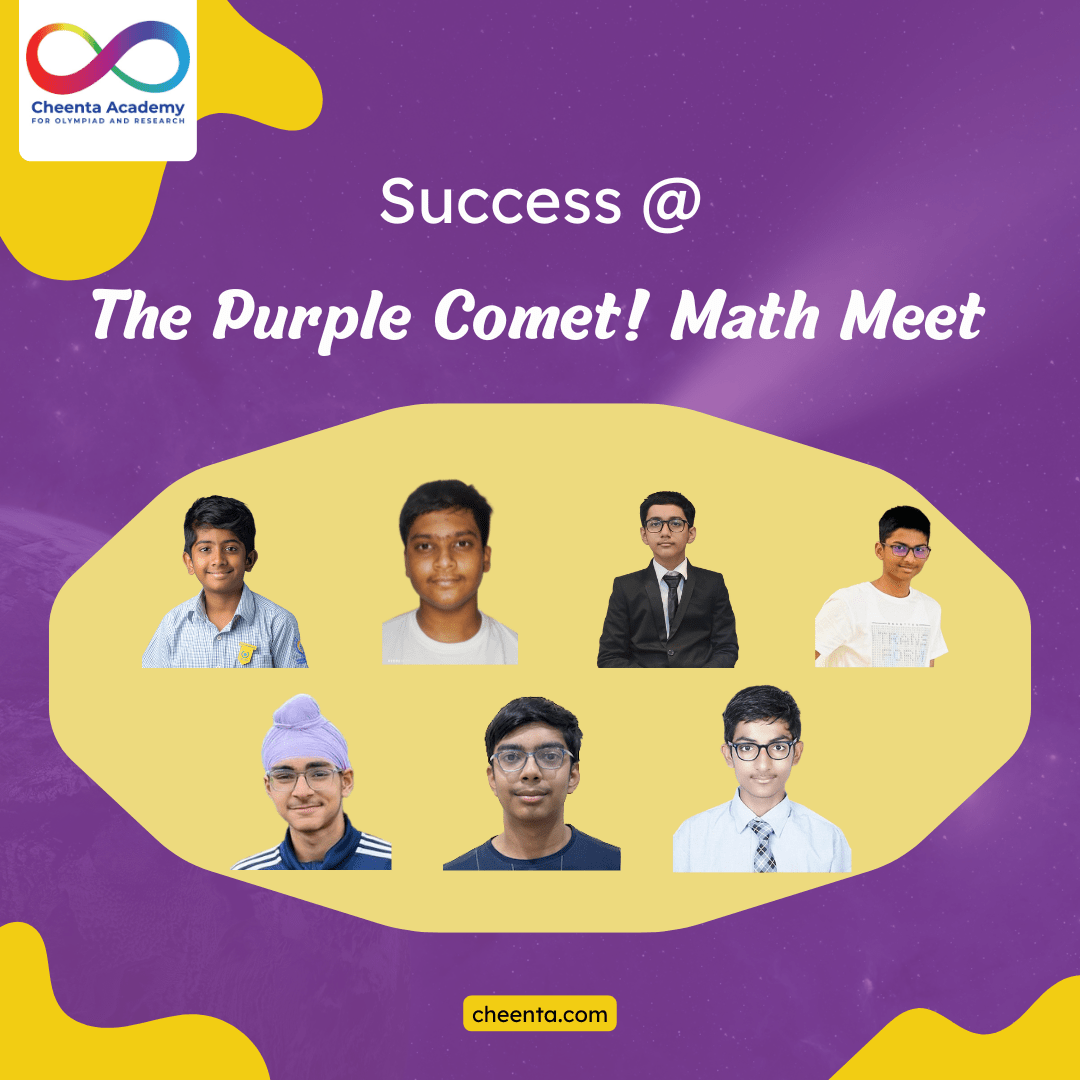
Cheenta students shine at the Purple Comet Math Meet 2025 organized by Titu Andreescu and Jonathan Kanewith top national and global ranks.
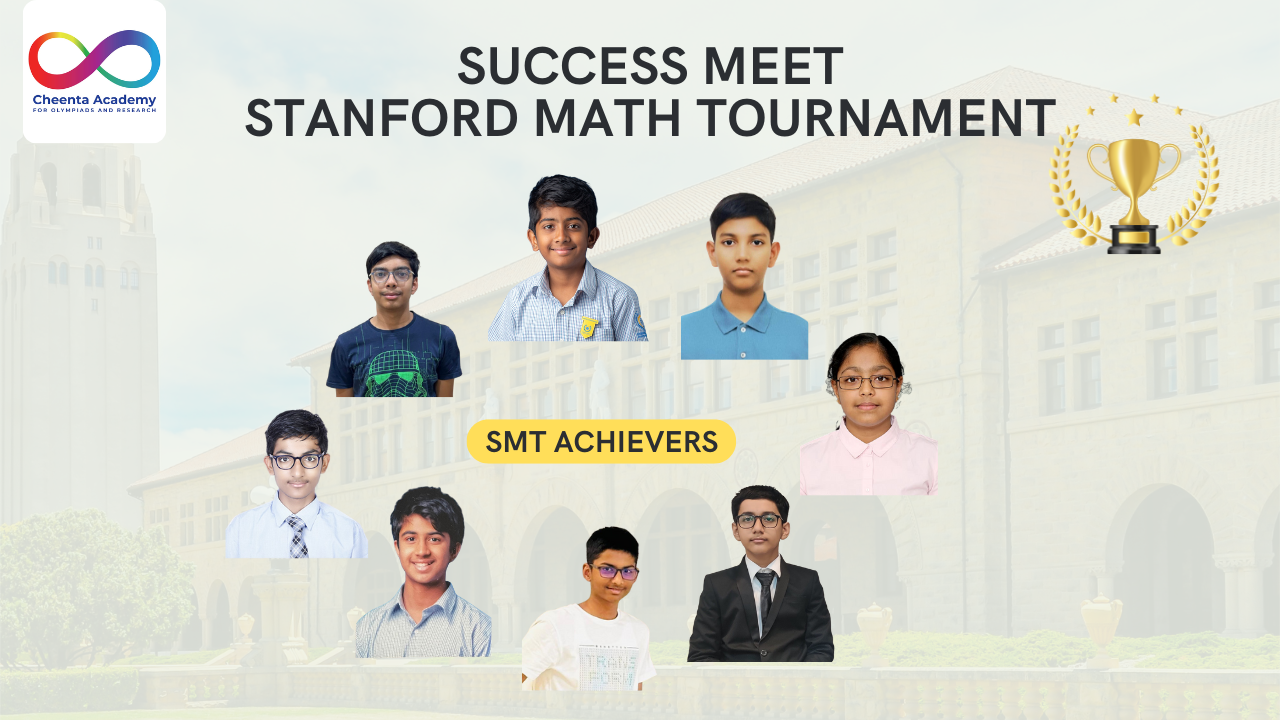
Celebrate the success of Cheenta students in the Stanford Math Tournament. The Unified Vectors team achieved Top 20 in the Team Round.
