What is the value of $$ 1-(-2)-3-(-4)-5-(-6) ? $$
Carl has 5 cubes each having side length 1 , and Kate has 5 cubes each having side length 2 . What is the total volume of these 10 cubes?
The ratio of $w$ to $x$ is $4: 3$, the ratio of $y$ to $z$ is $3: 2$, and the ratio of $z$ to $x$ is $1: 6$. What is the ratio of $w$ to $y$ ?
The acute angles of a right triangle are $a^{\circ}$ and $b^{\circ}$, where $a>b$ and both $a$ and $b$ are prime numbers. What is the least possible value of $b$ ?
How many distinguishable arrangements are there of 1 brown tile, 1 purple tile, 2 green tiles, and 3 yellow tiles in a row from left to right? (Tiles of the same color are indistinguishable.)
Driving along a highway, Megan noticed that her odometer showed 15951 (miles). This number is a palindrome-it reads the same forward and backward. Then 2 hours later, the odometer displayed the next higher palindrome. What was her average speed, in miles per hour, during this 2 -hour period?
How many positive even multiples of 3 less than 2020 are perfect squares?
Points $P$ and $Q$ lie in a plane with $P Q=8$. How many locations for point $R$ in this plane are there such that the triangle with vertices $P$, $Q$, and $R$ is a right triangle with area 12 square units?
How many ordered pairs of integers $(x, y)$ satisfy the equation $$ x^{2020}+y^{2}=2 y ? $$
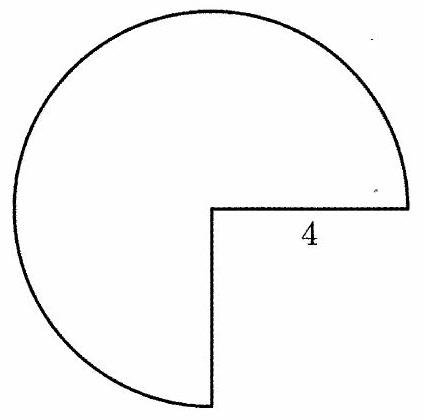
A three-quarter sector of a circle of radius 4 inches together with its interior can be rolled up to form the lateral surface of a right circular cone by taping together along the two radii shown. What is the volume of the cone in cubic inches?
Ms. Carr asks her students to read any 5 of the 10 books on a reading list. Harold randomly selects 5 books from this list, and Betty does the same. What is the probability that there are exactly 2 books that they both select?
The decimal representation of $$ \frac{1}{20^{20}} $$ consists of a string of zeros after the decimal point, followed by a 9 and then several more digits. How many zeros are in that initial string of zeros after the decimal point?
Andy the Ant lives on a coordinate plane and is currently at ( $-20,20$ ) facing east (that is, in the positive $x$-direction). Andy moves 1 unit and then turns $90^{\circ}$ left. From there, Andy moves 2 units (north) and then turns $90^{\circ}$ left. He then moves 3 units (west) and again turns $90^{\circ}$ left. Andy continues this process, increasing his distance each time by 1 unit and always turning left. What is the location of the point at which Andy makes the 2020th left turn?
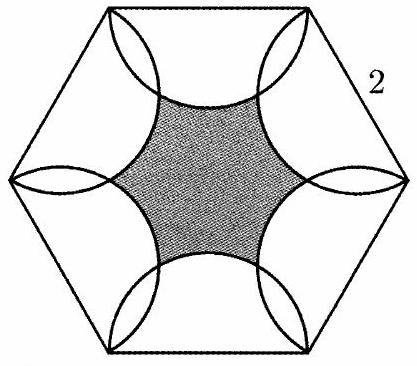
As shown in the figure below, six semicircles lie in the interior of a regular hexagon with side length 2 so that the diameters of the semicircles coincide with the sides of the hexagon. What is the area of the shaded region-inside the hexagon but outside all of the semicircles?
Steve wrote the digits $1,2,3,4$, and 5 in order repeatedly from left to right, forming a list of 10,000 digits, beginning $123451234512 \ldots$. He then erased every third digit from his list (that is, the 3rd, 6th, 9th, ... digits from the left), then erased every fourth digit from the resulting list (that is, the 4th, 8th, 12th, ... digits from the left in what remained), and then erased every fifth digit from what remained at that point. What is the sum of the three digits that were then in positions 2019, 2020, and 2021 ?
Bela and Jenn play the following game on the closed interval $[0, n]$ of the real number line, where $n$ is a fixed integer greater than 4 . They take turns playing, with Bela going first. At his first turn, Bela chooses any real number in the interval $[0, n]$. Thereafter, the player whose turn it is chooses a real number that is more than one unit away from all numbers previously chosen by either player. A player unable to choose such a number loses. Using optimal strategy, which player will win the game?
There are 10 people standing equally spaced around a circle. Each person knows exactly 3 of the other 9 people: the 2 people standing next to her or him, as well as the person directly across the circle. How many ways are there for the 10 people to split up into 5 pairs so that the members of each pair know each other?
An urn contains one red ball and one blue ball. A box of extra red and blue balls lies nearby. George performs the following operation four times: he draws a ball from the urn at random and then takes a ball of the same color from the box and returns those two matching balls to the urn. After the four iterations the urn contains six balls. What is the probability that the urn contains three balls of each color?
In a certain card game, a player is dealt a hand of 10 cards from a deck of 52 distinct cards. The number of distinct (unordered) hands that can be dealt to the player can be written as $158 A 00 A 4 A A 0$. What is the digit $A$ ?
Let $B$ be a right rectangular prism (box) with edge lengths 1,3 , and 4 , together with its interior. For real $r \geq 0$, let $S(r)$ be the set of points in 3-dimensional space that lie within a distance $r$ of some point in $B$. The volume of $S(r)$ can be expressed as $a r^{3}+b r^{2}+c r+d$, where $a$, $b, c$, and $d$ are positive real numbers. What is $\frac{b c}{a d}$ ?
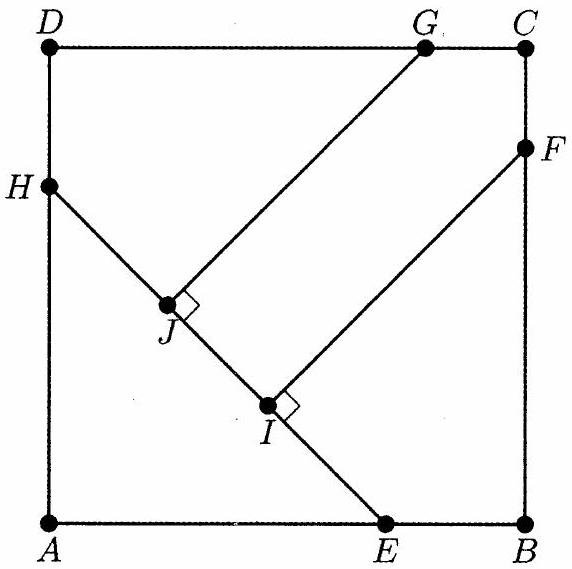
In square $A B C D$, points $E$ and $H$ lie on $\overline{A B}$ and $\overline{D A}$, respectively, so that $A E=A H$. Points $F$ and $G$ lie on $\overline{B C}$ and $\overline{C D}$, respectively, and points $I$ and $J$ lie on $\overline{E H}$ so that $\overline{F I} \perp \overline{E H}$ and $\overline{G J} \perp \overline{E H}$. See the figure below. Triangle $A E H$, quadrilateral $B F I E$, quadrilateral $D H J G$, and pentagon $F C G J I$ each has area 1 . What is $F I^{2}$ ?
What is the remainder when $2^{202}+202$ is divided by $2^{101}+2^{51}+1$ ?
Square $A B C D$ in the coordinate plane has vertices at the points $A(1,1), B(-1,1), C(-1,-1)$, and $D(1,-1)$. Consider the following four transformations:
How many positive integers $n$ satisfy $$ \frac{n+1000}{70}=\lfloor\sqrt{n}\rfloor ? $$ (Recall that $\lfloor x\rfloor$ is the greatest integer not exceeding $x$.)
Let $D(n)$ denote the number of ways of writing the positive integer $n$ as a product $$ n=f_{1} \cdot f_{2} \cdots f_{k} \text {, } $$ where $k \geq 1$, the $f_{i}$ are integers strictly greater than 1 , and the order in which the factors are listed matters (that is, two representations that differ only in the order of the factors are counted as distinct). For example, the number 6 can be written as $6,2 \cdot 3$, and $3 \cdot 2$, so $D(6)=3$. What is $D(96)$ ?

Publishing original scientific research in a peer-reviewed journal is an achievement many scholars work toward for years. Achieving this feat early in one's academic journey requires exceptional intellectual rigor, creativity, and persistence. Aaditya Punatar and Muskan Sadana have reached this remarkable milestone, successfully publishing their collaborative research paper in the prestigious Journal of Emerging Investigators […]

Her project on quantum-accelerated Steiner trees for 15-minute cities earned a place among the finalists at the world's largest pre-college STEM competition. Prishaa Shrimali of Marymount School of New York, was selected as a Grand Finalist at the 2026 Regeneron International Science and Engineering Fair (ISEF) in Phoenix, Arizona. Her project was Optimizing Urban Accessibility: […]

In 2026, the following Cheenta students have been successful for Indian Statistical Institute's M.Stat Entrance. They ranked within the first 50 in the entire country in these entrances. I.S.I. M.Stat Entrance
In 2026, the following Cheenta students have been successful for Indian Statistical Institute's B.Stat Entrance and Chennai Mathematical Institute's B.Sc. Math Entrance. They ranked within the first 200 in the entire country in these entrances. Most of these students attended the problem solving workshops regularly, which happen 5 days every week. CMI B.Sc. Math Entrance […]