Bhaskara Contest (NMTC JUNIOR LEVEL-IX and X Grades) 2023 - Problems and Solutions
 Join Trial or Access Free ResourcesJoin Trial or Access Free Resources
If $a, b, c$ are real numbers such that the polynomial $x^3+6 x^2+a x+b$ is the cube of $(x+c)$ then
a) $(a+b+c)$ is divisible by 13
b) $a+b=11 c$
c) $a>b$ and $b<c$.
(4) $(a+b+c)$ is divisible by 11 .
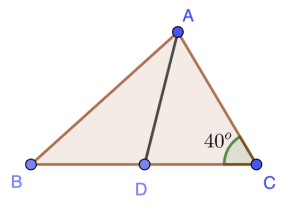
In the adjoining figure, $A B=9 \mathrm{~cm}, A C=7 \mathrm{~cm}$, $B C=8 \mathrm{~cm}, A D$ is the median and $\angle C=40^{\circ}$. Then measure of $\angle A D B$ (in degrees) is
a) 100
b) 140
c) 45
d) 120
If $x^2+6 x+1=0$ and $\frac{x^3+k x^2+1}{3 x^3+k x^2+3 x}=2$ then the value of $k$ is
a) 68
b) 72
c) 65
d) 70
If $x=\sqrt[3]{49}+\sqrt[3]{42}+\sqrt{36}$, then the value of $x-\frac{1}{x^2}$ is
a) $2 \sqrt[3]{42}$
b) $3 \sqrt[4]{42}$
c) $\sqrt[4]{42}$
d) $4 \sqrt[3]{42}$
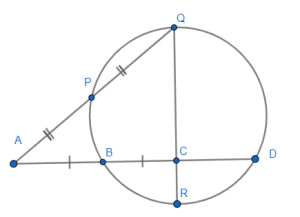
In the adjoining figure,
AB = BC = CD
$P$ is the midpoint of $AQ$. If $CR = 4, QC=12$, then $PQ$ is equal to
a) $4 \sqrt{3}$
b) $6 \sqrt{3}$
c) $8 \sqrt{3}$
d) $2 \sqrt{3}$
In the adjoining figure, $A$ is the midpoint of the are $B A C$.
Given that $A B=15$ and $A D=10$.
Then the value of $A B$ is

a) 22
b) 23
c) 22.5
d) 23.5
The number of real numbers $x$ which satisfy the equation $\frac{8^x+27^x}{12^x+18^x}=\frac{7}{6}$ is
a) 1
b) 2
c) 0
d) 4
$a, b$ are real numbers such that $2 a^2+5 b^2=20$. Then the maximum value of $a^4 b^6$ is
a) 256
b) 1024
c) 1262
d) 16
The number of ordered pairs $(x, y)$ of integers such that $x-y^2=4$ and $x^2+y^4=26$ is
a) 4
b) 3
c) 2
d) 1
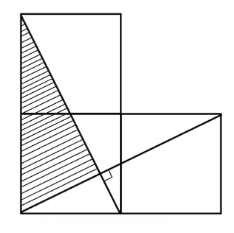
In the adjoining figure, three equal squares are placed. The squares are unit squares. The area of the shaded region $\left(\mathrm{in} \mathrm{cm}^2\right)$ is
a) $\frac{5}{4}$
b) $\frac{4}{5}$
c) $\frac{3}{2}$
d) $\frac{3}{4}$
In the adjoining figure, $A B$ is a diameter of the circle. Given $\angle B A C=20^{\circ}, \angle A E B=56^{\circ}$, Then the measure (in degrees) of $\angle B C D$ is
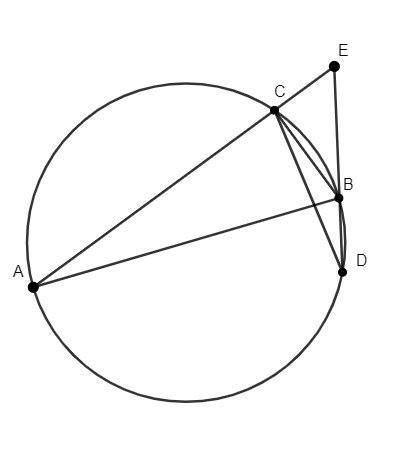
a) 12
b) 10
c) 14
d) 16
The number of ordered pairs $((m, n)$ of integers such that $1 \leq m, n \leq 100$ and $m^n n^*$ leaves a remainder 1 when divided by 4 is
a) 2250
b) 1000
c) 1125
d) 1250
The number of ordered pairs of positive integers $(x, y)$ satisfying the equation $x^2+4 y=3 x+16$ is
a) 1
b) 2
c) 3
d) 4
The algebraic expression $(a+b+a b+2)^2+(a-a b+2-b)^2-2 b^2\left(1+a^2\right)$ reduces to
a) $4(a+2)^{2}$
b) $2(a+2)^2+4 a b^2$
c) $(a-2)^2$
d) $2(a-2)^2+4 a b^2$
The sum of $(1 \times 4)+(2 \times 7)+(3 \times 10)+(4 \times 13)+\ldots 49$ terms is equal to
a) 122500
b) 116800
c) 11800
d) 117600
If the equations $x^3+\alpha x+1=0$ and $x^4-\alpha x^2+1=0$ have a common root, then the value of $a^2$ is \(\rule{1cm}{0.15mm}\) .
If $a, b, c, d$ are positive reals such that abcd=1 then the maximum value of $a^2+b^2+c^2+d^2+ab+ac+ad+bc+bd+cd$ is \(\rule{1cm}{0.15mm}\) .
The sum of all natural numbers ' $n$ ' for which $n(n+1)$ is a perfect square is \(\rule{1cm}{0.15mm}\) .
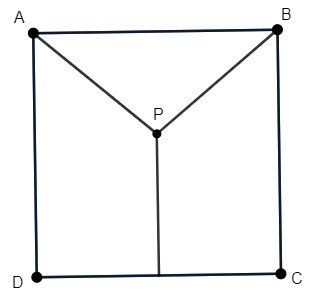
$P$ is a point inside the square $A B C D$ such that $P A=P B=$ Distance of $P$ from $C D$.
The ratio of the areas of the triangle $P A B$ to the area of the square $A B C D$ is $\frac{m}{n}$ where $m, n$ are relatively prime integers. Then the value of $m+n=$ \(\rule{1cm}{0.15mm}\).
The sum of roots of the simultuneous equations
$ \sqrt[y]{4^x}=32 \sqrt[x]{8^y} , \sqrt[y]{3^x}=3 \sqrt[y]{9^{1-y}}$ is \(\rule{1cm}{0.15mm}\) .
If $2 \sqrt{3+\sqrt{5-\sqrt{13+\sqrt{48}}}}=\sqrt{a}+\sqrt{b}$ where $a, b$ are natural numbers, then the value of $a+b$ is \(\rule{1cm}{0.15mm}\) .
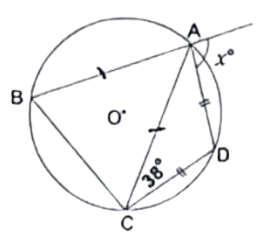
In the adjoining figure, $\angle A C D=38^{\circ}$.
Then the measure (in degrees) of angle $x$ is \(\rule{1cm}{0.15mm}\) .
If $\frac{a}{b+c}+\frac{c}{a+b}=\frac{2 b}{c+a}$ (where $a+b, b+c, c+a, a+b+c$ are all not zero), then the numerical value of $\frac{a^2+c^2}{b^2}$ is \(\rule{1cm}{0.15mm}\) .
The geometric and arithmetic means of two positive numbers are respectively 8 and 17 . The larger among the two numbers is \(\rule{1cm}{0.15mm}\) .
The number of two-digit numbers in which the tens and the units digit are different and odd is \(\rule{1cm}{0.15mm}\) .
The value of $(5 \sqrt[3]{4}-3 \sqrt[3]{\frac{1}{2}})(12 \sqrt[3]{2}+\sqrt[3]{16}-2 \sqrt[3]{2})$ is equal to \(\rule{1cm}{0.15mm}\) .
If $\frac{x y}{x+y}=1, \frac{y z}{y+z}=2, \frac{z x}{z+x}=3$, then the numerical value of $15 x-7 y-z$ is \(\rule{1cm}{0.15mm}\) .
The sum of all natural numbers which satisfy the simultaneous inequations $x+3<4+2 x$ and $5 x-3<4 x-1$ is \(\rule{1cm}{0.15mm}\) .
In an increasing geometric progression (with $1^{\text {st }}$ term $a$ and $n^{\text {th }}$ term $t_n$ ). the difference between the fourth and the first term is 52 and the sum of the first three terms is 26. Then the numerical value of $\frac{t_{2024}}{t_{2023}}+\frac{a^{2024}}{a^{2023}}$ is \(\rule{1cm}{0.15mm}\) .
The base of a triangle is 4 units less than the altitude drawn to it. The area of the triangle is $96\left(\right.$ unit $\left.^2\right)$. The ratio of the base to height is $\frac{p}{q}$ where $p , q$ are relatively prime to each other. Then the value of $p+q$ is \(\rule{1cm}{0.15mm}\) .

Publishing original scientific research in a peer-reviewed journal is an achievement many scholars work toward for years. Achieving this feat early in one's academic journey requires exceptional intellectual rigor, creativity, and persistence. Aaditya Punatar and Muskan Sadana have reached this remarkable milestone, successfully publishing their collaborative research paper in the prestigious Journal of Emerging Investigators […]
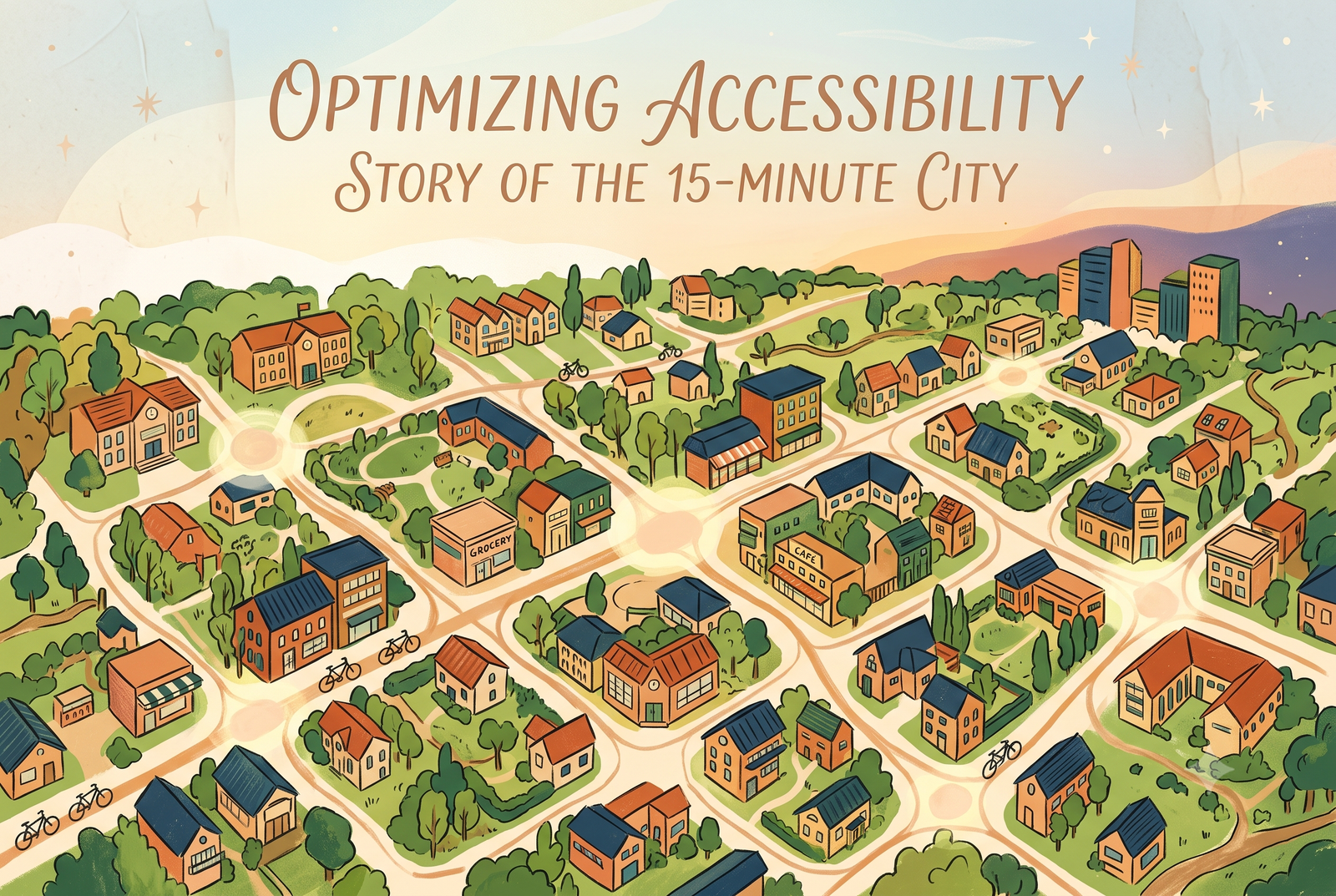
Her project on quantum-accelerated Steiner trees for 15-minute cities earned a place among the finalists at the world's largest pre-college STEM competition. Prishaa Shrimali of Marymount School of New York, was selected as a Grand Finalist at the 2026 Regeneron International Science and Engineering Fair (ISEF) in Phoenix, Arizona. Her project was Optimizing Urban Accessibility: […]

In 2026, the following Cheenta students have been successful for Indian Statistical Institute's M.Stat Entrance. They ranked within the first 50 in the entire country in these entrances. I.S.I. M.Stat Entrance
In 2026, the following Cheenta students have been successful for Indian Statistical Institute's B.Stat Entrance and Chennai Mathematical Institute's B.Sc. Math Entrance. They ranked within the first 200 in the entire country in these entrances. Most of these students attended the problem solving workshops regularly, which happen 5 days every week. CMI B.Sc. Math Entrance […]
Hi
YO
YO