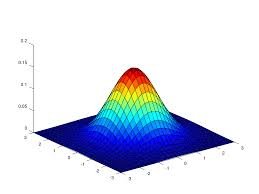
This is a very beautiful sample problem from ISI MStat PSB 2008 Problem 8. It's a very simple problem, based on bivariate normal distribution, which again teaches us that observing the right thing makes a seemingly laborious problem beautiful . Fun to think, go for it !!
Let \( \vec{Y} = (Y_1,Y_2)' \) have the bivariate normal distribution, \( N_2( \vec{0}, \sum ) \),
where, \(\sum\)= \begin{pmatrix} \sigma_1^2 & \rho\sigma_1\sigma_2 \\ \rho\sigma_2\sigma_1 & \sigma^2 \end{pmatrix} ;
Obtain the mean ad variance of \( U= \vec{Y'} {\sum}^{-1}\vec{Y} - \frac{Y_1^2}{\sigma^2} \) .
Bivariate Normal
Conditonal Distribution of Normal
Chi-Squared Distribution
This is a very simple and cute problem, all the labour reduces once you see what to need to see !
Remember , the pdf of \(N_2( \vec{0}, \sum)\) ?
Isn't \( \vec{Y}\sum^{-1}\vec{Y}\) is the exponent of e, in the pdf of bivariate normal ?
So, we can say \(\vec{Y}\sum^{-1}\vec{Y} \sim {\chi_2}^2 \) . Can We ?? verify it !!
Also, clearly \( \frac{Y_1^2}{\sigma^2} \sim {\chi_1}^2 \) ; since \(Y_1\) follows univariate normal.
So, expectation is easy to find accumulating the above deductions, I'm leaving it as an exercise .
Calculating the variance may be a laborious job at first, but now lets imagine the pdf of the conditional distribution of \( Y_2 |Y_1=y_1 \) , what is the exponent of e in this pdf ?? \( U = \vec{Y'} {\sum}^{-1}\vec{Y} - \frac{Y_1^2}{\sigma^2} \) , right !!
and also , \( U \sim \chi_1^2 \) . Now doing the last piece of subtle deduction, and claiming that \(U\) and \( \frac{Y_1^2}{\sigma^2} \) are independently distributed . Can you argue why ?? go ahead . So, \( U+ \frac{Y_1^2}{\sigma^2} \sim \chi_2^2 \).
So, \( Var( U + \frac{Y_1^2}{\sigma^2})= Var( U) + Var( \frac{Y_1^2}{\sigma^2}) \)
\( \Rightarrow Var(U)= 4-2=2 \) , [ since, Variance of a R.V following \(\chi_n^2\) is \(2n\).]
Hence the solution concludes.
Before leaving, lets broaden our mind and deal with Multivariate Normal !
Let, \(\vec{X}\) be a 1x4 random vector, such that \( \vec{X} \sim N_4(\vec{\mu}, \sum ) \), \(\sum\) is positive definite matrix, then can you show that,
\( P( f_{\vec{X}}(\vec{x}) \ge c) = \begin{cases} 0 & c \ge \frac{1}{4\pi^2\sqrt{|\sum|}} \\ 1-(\frac{k+2}{2})e^{-\frac{k}{2}} & c < \frac{1}{4\pi^2\sqrt{|\sum|}} \end{cases}\)
Where, \( k=-2ln(4\pi^2c \sqrt{|\sum|}) \).
Keep you thoughts alive !!


Publishing original scientific research in a peer-reviewed journal is an achievement many scholars work toward for years. Achieving this feat early in one's academic journey requires exceptional intellectual rigor, creativity, and persistence. Aaditya Punatar and Muskan Sadana have reached this remarkable milestone, successfully publishing their collaborative research paper in the prestigious Journal of Emerging Investigators […]

Her project on quantum-accelerated Steiner trees for 15-minute cities earned a place among the finalists at the world's largest pre-college STEM competition. Prishaa Shrimali of Marymount School of New York, was selected as a Grand Finalist at the 2026 Regeneron International Science and Engineering Fair (ISEF) in Phoenix, Arizona. Her project was Optimizing Urban Accessibility: […]

In 2026, the following Cheenta students have been successful for Indian Statistical Institute's M.Stat Entrance. They ranked within the first 50 in the entire country in these entrances. I.S.I. M.Stat Entrance
In 2026, the following Cheenta students have been successful for Indian Statistical Institute's B.Stat Entrance and Chennai Mathematical Institute's B.Sc. Math Entrance. They ranked within the first 200 in the entire country in these entrances. Most of these students attended the problem solving workshops regularly, which happen 5 days every week. CMI B.Sc. Math Entrance […]