
TIFR 2014 Problem 7 Solution is a part of TIFR entrance preparation series. The Tata Institute of Fundamental Research is India's premier institution for advanced research in Mathematics. The Institute runs a graduate programme leading to the award of Ph.D., Integrated M.Sc.-Ph.D. as well as M.Sc. degree in certain subjects.
The image is a front cover of a book named Real and Complex Analysis by Walter Rudin. This book is very useful for the preparation of TIFR Entrance.
Also Visit: College Mathematics Program of Cheenta
Let (f_n(x); n\ge 1) be a sequence of continuous nonnegative functions on ([0,1]) such that
( \lim_{n\to\infty} \int_{0}^{1}f_n(x)dx = 0 )
Which of the following statements is always correct?
A. (f_n \to 0) uniformly of ([0,1])
B. (f_n) may not converge uniformly but converges to (0) point-wise.
C. (f_n) will converge point-wise and the limit may be non-zero.
D. (f_n) is not guaranteed to have a point-wise limit.
We start by a very well known example: (g_n(x)=x^n).
( \int_{0}^{1}g_n(x)dx= \frac{1}{n+1}\to 0 \int_{0}^{1}f_n(x)dx ) as (n\to \infty).
We know (g_n) does not converge uniformly on ([0,1]) because the limit is (1) at (x=1) and (0) everywhere else so we have a non-continuous limit.
So straight-away A,B are false. Question is now whether at all the sequence has to have a point-wise limit or not.
For this, we take our hint from (g_n) and construct (f_n(x)= \sqrt{n}x^n ).
Then ( \int_{0}^{1}f_n(x)dx= \sqrt{n}\frac{1}{n+1}\to 0 ) as ( n\to \infty).
But look at (f_n(1)= \sqrt{n} ). Therefore, (f_n) does not converge at the point (x=1).
So option (D) i.e., (f_n) is not guaranteed to have a point-wise limit. is true.

In 2025, 8 students from Cheenta Academy cracked the prestigious Regional Math Olympiad. In this post, we will share some of their success stories and learning strategies. The Regional Mathematics Olympiad (RMO) and the Indian National Mathematics Olympiad (INMO) are two most important mathematics contests in India.These two contests are for the students who are […]
Cheenta Academy proudly celebrates the success of 27 current and former students who qualified for the Indian Olympiad Qualifier in Mathematics (IOQM) 2025, advancing to the next stage — RMO. This accomplishment highlights their perseverance and Cheenta’s ongoing mission to nurture mathematical excellence and research-oriented learning.
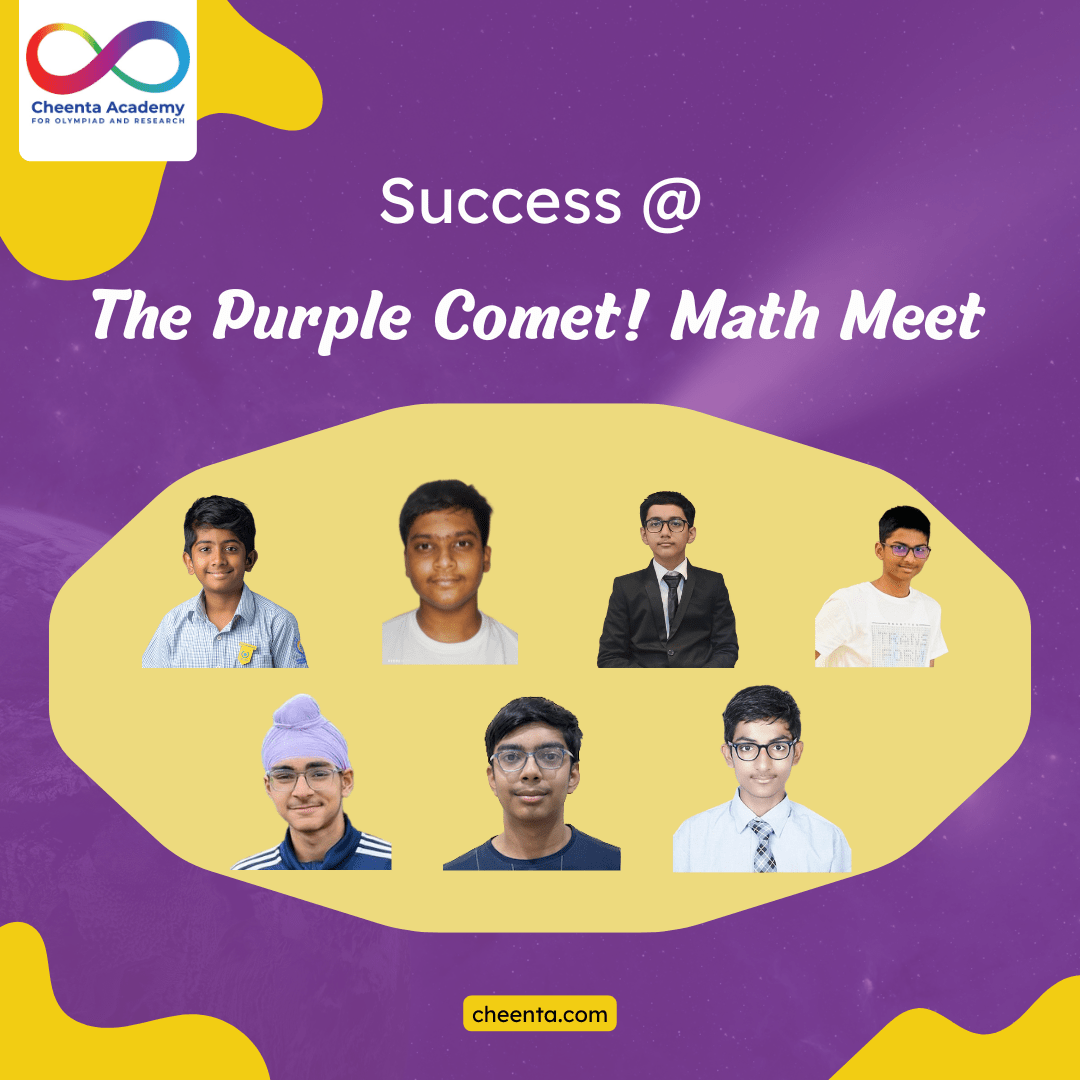
Cheenta students shine at the Purple Comet Math Meet 2025 organized by Titu Andreescu and Jonathan Kanewith top national and global ranks.
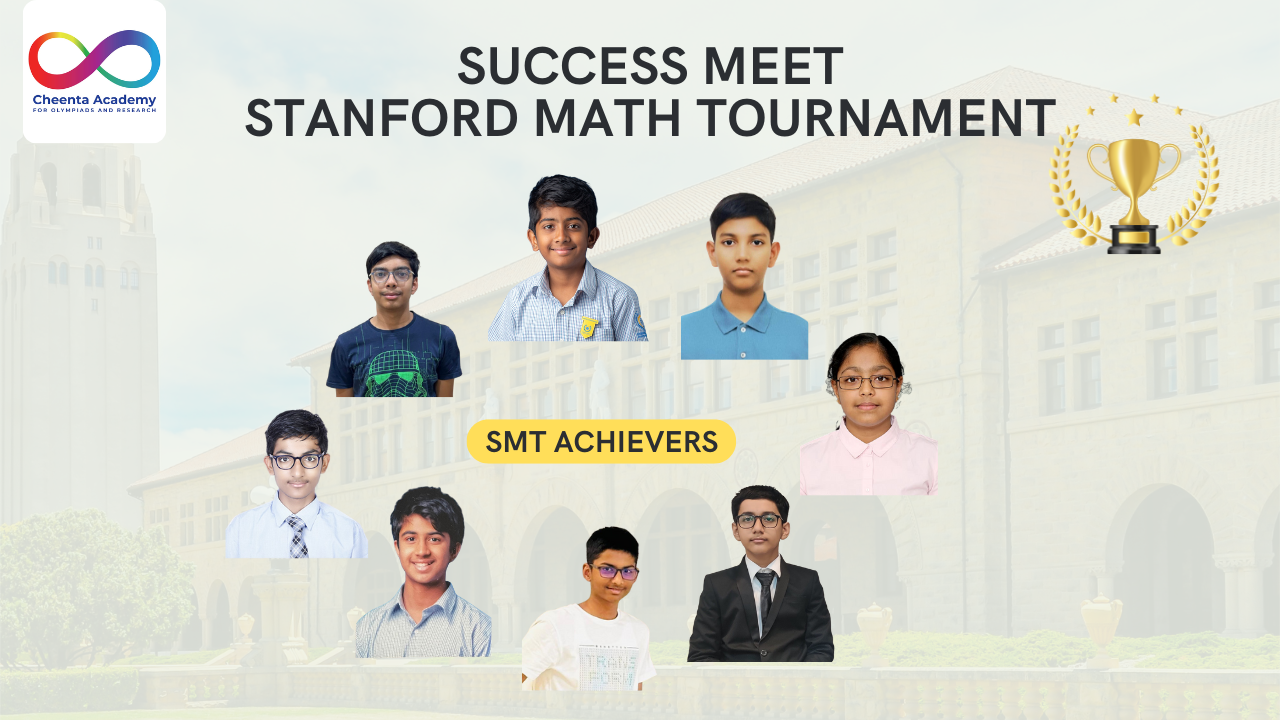
Celebrate the success of Cheenta students in the Stanford Math Tournament. The Unified Vectors team achieved Top 20 in the Team Round.
