1. A point mass m moves in a straight line under a retardation $k v^{2}$ [where $k$ is a positive constant and $v$ is the instantaneous velocity]. The initial velocity of the point mass is $u$. The displacement of the point mass at time t is
(a) $\frac{1}{k} \ln (1+k u t)$
(b) $\frac{1}{k} \ln$ kut
(c) $k$ ln kut
(d) $\frac{1}{k} \ln (1-k u t)$
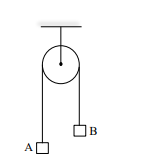
2. In the arrangement shown in figure, 'a' represents the magnitude of acceleration of small blocks A and B while ' T ' is the tension in the massless string passing over the frictionless and massless pulley. The sum of the masses of blocks A and B is constant. For this system, a linear relationship can be obtained between
(a) a and $\frac{1}{\mathrm{~T}}$
(b) a and T
(c) a and $\mathrm{T}^{2}$
(d) T and a ${ }^{2}$
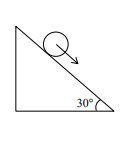
3. A thin uniform circular ring of mass m is rolling without slipping down an inclined plane of inclination $30^{\circ}$ with the horizontal. The coefficient of friction between the ring and the surface is $\mu$. The correct statement is
(a) linear acceleration of the center of the ring along the plane is $a=\frac{g}{2}$
(b) force of friction between the ring and the inclined plane is $\mathrm{F}_{\text {friction }}=\frac{\mathrm{mg}}{4}$
(c) the ring keeps rolling for all values of the coefficient of friction $\mu \geq \frac{1}{4}$
(d) linear acceleration of the center of the ring along the plane is $a=\frac{g}{3}$
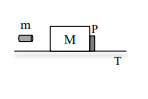
4. A bullet of mass m can penetrate a target (a heavy block of mass M ) up to a distance S , when the target M is held stationary by a stopper P (shown in figure). Up to what distance $\mathrm{S}^{\prime}$ the bullet will penetrate if the block of mass M is free to move (i.e. when the stopper P is removed) on the frictionless surface T .
(a) $\mathrm{S}^{\prime}=\mathrm{S}$
(b) $\mathrm{S}^{\prime}=\frac{\mathrm{m}}{\mathrm{M}} \mathrm{S}$
(c) $S^{\prime}=\frac{m}{m+M} S$
(d) $S^{\prime}=\frac{M}{M+m} S$
5. Knowing that the atomic masses of Al and Mg are respectively ${ }_{13}^{25} \mathrm{Al}=24.990432 \mathrm{u}$ and ${ }_{12}^{25} \mathrm{Mg}=24.985839 \mathrm{u}$ while electron mass is often expressed as $\mathrm{m}_{\mathrm{e}}=0.511 \mathrm{MeV}$, the Q value (energy liberated) of the $\beta$ decay nuclear reaction ${ }^{25} \mathrm{Al} \rightarrow{ }^{25} \mathrm{Mg}+\mathrm{e}^{+}+v$ in MeV is
(a) 4.278
(b) 3.767
(c) 3.256
(d) 931.478
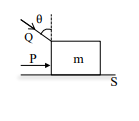
6. A block of mass m , lying on a rough horizontal plane, is acted upon by a horizontal force P and simultaneously by another force Q acting at an angle $\theta$ from the vertical as shown. The block will remain in equilibrium if the coefficient of friction between the block and the surface $S$ is
(a) at least $\frac{P+Q \sin \theta}{m g+Q \cos \theta}$
(b) at least $\frac{P+Q \cos \theta}{m g+Q \sin \theta}$
(c) equal to $\frac{\mathrm{P}+\mathrm{Q} \sin \theta}{\mathrm{mg}-\mathrm{Q} \cos \theta}$
(d) equal to $\frac{P+Q \cos \theta}{m g-Q \sin \theta}$
7. Knowing that the acceleration due to gravity on the Earth surface is g and the radius of the Earth is R , a small body of mass m falls on the Earth from a height $\mathrm{h}=\frac{\mathrm{R}}{5}$ above the Earth's surface. During the freefall, the potential energy of the falling body decreases by
(a) mgh
(b) $\frac{4}{5} \mathrm{mgh}$
(c) $\frac{5}{6} \mathrm{mgh}$
(d) $\frac{6}{7} \mathrm{mgh}$
8. At some instant, a motor car is moving on a circular path of radius 600 m , with a speed $\mathrm{u}=30 \mathrm{~ms}^{-1}$. If its speed is increased at a rate of $2 \mathrm{~ms}^{-2}$, the magnitude of the acceleration of the car at that instant is
(a) $2.0 \mathrm{~ms}^{-2}$
(b) $2.5 \mathrm{~ms}^{-2}$
(c) $3.5 \mathrm{~ms}^{-2}$
(d) $1.5 \mathrm{~ms}^{-2}$
9. A cricket ball, thrown across a field, is at heights of $\mathrm{h}_{1}$ and $\mathrm{h}_{2}$ above the point of projection, at time $\mathrm{t}_{1}$ and time $t_{2}$ after the throw, respectively. It is then caught by the wicket keeper at the same height as that from which it was thrown. The Time of Flight (T) of the ball is
(a) $\mathrm{T}=\frac{\mathrm{h}_{1} \mathrm{t}_{2}^{2}-\mathrm{h}_{2} \mathrm{t}_{1}^{2}}{\mathrm{~h}_{1} \mathrm{t}_{2}-\mathrm{h}_{2} \mathrm{t}_{1}}$
(b) $\mathrm{T}=\frac{\mathrm{h}_{1} \mathrm{t}_{2}^{2}+\mathrm{h}_{2} \mathrm{t}_{1}^{2}}{\mathrm{~h}_{2} \mathrm{t}_{1}+\mathrm{h}_{1} \mathrm{t}_{2}}$
(c) $\mathrm{T}=\frac{\mathrm{h}_{1} \mathrm{t}_{1}^{2}-\mathrm{h}_{2} \mathrm{t}_{2}^{2}}{\mathrm{~h}_{1} \mathrm{t}_{1}-\mathrm{h}_{2} \mathrm{t}_{2}}$
(d) $\mathrm{T}=\frac{\mathrm{h}_{1} \mathrm{t}_{1}^{2}+\mathrm{h}_{2} \mathrm{t}_{2}^{2}}{\mathrm{~h}_{1} \mathrm{t}_{1}+\mathrm{h}_{2} \mathrm{t}_{2}}$
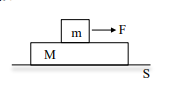
10. A plate of mass M is placed on a horizontal frictionless surface S . A block of mass m is placed on the plate. The coefficient of dynamic friction between the block and the plate is $\mu$. If a horizontal force $\mathrm{F}=2 \mu \mathrm{mg}$ is applied to the block (as shown), the acceleration of the plate will be
(a) $\frac{\mu m g}{M}$
(b) $\frac{\mu \mathrm{mg}}{\mathrm{m}+\mathrm{M}}$
(c) $\frac{2 \mu \mathrm{mg}}{\mathrm{M}}$
(d) $\frac{2 \mu m g}{m+M}$
11. A simple pendulum, with a bob of mass m , oscillates in a vertical plane, with an angular amplitude $\theta_{0}$. The tension in its string when it passes through the mean position is 2 mg . Neglecting the effect of air friction and the viscosity of air, the angular amplitude $\theta_{0}$ is
(a) $30^{\circ}$
(b) $60^{\circ}$
(c) $90^{\circ}$
(d) $120^{\circ}$
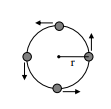
12. Because of their mutual gravitational attraction, four identical planets each of mass m are orbiting in a circular path of radius r in the same sense (angular direction). The magnitude of the velocity of each planet is
(a) $\left[\frac{G m}{r}\left(\frac{1+2 \sqrt{2}}{4}\right)\right]^{\frac{1}{2}}$
(b) $3 \sqrt{\frac{G m}{r}}$
(c) $\sqrt{\frac{G m}{r}(1+2 \sqrt{2})}$
(d) $\left[\frac{1}{2} \frac{\mathrm{Gm}}{\mathrm{r}}\left(\frac{1+\sqrt{2}}{2}\right)\right]^{\frac{1}{2}}$
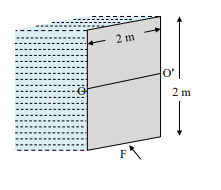
13. A rigid square sheet of size $2 \mathrm{~m} \times 2 \mathrm{~m}$ is hinged at the middle of the vertical edges to serve as a door which can turn about the horizontal axis $\mathrm{OO}^{\prime}$. A fluid of density $\rho$ fills the space to the left of the sheet up to its top. The horizontal force F required (to be applied at the lower edge) to hold the sheet vertical is
(a) $\frac{2}{3} \rho g$
(b) $\frac{4}{3} \rho \mathrm{~g}$
(c) $\frac{8}{3} \rho \mathrm{~g}$
(d) $\frac{1}{3} \rho \mathrm{~g}$
14. A major artery in human body, with radius 0.4 cm , carries blood at a flow rate of 5.0 cubic centimeters per second. The pressure difference of blood per meter length of the artery is nearly [Given that the coefficient of viscosity ( $\eta$ ) of blood at body temperature is $4.0 \times 10^{-3} \mathrm{~Pa}$.s and the density of mercury is $13.6 \mathrm{~g} / \mathrm{cm}^{3}$ ]
(a) 9.6 mm of Hg
(b) 3.2 mm of Hg
(c) 1.5 mm of Hg
(d) 6.0 mm of Hg
15. If P represents radiation pressure, E represents radiation energy striking per unit area per unit time and c represents speed of light then the possible values of non-zero integers $x, y$ and $z$ such that $\mathrm{P}^{x} \mathrm{E}^{y} \mathrm{c}^{z}$ is dimensionless, may be
(a) $x=1, y=1, z=1$
(b) $x=-1, y=1, z=1$
(c) $x=1, y=-1, z=1$
(d) $x=1, y=1, z=-1$
16. A large tank, open at the top, has two small holes in the vertical wall. One is a square hole of side 's' at a depth $h$ below the top and the other is a circular hole of radius r at a depth 4 h below the top (given that $\mathrm{s} \ll \mathrm{h} ; \mathrm{r} \ll \mathrm{h})$. When the tank is completely filled up to the brim with water, the quantity of water flowing out per second from each hole is the same, then r is equal to
(a) $2 \pi \mathrm{~S}$
(b) $\frac{\mathrm{S}}{2 \pi}$
(c) $\frac{\mathrm{s}}{\sqrt{2 \pi}}$
(d) $\frac{\mathrm{s}}{2 \sqrt{\pi}}$
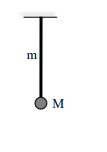
17. A pendulum consists of a heavy but very small bob of mass M suspended at the end of a rigid rod of mass m and length L . The time period of small oscillations in the vertical plane, about a horizontal axis through the upper end of the rod is
(a) $2 \pi \sqrt{\left(\frac{m+2 M}{m+3 M}\right) \times\left(\frac{3 L}{2 g}\right)}$
(b) $2 \pi \sqrt{\left(\frac{m+3 M}{m+2 M}\right) \times\left(\frac{2 L}{3 g}\right)}$
(c) $2 \pi \sqrt{\frac{3 \mathrm{~L}}{2 \mathrm{~g}}}$
(d) $2 \pi \sqrt{\left(\frac{2 m+M}{3 m+M}\right) \times\left(\frac{3 L}{2 g}\right)}$
18. A transverse wave is travelling along a long stretched string from left to right (along + ve $x$ direction). The snapshot of a small part of the string at any moment $t$ is shown in the figure. At this particular instant
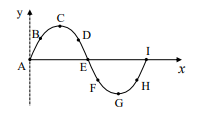
(a) A and E are at rest for a moment while C and G have maximum speed
(b) B and D have upward velocity whereas F and H have downward
(c) D, E, F are moving downward at that moment
(d) B and H are moving downward at that moment
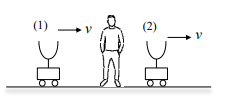
19. Two tuning forks, with natural frequency 700 Hz each, move relative to a stationary observer. Fork (1) moves towards the observer while the fork (2) moves away from the observer. Both the forks move with same velocity $v$ on the same line. The observer, standing between the two forks, hears 4 beats per sec. Using the speed of sound in air as $v_{s}=350 \mathrm{~ms}^{-1}$, the speed of each tuning fork is
(a) $2.0 \mathrm{~ms}^{-1}$
(b) $1.5 \mathrm{~ms}^{-1}$
(c) $1.0 \mathrm{~ms}^{-1}$
(d) $0.5 \mathrm{~ms}^{-1}$
20. The speed of sound in a mixture of 1 mole of Helium (molar mass $=4 \mathrm{~g}$ ) and 2 moles of oxygen (molar mass $=32 \mathrm{~g}$ ) at $27^{\circ} \mathrm{C}$ is nearly
(a) $318 \mathrm{~ms}^{-1}$
(b) $332 \mathrm{~ms}^{-1}$
(c) $381 \mathrm{~ms}^{-1}$
(d) $401 \mathrm{~ms}^{-1}$
21. Three identical large metal plates are kept parallel and close to each other. Each plate can be treated as an ideal black body and has very high thermal conductivity. The first and third plates are maintained at high temperature $\mathrm{T}_{1}=3 \mathrm{~T}$ and $\mathrm{T}_{3}=2 \mathrm{~T}$. The temperature $\mathrm{T}_{2}$ of the middle (i.e. second) plate under steady state condition is
(a) $\frac{5 \mathrm{~T}}{2}$
(b) $\left(\frac{65}{2}\right)^{\frac{1}{4}} \mathrm{~T}$
(c) $\left(\frac{97}{2}\right)^{\frac{1}{4}} \mathrm{~T}$
(d) $\left(\frac{65}{4}\right)^{\frac{1}{4}} \mathrm{~T}$
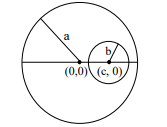
22. A thin uniform circular disc of radius ' $a$ ' is placed in XY plane with its center at origin ( 0,0 ). A small circular disc of radius $b$ with center at ( $c, 0$ ) is cut and taken out to create a hole. The center of mass of the remaining disc is at
(a) $-\frac{b^{2}}{a^{2}} c, 0$
(b) $-\frac{b^{2}}{a^{2}-c^{2}} c, 0$
(c) $-\frac{b^{2}}{a^{2}+b^{2}} c, 0$
(d) $-\frac{b^{2}}{a^{2}-b^{2}} c, 0$
23. One mole of an ideal monoatomic gas, contained in a cylinder fitted with movable piston, is originally at $\mathrm{P}_{1}, \mathrm{~V}_{1}$ and $\mathrm{T}_{1}=27^{\circ} \mathrm{C}$. The gas is slowly heated. Initially 8.31 watt-hour of energy is added to it; at the same time it is allowed to expand at constant pressure to a new state $\mathrm{P}_{1}, \mathrm{~V}_{2}$ and $\mathrm{T}_{2}$. The correct option is
(a) Value of $\mathrm{T}_{2}$ is $1740^{\circ} \mathrm{C}$
(b) Work done by the gas is 2160 R joule
(c) Internal energy of the gas increases by 1440 R joule
(d) $\frac{V_{2}}{V_{1}}=5.8$
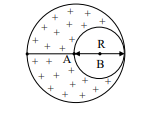
24. A non-conducting solid sphere, of radius R , with its center at A , has a spherical cavity of diameter R with center at B as shown. There is no charge in the cavity while the solid part has a uniform volume charge density $\rho$. Electric potential at the center of the sphere (at point A) is $V=\frac{k \rho R^{2}}{12 \epsilon_{0}}$ (in SI units) where the value of $k$ is
(a) 3
(b) 5
(c) 7
(d) 9
25. Energy from the Sun falls on the Earth surface at the rate of $1400 \mathrm{~W} / \mathrm{m}^{2}$, which is known as solar constant. The respective rms values $\mathrm{E}_{\mathrm{rms}}$ and $\mathrm{B}_{\mathrm{rms}}$ of electric and magnetic fields in the sunlight (electromagnetic radiation) reaching Earth surface are (Take speed of light $\mathrm{c}=3 \times 10^{8} \mathrm{~ms}^{-1}$ )
(a) $\mathrm{E}_{\mathrm{rms}}=726.5 \mathrm{~V} / \mathrm{m}, \mathrm{B}_{\mathrm{rms}}=2.42 \mu \mathrm{~T}$
(b) $\mathrm{E}_{\mathrm{rms}}=7260 \mathrm{~V} / \mathrm{m}, \quad \mathrm{B}_{\mathrm{rms}}=242 \mathrm{nT}$
(c) $\mathrm{E}_{\text {rms }}=1030 \mathrm{~V} / \mathrm{m}, \mathrm{B}_{\text {rms }}=3.42 \mu \mathrm{~T}$
(d) $\mathrm{E}_{\mathrm{rms}}=10300 \mathrm{~V} / \mathrm{m}, \mathrm{B}_{\mathrm{rms}}=342 \mathrm{nT}$
26. The figure below depicts the voltage wave forms of binary input signals A and B and the output signal C of a certain logic gate.
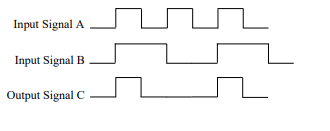
The logic gate is
(a) AND
(b) NAND
(c) OR
(d) XOR
27. Two electric charges, $+q$ at the origin $\mathrm{O}(0,0)$ and $-2 q$ at the point $\mathrm{A}(6,0)$ are placed on $x$ axis. The locus of the point P in $x-y$ plane where the potential vanishes $(\mathrm{V}=0)$ is
(a) a straight line perpendicular to $x$ axis and passing through $(2,0)$
(b) only the point $(2,0)$
(c) a circle with center at ( $-2,0$ ) and radius 4
(d) an ellipse with foci at O and A
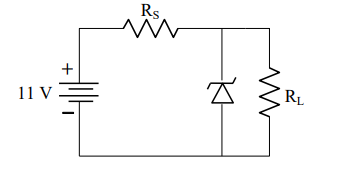
28. In the circuit shown, the Zener diode is an ideal one with breakdown voltage of 5.0 volt. The values of the resistances are $\mathrm{R}_{\mathrm{S}}=10 \mathrm{k} \Omega$ and $\mathrm{R}_{\mathrm{L}}=1 \mathrm{k} \Omega$. The current through the resistances, when the supply voltage is 11.0 V , is
(a) 0.6 mA through $\mathrm{R}_{\mathrm{S}}$ and 5.0 mA through $\mathrm{R}_{\mathrm{L}}$
(b) 1.0 mA through $\mathrm{R}_{\mathrm{S}}$ and 1.0 mA through $\mathrm{R}_{\mathrm{L}}$
(c) 1.1 mA through $\mathrm{R}_{\mathrm{S}}$ and no current through $\mathrm{R}_{\mathrm{L}}$
(d) no current through $\mathrm{R}_{\mathrm{S}}$ and 11 mA through $\mathrm{R}_{\mathrm{L}}$
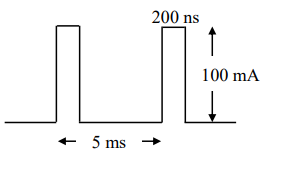
29. In an accelerator the electrons are accelerated up to an energy of 50 MeV . The electrons do not emerge continuously from the accelerator rather they come in pulses at time interval of 5.0 milliseconds. Each pulse has a much shorter duration of 200 nanoseconds. Electron current during the pulse is 100 mA , while the current is zero between the two successive pulses (see figure), then
(a) the average current per pulse is 4 mA
(b) the peak value of power delivered by the electron beam is 50 MW
(c) the average power delivered by the electron beam is 200 W
(d) the average power delivered by the electron beam is 2 MW
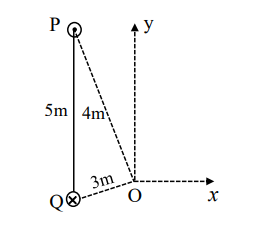
30. Two infinitely long straight parallel wires perpendicular to the plane of the paper are 5 m apart. One of the wires, P carries current I out of the plane of the paper and the other, Q carries the current I into the plane of paper. The magnetic field B at the origin O of the coordinate system with $x$ and y axes as perpendicular and parallel to PQ , respectively, is [Given $\mathrm{OP}=4 \mathrm{~m}$ and $\mathrm{OQ}=3 \mathrm{~m}$ ]
(a) $\frac{\mu_{0} I}{2 \pi}\left(\hat{i}-\frac{3}{5} \hat{j}\right)$
(b) $\frac{\mu_{0} I}{5 \pi}\left(\hat{i}-\frac{7}{24} \hat{j}\right)$
(c) $\frac{\mu_{0} I}{5 \pi}\left(-\hat{i}+\frac{3}{8} \hat{j}\right)$
(d) $\frac{\mu_{0} I}{24 \pi}(2 \hat{i}+3 \hat{j})$
31. Charge q is uniformly distributed over the surface of a thin non-conducting annular disc of inner radius $\mathrm{R}_{1}$ and outer radius $\mathrm{R}_{2}$. The disc is made to rotate with constant frequency f , about an axis passing through the center of the annular disc and perpendicular to its plane. The magnetic moment of the disc is
(a) $\pi f q \frac{R_{2}^{2}+R_{1}^{2}}{2}$
(b) $\pi f q \frac{R_{2}^{2}-R_{1}^{2}}{2}$
(c) $\pi \mathrm{fq} \frac{\mathrm{R}_{2}^{2}-\mathrm{R}_{1}^{2}}{4}$
(d) $2 \pi f q\left(R_{2}^{2}-R_{1}^{2}\right)$
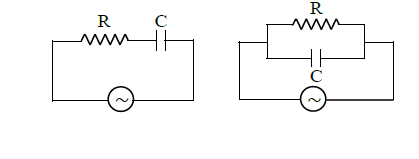
32. For a resistance R and capacitance C in series, the impedance is twice that of a parallel combination of the same elements when used with an AC voltage of frequency $f$. The frequency $f$ of the applied emf is
(a) $\mathrm{f}=2 \pi \mathrm{RC}$
(b) $\mathrm{f}=\frac{1}{2 \pi \mathrm{RC}}$
(c) $\mathrm{f}=\frac{2 \pi}{\mathrm{RC}}$
(d) $f=\frac{1}{2 \pi \sqrt{R^{2}+C^{2}}}$
33. In an experiment on photoelectric effect on a metal surface, one finds a stopping potential of 1.8 V for the wavelength of 300 nm and a stopping potential of 0.9 V for the wavelength of 400 nm . The cutoff wavelength $\lambda_{0}$ (the maximum wavelength that can produce photoelectric effect) for the metal is
(a) 500 nm
(b) 550 nm
(c) 600 nm
(d) 750 nm
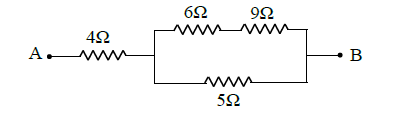
34. Given that the power dissipated in $5 \Omega$ resistance is 7.2 W in the circuit shown.
Statement (1): Power dissipated in $6 \Omega$ resistance is 6 W .
Statement (2): Potential difference $\mathrm{V}_{\mathrm{AB}}$ between A and B is $\mathrm{V}_{\mathrm{AB}}=12.4 \mathrm{~V}$
Then
(a) Statement (1) is correct but statement (2) is wrong
(b) Statement (1) is wrong but statement (2) is correct
(c) Both statements (1) and (2) are wrong
(d) Both statements (1) and (2) are correct
35. A transparent and homogeneous sphere of glass of radius r is immersed in water (refractive indices of glass and water being ${ }_{a} \mu_{g}=\frac{3}{2}$ and ${ }_{a} \mu_{w}=\frac{4}{3}$ ). The image of a point object O , located at distance d on its axis in front of the sphere, is formed at point I at the same distance d from the sphere on the opposite side as shown.
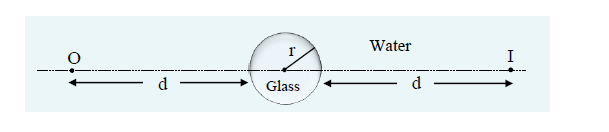
The distance d is equal to
(a) $2 r$
(b) 3 r
(c) 6 r
(d) 8 r
36. A certain substance, with a dielectric constant $\mathrm{k}=2.5$ and the dielectric strength $\mathrm{E}=1.8 \times 10^{7} \mathrm{~N} / \mathrm{C}$, completely fills the space between the plates of a parallel plate capacitor (with circular plates) of capacitance $\mathrm{C}=72.0 \mathrm{nF}$. The minimum diameter of the circular plates, to ensure that the capacitor can withstand a potential difference of $\mathrm{V}=4.0 \mathrm{kV}$, is
(a) 12 cm
(b) 24 cm
(c) 48 cm
(d) 96 cm
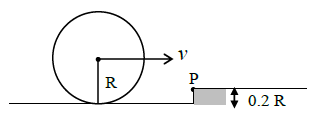
37. A uniform solid sphere of radius R rolls without slipping on a rough horizontal surface with a forward velocity $v$ of its center. On its way, it suddenly encounters a small step of height 0.2 R as shown. The angular velocity of the sphere just after the impact is [given that the sphere does not bounce back, rather it goes ahead up the step]
(a) $\frac{v}{7 R}$
(b) $\frac{3 v}{7 R}$
(c) $\frac{6 v}{7 R}$
(d) $\frac{v}{R}$
38. The magnetic field (B) produced by the current $i$ flowing through the sides of a square loop of side $\ell$, at a point P at distance $x$ from the center of the square, on the axis perpendicular to the plane of the square loop and passing through its center, is
(a) $B=\frac{\mu_{0} i}{4 \pi} \frac{2 \sqrt{2} \ell^{2}}{\left(4 x^{2}+\ell^{2}\right) \sqrt{2 x^{2}+\ell^{2}}}$
(b) $B=\frac{\mu_{0} i}{4 \pi} \frac{4 \sqrt{2} \ell x}{\left(x^{2}+\ell^{2}\right) \sqrt{2 x^{2}+\ell^{2}}}$
(c) $B=\frac{\mu_{0} i}{4 \pi} \frac{4 \times 2 \sqrt{2} \ell^{2}}{\left(4 x^{2}+\ell^{2}\right) \sqrt{2 x^{2}+\ell^{2}}}$
(d) $B=\frac{\mu_{0} i}{4 \pi} \frac{4 \sqrt{2} \ell x}{\left(4 x^{2}+\ell^{2}\right) \sqrt{x^{2}+\ell^{2}}}$
39. A linear positive charge distribution, with linear charge density $\lambda$ coulomb per meter, extends along $+x$ - axis from $x=0$ to $x=\infty$.
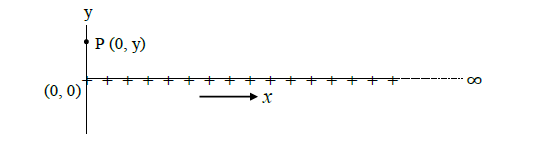
The electric field $\vec{E}$ at any point $\mathrm{P}(0, \mathrm{y})$ on the y - axis
(a) is proportional to $\frac{\lambda}{y^{2}}$ irrespective of whether y is positive or negative.
(b) is always directed away and perpendicular to the line of charge.
(c) has a vanishing component parallel to the line of charge.
(d) is directed along a straight line of slope $m=-1$ if y is positive but along a line of slope $m=+1$ if y is negative.
40. Imagine a situation, in which an infinite sheet with positive charge $+\sigma$ per unit area lies in the xy-plane and a second infinite sheet with negative charge $-\sigma$ per unit area lies in the yz-plane. The net electric field E at any point $(\mathrm{x}, \mathrm{y}, \mathrm{z})$ [that does not lie on either of these planes xy or yz ] can be expressed as
(a) $\vec{E}=\frac{\sigma}{2 \epsilon_{0}}(-\hat{i}+\hat{k})$
(b) $\vec{E}=\frac{\sigma}{2 \epsilon_{0}} \hat{j}$
(c) $\vec{E}=\frac{\sigma}{2 \epsilon_{0}}\left[-\frac{x}{|x|} \hat{i}+\frac{z}{|z|} \hat{k}\right]$
(d) $\vec{E}=\frac{\sigma}{\epsilon_{0}}\left[\frac{x}{|x|} \hat{i}-\frac{z}{|z|} \hat{k}\right]$
41. For the electric field E , in a region of space where a non-uniform, but spherically symmetric distribution of charge has a charge density $\rho(\mathrm{r})$ as $\quad \rho(r)=\rho_{0}\left(1-\frac{r}{R}\right)$ for $r \leq R, \quad$ one can say that $\rho(r)=0 \quad$ for $r \geq R$,
(a) $\mathrm{E}=0$ : both at $\mathrm{r}=0$ and $\mathrm{r}=\mathrm{R}$
(b) $\mathrm{E} \propto \mathrm{r}$ for $\mathrm{r}<\mathrm{R}$ and $E \propto \frac{1}{r^{2}}$ for $r \geq R$
(c) the magnitude of E increases with r and reaches its maximum at $r=\frac{2 R}{3}$
(d) the maximum electric field produced by the given charge distribution is $E_{\max }=\frac{\rho_{0} R}{3 \in_{0}}$
42. A typical network of resistances $\mathrm{R}_{1}$ and $\mathrm{R}_{2}$ shown below extends to infinity towards the right. The total resistance $R_{\text {effective }}$ of this network between points $A$ and $B$ is
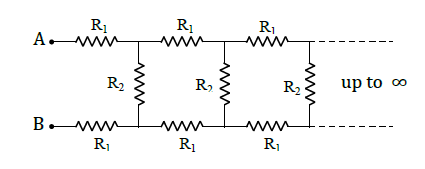
(a) $R_{\text {effective }}=R_{1}+\sqrt{R_{1}^{2}+2 R_{1} R_{2}}$
(b) $R_{\text {effective }}=R_{2}+\sqrt{R_{1}^{2}+2 R_{1} R_{2}}$
(c) $\mathrm{R}_{\text {effective }}=\mathrm{R}_{1}+\sqrt{3 \mathrm{R}_{1} \mathrm{R}_{2}}$
(d) $R_{\text {effective }}=R_{1}+\sqrt{R_{2}^{2}+2 R_{1} R_{2}}$
43. A cylindrical cavity of diameter 'a' exists inside a long solid cylinder of diameter '2a' as shown in figure. Both the cylinder and the cavity are taken to be infinitely long. The axis of the cavity is parallel to the axis of the cylinder and is at a distance $\frac{\mathrm{a}}{2}$ from it. A uniform current of current density $\mathrm{J}\left(\mathrm{Am}^{-2}\right)$ flows through the cylinder along its length and not through the cavity. The magnitude of the magnetic field at a point P on the surface of the cylinder lying farthest from the axis of the cavity, is
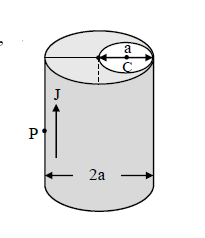
(a) $\mathrm{B}=\frac{3}{8} \frac{\mu_{0} \mathrm{~J}}{\mathrm{a}}$
(b) $\mathrm{B}=\frac{3}{4} \mu_{0} \mathrm{Ja}$
(c) $\mathrm{B}=\frac{3}{8} \mu_{0} \mathrm{Ja}$
(d) $\mathrm{B}=\frac{5}{12} \mu_{0} \mathrm{Ja}$
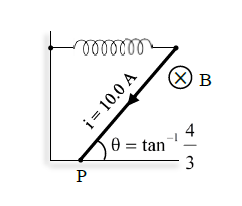
44. A thin uniform rod, of length $\ell=0.200 \mathrm{~m}$ with negligible mass, is attached to the floor by a frictionless hinge at a fixed point P . A horizontal spring connects the other end of the rod to a vertical wall. The rod is in a uniform magnetic field $\mathrm{B}=0.500$ tesla directed into the plane of paper. There is a current $\mathrm{i}=10.0 \mathrm{~A}$ in the rod in the direction shown. Force constant of the spring is $5.00 \mathrm{~N} / \mathrm{m}$. The rod is in equilibrium at $\theta=\tan ^{-1} \frac{4}{3}$
Statement (1) Torque on the rod due to magnetic force is 0.1 Nm clockwise Statement (2) In equilibrium the energy stored in the spring is 0.039 J
(a) Statement (1) is correct but statement (2) is wrong
(b) Statement (1) is wrong but statement (2) is correct
(c) Both statements (1) and (2) are wrong
(d) Both statements (1) and (2) are correct
45. The electric flux through a certain area of a dielectric medium is $\phi=\left(8.00 \times 10^{3}\right) t^{4}$ in SI units. The displacement current through that area is 12.5 pA at a time $\mathrm{t}=20.0 \mathrm{~ms}$. The dielectric constant of the dielectric medium is
(a) 22.1
(b) 5.52
(c) 55.2
(d) 2.76
46. A thin equi-convex lens of flint glass (refractive index $\mu_{1}$ ) is kept coaxially in contact with another thin equi-concave lens of crown glass (refractive index $\mu_{2}$ ). The system is completely immersed in water $\left({ }_{a} \mu_{w}=\frac{4}{3}\right)$.
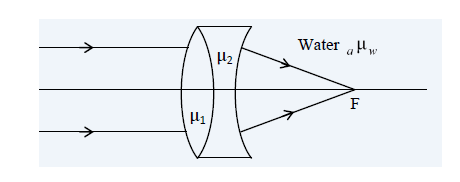
Parallel rays of light incident parallel to the principal axis in water are focused by this system at a distance of 24 cm beyond the system. The thickness of the system is negligible. If the radius of curvature of each surface is $\mathrm{R}=20 \mathrm{~cm}$, the difference ( $\mu_{1}-\mu_{2}$ ) is
(a) $\frac{2}{9}$
(b) $\frac{3}{9}$
(c) $\frac{4}{9}$
(d) $\frac{5}{9}$
47. Two identical large thin metal plates carrying charges $+\mathrm{q}_{1}$ and $+\mathrm{q}_{2}\left(\mathrm{q}_{1}>\mathrm{q}_{2}\right)$, respectively, are kept close at a distance d apart and parallel to each other to form a parallel plate capacitor of capacitance C . The potential difference between the plates is
(a) $\frac{q_{1}-q_{2}}{C}$
(b) $\frac{q_{1}-q_{2}}{2 C}$
(c) $\frac{q_{1}-q_{2}}{4 C}$
(d) $\frac{q_{1}+q_{2}}{2 C}$
48. In a certain electrical network, the three nodes $\mathrm{A}, \mathrm{B}$ and C are each at a potential of 1.0 volt while the node D is at a potential 2.0 volt. The potential at the Node O in volt is
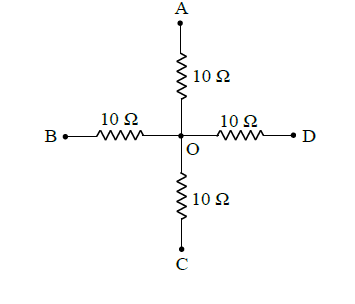
(a) $\frac{3}{2}$
(b) $\frac{4}{3}$
(c) $\frac{5}{4}$
(d) $\frac{6}{5}$
49. A thin uniform metallic rod, of length $\ell=1.0 \mathrm{~m}$ and area of cross section $\mathrm{A}=2 \mathrm{~mm}^{2}$, is made to rotate with angular velocity $\omega=400 \mathrm{rad} / \mathrm{s}$ in a horizontal plane about a vertical axis through one of its ends. The density and the Young's modulus of the material of the rod are $\rho=10^{4} \mathrm{~kg} \mathrm{~m}^{-3}$ and $\mathrm{Y}=2.0 \times 10^{11} \mathrm{Nm}^{-2}$. Taking r as the distance of a point on the rod from the axis of rotation, the
(a) tension at midpoint of the rod is $\mathrm{T}=1200 \mathrm{~N}$.
(b) tension in the rod varies with distance r from the axis of rotation as $\mathrm{T}=1600 \mathrm{r}^{2} \mathrm{~N}$
(c) stress in the rod at $\mathrm{r}=0.5 \mathrm{~m}$ is $3.0 \times 10^{8} \mathrm{Nm}^{-2}$
(d) elongation of the rod is $\frac{8}{3} \mathrm{~mm}$
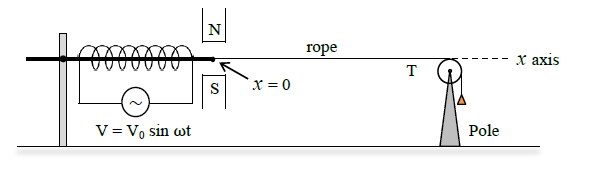
50. One end of a long and thin rope, stretched horizontally with a tension $\mathrm{T}=8 \mathrm{~N}$, along $x$ axis, is supporting a weight after passing over a pulley fixed on a vertical pole (see figure). At the other end, a simple harmonic oscillator (a clamped iron rod along the axis of a solenoid fed with AC voltage and oscillating between north and south poles) at $x=0$, generates a transverse wave of frequency 100 Hz and an amplitude of 2 cm , in the rope. The wave propagates along the rope. The mass per unit length of the rope is $20 \mathrm{~g} / \mathrm{m}$. Ignoring the effect of gravity (on the rope), the correct option(s) is /are
(a) Wavelength of the transverse wave is 20 cm .
(b) Maximum magnitude of transverse acceleration of any point on the rope is nearly $800 \mathrm{~ms}^{-2}$
(c) If the oscillator produces maximum negative displacement at $x=0$ at time $\mathrm{t}=0$, the equation of the wave can be expressed as $\mathrm{y}(x, \mathrm{t})=-0.02 \sin [10 \pi x-100 \pi \mathrm{t}]$ in SI units.
(d) Tension in the given rope remaining unchanged, if a harmonic oscillator of frequency 200 Hz is used (instead of earlier frequency 100 Hz ), the wavelength will be 10 cm .
51. Nuclei of a radioactive element A are being produced at a constant rate $\alpha$. The element A has a decay constant $\lambda$. If there are $\mathrm{N}_{0}$ nuclei at $\mathrm{t}=0$, then
(a) number of nuclei $\mathrm{N}(\mathrm{t})$, at time t , is $\mathrm{N}(\mathrm{t})=\frac{1}{\lambda}\left[\left(\alpha-\lambda \mathrm{N}_{0}\right) \mathrm{e}^{-\lambda \mathrm{t}}\right]$
(b) if $\alpha=\lambda \mathrm{N}_{0}$, the number of nuclei $\mathrm{N}(\mathrm{t})$ at any time t will remain constant
(c) if $\alpha=2 \lambda \mathrm{~N}_{0}$ then $\mathrm{N}(\mathrm{t})=2 \mathrm{~N}_{0}$ as $\mathrm{t} \rightarrow \infty$
(d) if $\alpha=2 \lambda N_{0}$, the number of nuclei $N(t)$ after one half-life of $A$ is $N\left(\frac{T}{2}\right)=\frac{3}{2} N_{0}$
52. In Young's double slit experiment, a fine beam of coherent monochromatic light of wavelength $\lambda=600 \mathrm{~nm}$ is incident on identical slits $\mathrm{S}_{1}$ and $\mathrm{S}_{2}$ at separation d. The intensity at the central maximum formed at O is $\mathrm{I}_{\text {max }}$ and the angular fringe width is $\beta=0.1^{\circ}$. When a thin transparent film is placed in front of the slit $\mathrm{S}_{2}$, the intensity at O changes. It is found that the smallest thickness of the film, for which the intensity at O becomes half the maximum intensity ( i.e. $\frac{\mathrm{I}_{\text {max }}}{2}$ ), is 250 nm . Neglecting the absorption of light by the film, the zero order fringe earlier at O now forms at $\mathrm{O}^{\prime}$ where $\mathrm{OO}^{\prime}=0.5 \mathrm{~mm}$.
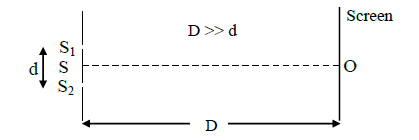
Choose correct option(s)
(a) The refractive index of the film is 1.6
(b) The fringe width near O is 2 mm
(c) On the screen, $\mathrm{O}^{\prime}$ is above O
(d) The distance D of the screen from the double slit is nearly 1.15 m
53. An insulated non-conducting solid sphere of radius 'a', carrying a positive charge +4 Q uniformly distributed throughout its volume, is surrounded by a concentric thick conducting spherical shell of inner radius $b$ and outer radius $c$. This thick shell carries a negative charge - 2Q (see figure). The correct option(s) is/are
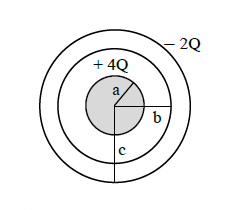
(a) Electric field strength at distance $r(r<a)$ from the center is $\vec{E}=\frac{1}{4 \pi \epsilon_{0}} \frac{4 Q}{a^{3}} \vec{r}$
(b) Charge on the inner surface of the conducting spherical shell is +2 Q
(c) Charge on the outer surface of the conducting spherical shell is +2 Q
(d) Electrical energy stored in region $0<\mathrm{r}<\mathrm{a}$ [i.e. in the inner sphere] is $\frac{2 \mathrm{Q}^{2}}{5 \pi \in_{0} \mathrm{a}}$
54. A single electron orbits around a stationary nucleus of charge +Ze in a hydrogen-like atom, where Z is the atomic number and e is the magnitude of the charge on an electron. It requires 47.25 eV to excite the electron from second Bohr orbit to the third Bohr orbit. Ionization energy of hydrogen atom is 13.6 eV . Then
(a) the value of Z is 5
(b) the energy required to excite the electron from the $3^{\text {rd }}$ orbit to the $4^{\text {th }}$ orbit is 16.53 eV (nearly)
(c) the wavelength of electromagnetic radiation required to liberate the electron completely when in the first Bohr orbit is $36.56 \AA$
(d) the angular momentum of an electron in the second Bohr orbit is $1.056 \times 10^{-33} \mathrm{Js}$
55. One mole of an ideal monoatomic gas of molecular mass M undergoes a cyclic process (ABCA) shown in the figure as a density ( $\rho$ ) versus pressure (P) curve. The correct option(s) is/are
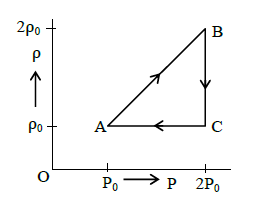
(a) Work done on the gas in going from A to B is $\mathrm{W}_{\mathrm{AB}}=\frac{\mathrm{MP}_{0}}{\rho_{0}} \ell \mathrm{n} 2$
(b) Work done by the gas in the process BC is $\mathrm{W}_{\mathrm{BC}}=\frac{\mathrm{MP}_{0}}{2 \rho_{0}}$
(c) Efficiency $(\eta)$ of the complete cycle ABCA is $\eta=\frac{2}{5}(1-\ell \operatorname{n} 2)$
(d) Heat rejected by the gas in the complete cycle $A B C A$ is $Q_{A B C A}=\frac{{M P_{0}}^{\rho_{0}}}{\rho_{0}}(1-\ell \operatorname{n} 2)$
56. Two ideal inductors $\mathrm{L}_{1}=\mathrm{L}_{2}=\mathrm{L}$ and three identical resistors $\mathrm{R}_{1}=\mathrm{R}_{2}=\mathrm{R}_{3}=\mathrm{R}$ have been connected to a DC source of emf E as shown in the circuit. When the key K is kept pressed (closed) for a long time, the current through the resistance $\mathrm{R}_{1}$ on the extreme right is measured to be I . Immediately after releasing (switching off) the key, the current through the resistors is
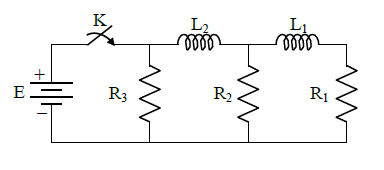
(a) I downwards in $\mathrm{R}_{1}$
(b) I downwards in $\mathrm{R}_{2}$
(c) 2 I upwards in $\mathrm{R}_{3}$
(d) zero in each $\mathrm{R}_{1}, \mathrm{R}_{2}$ and $\mathrm{R}_{3}$
57. A particle of mass $m$ moves along $x$ axis with its potential energy as $U(x)=\frac{\alpha}{x^{2}}-\frac{\beta}{x}$ where $\alpha$ and $\beta$ are positive constants. The particle is released from rest at $x_{0}=\frac{\alpha}{\beta}$. Then
(a) $\mathrm{U}(x)$ can be expressed as $U(x)=\frac{\alpha}{x_{0}^{2}}\left[\left(\frac{x_{0}}{x}\right)^{2}-\frac{x_{0}}{x}\right]$
(b) velocity of the particle $v(x)$ as a function of $x$ can be expressed as $v(x)=\left[\frac{2 \alpha}{m x_{0}^{2}}\left\{\frac{x_{0}}{x}-\left(\frac{x_{0}}{x}\right)^{2}\right\}\right]^{\frac{1}{2}}$
(c) the maximum speed of the particle is $v_{\text {max }}=\sqrt{\frac{\alpha}{2 m x_{0}^{2}}}$
(d) the total energy of the particle $\mathrm{KE}(x)+\mathrm{U}(x)$ is zero
58. Two blocks A and B , of masses M and 2 M , respectively, are connected by a massless spring of natural length $\mathrm{L}_{0}$ and spring constant K . The blocks are initially at rest on a smooth horizontal floor with spring at its natural length $\mathrm{L}_{0}$. A third block C of mass M , identical to that of block A , moves on the floor with speed $v$ along the line joining A and B and collides with A elastically. In the subsequent motion
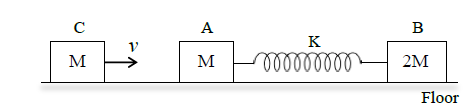
(a) the spring will be compressed to a maximum when at a length of $v \sqrt{\frac{M}{3 K}}$
(b) the kinetic energy of A and B together, when the spring is compressed to the maximum, is $\frac{M v^{2}}{6}$
(c) the blocks A and B stop for a moment when the spring is at the maximum compression
(d) the time required to reach the maximum compression from the normal length is $\frac{\pi}{2} \sqrt{\frac{2 \mathrm{M}}{3 \mathrm{~K}}}$
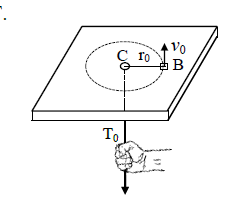
59. A small block B of mass $\mathrm{m}=0.25 \mathrm{~kg}$, lying on a frictionless horizontal table, is attached to a massless cord (breaking strength 40 N ) passing through a narrow hole C at the center of the table. Initially when the block is revolving in a circle of radius $\mathrm{r}_{0}=0.80 \mathrm{~m}$ about a vertical axis through the hole, with a tangential speed of $\mathrm{v}_{0}=4.00 \mathrm{~m} / \mathrm{s}$; the tension in the string is $\mathrm{T}_{0}$ and the kinetic energy of the block is $\mathrm{K}_{0}$. The string is then pulled down slowly from below, decreasing the radius of circular path from $\mathrm{r}_{0}$ to r so that the kinetic energy of the block is now K and the tension in the string is T .
As a result
(a) the tension $\mathrm{T}=\mathrm{T}_{0} \frac{\mathrm{r}_{0}^{4}}{\mathrm{r}^{4}}$
(b) the kinetic energy $\mathrm{K}=\mathrm{K}_{0} \frac{\mathrm{r}_{0}^{2}}{\mathrm{r}^{2}}$
(c) the radius r of the circular path just when the string breaks is 0.40 m
(d) the work done by the tension in the string in reducing the radius of circle from $\mathrm{r}_{0}$ to $\frac{\mathrm{r}_{0}}{2}$ is $4 \mathrm{~K}_{0}$
60. A circular coil of thin insulated copper wire ( $\mathrm{N}=2000$ turns), wrapped around an iron cylinder of cross-section area $\Delta \mathrm{S}=0.001 \mathrm{~m}^{2}$, is connected to a suspended type moving coil ballistic galvanometer. The suspended rectangular coil of the galvanometer is of mass $m=80 \mathrm{~g}$, length $\ell=5 \mathrm{~cm}$, breadth $\mathrm{b}=3$ cm and has $\mathrm{n}=100$ turns of fine copper wire wound on a non-metallic frame of ivory. This rectangular coil of the galvanometer is free to execute torsional oscillations in a radial magnetic field $\mathrm{B}=0.1$ tesla. The galvanometer is being used to measure the charge by employing the formula $\mathrm{q}=\frac{\mathrm{T}}{2 \pi} \frac{\mathrm{c}}{\mathrm{nAB}} \theta$. [Given that the moment of inertia of the oscillating coil about the vertical axis is $I=2.7 \times 10^{-6} \mathrm{~kg} \mathrm{~m}^{2}$ and the torsional constant (torsional rigidity) of the suspension fiber is $\mathrm{c}=3.0 \times 10^{-3} \mathrm{Nm} /$ radian : $\mathrm{A}=\ell \times b$ is the area of the coil]
When the magnetic induction of 1.0 weber per meter ${ }^{2}$, perpendicular to the plane of the circular coil, is reversed (in opposite direction), a deflection of 40 mm is observed on a scale placed 1.0 meter away in front of the reflecting mirror attached with the suspension fiber of the rectangular coil. The correct statement(s) is/are
(a) the time period of the oscillating rectangular coil is $\mathrm{T}=0.19 \mathrm{~s}$
(b) the net change in flux through the circular coil wrapped on the iron cylinder is 4.0 weber
(c) the induced charge in the circular coil wrapped on the iron cylinder is $\mathrm{q}_{\text {ind }}=240 \mu \mathrm{C}$
(d) total resistance of the circuit containing the circular coil is $\mathrm{R}=33.3 \mathrm{k} \Omega$