1. In the Bohr model of hydrogen atom, the force between the nucleus and the electron is modified as $F=\frac{e^2}{4 \pi \epsilon_0}\left(\frac{1}{r^2}+\frac{\delta}{r^3}\right)$ where $\delta$ is a small constant. Using the Bohr radius $a_0=\frac{\epsilon_0 h^2}{\pi m e^2}$, the radius of $n^{\text {th }}$ orbit is
(a) $a_0 n^2-\delta$
(b) $a_0 n^2+\delta$
(c) $a_0(n-\delta)^2$
(d) $a_0(n+\delta)^2$
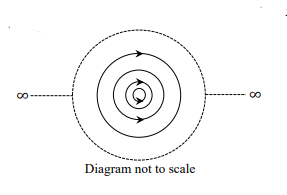
2. An infinite number of conducting rings having increasing radii $r_0, r_1, r_2, r_3$ and so on, such that $r_0=r, r_1=2 r, r_2=2^2 r, r_3=2^3 r$ and so on …. upto $\infty$, have been placed concentrically on a plane. All the rings carry the same current $i$ but the current in consecutive rings is in opposite direction as shown. The magnetic field produced at the common center of the rings is
(a) Zero
(b) $\frac{\mu_0 i}{4 r}$
(c) $\frac{\mu_0 i}{3 r}$
(d) $\frac{\mu_0 i}{2 r}$
3. One mole of an ideal monoatomic gas, initially at temperature T , is heated in such a way that its molar heat capacity during the process of heating is $\mathrm{C}=2 \mathrm{R}$. The volume of the gas gets tripled (at constant pressure) during the process. The final temperature attained by the gas is
(a) 3 T
(b) $3^2 \mathrm{~T}$
(c) $\frac{1}{3} \mathrm{~T}$
(d) $3^3 \mathrm{~T}$
4. A spring is compressed under the action of a constant force F . The compression of the spring is $\xi$. Suppose the direction of the force is reversed suddenly as well as its magnitude is doubled. The maximum extension of the spring beyond its natural length will now be (the spring obeys Hook's law).
(a) $2 \xi$
(b) $3 \xi$
(c) $4 \xi$
(d) $5 \xi$
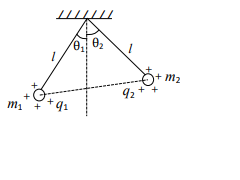
5. Two small positively charged spherical balls are suspended from a common point at the ceiling by non-conducting massless strings of equal length $\ell$. The first ball has mass $m_1$ and charge $q_1$ while the second ball has mass $m_2$ and charge $q_2$. If the two strings subtend angles $\theta_1$ and $\theta_2$ with the vertical as shown, then
(a) $\frac{\sin \theta_1}{\sin \theta_2}=\frac{q_2}{q_1}$
(b) $\frac{\sin \theta_1}{\sin \theta_2}=\frac{m_2}{m_1}$
(c) $\frac{\tan \theta_1}{\tan \theta_2}=\frac{q_1}{q_2} \times \frac{m_2}{m_1}$
(d) $\frac{\sin \theta_1}{\sin \theta_2}=1$
6. An air filled parallel plate capacitor, with plate area A and plate separation d , is connected to a battery of emf V volt having negligible internal resistance. One of the plates of the capacitor vibrates with amplitude 'a' (a << d) and angular frequency $\omega$. If the instantaneous current in the circuit reaches a maximum value $\mathrm{I}_{0}$, the amplitude of the vibrations is ' a ' equal to\\
(a) $\frac{I_{0} d^{2}}{\epsilon_{0} \omega V A}$
(b) $\frac{2 \mathrm{I}_{0} \mathrm{~d}}{\epsilon_{0} \omega \mathrm{VA}}$
(c) $\frac{2 \mathrm{I}_{0} \mathrm{~d}^{2}}{\epsilon_{0} \omega \mathrm{VA}}$
(d) $\frac{I_{0} d^{2}}{2 \in_{0} \omega V A}$
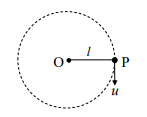
7. A small ball of mass $m$ is attached to one end of a massless un-stretchable string of length $\ell$ and is held at the point P . The other end of the string is fixed to a support at O such that OP is horizontal. The minimum downward speed $u$, that should be imparted to the ball at the point P so that the ball can complete the vertical circle without any slack in the string, is
(a) $\sqrt{2 g \ell}$
(b) $\sqrt{3 g \ell}$
(c) $\sqrt{4 g \ell}$
(d) $\sqrt{5 g \ell}$
8. An illuminated point object is placed on the principal axis, in front of an equi-convex glass lens of focal length $\mathrm{f}=40 \mathrm{~cm}$, at a distance of $\mathrm{u}=1.20 \mathrm{~m}$ from the lens. A reflecting plane mirror has been placed behind the lens perpendicular to the principal axis and facing the lens. The nature of the final image and the distance of the plane mirror from the lens, so as to form the final image at the plane mirror itself, is
(a) virtual image, 40 cm
(b) real image, 40 cm
(c) virtual image, 50 cm
(d) real image, 20 cm
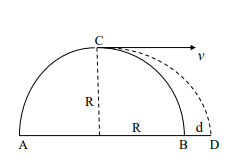
9. A ball is kicked horizontally from the top C of a hemispherical rock ACB of radius R on a horizontal ground, with a velocity $v$, so as not to hit the rock at any point during its flight.
Choose the correct statement (see the figure)
(a) The ball will just strike at B
(b) The ball will strike at D where $\mathrm{d}=\mathrm{BD}=(\sqrt{2}-1) \mathrm{R}$
(c) The ball will strike at D such that $\mathrm{d}=\mathrm{BD}=(2-\sqrt{2}) \mathrm{R}$
\includegraphics[max width=\textwidth, alt={}, center]{4e5549a2-6dc0-4de7-8b54-53954cd4753c-04_313_538_1398_1311}
(d) The speed $v$ of the ball should always be greater than the critical speed $v_{0}$ where $v_{0}$ is $\sqrt{\frac{g R}{2}}$
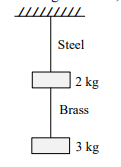
10. The ratio of lengths, radii and Young's moduli of steel to brass wires in the figure are $\alpha, \beta$ and $\gamma$, respectively. The corresponding ratio of the increase in their lengths is
(a) $\frac{2 \alpha}{3 \beta^{2} \gamma}$
(b) $\frac{5 \alpha}{3 \beta^{2} \gamma}$
(c) $\frac{2 \alpha \beta^{2}}{3 \gamma}$
(d) $\frac{5 \alpha \beta^{2}}{3 \gamma}$
11. A uniform beam of light of intensity $60 \mathrm{~mW} / \mathrm{m}^{2}$ is incident on a totally absorbing sphere of radius $2.0 \mu \mathrm{~m}$. The density of the material of the sphere is $\rho=5.0 \times 10^{3} \mathrm{~kg} / \mathrm{m}^{3}$. The sphere is placed in a region of space where gravitational force can be neglected / ignored. The magnitude of acceleration of the sphere due to the incidence of the light is
(a) $1.5 \mathrm{~ms}^{-2}$
(b) $3.0 \mathrm{~ms}^{-2}$
(c) $7.5 \mathrm{~ms}^{-2}$
(d) Zero
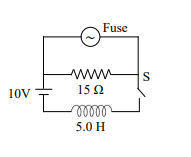
12. The fuse, in the upper branch of the circuit shown, is an ideal 4.0 A fuse. The fuse has zero resistance as long as current through it remains less than 4.0 A. The fuse blows out when the current reaches 4.0 A. Needless to say that the resistance becomes infinite thereafter. Switch S is closed at time $t=0$. The fuse blows out at time
(a) $t=2$ sec
(b) $t=4$ sec
(c) $t=8$ sec
(d) It won't blow
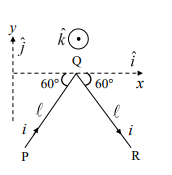
13. The bent wire PQR shown in the figure lies in a uniform magnetic field $\vec{B}=3.0 \hat{i}+4.0 \hat{k} T$. The direction $\hat{k}$ being normal to the plane of the paper and directed towards the viewer. The two straight sections PQ and QR of the wire each have length 2.0 m and the wire carries a current of 2.5 A. Net force on the wire due to magnetic field $\vec{B}$ is
(a) $40 \hat{\mathrm{j}} \mathrm{N}$
(b) $-20 \hat{\mathrm{j}} \mathrm{N}$
(c) $-40 \hat{\mathrm{j} ~ \mathrm{~N}}$
(d) $-20 \sqrt{3} \hat{\mathrm{j}} \mathrm{N}$
14. A charged spherical capacitor consists of two concentric spherical shells of radii a and $\mathrm{b}(\mathrm{b}>\mathrm{a})$. Half of the stored electrical energy of this system lies within a spherical region of radius r if
(a) $r=\sqrt{a b}$
(b) $r=\frac{a+b}{2}$
(c) $r=\frac{2 a b}{a+b}$
(d) $r=\frac{a^{2}+b^{2}}{a+b}$
15. Two stars of masses $M_{1}=M_{s}$ and $M_{2}=15 M_{s}$ (where $M_{s}=$ mass of the Sun) form a binary system. The stars are revolving round each other, always being at a separation of $\mathrm{d}=4 \mathrm{AU}$ between them ( 1 AU is distance of the Earth from the Sun), move in circular orbits about their center of mass. The period of revolution of each star is
(a) 1 year
(b) 2 years
(c) 4 years
(d) 8 years
16. The total energy released in $\alpha$ decay of a stationary Radium nucleus ${ }^{226} \mathrm{Ra}$ (mass 116 u ) is $\mathrm{Q}=4.9 \mathrm{MeV}$ (mass of $\alpha$ particle $\mathrm{m}_{\alpha}=4 \mathrm{u}$ ) then the
(a) energy of the recoiled daughter nucleus is nearly 8.7 keV
(b) energy of the recoiled daughter nucleus is nearly 4.81 MeV
(c) recoil speed of the daughter nucleus is $2.74 \times 10^{5} \mathrm{~ms}^{-1}$
(d) speed of emitted $\alpha$ particle is nearly $1.5 \times 10^{6} \mathrm{~ms}^{-1}$
17. A listener at rest (with respect to the air and the ground) hears a sound of frequency $f_{1}$ from a source moving towards him with a velocity of $15 \mathrm{~ms}^{-1}$, towards East. If the listener now moves towards the approaching source with a velocity of $25 \mathrm{~ms}^{-1}$, towards West, he hears a frequency $f_{2}$ that differs from $f_{1}$ by 40 Hz . The frequency $f$ of the sound produced by the source is (speed of sound in the air is $340 \mathrm{~ms}^{-1}$ )
(a) 520 Hz
(b) 450 Hz
(c) 480 Hz
(d) 550 Hz
18. A uniform rod of length $\ell$ swings from a pivot as a physical pendulum. The position of the pivot can be varied along the length of the rod. The minimum time period with which the rod can oscillate with an appropriate position of the pivot is $T=2 \pi \sqrt{\frac{L}{g}}$ where $L$ is equal to
(a) $\frac{\ell}{2}$
(b) $\frac{\ell}{\sqrt{2}}$
(c) $\frac{\ell}{\sqrt{3}}$
(d) $\frac{\ell}{2 \sqrt{3}}$
19. The number density of conduction electrons in pure silicon at room temperature is about $10^{16} \mathrm{~m}^{-3}$. The number density of conduction electrons is increased by a factor of $10^{6}$ by doping the silicon lattice with phosphorus. Assume that at room temperature every phosphorus atom contributes one electron to the conduction band. The fraction of silicon atoms replaced by phosphorus atoms is (Given that the density of silicon is $2.33 \mathrm{gm} / \mathrm{cm}^{3}$ and that the molar mass of silicon $\mathrm{M}=28.1 \mathrm{gm}$ )
(a) $1.0 \times 10^{-7}$
(b) $2.0 \times 10^{-7}$
(c) $4.0 \times 10^{-7}$
(d) $5.0 \times 10^{-7}$
20. A soap bubble 10 cm in radius, with a film thickness of $\frac{10}{3} \times 10^{-6} \mathrm{~cm}$, is charged to a potential of 80 V . The bubble bursts and converts into a single spherical drop. Assuming that the soap solution is a good conductor, the potential at the surface of the drop is
(a) 2 kV
(b) 4 kV
(c) 6 kV
(d) 8 kV
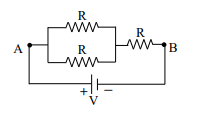
21. Three resistances, each of $\mathrm{R}=4 \Omega$ rated 16 W , are connected across A and B as shown. Potential difference of $V$ volt is applied between points $A$ and $B$.
Statement 1: Maximum potential difference V that can be applied is 12 volt.
Statement 2: Maximum power that can be dissipated is 24 watt.
(a) Statements 1 and 2 both are wrong
(b) Statement 1 is correct but statement 2 is wrong
(c) Statement 1 is wrong but statement 2 is correct
(d) Statements 1 and 2 both are correct
22. Water is filled in a vertical cylinder up to a certain height h . The cylinder is made to rotate with an angular velocity $\omega$ about a vertical axis coinciding with the axis of the cylinder. The water surface seen from top appears as a/an
(a) ellipsoid
(b) hemisphere
(c) paraboloid
(d) hyperboloid
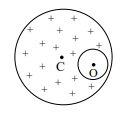
23. A uniformly charged non-conducting sphere with its center at C carries positive charge with uniform charge density $+\rho$, except in a spherical cavity (inside the sphere) with center O . The electric field $\mathbf{E}$ at any point inside the cavity is
(a) zero
(b) uniform
(c) directed radially outward
(d) directed radially inward
24. A cylindrical tank with base area $\mathrm{A}=0.05 \mathrm{~m}^{2}$ is filled with water up to a height $\mathrm{H}=50 \mathrm{~cm}$. There is a small hole of area $a=0.001 \mathrm{~m}^{2}(a \ll \mathrm{~A})$ in the bottom of the tank. It takes time t to empty the tank up to a height $\frac{\mathrm{H}}{2}$ (i.e to empty half of the water volume). The additional time required to empty the tank completely is
(a) t
(b) $t \sqrt{2}$
(c) $\mathrm{t}(\sqrt{2}-1)$
(d) $\mathrm{t}(\sqrt{2}+1)$
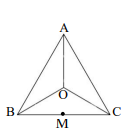
25. OABC is a regular tetrahedron, each side of which is made of uniform wire of resistance $4 \Omega / \mathrm{m}$. The length of each side is 2 m . The point M is the midpoint of the side BC . The resistance between O and M is
(a) $5 \Omega$
(b) $4 \Omega$
(c) $10 \Omega$
(d) $15 \Omega$
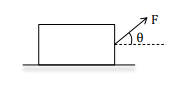
26. A box weighing W is placed on a rough horizontal floor. The coefficient of static friction between the box and the floor is $\mu$. To move the box, a pulling force F is applied along the rope joined to the box at an angle $\theta$ with horizontal. By suitable choice of $\theta$, the minimum value of $F$ that can make the box move is
(a) $\mu \mathrm{W}$
(b) $\frac{\mathrm{W}}{\sqrt{1+\mu^{2}}}$
(c) $\frac{\mu \mathrm{W}}{\sqrt{1+\mu^{2}}}$
(d) $\frac{W \sqrt{1-\mu^{2}}}{\mu}$
27. The external wall of a room measuring $2 \mathrm{~m} \times 3 \mathrm{~m}$ consists of a layer of white pine of thickness $\mathrm{d}_{\text {pine }}=2.0 \mathrm{~cm}$ and a layer of rock wool in succession. The external temperature is 36 K below the indoor temperature (Given the thermal conductivity coefficient of white pine $\mathrm{K}_{\mathrm{P}}=0.10 \mathrm{Wm}^{-1} \mathrm{kelvin}^{-1}$ and that of rock wool $\mathrm{K}_{\mathrm{w}}=0.04 \mathrm{Wm}^{-1}$ kelvin $^{-1}$ ). The thickness of the layer of the rock wool, so that the thermal conduction rate $\mathrm{P}_{\text {cond }}=\frac{\mathrm{dQ}}{\mathrm{dt}}$ across the wall does not exceed 120 watt (assuming no loss of heat during conduction and no other way of heat transfer other than conduction), is
(a) 7.2 cm
(b) 6.4 cm
(c) 4.8 cm
(d) 0.8 cm
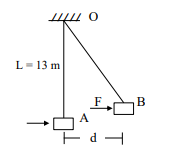
28. A 240 kg block is suspended from a fixed point O , at the end of a long ( $\mathrm{L}=13 \mathrm{~m}$ ) massless rope. A horizontal force F slowly pushes the block to move it a horizontal distance $\mathrm{d}=5 \mathrm{~m}$ sideways, to a position B where it remains stationary as shown in the figure.
Statement 1 Force F at position B is 980 N.
Statement 2 Work done by the force to bring the box from A to B is 2352 J
(a) Only statement 1 is correct
(b) Only statement 2 is correct
(c) Both statements 1 and 2 are wrong
(d) Both statements 1 and 2 are correct
29. The number of radioactive nuclei N of a radioactive sample is experimentally measured as a function of time t . At $\mathrm{t}=0, \mathrm{~N}(\mathrm{t}=0)=50,000$ and at $\mathrm{t}=10 \mathrm{~s}, \mathrm{~N}(\mathrm{t}=10 \mathrm{~s})=5000 \pm 100$. The half-life of the sample is estimated from these measurements. The error in the estimation of the half-life is approximately [note that for small values of $x, L t x \rightarrow 0, \ln (1+x) \approx x$ ]
(a) 0.26 s
(b) 0.15 s
(c) 0.05 s
(d) 0.10 s
30. An amount of heat equal to 10.61 J is given to an ideal gas at constant pressure of one atm ( $1.01 \times 10^{5} \mathrm{~Pa}$ ). As a result the volume of the gas increases by $30.0 \mathrm{~cm}^{3}$. The gas is
(a) mono atomic
(b) diatomic
(c) tri-atomic
(d) mixture of monoatomic and diatomic
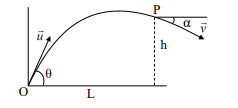
31. A ball is projected from point O on the ground with a certain velocity $\vec{u}$ at angle $\theta$ from horizontal. When it reaches point P located at a horizontal distance L from O and is at a height h above the ground, the angle $\alpha$ subtended by the velocity vector $\vec{v}$ with horizontal at this point P is expressed as
(a) $\tan \alpha=\frac{\mathrm{h}}{\mathrm{L}}-\tan \theta$
(b) $\tan \alpha=\frac{2 \mathrm{~h}}{\mathrm{~L}}+\tan \theta$
(c) $\tan \alpha=\tan \theta-\frac{2 \mathrm{~h}}{\mathrm{~L}}$
(d) $\tan \alpha=\frac{2 \mathrm{~h}}{\mathrm{~L}}-\tan \theta$
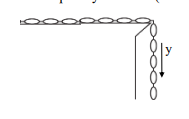
32. A flexible chain, of length L and uniform mass per unit length $\lambda$, slides off the edge of a frictionless table (see figure). Initially a length $y=y_{0}$ of the chain hangs over the edge, with the chain held at rest. Now the chain is let free. The velocity of the chain when the chain becomes completely vertical (i.e. when the chain is just to leave the edge) is
(a) $v=\sqrt{g\left(L-\frac{y_{0}^{2}}{L}\right)}$
(b) $v=\sqrt{2 g\left(L-\frac{y_{0}^{2}}{L}\right)}$
(c) $v=\sqrt{g\left(L-y_{0}\right)}$
(d) $v=\sqrt{2 g\left(L-y_{0}\right)}$
33. A Keplerian telescope is adjusted in its normal setting for parallel rays. Mounting of the objective has diameter D and the diameter of the image of that mounting formed by the eye piece of the telescope is d . Magnifying power of the telescope is
(a) $\frac{\mathrm{D}}{\mathrm{d}}-1$
(b) $\frac{\mathrm{D}}{\mathrm{d}}+1$
(c) $\frac{\mathrm{D}+\mathrm{d}}{\mathrm{D}-\mathrm{d}}$
(d) $\frac{\mathrm{D}}{\mathrm{d}}$
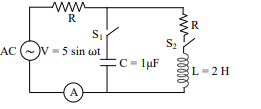
34. In the circuit shown below, the resistance $\mathrm{R}=\sqrt{3} \times 10^{3} \Omega$, the inductance $\mathrm{L}=2 \mathrm{H}$ and the capacitance $\mathrm{C}=1 \mu \mathrm{~F}$ have been connected to an AC supply of the peak voltage of $\mathrm{V}_{\max }=5$ volt at a frequency $\omega$. Either the switch $\mathrm{S}_{1}$ or the switch $\mathrm{S}_{2}$ is closed at a time. In either case, same maximum current ( $\mathrm{i}_{\text {max }}$ ) is recorded in the circuit. The frequency of the AC source is nearly
(a) 1.5 kHz
(b) 500 Hz
(c) 326 Hz
(d) 126 Hz
35. There are two given physical quantities $A=\frac{F}{\rho v^{2} D}$ and $B=\frac{\rho v D}{\eta}$ where $F$ is force, $\rho$ is density, $D$ is diameter, $v$ is velocity and $\eta$ is the Coefficient of viscosity. Which of the two A and B is/are dimensionless?
(a) A
(b) B
(c) neither A nor B
(d) both A and B
36. A uniform inextensible string of length L and mass M is suspended vertically from a rigid support. A transverse pulse is allowed to propagate down through the string from the support. At the same time, a ball of mass $m$ is dropped from the rigid support. The ball will pass the pulse at a distance of (from the top of the string i.e. from the support)
(a) $\frac{15 \mathrm{~L}}{16}$
(b) $\frac{8 \mathrm{~L}}{9}$
(c) $\frac{\mathrm{L}}{2}$
(d) $\frac{3 \mathrm{~L}}{4}$
37. In a positron decay, the radionuclide ${ }^{11} C$ decays according to ${ }^{11} C \longrightarrow{ }^{11} B+e^{+}+v$ [the respective atomic masses are ${ }^{11} C=11.01142 u,{ }^{11} B=11.00931 u$ and the mass of positron $=$ the mass of electron $\left.=m_{e}=0.00055 u\right]$. The disintegration energy (i.e. the Q value) is approximately
(a) 1.45 MeV
(b) 0.94 MeV
(c) 0.43 MeV
(d) -1.45 MeV
38. Two mechanical waves, given by $y_{1}=A \sin (8 x-50 t)$ and $y_{2}=A \sin \left(8 x+50 t+\frac{\pi}{3}\right)$ travelling in opposite directions along $x$ - axis, superpose. The position of the node (for $x>0$ ) nearest to the origin is (the displacements $\mathrm{y}_{1}$ and $\mathrm{y}_{2}$ are in meter)
(a) 32.7 cm
(b) 16.35 cm
(c) 6.54 cm
(d) 5.45 cm
39. At a certain location on the Earth surface, the intensity of sunlight is $1.00 \mathrm{~kW} / \mathrm{m}^{2}$. A perfectly reflecting concave mirror, of radius of curvature R and aperture radius r , is facing the Sun to produce the light intensity of $100 \mathrm{~kW} / \mathrm{m}^{2}$ at the image. Knowing that the disc of the Sun subtends an angle of 0.01 radian at the Earth surface, the relation between $R$ and $r$ is
(a) $\mathrm{R}=10 \mathrm{r}$
(b) $R=20 r$
(c) $R=40 r$
(d) $r=20 R$
40. A charge Q is uniformly distributed throughout the volume of a non-conducting sphere of radius R . The total electrostatic energy of electric field inside the sphere is $U=\alpha \times \frac{Q^{2}}{4 \pi \epsilon_{0} R}$. The value of $\alpha$ is
(a) Zero
(b) $\frac{3}{5}$
(c) $\frac{1}{2}$
(d) $\frac{1}{10}$
41. A long straight vertical wire of circular cross section of radius R contains $n$ conduction electrons per unit volume. A current I flows upward in the wire. The expression for magnetic force on an electron at the surface of the wire is [Assume all the conduction electrons are moving with drift velocity]
(a) $\frac{\mu_{0}}{4 \pi^{2}} \frac{I^{2}}{n R^{3}}$ outward
(b) $\frac{\mu_{0}}{2 \pi} \frac{I^{2}}{n R^{3}}$ inward
(c) $\frac{\mu_{0}}{2 \pi^{2}} \frac{I^{2}}{n R^{3}}$ inward
(d) $\frac{\mu_{0}}{2 \pi^{2}} \frac{I^{2}}{n R^{3}}$ outward
42. In Young's double slit experiment, a bright fringe is observed at $\mathrm{y}=1.5 \mathrm{~cm}$ from the center of the fringe pattern when monochromatic light of wavelength 612 nm is used. The screen is at 1.4 m from the plane of the two slits, whose separation is 0.4 mm . The number of dark fringes between the center and the said bright fringe at $\mathrm{y}=1.5 \mathrm{~cm}$ is
(a) 13
(b) 8
(c) 7
(d) 6
43. An illuminated point object is placed in front of an equi-convex lens of refractive index $\mu=1.5$ and focal length $\mathrm{f}=40 \mathrm{~cm}$, at a distance of $\mathrm{u}=1.20 \mathrm{~m}$ in front of the lens on its principal axis. Water ( $\mu=4 / 3$ ) fills the space behind the lens up to a distance of 40 cm from the lens. The final image is formed on the principal axis beyond the lens at a distance v from the lens. The value of v and the nature of image are
(a) 60 cm , virtual
(b) 80 cm , virtual
(c) 110 cm , real
(d) 130 cm , real
44. A paramagnetic gas at room temperature $27^{\circ} \mathrm{C}$ is placed in an external uniform magnetic field of magnitude $\mathrm{B}=1.5$ tesla . The atoms of the gas have magnetic dipole moment $\mu=1.0 \mu_{\mathrm{B}}$ where $1 \mu_{\mathrm{B}}=\frac{\mathrm{eh}}{4 \pi \mathrm{~m}}$ is Bohr magneton, and m is the mass of electron. The energy difference $\Delta \mathrm{U}_{\mathrm{B}}$ between the parallel alignment and the antiparallel alignment of the atom's magnetic dipole moment, with respect to the external field B , is $x \times 10^{-4} \mathrm{eV}$ where the value of $x$ is
(a) 17.4
(b) 1.74
(c) 34.8
(d) 8.7
45. A glass capillary with inner diameter of 0.40 mm is vertically submerged in water so that the length of its part protruding above the water surface is $\mathrm{h}=25 \mathrm{~mm}$. Surface Tension of water is $\mathrm{T}=0.073 \mathrm{Nm}^{-1}$. Since the water wets the glass completely, it may be concluded that the
(a) length of capillary above the water surface is insufficient so the water will flow out as a fountain
(b) water will rise up to the brim forming a meniscus of radius 1.2 mm at the top
(c) water will rise up to the brim forming a meniscus of radius 0.6 mm at the top
(d) water will rise up to the brim forming a meniscus of radius equal to radius of the capillary
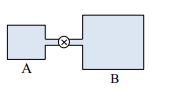
46. The container A in the figure holds an ideal gas at a pressure of $5.0 \times 10^{5} \mathrm{~Pa}$ at $27^{\circ} \mathrm{C}$. It is connected to the container B by a thin tube fitted with a closed valve. Container B with volume four times the volume of A holds the same ideal gas at a pressure $1.0 \times 10^{5} \mathrm{~Pa}$ at $127{ }^{\circ} \mathrm{C}$. The valve is now opened to allow the pressure to equalize, but the temperature of each container is maintained as before. The common pressure in the two containers (in kPa ) is
(a) 200
(b) 300
(c) 320
(d) 180
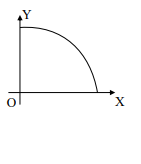
47. A thin plastic disc, which is a quarter of a circle of radius $\mathrm{R}=0.6 \mathrm{~m}$, lies in the first quadrant of $\mathrm{x}-\mathrm{y}$ plane, with the center of curvature at the origin O as shown. It is charged uniformly on one side (one face) with surface charge density $\sigma$. Electric potential at point $\mathrm{P}(0,0,0.8 \mathrm{~m})$ is
(a) $\frac{\sigma}{8 \epsilon_{0}}$
(b) $\frac{\sigma}{8 \pi \epsilon_{0}}$
(c) $\frac{\sigma}{20 \epsilon_{0}}$
(d) $\frac{\sigma}{40 \epsilon_{0}}$
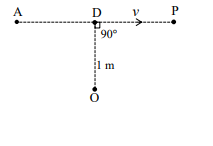
48. The charge on a small point object at A produces an electric potential $\mathrm{V}=3$ volt at a point P . Because of an unavoidable situation, leakage of the charge from the object at A starts at $\mathrm{t}=0$ at a constant rate of $3 \mu \mathrm{Cs}^{-1}$. To maintain the potential of 3 volt at the point P , the object is made to move towards P with a certain velocity $v$. When the point object crosses the point D shown in the figure, it is found to have a charge of $10 \mu \mathrm{C}$ and the direction of its velocity is perpendicular to OD. The resulting magnetic field $\mathbf{B}$, at this instant, at the location O (such that $\mathrm{OD}=1.0 \mathrm{~m}$ ) is
(a) $8.1 n T$
(b) $\frac{1}{9} \mu T$
(c) $9.9 \mu \mathrm{~T}$
(d) $9.0 n T$
49. An electric circuit consists of a battery of emf $E$, an inductance $L$ and a resistance $R$ in series. The switch S is closed at $\mathrm{t}=0$. The current in the circuit grows exponentially with time as depicted by curve (1). The values of the circuit parameters (E, L or R) are now somehow changed. The circuit is closed second time, the growth of current I follows curve (2). The following conclusion(s) may be drawn
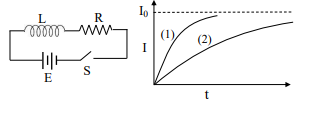
(a) E and R are unchanged but L has increased
(b) $\frac{E}{R}$ is unchanged but $\frac{L}{R}$ has increased
(c) $\frac{E}{R}$ is unchanged but $\frac{L}{R}$ has decreased
(d) Stored magnetic energy has increased
50. The Earth is revolving around the Sun (mass M ) in a circular orbit of radius r with a period of revolution $T=1$ year. Suppose that during the revolution of the Earth, at any instant, the mass of the Sun instantaneously becomes double i.e. 2M. The correct alternative(s) is/are [Assume that the Sun and the Earth are point masses]
(a) The period of revolution of the Earth around the Sun now becomes $\frac{1}{\sqrt{2}}$ year
(b) There is no change in angular momentum of the Earth around the Sun
(c) Minimum distance of the Earth from Sun during revolution is now $\frac{r}{3}$
(d) Maximum speed of the Earth during revolution around the Sun is $3 \sqrt{\frac{G M}{r}}$
51. An optical fibre consists of a glass core (refractive index $\mathrm{n}_{1}$ ) surrounded by a cladding (refractive index $n_{2}<n_{1}$ ). A beam of light enters one end of the fibre at P , from air at angle $\theta$, with the axis of fibre as shown in the figure. Choose the correct option(s)
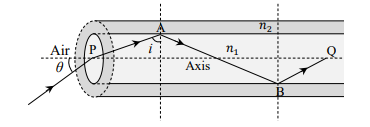
(a) Maximum value of $\theta$ for which a ray can travel down the fibre is $\theta=\sin ^{-1} \sqrt{n_{1}^{2}-n_{2}^{2}}$
(b) Maximum value of $\theta$ for which a ray can travel down the fibre is $\theta=\cos ^{-1} \sqrt{n_{1}^{2}-n_{2}^{2}}$
(c) If $\theta=30^{\circ}$ (in air) and $n_{1}=1.50$, then for reflection just at the critical angle, the value of $n_{2}$ is $\sqrt{2}$
(d) A ray entering at $\theta=0$ travels a distance L from P to Q , inside the fibre directly along the fibre axis. Another ray travelling through fibre is repeatedly reflected at the critical angle, at interface of glass core and surrounding layer/cladding. Both the rays travel from point P to point Q on the axis. If the two rays started from point P at the same time, the difference $\Delta t$ in the time taken to reach the point Q by the two rays is $\Delta t=\frac{n_{1}}{n_{2}} \times \frac{L}{c}\left(n_{1}-n_{2}\right)$ (here c is the speed of light in vacuum)
52. A series LCR circuit fed with AC has resonant angular frequency of $\omega=2.0 \times 10^{4} \mathrm{rad} / \mathrm{s}$. When the same circuit is driven at an angular frequency of $2.5 \times 10^{4} \mathrm{rad} / \mathrm{s}$, it has an impedance of $1.0 \mathrm{k} \Omega$ and phase constant of $\phi=45^{\circ}$. The values of $\mathrm{L}, \mathrm{C}$ and R for this circuit may be
(a) $\mathrm{R}=707 \Omega$
(b) $\mathrm{L}=78.6 \mathrm{mH}$
(c) $\mathrm{C}=31.8 \mathrm{nf}$
(d) $\mathrm{R}=506 \Omega$
53. A long straight wire, having a radius greater than 4.0 mm , carries a current that is uniformly distributed over its cross - section. The magnitude of magnetic field $\mathbf{B}$ due to the current is 0.28 mT at $\mathrm{r}=4.0 \mathrm{~mm}$ and 0.20 mT at $\mathrm{r}=10.0 \mathrm{~mm}$, respectively, from the axis of the wire then the
(a) magnitude of the magnetic field $\mathbf{B}$ at a distance $\mathrm{r}=2.0 \mathrm{~mm}$ from axis is 0.14 mT
(b) magnitude of the magnetic field $\mathbf{B}$ at $\mathrm{r}=5.0 \mathrm{~mm}$ is greater than that at $\mathrm{r}=6.0 \mathrm{~mm}$
(c) current flowing in the wire is $\mathrm{I}=20 \mathrm{~A}$
(d) current density in the wire is $\mathrm{J} \approx 1.1 \times 10^{5} \mathrm{~A} / \mathrm{m}^{2}$
54. In the given combination of capacitors $\mathrm{C}_{1}=4 \mu \mathrm{~F}, \mathrm{C}_{2}=2 \mu \mathrm{~F}, \mathrm{C}_{3}=2 \mu \mathrm{~F}, \mathrm{C}_{4}=4 \mu \mathrm{~F}$ and $\mathrm{C}_{5}=3 \mu \mathrm{~F}$, a source of 12 volt is connected across the points A and B . Then the
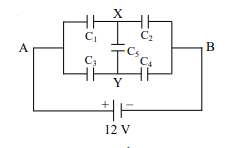
(a) equivalent capacity between A and B is $\frac{8}{3} \mu \mathrm{~F}$
(b) stored electrical energy of the system is $204 \mu \mathrm{~J}$
(c) potential difference between X and Y is $\mathrm{V}_{\mathrm{XY}}=2$ volt
(d) potential difference across the capacitor $\mathrm{C}_{2}$ is 8 volt
55. One mole of an ideal monoatomic gas, initially at temperature $T$, is compressed to $\frac{1}{8}$ of its volume by a piston in a cylinder such that the heat dissipated into the environment is equal to the change in the internal energy of the gas. Then the
(a) molar heat capacity of the gas is $\mathrm{C}=\frac{3 \mathrm{R}}{2}$
(b) final temperature of the gas is 2 T
(c) work done on the gas is 3 RT
(d) equation of state of the process is $\mathrm{PV}^{4 / 3}=$ constant
56. A solid ball of mass M and radius R (see figure) is lying on a horizontal table. The ball experiences a short horizontal impulse which imparts a momentum p to the ball. The height of point of impact above the center line is $\mathrm{h}=\alpha \mathrm{R}(0 \leq \alpha \leq 1)$. Choose the correct option/option(s).
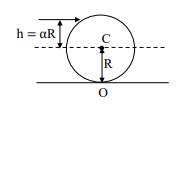
(a) Translational energy of the ball is $\frac{p^{2}}{2 M}$
(b) Energy of pure rotational motion of the ball is $\frac{5}{4} \frac{\mathrm{p}^{2} \alpha^{2}}{\mathrm{M}}$
(c) For $\alpha=\frac{2}{5}$, the ball rolls without sliding
(d) For $\alpha=0$, pure rotational motion will be observed
57. According to Bohr theory, in the ground state of hydrogen atom, an electron revolves in circular orbit of radius $r$ with velocity $v$ and circulation frequency $f$. The magnetic dipole moment of the electronic orbit is $p_{m}$. The magnetic field produced by the circulating electron at the center of the atom is $\mathbf{B}$. Then for a $\mathrm{He}^{+}$ion in the state $\mathrm{n}=2$ (electron in the $2^{\text {nd }}$ orbit)
(a) the radius of the orbit is 2 r
(b) the magnetic dipole moment of the orbit is $2 p_{m}$
(c) the frequency of circulation is $\frac{f}{2}$
(d) the magnetic field at the center is $\frac{\mathrm{B}}{4}$
58. A body of mass $\mathrm{m}=0.25 \mathrm{~kg}$ is moving along $x$ axis under the action of a conservative force. Its potential energy as a function of position $x$ is given by $\mathrm{U}(x)=-\frac{100 x}{x^{2}+4} \mathrm{~J}(x$ in m). Then
(a) force $\mathrm{F}(x)$ acting on the body at $x=0$ is 25 N
(b) there is stable equilibrium at $x=2 \mathrm{~m}$
(c) there is unstable equilibrium at $X=-2 \mathrm{~m}$
(d) the body executes (small) oscillations with angular frequency $\omega=0.5 \mathrm{rads}^{-1}$
59. A uniform rod OA of length L is freely pivoted at one end O . Let C be the midpoint (i.e. $\mathrm{OC}=\frac{\mathrm{L}}{2}=\mathrm{CA}$ ).
Choose the correct statement(s)
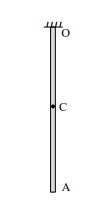
(a) The rod can perform small angular oscillations with time period $\mathrm{T}=2 \pi \sqrt{\frac{\mathrm{~L}}{2 \mathrm{~g}}}$
(b)The rod is brought to the horizontal position and then released from rest. The angular velocity of the rod at the instant when it is vertical is $\omega=\sqrt{\frac{3 g}{\mathrm{~L}}}$
(c) When the oscillating rod comes to the vertical position, it breaks at midpoint C without generating any impulsive force, the largest angle from vertical reached by the upper part OC of the rod is $60^{\circ}$.
(d)After breaking, the lower part just falls vertically rotating about its center.
60. A boy stands on a stationary ice boat on a frictionless horizontal flat iceberg. The boy and the boat have a combined mass of $M=60 \mathrm{~kg}$. Two balls of masses $m_{1}=10 \mathrm{~kg}$ and $m_{2}=20 \mathrm{~kg}$ are placed on the boat. In order to get the boat moving, the boy throws the balls backward horizontally either in succession or both together. In each case the balls are thrown backward with a certain speed $v_{\text {rel }}=6 \mathrm{~ms}^{-1}$ relative to the boat just when the ball is being thrown. The resulting speed of the system of the boat and the boy is
(a) $V=2.00 \mathrm{~ms}^{-1}$ when both the balls $\mathrm{m}_{1}$ and $\mathrm{m}_{2}$ are thrown together.
(b) $\mathrm{V}=3.00 \mathrm{~ms}^{-1}$ when both the balls $\mathrm{m}_{1}$ and $\mathrm{m}_{2}$ are thrown together.
(c) $V=2.17 \mathrm{~ms}^{-1}$ if the balls are thrown one after the other, first $m_{1}$ and then $m_{2}$.
(d) $V=2.19 \mathrm{~ms}^{-1}$ if the balls are thrown one after the other, first $\mathrm{m}_{2}$ and then $\mathrm{m}_{1}$.