Mathematics and Artificial Intelligence
How Artificial Intelligence Can Assist Mathematicians?
Double-click to edit button text.Expository Paper: Exploring Hyperbolic Groups with Elementary Geometry and Genetic Algorithms
Is Math Curvy? Is Math Fat?
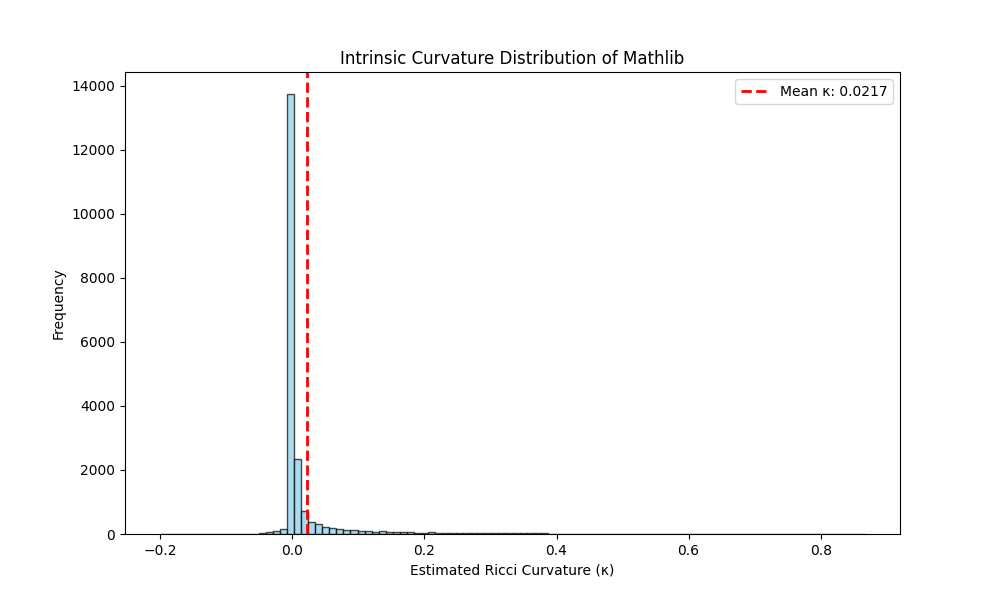
Mathlib library, $619{,}518$ declarations and $12.5$ million logical dependencies, and ask two questions about its geometry. Is it curvy? Is it fat?
The answer to both is yes, but at different scales. Globally the graph is tree-like: stochastic sampling of $10{,}000$ quadruples yields a Gromov hyperbolicity constant $\delta = 1.50$ ($\delta = 1.00$ after pruning high-degree utility nodes). Locally it is dense: a Jaccard-overlap proxy for Ollivier--Ricci curvature measured on $20{,}000$ edges returns a mean $\kappa \approx 0.022 > 0$. I call this dual architecture a \emph{tree of cliques}.
Three null-model controls, Erd\H{o}s R\'enyi, Barab\'asi--Albert, and a configuration model with Mathlib's exact degree sequence; all exhibit \emph{negative} local curvature ($\kappa \approx -0.01$ to $-0.02$) after identical pruning. The positive curvature of Mathlib is not a statistical artifact. It is a property of mathematical knowledge itself.
We embed the graph into a 16-dimensional Poincar\'e ball and use the geometry to hunt for logical voids. Two results have been formally verified in Lean~4: a scale-invariance lemma for $\tau$-packings in the Besicovitch covering theorem, and a construction of the cycle matroid bridging graph theory and matroid theory, a foundational definition absent from the current Mathlib library.
How Artificial Intelligence can Assist Educators in Mathematical Science?
Randomized Control Trial on How Artificial Intelligence can Improve Human Collaboration in Virtual Classroom
Can Geometry Reduce LLM Hallucination in Math?
Geometry as Infrastructure

Dr. Ashani Dasgupta
Dr. Ashani Dasgupta specializes in geometric group theory and low-dimensional topology. His research includes relative hyperbolicity, embedding problems, Morse conditions, local connectedness of boundaries for relatively hyperbolic groups, and connectedness properties of Bowditch boundaries.

Srijit Mukherjee
Srijit Mukherjee is a PhD student in the EECS Department at Pennsylvania State University (after studies in Statistics at Indian Statistical Institute). He builds interpretable AI solutions for biomedical imaging and diseases, collaborating with doctors and engineers at Harvard and Yale. His work explores expressing "mind, information, and intelligence" through mathematics and engineering, with applications in generative AI for problem-solving and novel problem creation.
Dr. Arka Banerjee
Arka Banerjee (Postdoc at Auburn University) focuses on metric geometry, geometric group theory, coarse geometry, coarse cohomology, coarse embeddings, group actions on CAT(0) cube complexes, coarse Poincaré duality spaces, and topological methods in geometry and topology.
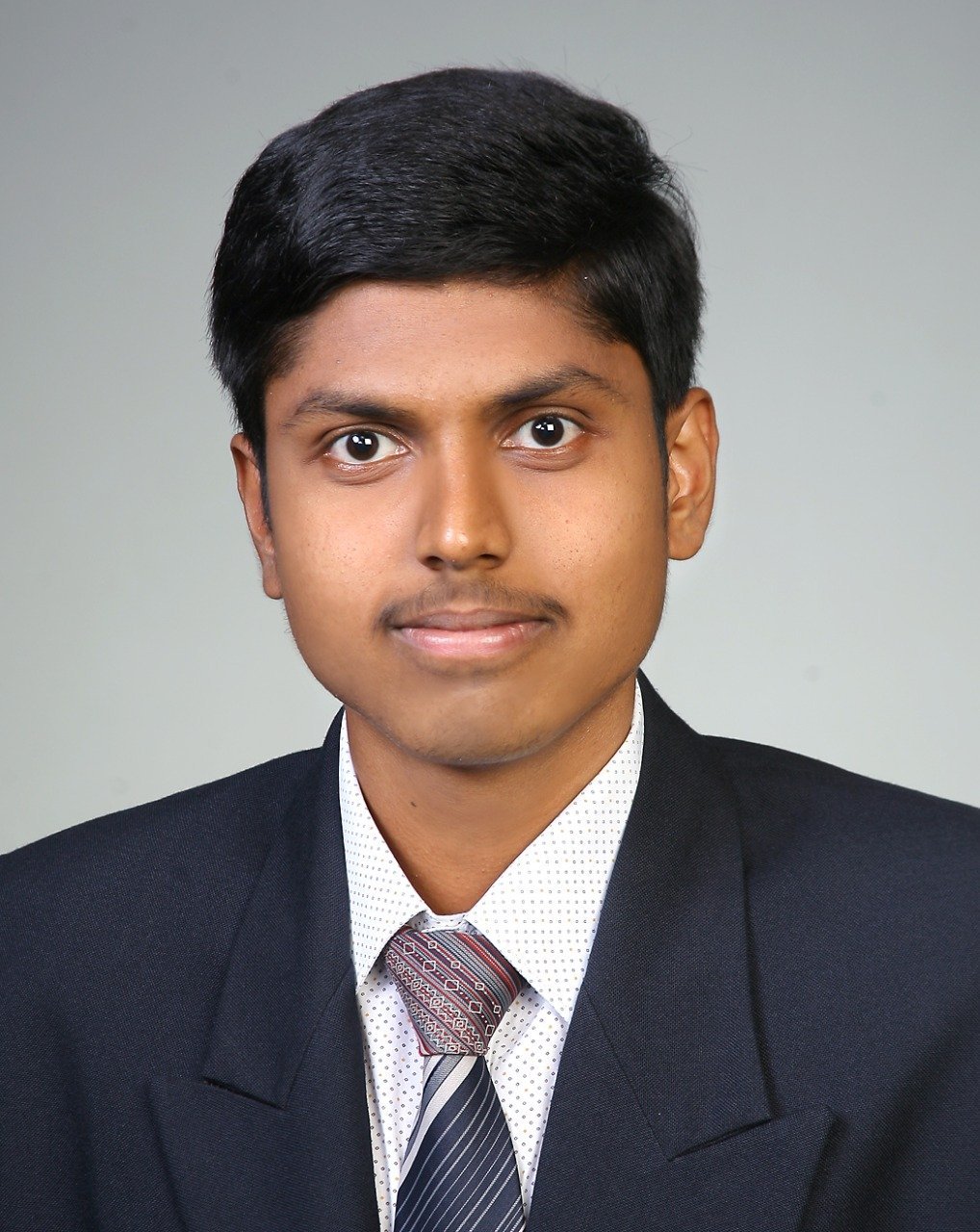
Ragunath JV
Raghunath is a PhD applicant in Pure Mathematics, with a focus on Topology, Group Theory, and allied areas. He love discussing Math Olympiad problems, particularly strategical game-theory, geometry, combinatorics problems.
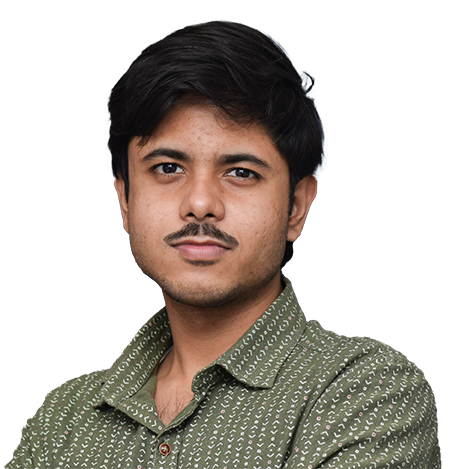
Swarnabja Bhaumick
Swarnabja Bhaumick works in computer vision and machine learning, specializing in event and activity recognition in video surveillance for cyber-physical systems. His research uses deep learning methods (hybrid CNN-RNN architectures, graph-based key-frame selection, multi-tier feature fusion) to handle unconstrained videos from drones/CCTVs and achieve robust performance on benchmarks like UCF-101, HMDB, and CCV.
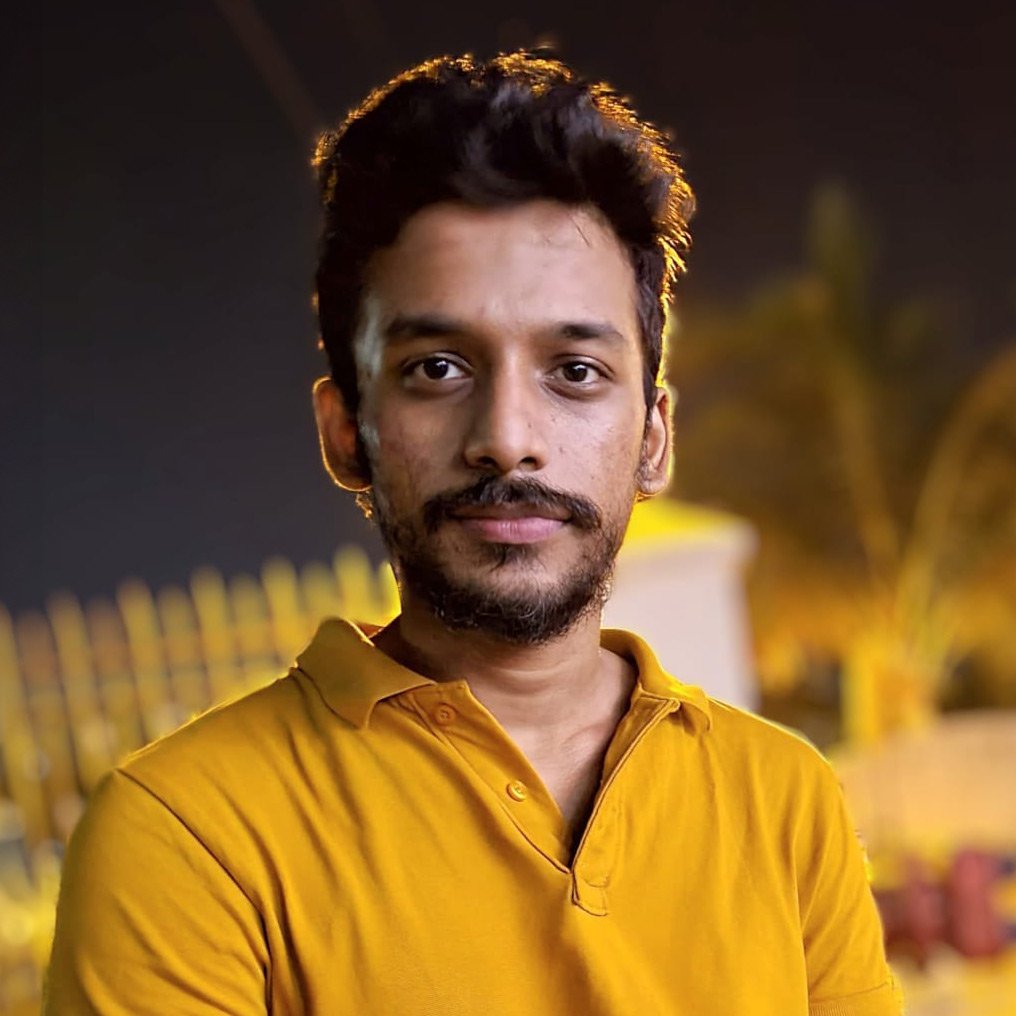
Shayeef Murshid
Shayeef Murshid (Indian Statistical Institute) researches quantum computing and quantum information theory, with emphasis on quantum state discrimination, nonlocality, and the intersection with quantum cryptography — including secure encryption protocols and certified data deletion mechanisms.
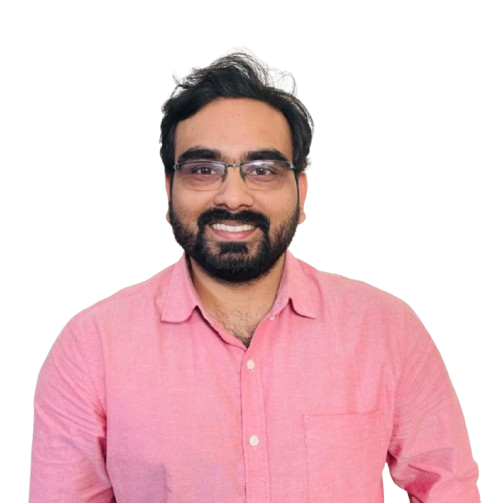
Dr. Sourayan Banerjee
Sourayan Banerjee is a PhD holder from IISER Bhopal and a Postdoctoral scholar at IIT Kanpur. His research focuses on Algebraic K-theory, exploring the intersections of algebra and topology.