Let's discuss a beautiful problem useful for Physics Olympiad based on the Conical Pendulum.
The Conical Pendulum Problem:
An inventor designs a pendulum clock using a bob with mass m at the end of a thin wire of length L. Instead of swinging back and forth, the bob is to move in a horizontal circle with constant speed v, with the wire making a fixed angle \(\beta\) with the vertical direction. This is called a conical pendulum because the suspending wire traces out a cone. Find the tension F in the wire and the period T( the time for one revolution of the bob).
Solution:
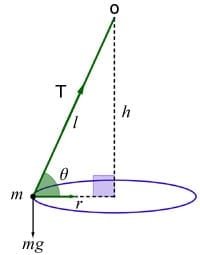
SET UP: To find the tension F and period R, we need two equations. These will be the horizontal and vertical components of Newton's second law applied to the bob. We'll find the radial acceleration of the bob using one of the circular motion equations.
The figure shows the free-body diagram and coordinate system for the bob at a particular instant. There are just two forces on the bob: the weight mg and the tension F in the wire. Note that the entre of the circular path is in the same horizontal plane as the bob, not at the top end of the wire. The horizontal component of tension is the force that produces the radial acceleration \(a_rad\).
Execution: The bob has zero vertical acceleration.
Newton's second law says that
$$ \Sigma F_x=Fsin\beta=ma_r$$
$$ \Sigma F_y=Fcos\beta+(-mg)=0$$
These are two equations for the two unknowns F and \(\beta\). The equation for \(\Sigma F_y\) gives $$ F=mg/cos\beta$$.
That's our target expression for F in terms of \(\beta\).
Substituting this result into the equation for \(\Sigma F_x\) and using \(sin\beta/ cos\beta =tan\beta\), we find
$$ a_r=g tan\beta$$
To relate \(\beta\) to the period T, we use the equation
$$ T=2\pi R/v$$
in terms of the period , $$ a_R=4\pi^2R/T^2$$
so, T=\(2 \pi \sqrt{\frac{R}{gtan\beta}}\)
Now, $$ R=Lsin\beta$$. We substitute this and use \(sin\beta / tan \beta=cos\beta\):
So, $$ T= 2\pi\sqrt{\frac{Lcos\beta}{g}}$$
Evaluation: For a given length L, as the angle \(\beta\) increases, \(cos\beta\) decreases. A conical pendulum will never make a very good clock because the period depends on the angle \(\beta\) in such a direct way.
In 2026, the following Cheenta students have been successful for Indian Statistical Institute's M.Stat Entrance. They ranked within the first 50 in the entire country in these entrances. I.S.I. M.Stat Entrance
In 2026, the following Cheenta students have been successful for Indian Statistical Institute's B.Stat Entrance and Chennai Mathematical Institute's B.Sc. Math Entrance. They ranked within the first 200 in the entire country in these entrances. Most of these students attended the problem solving workshops regularly, which happen 5 days every week. CMI B.Sc. Math Entrance […]

In 2025, 8 students from Cheenta Academy cracked the prestigious Regional Math Olympiad. In this post, we will share some of their success stories and learning strategies. The Regional Mathematics Olympiad (RMO) and the Indian National Mathematics Olympiad (INMO) are two most important mathematics contests in India.These two contests are for the students who are […]
Cheenta Academy proudly celebrates the success of 27 current and former students who qualified for the Indian Olympiad Qualifier in Mathematics (IOQM) 2025, advancing to the next stage — RMO. This accomplishment highlights their perseverance and Cheenta’s ongoing mission to nurture mathematical excellence and research-oriented learning.