Try this beautiful problem from the American Invitational Mathematics Examination I, AIME I, 1996 based on Parallelogram.
In parallelogram ABCD , Let O be the intersection of diagonals AC and BD, angles CAB and DBC are each twice as large as angle DBA and angle ACB is r times as large as angle AOB. Find the greatest integer that does not exceed 1000r.
Integers
Trigonometry
Algebra
Answer: is 777.
AIME I, 1996, Question 15
Geometry Vol I to IV by Hall and Stevens
Let \(\theta= \angle DBA\)
\(\angle CAB=\angle DBC=2 \theta\)
or, \(\angle AOB=180-3\theta, \angle ACB=180-5\theta\)
or, since ABCD parallelogram, OA=OC
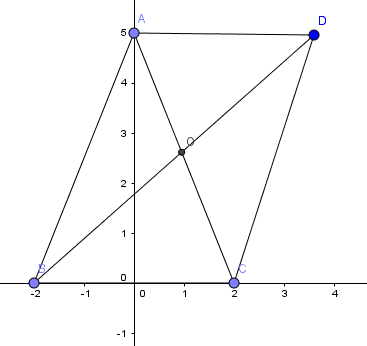
by sine law on \(\Delta\)ABO, \(\Delta\)BCO
\(\frac{sin\angle CBO}{OC}\)=\(\frac{sin\angle ACB}{OB}\)
and \(\frac{sin\angle DBA}{OC}=\frac{sin\angle BAC}{OB}\)
here we divide and get \(\frac{sin2\theta}{sin\theta}\)=\(\frac{sin(180-5\theta)}{sin 2\theta}\)
\(\Rightarrow sin^{2}{2\theta}=sin{5\theta}sin{\theta}\)
\(\Rightarrow 1-cos^{2}2\theta=\frac{cos4\theta-cos6\theta}{2}\)
or, \(4 cos^{3}2\theta-4cos^{2}2\theta -3cos2\theta+3=(4cos^{2}2\theta-3)(cos2\theta-1)=0 [using cos3\theta=4cos^{3}\theta-3cos\theta]\)
or, \(cos 2\theta=\frac{\sqrt{3}}{2}\)
or, \(\theta\)=15
\([1000r]=[1000\frac{180-5\theta}{180-3\theta}]=[\frac{7000}{9}]\)=777.

AMC - AIME Boot Camp... for brilliant students.
Use our exclusive one-on-one plus group class system to prepare for Math Olympiad
In 2026, the following Cheenta students have been successful for Indian Statistical Institute's M.Stat Entrance. They ranked within the first 50 in the entire country in these entrances. I.S.I. M.Stat Entrance
In 2026, the following Cheenta students have been successful for Indian Statistical Institute's B.Stat Entrance and Chennai Mathematical Institute's B.Sc. Math Entrance. They ranked within the first 200 in the entire country in these entrances. Most of these students attended the problem solving workshops regularly, which happen 5 days every week. CMI B.Sc. Math Entrance […]

In 2025, 8 students from Cheenta Academy cracked the prestigious Regional Math Olympiad. In this post, we will share some of their success stories and learning strategies. The Regional Mathematics Olympiad (RMO) and the Indian National Mathematics Olympiad (INMO) are two most important mathematics contests in India.These two contests are for the students who are […]

Cheenta Academy proudly celebrates the success of 27 current and former students who qualified for the Indian Olympiad Qualifier in Mathematics (IOQM) 2025, advancing to the next stage — RMO. This accomplishment highlights their perseverance and Cheenta’s ongoing mission to nurture mathematical excellence and research-oriented learning.
Why does $\cos^2 2 \theta = \frac 3 4 \implies \cos 2 \theta = \frac {\sqrt 3} {2}$? It may so happen that $\cos 2 \theta = - \frac {\sqrt 3} {2}$ in which case $2 \theta = 150^{\circ} \implies \theta = 75^{\circ}.$ Why don't we take this value of $\theta$?
Oh! Sorry then $3 \theta > 180^{\circ}$ which cannot be possible.