A geometric progression is a sequence in which each term is derived by multiplying or dividing the preceding term by a fixed number called the common ratio. E.g., the height to which a ball rises in each successive bounce follows a geometric progression. The sequence 4, -2, 1,... is a Geometric Progression (GP) for which (-1/2) is the common ratio. We can use the concept to find an arbitrary term, a finite or infinite sum of the series, and apply them in various contexts, including some difficult problems.
Suppose that the three distinct real numbers \(a,b \text{ and } c\) are in G.P. and \(a+b+c=xb\). Then
(A) \(-3<x<1 ;\)
(B) \(x>1\) or \(x<-3 ;\)
(C) \(x>3\) or \(x<-1 ;\)
(D) \(-1<x<3 ;\)
ISI entrance B. Stat. (Hons.) 2003 problem 3
Geometric Progression
6 out of 10
challenges and thrills of pre college mathematics
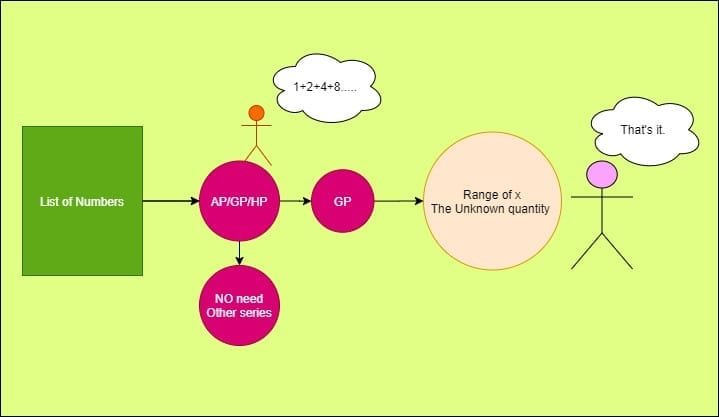
If any three quantity are in GP then we have a relation between them, in this case \(a,b,c\) are in G.P. so we have
\(b^2=ac\) or \(b= \sqrt{ac}\).
We also have \(a+b+c=xb\) so
which is equal to \(a+c=b(x-1)\)
=\(\frac{a}{b}+\frac{c}{b}=(x-1)\)
since \(b=\sqrt{ac}\) we will get
=\(\sqrt{\frac{a}{c}}+\sqrt{\frac{c}{a}}=(x-1)\)
=\(\sqrt{\frac{a}{c}}+\frac{1}{\sqrt{\frac{a}{c}}}=(x-1)\)
Let \(\sqrt{\frac{a}{c}}=k\), then we have the form of \(k+\frac{1}{k}\) which we know has a value either greater than 2 or less than -2.
so we can write
either, \(x-1 > 2\) or \(x-1 < -2\)
and now you can easily get the answer.
So the answer is x>3 or x<-1.

I.S.I. & C.M.I. Entrance Program
Taught by students and alumni of I.S.I. & C.M.I.

In 2026, the following Cheenta students have been successful for Indian Statistical Institute's M.Stat Entrance. They ranked within the first 50 in the entire country in these entrances. I.S.I. M.Stat Entrance
In 2026, the following Cheenta students have been successful for Indian Statistical Institute's B.Stat Entrance and Chennai Mathematical Institute's B.Sc. Math Entrance. They ranked within the first 200 in the entire country in these entrances. Most of these students attended the problem solving workshops regularly, which happen 5 days every week. CMI B.Sc. Math Entrance […]

In 2025, 8 students from Cheenta Academy cracked the prestigious Regional Math Olympiad. In this post, we will share some of their success stories and learning strategies. The Regional Mathematics Olympiad (RMO) and the Indian National Mathematics Olympiad (INMO) are two most important mathematics contests in India.These two contests are for the students who are […]
Cheenta Academy proudly celebrates the success of 27 current and former students who qualified for the Indian Olympiad Qualifier in Mathematics (IOQM) 2025, advancing to the next stage — RMO. This accomplishment highlights their perseverance and Cheenta’s ongoing mission to nurture mathematical excellence and research-oriented learning.