Magic Squares are infamous; so famous that even the number of letters on its Wikipedia Page is more than that of Mathematics itself. People hardly talk about Magic Rectangles.
Ya, Magic Rectangles! Have you heard of it? No, right? Not me either!
So, I set off to discover the math behind it.
First, we have to write the condition mathematically.
Take a table of dimension $latex m $ x $latex n $. Now fill in the tables with positive integers so that the sum of the rows, columns, and diagonals are equal. Does there exist such a rectangle?
Let's start building it from scratch.

Now let's check something else. Let's calculate the sum of the elements of the table in two different ways.
Let's say the column, row and diagonal sum be $latex S $. There are $latex m $ rows and $latex n $ columns.
The Rows say the sum of the elements of the table is $latex S.m $. See the picture below.
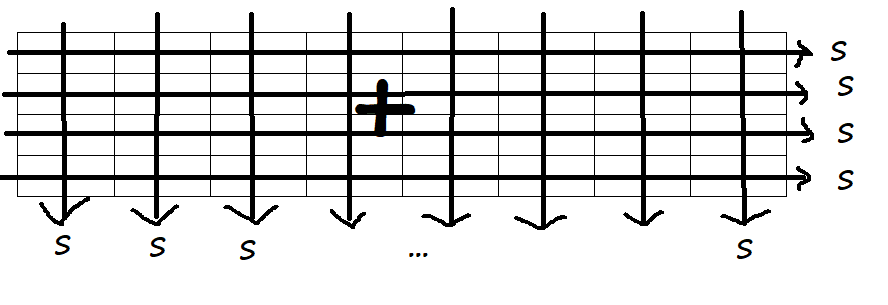
The Rows say the sum of the elements of the table is $latex S.n $. See the picture below.
Now, magically it comes that the $latex S.m = S.n $. Therefore the number of rows and columns must be equal.
Whoa! That was cute!
Visit this post to know about Magic Square more.
Edit 1: Look into the comments for a nice observation that if we allowed integers, and the common sum is 0, then we may not have got the result. Also we need to define the sum of the entries of a diagonal of a rectangle.

Publishing original scientific research in a peer-reviewed journal is an achievement many scholars work toward for years. Achieving this feat early in one's academic journey requires exceptional intellectual rigor, creativity, and persistence. Aaditya Punatar and Muskan Sadana have reached this remarkable milestone, successfully publishing their collaborative research paper in the prestigious Journal of Emerging Investigators […]

Her project on quantum-accelerated Steiner trees for 15-minute cities earned a place among the finalists at the world's largest pre-college STEM competition. Prishaa Shrimali of Marymount School of New York, was selected as a Grand Finalist at the 2026 Regeneron International Science and Engineering Fair (ISEF) in Phoenix, Arizona. Her project was Optimizing Urban Accessibility: […]

In 2026, the following Cheenta students have been successful for Indian Statistical Institute's M.Stat Entrance. They ranked within the first 50 in the entire country in these entrances. I.S.I. M.Stat Entrance

In 2026, the following Cheenta students have been successful for Indian Statistical Institute's B.Stat Entrance and Chennai Mathematical Institute's B.Sc. Math Entrance. They ranked within the first 200 in the entire country in these entrances. Most of these students attended the problem solving workshops regularly, which happen 5 days every week. CMI B.Sc. Math Entrance […]

Wrong!
First of all, let us make the concept of diagonal of a matrix clear. For square matrices it is obvious (we have main diagonal and antidiagonal). To generalise for non-square matrices, we define main diagonal as the set of entries a[i,j] satisfying i=j. And antidiagonal as the set of entries a[i,j] satisying i+j=n+1 (where n is the number of columns). For a visualisation see https://en.wikipedia.org/wiki/Main_diagonal .
Now by this definition consider the matrix
1 1 -1 -1
-1 -1 1 1
This is a 2x4 matrix with sum of each row= sum of each column= sum of each diagonal =0
The main flaw in your proof was that you cancelled S on both sides to get m=n. But S could be 0 !
That's great observation. But I told in my post that it is filled with positive integers.
Nevertheless, I will update your thoughts and observations in the post soon.
Thank You. Be tuned for most posts.
Oh sorry, I missed the constraint of positive integers. But if we allow negative entries, then it is possible to have magic rectangles.
Anyways, your double counting argument is very interesting. We cannot have magic rectangles with non-zero S (namely, the sum of each row/column/diagonal.)