Mary thought of a positive two-digit number. She multiplied it by 3 and added 11. Then she switched the digits of the result, obtaining a number between 71 and 75, inclusive. What was Mary's number?
Sofia ran 5 laps around the 400 -meter track at her school. For each lap, she ran the first 100 meters at an average speed of 4 meters per second and the remaining 300 meters at an average speed of 5 meters per second. How much time did Sofia take running the 5 laps?
Real numbers \(x, y\), and \(z\) satisfy the inequalities \(0<x<1,-1<y<0\), and \(1<z<2\). Which of the following numbers is necessarily positive?
Supposed that \(x\) and \(y\) are nonzero real numbers such that \[ \frac{3 x+y}{x-3 y}=-2 . \] What is the value of \[ \frac{x+3 y}{3 x-y} ? \]
Camilla had twice as many blueberry jelly beans as cherry jelly beans. After eating 10 pieces of each kind, she now has three times as many blueberry jelly beans as cherry jelly beans. How many blueberry jelly beans did she originally have?
What is the largest number of solid \(2-\mathrm{in}\) by \(2-\mathrm{in}\) by \(1-\mathrm{in}\) blocks that can fit in a \(3-\mathrm{in}\) by \(2-\) in by 3 -in box?
Samia set off on her bicycle to visit her friend, traveling at an average speed of 17 kilometers per hour. When she had gone half the distance to her friend's house, a tire went flat, and she walked the rest of the way at 5 kilometers per hour. In all it took her 44 minutes to reach her friend's house. In kilometers rounded to the nearest tenth, how far did Samia walk?
Points \(A(11,9)\) and \(B(2,-3)\) are vertices of \(\triangle A B C\) with \(A B=A C\). The altitude from \(A\) meets the opposite side at \(D(-1,3)\). What are the coordinates of point \(C\) ?
A radio program has a quiz consisting of 3 multiple-choice questions, each with 3 choices. A contestant wins if he or she gets 2 or more of the questions right. The contestant answers randomly to each question. What is the probability of winning?
The lines with equations \(a x-2 y=c\) and \(2 x+b y=-c\) are perpendicular and intersect at \((1,-5)\). What is \(c\) ?
At Typico High School, \(60 %\) of the students like dancing, and the rest dislike it. Of those who like dancing, \(80 %\) say that they like it, and the rest say that they dislike it. Of those who dislike dancing, \(90 %\) say that they dislike it, and the rest say that they like it. What fraction of students who say they dislike dancing actually like it?
Elmer's new car gives \(50 %\) percent better fuel efficiency. However, the new car uses diesel fuel, which is \(20 %\) more expensive per liter than the gasoline the old car used. By what percent will Elmer save money if he uses his new car instead of his old car for a long trip?
There are 20 students participating in an after-school program offering classes in yoga, bridge, and painting. Each student must take at least one of these three classes, but may take two or all three. There are 10 students taking yoga, 13 taking bridge, and 9 taking painting. There are 9 students taking at least two classes. How many students are taking all three classes?
An integer \(N\) is selected at random in the range \(1 \leq N \leq 2020\). What is the probability that the remainder when \(N^{16}\) is divided by 5 is 1 ?
Rectangle \(A B C D\) has \(A B=3\) and \(B C=4\). Point \(E\) is the foot of the perpendicular from \(B\) to diagonal \(\overline{A C}\). What is the area of \(\triangle A D E\) ?
How many of the base-ten numerals for the positive integers less than or equal to 2017 contain the digit 0 ?
Call a positive integer monotonous if it is a one-digit number or its digits, when read from left to right, form either a strictly increasing or a strictly decreasing sequence. For example, 3,23578 , and 987620 are monotonous, but 88,7434 , and 23557 are not. How many monotonous positive integers are there?
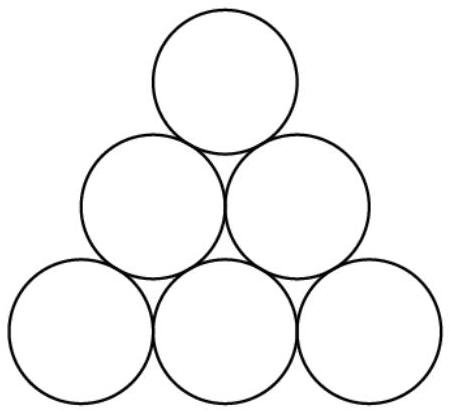
In the figure below, 3 of the 6 disks are to be painted blue, 2 are to be painted red, and 1 is to be painted green. Two paintings that can be obtained from one another by a rotation or a reflection of the entire figure are considered the same. How many different paintings are possible?
Let \(A B C\) be an equilateral triangle. Extend side \(\overline{A B}\) beyond \(B\) to a point \(B^{\prime}\) so that \(B B^{\prime}=3 A B\). Similarly, extend side \(\overline{B C}\) beyond \(C\) to a point \(C^{\prime}\) so that \(C C^{\prime}=3 B C\), and extend side \(\overline{C A}\) beyond \(A\) to a point \(A^{\prime}\) so that \(A A^{\prime}=3 C A\). What is the ratio of the area of \(\triangle A^{\prime} B^{\prime} C^{\prime}\) to the area of \(\triangle A B C\) ?
The number \(21!=51,090,942,171,709,440,000\) has over 60,000 positive integer divisors. One of them is chosen at random. What is the probability that it is odd?
In \(\triangle A B C, A B=6, A C=8, B C=10\), and \(D\) is the midpoint of \(\overline{B C}\). What is the sum of the radii of the circles inscribed in \(\triangle A D B\) and \(\triangle A D C\) ?
The diameter \(A B\) of a circle of radius 2 is extended to a point \(D\) outside the circle so that \(B D=3\). Point \(E\) is chosen so that \(E D=5\) and line \(E D\) is perpendicular to line \(A D\). Segment \(A E\) intersects the circle at a point \(C\) between \(A\) and \(E\). What is the area of \(\triangle A B C\) ?
Let \(N=123456789101112 \cdots 4344\) be the 79 -digit number that is formed by writing the integers from 1 to 44 in order, one after the other. What is the remainder when \(N\) is divided by 45 ?
The vertices of an equilateral triangle lie on the hyperbola \(x y=1\), and a vertex of this hyperbola is the centroid of the triangle. What is the square of the area of the triangle?
Last year Isabella took 7 math tests and received 7 different scores, each an integer between 91 and 100, inclusive. After each test she noticed that the average of her test scores was an integer. Her score on the seventh test was 95 . What was her score on the sixth test?

Publishing original scientific research in a peer-reviewed journal is an achievement many scholars work toward for years. Achieving this feat early in one's academic journey requires exceptional intellectual rigor, creativity, and persistence. Aaditya Punatar and Muskan Sadana have reached this remarkable milestone, successfully publishing their collaborative research paper in the prestigious Journal of Emerging Investigators […]
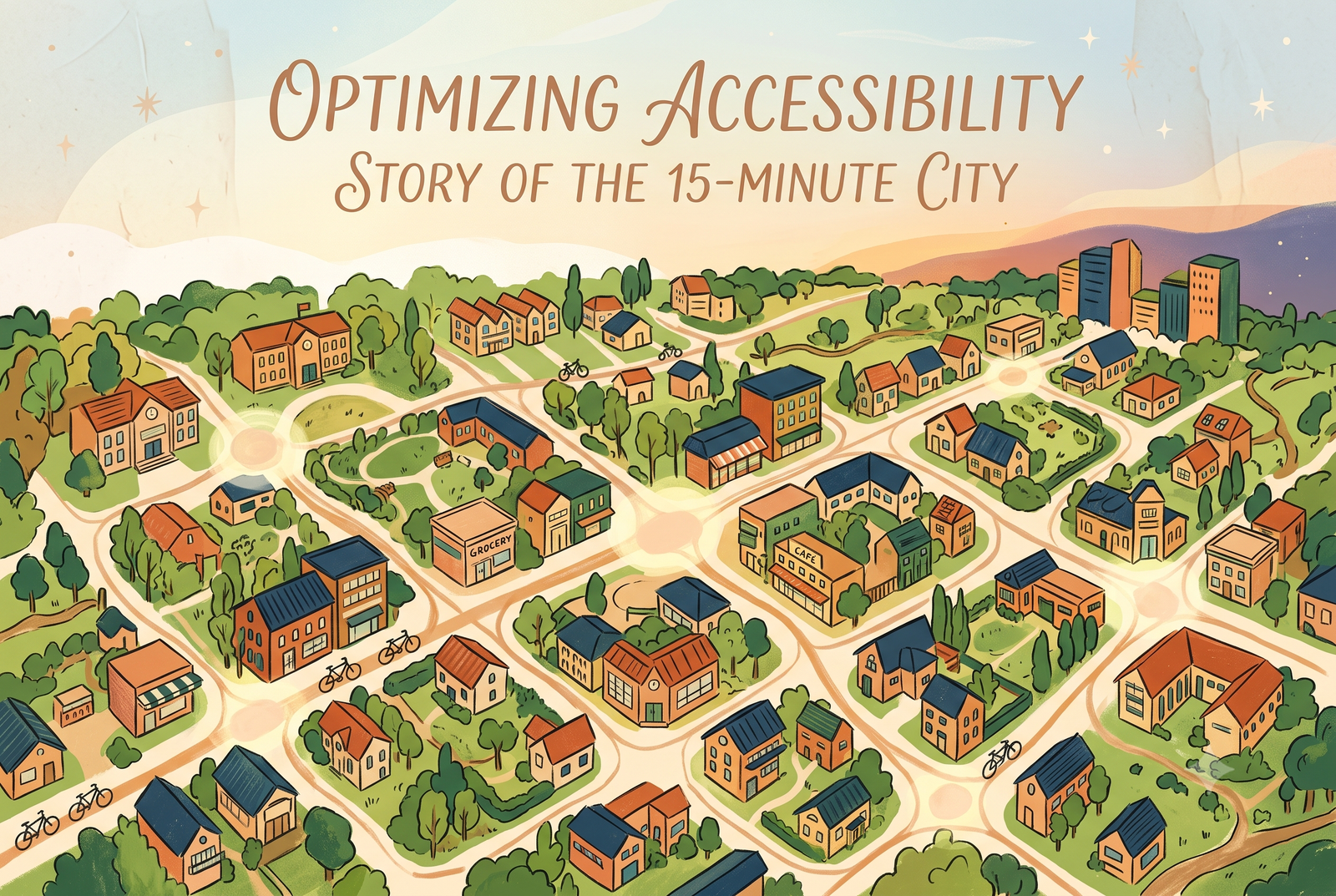
Her project on quantum-accelerated Steiner trees for 15-minute cities earned a place among the finalists at the world's largest pre-college STEM competition. Prishaa Shrimali of Marymount School of New York, was selected as a Grand Finalist at the 2026 Regeneron International Science and Engineering Fair (ISEF) in Phoenix, Arizona. Her project was Optimizing Urban Accessibility: […]
In 2026, the following Cheenta students have been successful for Indian Statistical Institute's M.Stat Entrance. They ranked within the first 50 in the entire country in these entrances. I.S.I. M.Stat Entrance
In 2026, the following Cheenta students have been successful for Indian Statistical Institute's B.Stat Entrance and Chennai Mathematical Institute's B.Sc. Math Entrance. They ranked within the first 200 in the entire country in these entrances. Most of these students attended the problem solving workshops regularly, which happen 5 days every week. CMI B.Sc. Math Entrance […]