What is the difference between the sum of the first 2003 even counting numbers and the sum of the first 2003 odd counting numbers?
Members of the Rockham Soccer League buy socks and T-shirts. Socks cost \($ 4\) per pair and each T-shirt costs \($ 5\) more than a pair of socks. Each member needs one pair of socks and a shirt for home games and another pair of socks and a shirt for away games. If the total cost is \($ 2366\), how many members are in the League?
A solid box is 15 cm by 10 cm by 8 cm . A new solid is formed by removing a cube 3 cm on a side from each corner of this box. What percent of the original volume is removed?
It takes Mary 30 minutes to walk uphill 1 km from her home to school, but it takes her only 10 minutes to walk from school to home along the same route. What is her average speed, in \(\mathrm{km} / \mathrm{hr}\), for the round trip?
Let \(d\) and \(e\) denote the solutions of \(2 x^{2}+3 x-5=0\). What is the value of \((d-1)(e-1)\) ?
Define \(x \triangleright y\) to be \(|x-y|\) for all real numbers \(x\) and \(y\). Which of the following statements is not true?
How many non-congruent triangles with perimeter 7 have integer side lengths?
What is the probability that a randomly drawn positive factor of 60 is less than 7 ?
Simplify \[ \sqrt[3]{x \sqrt[3]{x \sqrt[3]{x \sqrt{x}}}} \]
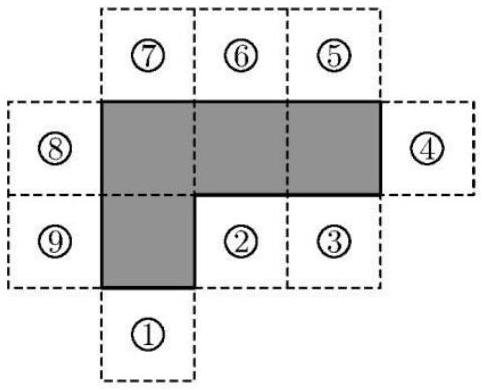
The polygon enclosed by the solid lines in the gure consists of 4 congruent squares joined edge-to-edge. One more congruent square is attached to an edge at one of the nine positions indicated. How many of the nine resulting polygons can be folded to form a cube with one face missing?
The sum of the two 5 -digit numbers \(A M C 10\) and \(A M C 12\) is 123422 . What is \(A+M+C\) ?
A point ( \(x, y\) ) is randomly picked from inside the rectangle with vertices ( 0,0\(),(4,0),(4,1)\), and \((0,1)\). What is the probability that \(x<y\) ?
The sum of three numbers is 20 . The rst is 4 times the sum of the other two. The second is seven times the third. What is the product of all three?
Let \(n\) be the largest integer that is the product of exactly 3 distinct prime numbers, \(d, e\), and \(10 d+e\), where \(d\) and \(e\) are single digits. What is the sum of the digits of \(n\) ?
What is the probability that an integer in the set \(\{1,2,3, \ldots, 100\}\) is divisible by 2 and not divisible by 3 ?
What is the units digit of \(13^{2003}\) ?
The number of inches in the perimeter of an equilateral triangle equals the number of square inches in the area of its circumscribed circle. What is the radius, in inches, of the circle?
What is the sum of the reciprocals of the roots of the equation \[ \frac{2003}{2004} x+1+\frac{1}{x}=0 ? \]
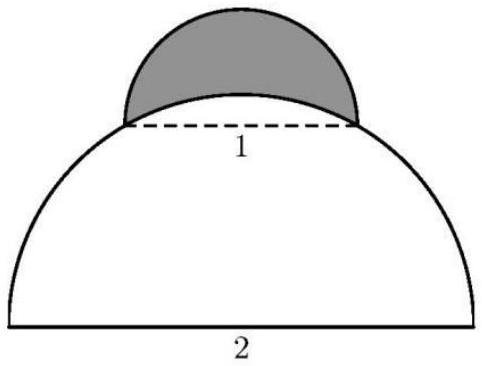
A semicircle of diameter 1 sits at the top of a semicircle of diameter 2, as shown. The shaded area inside the smaller semicircle and outside the larger semicircle is called a lune. Determine the area of this lune.
A base-10 three-digit number \(n\) is selected at random. Which of the following is closest to the probability that the base- 9 representation and the base- 11 representation of \(n\) are both three-digit numerals?
Pat is to select six cookies from a tray containing only chocolate chip, oatmeal, and peanut butter cookies. There are at least six of each of these three kinds of cookies on the tray. How many different assortments of six cookies can be selected?
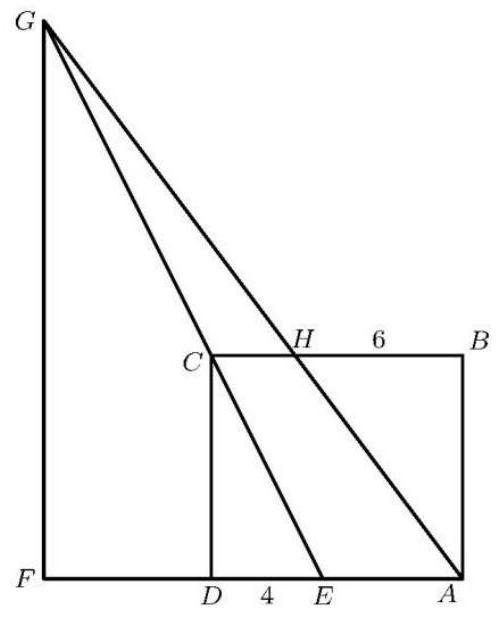
In rectangle \(A B C D\), we have \(A B=8, B C=9, H\) is on \(\overline{B C}\) with \(B H=6, E\) is on \(\overline{A D}\) with \(D E=4\), line \(E C\) intersects line \(A H\) at \(G\), and \(F\) is on line \(A D\) with \(\overline{G F} \perp \overline{A F}\). Find the length \(G F\).
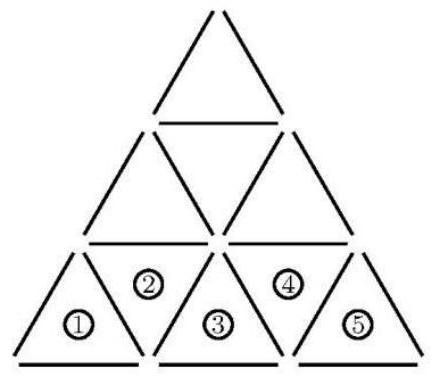
Sally has ve red cards numbered 1 through 5 and four blue cards numbered 3 through 6 . She stacks the cards so that the colors alternate and so that the number on each red card divides evenly into the number on each neighboring blue card. What is the sum of the numbers on the middle three cards?
Let \(n\) be a 5-digit number, and let \(q\) and \(r\) be the quotient and remainder, respectively, when \(n\) is divided by 100 . For how many values of \(n\) is \(q+r\) divisible by 11 ?

Publishing original scientific research in a peer-reviewed journal is an achievement many scholars work toward for years. Achieving this feat early in one's academic journey requires exceptional intellectual rigor, creativity, and persistence. Aaditya Punatar and Muskan Sadana have reached this remarkable milestone, successfully publishing their collaborative research paper in the prestigious Journal of Emerging Investigators […]

Her project on quantum-accelerated Steiner trees for 15-minute cities earned a place among the finalists at the world's largest pre-college STEM competition. Prishaa Shrimali of Marymount School of New York, was selected as a Grand Finalist at the 2026 Regeneron International Science and Engineering Fair (ISEF) in Phoenix, Arizona. Her project was Optimizing Urban Accessibility: […]

In 2026, the following Cheenta students have been successful for Indian Statistical Institute's M.Stat Entrance. They ranked within the first 50 in the entire country in these entrances. I.S.I. M.Stat Entrance
In 2026, the following Cheenta students have been successful for Indian Statistical Institute's B.Stat Entrance and Chennai Mathematical Institute's B.Sc. Math Entrance. They ranked within the first 200 in the entire country in these entrances. Most of these students attended the problem solving workshops regularly, which happen 5 days every week. CMI B.Sc. Math Entrance […]