If $60 \%$ of a number $x$ is 40 , then what is $x \%$ of 60 ?
Problem 2
Find the number of positive integers $n$ less than or equal to 100 , which are divisible by 3 but are not divisible by 2.
Problem 3
The area of an integer-sided rectangle is 20 . What is the minimum possible value of its perimeter?
Problem 4
How many isosceles integer-sided triangles are there with perimeter 23?
Problem 5
How many 3 -digit numbers $a b c$ in base 10 are there with $a \neq 0$ and $c=a+b$ ?
Problem 6
The height and the base radius of a closed right circular cylinder are positive integers and its total surface area is numerically equal to its volume. If its volume is $k \pi$ where $k$ is a positive integer, what is the smallest possible value of $k$ ?
Problem 7
A quadrilateral has four vertices $A, B, C, D$. We want to colour each vertex in one of the four colours red, blue, green or yellow, so that every side of the quadrilateral and the diagonal $A C$ have end points of different colours. In how many ways can we do this?
Problem 8
The sum of two real numbers is a positive integer $n$ and the sum of their squares is $n+1012$. Find the maximum possible value of $n$.
Problem 9
Four sides and a diagonal of a quadrilateral are of lengths $10, 20, 28, 50, 75$, not necessarily in that order. Which amongst them is the only possible length of the diagonal?
Problem 10
The age of a person (in years) in 2025 is a perfect square. His age (in years) was also a perfect square in 2012. His age (in years) will be a perfect cube $m$ years after 2025. Determine the smallest value of $m .=15$
Problem 11
There are six coupons numbered 1 to 6 and six envelopes, also numbered 1 to 6 . The first two coupons are placed together in any one envelope. Similarly, the third and the fourth are placed together in a different envelope, and the last two are placed together in yet another different envelope. How many ways can this be done if no coupon is placed in the envelope having the same number as the coupon?
Problem 12
Consider five-digit positive integers of the form $\overline{a b c a b}$ that are divisible by the two digit number $a b$ but not divisible by 13 . What is the largest possible sum of the digits of such a number?
Problem 13
A function $f$ is defined on the set of integers such that for any two integers $m$ and $n$,
$$ f(m n+1)=f(m) f(n)-f(n)-m+2 $$
holds and $f(0)=1$. Determine the largest positive integer $N$ such that $\sum_{k=1}^N f(k)<100$ .
Problem 14
Consider a fraction $\frac{a}{b} \neq \frac{3}{4}$, where $a, b$ are positive integers with $\operatorname{gcd}(a, b)=1$ and $b \leq 15$. If this fraction is chosen closest to $\frac{3}{4}$ amongst all such fractions, then what is the value of $a+b$ ?
Problem 15
Three sides of a quadrilateral are $a=4 \sqrt{3}, b=9$ and $c=\sqrt{3}$. The sides $a$ and $b$ enclose an angle of $30^{\circ}$, and the sides $b$ and $c$ enclose an angle of $90^{\circ}$. If the acute angle between the diagonals is $x^{\circ}$, what is the value of $x$ ?
Problem 16
$f(x)$ and $g(x)$ be two polynomials of degree 2 such that
$$ \frac{f(-2)}{g(-2)}=\frac{f(3)}{g(3)}=4 $$
If $g(5)=2, f(7)=12, g(7)=-6$, what is the value of $f(5)$ ?
Problem 17
The triangle $A B C, \angle B=90^{\circ}, A B=1$ and $B C=2$. On the side $B C$ there are two points $D$ and $E$ such that $E$ lies between $C$ and $D$ and $D E F G$ is a square, where $F$ lies on $A C$ and $G$ lies on the circle through $B$ with centre $A$. If the area of $D E F G$ is $\frac{m}{n}$ where $m$ and $n$ are positive integers with $\operatorname{gcd}(m, n)=1$, what is the value of $m+n$ ?
Problem 18
$M T A I$ is a parallelogram of area $\frac{40}{41}$ square units such that $M I=1 / M T$. If $d$ is the least possible length of the diagonal $M A$, and $d^2=\frac{a}{b}$, where $a, b$ are positive integers with $\operatorname{gcd}(a, b)=1$, find $|a-b|$.
Problem 19
Let $N$ be the number of nine-digit integers that can be obtained by permuting the digits of 223334444 and which have at least one 3 to the right of the right-most occurrence of 4 . What is the remainder when $N$ is divided by $100$?
Problem 20
Let $f$ be the function defined by
$$ f(n)=\text { remainder when } n^n \text { is divided by } 7, $$
for all positive integers $n$. Find the smallest positive integer $T$ such that $f(n+T)=f(n)$ for all positive integers $n$.
Problem 21
Let $P(x)=x^{2025}, Q(x)=x^4+x^3+2 x^2+x+1$. Let $R(x)$ be the polynomial remainder when the polynomial $P(x)$ is divided by the polynomial $Q(x)$. Find $R(3)$.
Problem 22
Let $A B C D$ be a rectangle and let $M, N$ be points lying on sides $A B$ and $B C$, respectively. Assume that $M C= C D$ and $M D=M N$, and that points $C, D, M, N$ lic on a circle. If $(A B / B C)^2=m / n$ where $m$ and $n$ are positive integers with $\operatorname{gcd}(m, n)=1$, what is the value of $m+n$ ?
Problem 23
Let \(A B C D\) be a rectangle and let \(M, N\) be points lying on sides \(A B\) and \(B C\), respectively. Assume that \(M C= C D\) and \(M D=M N\), and that points \(C, D, M, N\) lie on a circle. If \((A B / B C)^2=m / n\) where \(m\) and \(n\) are positive integers with \(\operatorname{gcd}(m, n)=1\), what is the value of \(m+n\) ?
Problem 24
There are $m$ blue marbles and $n$ red marbles on a table. Armaan and Babita play a game by taking turns. In each turn the player has to pick a marble of the colour of his/her choice. Armaan starts first, and the player who picks the last red marble wins. For how many choices of $(m, n)$ with $1 \leq m, n \leq 11$ can Armaan force a win?
Problem 25
For some real numbers $m, n$ and a positive integer $a$, the list $(a+1) n^2, m^2, a(n+1)^2$ consists of three consecutive integers written in increasing order. What is the largest possible value of $m^2$ ?
Problem 26
Let $S$ be a circle of radius 10 with centre $O$. Suppose $S_1$ and $S_2$ are two circles which touch $S$ internally and intersect each other at two distinct points $A$ and $B$. If $\angle O A B=90^{\circ}$ what is the sum of the radii of $S_1$ and $S_2$ ?
Solution
Problem 27
A regular polygon with $n \geq 5$ vertices is said to be colourful if it is possible to colour the vertices using at most 6 colours such that each vertex is coloured with exactly one colour, and such that any 5 consecutive vertices have different colours. Find the largest number $n$ for which a regular polygon with $n$ vertices is not colourful.
Solution
Problem 28
Find the number of ordered triples $(a, b, c)$ of positive integers such that $1 \leq a, b, c \leq 50$ which satisfy the relation
Here, by $\operatorname{lcm}(x, y)$ we mean the LCM, that is, least common multiple of $x$ and $y$.
Problem 29
Consider a sequence of real numbers of finite length. Consecutive four term averages of this sequence are strictly increasing, but consecutive seven term averages are strictly decreasing. What is the maximum possible length of such a sequence?
Problem 30
Assume $a$ is a positive integer which is not a perfect square. Let $x, y$ be non-negative integers such that $\sqrt{x-\sqrt{x+a}}=\sqrt{a}-y$. What is the largest possible value of $a$ such that $a<100 ?$
39 Cheenta students succeeded in IOQM 2024
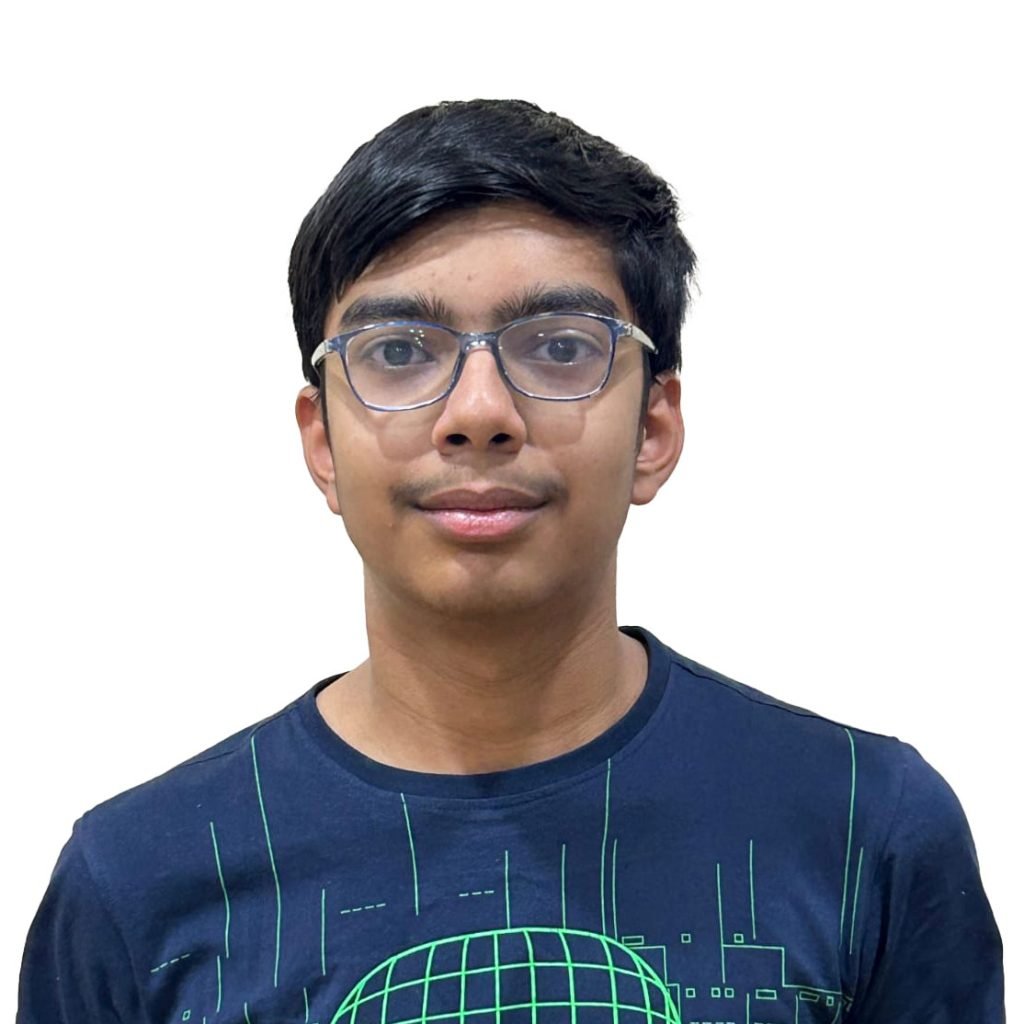
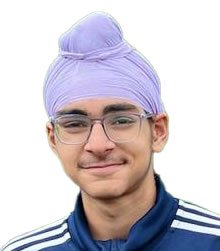
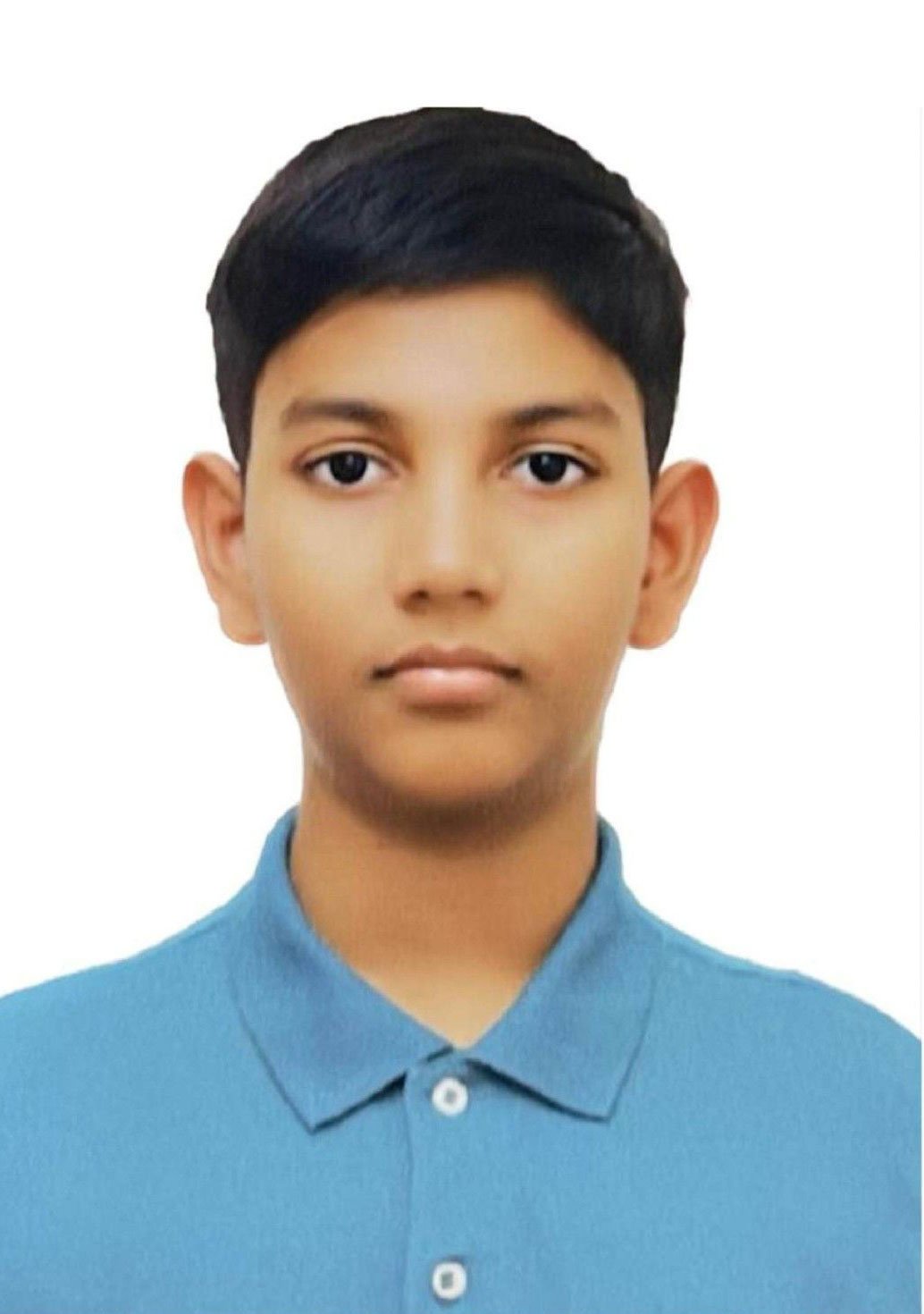
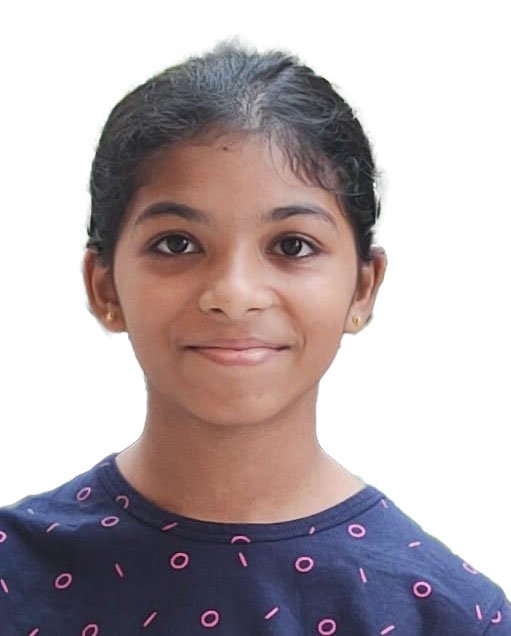
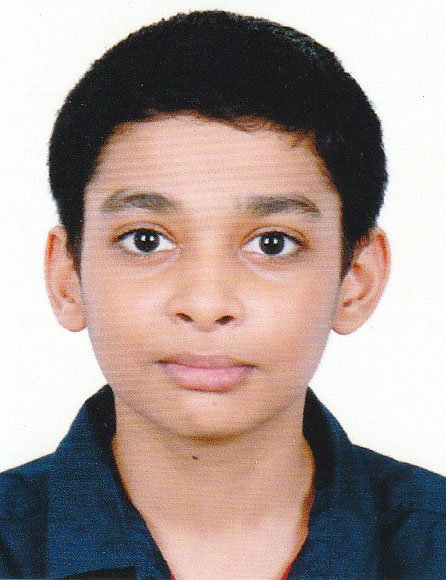
39 Cheenta students qualified for IOQM 2024 (RMO cut-off). About 130 kids students appeared in the contest from Cheenta this year making the success rate about 30%.
This remarkable achievement is the result of months of dedicated effort. Most of these students regularly participated in
Here are some of the qualified students who additionally qualified for Cheenta Advanced Math Expert Certification. Cheenta certifications are for pure mathematics, computer science, statistics, physics and research. They are accepted by our collaborating institutions for scholarships, internships and work-study opportunities.
Aditya Punatar
Saket Anand Gudadhe
Vihaan Shah
Kiaan Sawant
Ritam Das
Ambar Agarwal
Saisha Ganjiwale
Adhiraj Singh Anand
Divij Gupta
Soham Bharati
Shamik Saraswati
Krishiv Mohan
Souradip Das
Vismayah A. Mathew
Raghav Pai
Jayaditya Gupta
Avigyan Chakraborty
Alivia Roy
Advitya R
Nikhil Ganesh Chaudhury
S. Ashwin
Reyaansh Agrawal
Ayaan Kalra
Arnav Tayal
Neel Avinash
IOQM 2024 - Problems and Solutions
IOQM is the first level of (real) math olympiad in India. More than a 100,000 students take it every year. Success in IOQM leads to the second level which is RMO (Regional Math Olympiad) and third level INMO (Indian National Math Olympiad).
In this post we have added the problems and solutions from the IOQM 2024.
The smallest positive integer that does not divide $ \times 2 \times 3 \times 4 \times 5 \times 6 \times 7 \times 8 \times 9$ is:
Solution
Since this is 9 ! it will be divisible by all the numbers from $1-9$. Also, 9 ! contains $2 * 5=10$, it is divisible by 10 . Lets check for 11 . Since 11 is a prime number : 9! will not be divisible by 11 . So, the smallest positive number that does not divides $1 \times 2 \times \times 3 \times 4 \times 5 \times 6 \times$ $7 \times 8 \times 9$ is 11 .
Problem 2
The number of four-digit odd numbers having digits $1,2,3,4$, each occuring exactly once, is:
Solution
Number of odd numbers that we can form using $1,2,3,4$ without repeating implies that ones digit is either 1 or 3 . Rest of the three places can be occupied any of the remaining three digits. So the number of total ways $=3 \times 2 \times 1 \times 2=12$.
Problem 3
The number obtained by taking the last two digits of $5^{2024}$ in the same order is:
Solution
Last two digits of $5^n=25$
Problem 4
Let $A B C D$ be a quadriateral with $\angle A D C=70^{\circ}, \angle A C D=70^{\circ}, \angle A C B=10^{\circ}$ and $\angle B A D=110^{\circ}$. The measure of $\angle C A B$ (in degrees) is:
Problem 5
Let $a=\frac{x}{y}+\frac{y}{z}+\frac{z}{x}$, let $b=\frac{x}{z}+\frac{y}{x}+\frac{z}{y}$ and let $c=\left(\frac{x}{y}+\frac{y}{z}\right)\left(\frac{y}{z}+\frac{z}{x}\right)\left(\frac{z}{x}+\frac{x}{y}\right)$. The value of $|a b-c|$ is:
Solution
$a=\frac{x}{y}+\frac{y}{z}+\frac{z}{x}=\frac{x^2 z+y^2 x+z^2 y}{x y z}$
$b=\frac{x}{z}+\frac{y}{x}+\frac{z}{y}=\frac{x^2 y+y^2 z+z^2 x}{x y z}$
Find the number of triples of real numbers $(a, b, c)$ such that $a^{20}+b^{20}+c^{20}=a^{24}+b^{24}+c^{24}=1$
Solution
The triples $(a, b, c)$ is $(1,0,0),(0,1,0),(0,0,1),(-1,0,0),(0,-1,0),(0,0,-1)$
Problem 7
Determine the sum of all possible surface areas of a cube two of whose vertices are $(1,2,0)$ and $(3,3,2)$.
Solution
Notice that the distance between the points $(1,2,0)$ and $(3,3,2)=$ $\sqrt{2^2+1^2+2^2}=3$.
In the cube, we can have the vertices $(1,2,0)$ and $(3,3,2)$ as endpoints of a side of a cube (or) endpoints of a face diagonal (or) endpoints of a main diagonal and there is no other configuration. If $a$ denotes the side length of a cube, then $a=3, a \sqrt{2}=3, a \sqrt{3}=3$ are the only possibilities.
This implies $a=3, \frac{3}{\sqrt{2}}, \sqrt{3}$. We know that the surface area of cube $=$ $6 a^2=6 \times 9$ (or) $6 \times \frac{9}{2}$ (or) $6 \times 3$. Hence, the sum of all possible surface areas $=6 \times 9+6 \times \frac{9}{2}+6 \times 3=6\left(9+\frac{9}{2}+3\right)=99$.
Problem 8
Let $n$ be the smallest integer such that the sum of digits of $n$ is divisible by 5 as well as the sum of digits of $(n+1)$ is divisible by 5 . What are the first two digits of $n$ in the same order?
Solution
Let $S(m)$ denote the sum of digits of a natural number $m$. Notice that, $S(m+1)=S(m)+1$, if $m$ does not end with 9 .
Clearly, if the number $n$ does not end with 9 , then $S(n)$ and $S(n+1)$ would only differ by 1 and hence both of them cannot be divisible by 5 simultaneously. Hence, $n=\overline{x 9}$.
Now, similarly if $x$ does not end with 9 , then $S(n)=S(x)+9 ; S(n+1)=$ $S(x+1)=S(x)+1 \Rightarrow S(n+1)-S(n)=8$, contradiction. Hence, $n=\overline{y 99}$. And again $y$ must end with 9 as otherwise, $S(n+1)-S(n)=9+9-1=17$, contradiction.
If we proceed in this way, then we would get $n=\overline{z 9999}$. Now, for the smallest value of such $n$, we take $z$ to be a single digit number. Note that $9+9+9+9=36$ is 1 modulo 5 and hence we need $z$ to be 4 modulo 5 . Thus, $z=4$ is the least possible such number and hence $n=49999$ is the least possible value of $n$.
Problem 9
Consider the grid of points $X={(m, n) \mid 0 \leq m, n \leq 4}$. We say a pair of points ${(a, b),(c, d)}$ in $X$ is a knight-move pair if $(c=a \pm 2$ and $d=b \pm 1$ ) or ( $c=a \pm 1$ and $d=b \pm 2$ ). The number of knight-move pairs in $X$ is:
Solution
Solution: We will find the possible number of knight-move pairs corresponding to each point and add all of them. But in this counting each point would be over counted exactly twice (as pair consits of two distinct points) and we divide by 2 at last in order to account for it and to get the final answer.
Let us consider only the points in $Y={(m, n) \mid 0 \leq m, n \leq 2} \subset X$ because using symmetry one can extend the number of possible pairs containing that point to all the other points. Counting by this way explicitly, one would get the number of pairs as shown in the diagram.
Hence, the sum of all the numbers $=4 \times(2+3+4+3)+4 \times(4+6)+8=96$. So, final answer $=\frac{96}{2}=48$.
Problem 10
Determine the number of positive integral values of $p$ for which there exists a triangle with sides $a, b$, and $c$ which satisfy
$$ a^2+\left(p^2+9\right) b^2+9 c^2-6 a b-6 p b c=0 . $$
Solution
Notice that
$$ a^2+\left(p^2+9\right) b^2+9 c^2-6 a b-6 p b c=(p b-3 c)^2+(a-3 b)^2=0 $$
Hence, individually the bracket values must be $0 \Rightarrow p b-3 c=0 ; a-3 b=0 \Rightarrow$ $a=3 b ; p b=3 c$. Hence, $(a, b, c)=\left(3 b, b, \frac{p b}{3}\right)$. We know that the necessary and sufficient condition for existence of a triangle is that the largest side being less than sum of other two sides. So, we take two cases now,
If $p<9 \Rightarrow \frac{p b}{3}<3 b \Rightarrow 3 b$ is the largest side. Hence, we need $3b<b+\frac{pb}{3}\Rightarrow p>6$. Hence, the allowed values for this case are $p=7,8$.
If $p \geq 9 \Rightarrow \frac{p b}{3}\geq 3 b \Rightarrow \frac{p b}{3}$ is the largest side. Hence, we need $\frac{p b}{3}<3 b+b \Rightarrow$ $p<12$. Hence, the possible values for this case are $p=9,10,11$.
Hence, there five possible values for $p$ which are $7,8,9,10,11$.
What is the value of $\frac{1}{a}+\frac{1}{b}+\frac{1}{c} ?$
Solution
By adding up the two equations, we would get, $$\frac{a+1}{2b+1}+\frac{2b+1}{3c+1}+\frac{3c+1}{a+1}=3\rightarrow Eq 1$$ Notice that each of these terms are positive real numbers and their product $\frac{a+1}{2b+1}\times\frac{2b+1}{3c+1}\times\frac{3c+1}{a+1}=1$.
Let $\alpha=\frac{a+1}{2b+1},\ \beta=\frac{2b+1}{3c+1},\ \gamma=\frac{3c+1}{a+1}$, then by the AM-GM inequality, $$\frac{\alpha+\beta+\gamma}{3}\geq\left(\alpha\beta\gamma\right)^{\frac{1}{3}}=1$$ with the equality holding true when $\alpha=\beta=\gamma=1$. But from the equation $Eq 1$, we know that the equality holds true and hence $\frac{a+1}{2b+1}=\frac{2b+1}{3c+1}=\frac{3c+1}{a+1}=1\Rightarrow \boxed{a=2b=3c}$. Now, substituting it in the first equation in the question, we get, $a=\frac{1}{2}=2b=3c\Rightarrow\frac{1}{a}+\frac{1}{b}+\frac{1}{c}=12$.
Problem 12
Consider a square $A B C D$ of side length 16. Let $E, F$ be points on $C D$ such that $C E=E F=F D$. Let the line $B F$ and $A E$ meet in $M$. The area of $\triangle M A B$ is:
Solution
Drop perpendiculars from $M$ to $AB, CD$ and let the foot of perpendiculars be $X,Y$ respectively as shown.
Let $a=16=side\ of\ square$. Note that $CE=EF=FD\Rightarrow EF=\frac{a}{3}$. Since, $AB||EF\Rightarrow\triangle ABM\sim\triangle EFM\Rightarrow\frac{MX}{MY}=\frac{AB}{EF}=3$. But, we know that $XY=a\Rightarrow MX=\frac{3a}{4},\ MY=\frac{a}{4}$. Hence, area of $\triangle MAB=\frac{1}{2}\times MX\times AB=\frac{3a^2}{8}=96$.
Problem 13
Three positive integers $a, b, c$ with $a>c$ satisfy the folowing equations:
$$ a c+b+c=b c+a+66, \quad a+b+c=32 $$
Find the value of $a$.
Solution
Problem 14
Initially, there are $3^{80}$ particles at the origin $(0,0)$. At each step the particles are moved to points above the $x$-axis as follows: if there are $n$ particles at any point $(x, y)$, then $\left\lfloor\frac{n}{3}\right\rfloor$ of them are moved to $(x+1, y+1),\left\lfloor\frac{n}{3}\right\rfloor$ are moved to $(x, y+1)$ and the remaining to $(x-1, y+1)$. For example, after the first step, there are $3^{79}$ particles each at $(1,1),(0,1)$ and $(-1,1)$. After the second step, there are $3^{78}$ particles each at $(-2,2)$ and $(2,2), 2 \times 3^{78}$ particles each at $(-1,2)$ and $(1,2)$, and $3^{79}$ particles at $(0,2)$. After 80 steps, the number of particles at $(79,80)$ is:
Solution
Problem 15
Let $X$ be the set consisting of twenty positive integers $n, n+2, \ldots, n+38$. The smallest value of $n$ for which any three numbers $a, b, c \in X$, not necessarily distinct, form the sides of an acute-angled triangle is:
Problem 16
Let $f: \mathbb{R} \rightarrow \mathbb{R}$ be a function satisfying the relation $4 f(3-x)+3 f(x)=x^2$ for any real $x$. Find the value of $f(27)-f(25)$ to the nearest integer. (Here $\mathbb{R}$ denotes the set of real numbers.)
Solution
Problem 17
Consider an isosceles triangle $A B C$ with sides $B C=30, C A=A B=20$. Let $D$ be the foot of the perpendicular from $A$ to $B C$, and let $M$ be the midpoint of $A D$. Let $P Q$ be a chord of the circumcircle of triangle $A B C$, such that $M$ lies on $P Q$ and $P Q$ is parallel to $B C$. The length of $P Q$ is:
Solution
Problem 18
Let $p, q$ be two-digit numbers neither of which are divisible by 10 . Let $r$ be the four-digit number by putting the digits of $p$ followed by the digits of $q$ (in order). As $p, q$ vary, a computer prints $r$ on the screen if $\operatorname{gcd}(p, q)=1$ and $p+q$ divides $r$. Suppose that the largest number that is printed by the computer is $N$. Determine the number formed by the last two digits of $N$ (in the same order).
Problem 19
Consider five points in the plane, with no three of them collinear. Every pair of points among them is joined by a line. In how many ways can we color these lines by red or blue, so that no three of the points form a triangle with lines of the same color.
Solution
Problem 20
On a natural number $n$ you are allowed two operations: (1) multiply $n$ by 2 or (2) subtract 3 from n. For example starting with 8 you can reach 13 as follows: $8 \rightarrow 16 \rightarrow 13$. You need two steps and you cannot do in less than two steps. Starting from 11, what is the least number of steps required to reach 121 ?
Solution
Problem 21
An intenger $n$ is such that $\left\lfloor\frac{n}{9}\right\rfloor$ is a three digit number with equal digits, and $\left\lfloor\frac{n-172}{4}\right\rfloor$ is a 4 digit number with the digits $2,0,2,4$ in some order. What is the remainder when $n$ is divided by $100 ?$
Solution
Problem 22
In a triangle $A B C, \angle B A C=90^{\circ}$. Let $D$ be the point on $B C$ such that $A B+B D=A C+C D$. Suppose $B D: D C=2: 1$. If $\frac{A C}{A B}=\frac{m+\sqrt{p}}{n}$, where $m, n$ are relatively prime positive integers and $p$ is a prime number, determine the value of $m+n+p$.
Solution
Problem 23
Consider the fourteen numbers, $1^4, 2^4, \ldots, 14^4$. The smallest natural number $n$ such that they leave distinct remainders when divided by $n$ is:
using Fermat’s Little theorem we get $a \equiv b(\bmod 31)$ which is not possible hence 31 is the right answer
Problem 24
Consider the set $F$ of all polynomials whose coefficients are in the set of ${0,1}$. Let $q(x)=x^3+x+1$. The number of polynomials $p(x)$ in $F$ of degree 14 such that the product $p(x) q(x)$ is also in $F$ is:
Solution
Problem 25
A finite set $M$ of positive integers consists of distinct perfect squares and the number 92 . The average of the numbers in $M$ is 85 . If we remove 92 from $M$, the average drops to 84 . If $N^2$ is the largest possible square in $M$, what is the value of $N$ ?
$x=16$ satisfies the equation if $\left.\lfloor x\rfloor=17 \Rightarrow 16+15 x+15 x^2\right)=17^3$ has a root in $(17,18)$ But $\lfloor x\rfloor=18$ has no solution $\text { sum }=16+17=33$
Problem 27
In a triangle $A B C$, a point $P$ in the interior of $A B C$ is such that $\angle B P C-\angle B A C=\angle C P A-\angle C B A=\angle A P B-\angle A C B$. Suppose $\angle B A C=30^{\circ}$ and $A P=12$. Let $D, E, F$ be the feet of perpendiculars form $P$ on to $B C, C A, A B$ respectively. If $m \sqrt{n}$ is the area of the triangle $D E F$ where $m, n$ are integers with prime, then what is the value of the product $m n$ ?
Solution
let $\alpha, \beta, \gamma$ be $\angle B P C, \angle C P A, \angle A P C$ respectively.
Find the largest positive integer $n<30$ such that $\frac{1}{2}\left(n^8+3 n^4-4\right)$ is not divisible by the square of ann prime number.
Solution
$f(n)=\frac{n^8+3 n^4-4}{2}$
Note, by Fermat’s little theorem,
$ x^4=1(\bmod 5) $
$ x^8=1(\bmod 5)$
Also, powers of $n$ are even. $n=k(\bmod 25) \quad$ when $k=1,2,3,4$
then $25 / f(n) \Rightarrow n \neq 21,22,23,24,26,27,28,29$ Also note $4 / f(25)$ $\therefore$ largest such $n=20$
Problem 29
Let $n=2^{19} 3^{12}$. Let $M$ denote the number of positive divisors of $n^2$ which are less than $n$ but would not divide $n$. What is the number formed by taking the last two digits of $M$ (in the same order)?
Solution
$n=2^{19} \cdot 3^{12}$
$n^2=2^{19} \cdot 3^{24}$ Let $2^a 3^b$ be such a divisor of $n^2$ which does not divide $n$ but is less than $n$.
Case 1. $a>19, b \leq 12=118$ Case 2. $a \leq 19, b>12=110$
$\therefore 118+110=228 \rightarrow 28$
Problem 30
Let $A B C$ be a right-angled triangle with $\angle B=90^{\circ}$. Let the length of the altitude $B D$ be equal to 12 What is the minimum possible length of $A C$, given that $A C$ and the perimeter of triangle $A B C$ are integers?
There are no Pythagorean triples with hypotenuse = 24.
$\therefore$ least possible $A C=25$
(15, 20, 25 triangle)
How to prepare for the next IOQM?
IOQM is the first level of real Math Olympiads in India. Students in Class 8 or above are eligible to participate in it. Here are the three levels of Math Olympiads in India:
IOQM - Usually conducted in the month of September, more than 100,000 kids participate in this contest.
RMO - Usually conducted in the end of October, around 4000 kids participate in this level.
INMO - Usually conducted in the month of January, around 600 kids participates in this level.
As of 2023, the nation-widesuccess rate in IOQM is less than 4%. In the same year, Cheenta's success rate in IOQM is 21.55%.
How did Cheenta students prepare?
In 2023 around 116 Cheenta students participated in IOQM. 25 of them were successful in achieving certification or qualification in RMO. This makes the success rate of Cheenta around 21.55%. Various factors contributed to this extraordinary performance. In this post we will describe them.
5-days-a-week Problem Solving Class
Most of the successful students at Cheenta, participated in the 'Everyday Non-Routine Mathematics'. This is known as 5-days-a-week Problem Solving class. Students and faculty members discuss 4 to 5 interesting problems every day. This amounts to around 1000 - 1200 in-class problems. It is extremely important to put yourself in this regime of problem solving to achieve extraordinary problem solving skills.
Math Circles
Several successful students regularly participated in the Math Circle process. This is a unique flipped classroom experience that is available exclusively to Cheenta students. In this process, Cheenta students lead problem solving sessions with other kids (usually from rural schools). These are small groups of 5-6 kids which meet every week. They solve exciting problems together. In order to lead the problem solving classes, Cheenta students sometimes 'make problems'. They are also motivated to work extra hard to make these sessions a success.
Faculty Team who are Dedicated for Olympiads
Cheenta faculty team has been created over the last 13 years. They are dedicated mathematicians who love solving non-routine problems. They have taken the route of this sort of mathematics out sheer passion for the subject. This has a high impact on the students.
How to Start for Next IOQM
The first step is to choose great books and problem sets. IOQM - RMO - INMO preparation should not be bundled with engineering entrance preparations as these two goals require different psychological attitude.
Choose the Right Books
We suggest the following books to start your preparation for IOQM.
The goal is not to 'memorise' a lot of formulae and theorems. Instead focus on sharpening your mind by exposing yourself to a variety of non-routine problems every day.
Your bag of theorems won't help your mind to 'click' at the right time.
Mathematical Circles, Russian Experience by Fomin
Challenges and Thrills of Pre-College Mathematics by Venkatachala
Excursion in Mathematics by Bhaskaracharya Pratisthana
Mathematical Olympiad Treasures by Andreescu
Choose the Right Problem Sets
It is extremely important to practice non-routine problems every day. This can either happen in the 5-days-a-week problem solving classes (if you are a student of Cheenta) or you may try on your own. Here are a few sets of problems that are useful for the preparation of IOQM.
AMC 10 and AMC 12 problems,
American Invitational Mathematics Examination (AIME) problems
Singapore Math Olympiad (SMO) problems
Tournament of Towns Problems
Choose the Right Peer Group
What if you are stuck in a problem?
Ask your teacher. Ask your peers. Do not read solutions.
It is extremely important to have a right peer group of students and teachers who will support your journey in this exciting world of mathematics. No one has ever learnt mathematics by 'reading solutions'. Instead discuss with your peers and ask your teachers for a hint.
3000 Problems in A Year
As a rule of thumb, you should be exposing yourself to 3000 non-routine problems in a calendar year. If you are an internal student at Cheenta you will be seeing 1000 of these problems inside class. Rest of the 2000 problems should be done at home.
Notes on IOQM and RMO
In this post we are adding notes for IOQM, RMO and similar math olympiads. These are derived from Cheenta's Problem solving classes and Math Olympiad Training Program. These notes cover topics from Number Theorem, Geometry, Algebra and Geometry. Revisit this page for more notes.
Answer Key (This is a work in progress, please proceed with caution. We are reviewing some of these answers).
1st Problem - 45
2nd Problem - 68
3rd Problem - 8
4th Problem
5th Problem - 40
6th Problem - 30
7th Problem - 35
8th Problem - 24
9th Problem - 8
10th Problem - 40
11th Problem - 12
12th Problem
Problem 1
Three parallel lines $L_{1}, L_{2}, L_{3}$ are drawn in the plane such that the perpendicular distance between $L_{1}$ and $L_{2}$ is 3 and the perpendicular distance between $L_{2}$ and $L_{3}$ is also $3 .$ A square $A B C D$ is constructed such that $A$ lies on $L_{1}, B$ lies on $L_{3}$ and $C$ lies on $L_{2}$. Find the area of the square.
Ria writes down the numbers $1,2, \ldots, 101$ in red and blue pens. The largest blue number is equal to the number of numbers written in blue and the smallest red number is equal to half the number of numbers written in red. How many numbers did Ria write with red pen?
Solution & Discussion
Claim: Numbers written in blue needs to be consecutive from \(1,2, .[\) where \(B\) is the largest blue no] The smallest required \(\operatorname{no}(\mathrm{r}) \rightarrow B+1\) Total red number \(=2(B+1)\) \[ \begin{gathered} 2(B+1)+B=101 \\ 2 B+B+2=101 \\ 3 B=99 \\ B=33 \end{gathered} \] \[ r=34 \] total req no. \(\rightarrow 2 r=68\)
Problem 3
Consider the set $\mathcal{T}$ of all triangles whose sides are distinct prime numbers which are also in arithmetic progression. Let $\Delta \in \mathcal{T}$ be the triangle with the least perimeter. If $a^{\circ}$ is the largest angle of $\Delta$ and if $L$ is its perimeter, determine the value of $\frac{a}{L}$.
Solution
The triangles in $\tau=\{(a, b, c) | a+b>c, a+d=b, b+d=c, a, b, c \qquad \textrm{are prime}\}$ such that $a$ is less than $b$ is less than $c$. Least such prime tuple is $(3,5,7)$. Therefore, $7^{2}=3^{2}+5^{2}-2.3 .5 . \cos \alpha=>\alpha=120^{\circ}$ Then $\alpha / \mathrm{L}=120 / 15(\mathrm{~L}=$ perimeter $=15)$. Thus $\alpha / L=8$
Problem 4
Consider the set of all 6-digit numbers consisting of only 3 digits, $a, b, c$, where $a, b, c$ are distinct. Suppose the sum of all these numbers is 593999406 . What is the largest remainder when the three digit number $a b c$ is divided by $100 ?$
Solution
It is found that there are \(3^{6} = 729\) numbers where each digit will repeat 243 times. Therefore ,sum of those numbers \(=111111 \times 243(a+b+c).\) So now , \(\frac{593999406}{111111 \times 243}=\mathrm{a}+\mathrm{b}+\mathrm{c}=22.\) To get the maximum remainder, number will be 598 , so \(598 \equiv 98 \text{(mod 100)}.\)
Problem 5
In parallelogram ABCD the longer side is twice the shorter side. Let XYZW be the quadrilateral formed by the internal bisectors of the angles of $A B C D$. If the area of $X Y Z W$ is 10 . find the area of $A B C D$.
Since \(\mathrm{A} \mathrm{X} \| \mathrm{DZ} \Rightarrow \angle \mathrm{AXD}=\angle \mathrm{ZDX}\) \[ \begin{aligned} &\angle \mathrm{ADX}=\angle \mathrm{ZDX} \\ &\angle \mathrm{AXD}=\angle \mathrm{ADX} \\ &\mathrm{AD}=\mathrm{AX} \end{aligned} \] \( A X Z D\) will be rhombus
Let $x, y, z$ be positive real numbers such that $x^{2}+y^{2}=49 \cdot y^{2}+y z+z^{2}=36$ and $x^{2}+\sqrt{3} x z+z^{2}=25$. If the value of $2 x y+\sqrt{3} y z+z x$ can be written as $p \sqrt{q}$ where $p, q$ are integers and $q$ is not divisible by square of any prime number, find $p+q$.
Find the number of maps $f:\{1,2,3\} \longrightarrow\{1,2,3,4,5\}$ such that $f(i) \leq f(j)$ whenever $i$
Solution
You have to choose the 3 function values $f(1), f(2), f(3)$ from 5 possibilities, with repetition allowed. The order of the 3 chosen numbers is not important, because once you have chosen them, the condition $f(i) \leq f(j)$ tells you which is $f(1)$, which is $f(2)$ and which is $f(3)$. The number of choices of 3 elements from 5 , with order not important and repetition allowed, is $$ C(5+3-1,3)=C(7,3)=35 $$
Problem 8
For any real number $t$, let $\lfloor t\rfloor$ denote the largest integer $\leq t$. Suppose that $N$ is the greatest integer such that $$ [\sqrt{[\sqrt{[\sqrt{N}]}]}]=4 $$ Find the sum of digits of $N$..
Let $P_{0}=(3,1)$ and define $P_{n+1}=\left(x_{n}, y_{n}\right)$ for $n \geq 0$ by $$ x_{n+1}=-\frac{3 x_{n}-y_{n}}{2}, \quad y_{n+1}=-\frac{x_{n}+y_{n}}{2} $$ Find the area of the quadrilateral formed by the points $P_{96}, P_{97}, P_{98}, P_{99}$.
Problem 10
Suppose that \(P\) is the polynomial of least degree with integer coefficients such that \(P(\sqrt{7}+\sqrt{5})=2(\sqrt{7}-\sqrt{5})\). Find \(P(2)\).
In how many ways can four married couples sit in a merry-go-round with identical seats such that men and women occupy alternate seats and no husband seats next to his wife?
Solution
The number of ways the husbands can seat is $3!=6$. The first wife is having 2 options the rest are having only one option each. Hence the total possibility is $3! \times 2=12$.
Problem 12
A $12 \times 12$ board is divided into 144 unit squares by drawing lines parallel to the sides. Two rooks placed on two unit squares are said to be non attacking if they are not in the same column or same row. Find the least number $N$ such that rooks are placed on the unit squares, one rook per square, we can always find 7 rooks such that no two are attacking each other.
Solution
Part B
Problem 1
Let $D$ be an interior point on the side $B C$ of an acute-angled triangle $A B C$. Let the circumcircle of triangle $A D B$ intersect $A C$ again at $E(\neq A)$ and the circumcircle of triangle $A D C$ intersect $A B$ again at $F(\neq A)$. Let $A D, B E$ and $C F$ intersect the circumcircle of triangle $A B C$ again at $D_1(\neq A), E_1(\neq B)$ and $F_1(\neq C)$, respectively. Let $I$ and $I_1$ be the incentres of triangles $D E F$ and $D_1 E_1 F_1$, respectively. Prove that $E, F, I, I_1$ are concyclic.
Problem 2
Find all natural numbers $n$ for which there exists a permutation $\sigma$ of $1,2, \ldots, n$ such that $$ \sum_{i=1}^n \sigma(i)(-2)^{i-1}=0 . $$
Note: A permutation of $1,2, \ldots, n$ is a bijective function from ${1,2, \ldots, n}$ to itself.
Problem 3
For a positive integer $N$, let $T(N)$ denote the number of arrangements of the integers $1,2, \ldots, N$ into a sequence $a_1, a_2, \ldots, a_N$ such that $a_i>a_{2 i}$ for all $i, 1 \leq i<2 i \leq N$ and $a_i>a_{2 i+1}$, for all $i, 1 \leq i<2 i+1 \leq N$. For example, $T(3)$ is 2 , since the possible arrangements are 321 and 312 . (a) Find $T(7)$. (b) If $K$ is the largest non-negative integer so that $2^K$ divides $T\left(2^n-1\right)$, show that $K=$ $2^n-n-1$. (c) Find the largest non-negative integer $K$ so that $2^K$ divides $T\left(2^n+1\right)$.
IOQM 2022-2023 Dates | Exam Information | Application
IOQM 2022-2023 Announcement by HBCSE
Day and Date: Sunday, October 30, 2022
Venue: Designated IOQM Centres
Type of exam: Three hour paper and pen exam with responses to be written on OMR sheet. The IOQM will have 30 questions with each question having an integer answer in the range 00-99. The exam will have 10 questions of 2 marks each; 12 questions of 5 marks each; 2 questions of 10 marks each. The syllabus will be same as PRMO but the standard of this examination is estimated to vary from the difficulty level of PRMO to RMO of previous years. Sample questions can be downloaded from here
Language of the question paper: English and Hindi (Option to be chosen during enrollment)
INMO 2022-2023:
The second stage of the exam is Indian National Mathematics Olympiad (INMO).
The INMO 2022-2023 is scheduled to be held on 15th January, 2023.
This is a 4 hour exam that consists of 6 questions. Detailed proof should be written for every question.
Learn more about the eligibility and selection criteria of the exam here.
How to Apply for IOQM 2022-2023
Registration Start Date for IOQM 2022: 8th August, 2022
Registration End Date for IOQM 2022: 8th September, 2022
To register for the Indian Olympiad Qualifier in Mathematics (IOQM) 2022-2023, visit here.