Intersection of two Squares | AMC 8, 2004 | Problem 25
Try this beautiful problem from Geometry based on Intersection of two Squares.
When 2 Squares intersect | AMC-8, 2004 | Problem 25
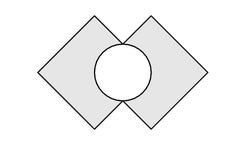
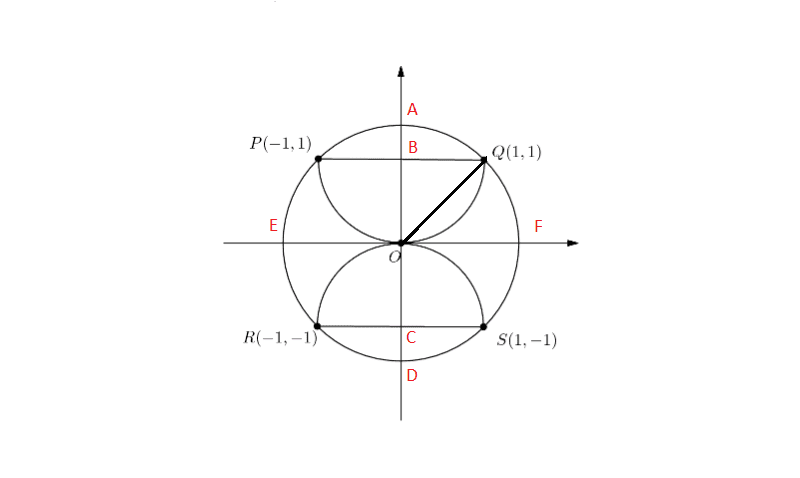
Two \(4\times 4\) squares intersect at right angles, bisecting their intersecting sides, as shown. The circle's diameter is the segment between the two points of intersection. What is the area of the shaded region created by removing the circle from the squares?
\(28-2\pi\)
\(25-2\pi\)
\(30-2\pi\)
Key Concepts
Geometry
square
Circle
Check the Answer
Answer: \(28-2\pi\)
AMC-8, 2004 problem 25
Pre College Mathematics
Try with Hints
Area of the square is \(\pi (r)^2\),where \(r\)=radius of the circle
Can you now finish the problem ..........
Clearly, if 2 squares intersect, it would be a smaller square with half the side length, 2.
can you finish the problem........
Clearly the intersection of 2 squares would be a smaller square with half the side length, 2.
The area of this region =Total area of larger two squares - the area of the intersection, the smaller square i.e \(4^2+4^2 -2^2=28 \)
Now The diagonal of this smaller square created by connecting the two points of intersection of the squares is the diameter of the circle
Using the Pythagorean th. diameter of the circle be \(\sqrt{2^2 +2^2}=2\sqrt 2\)
Area of Rectangle Problem | AMC 8, 2004 | Problem 24
Try this beautiful problem from Geometry from AMC-8, 2004 ,Problem-24, based on area of Rectangle.
Rectangle | AMC-8, 2004 | Problem 24
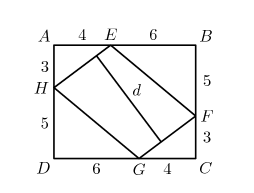
In the figure ABCD is a rectangle and EFGH is a parallelogram. Using the measurements given in the figure, what is the length d of the segment that is perpendicular to HE and FG?
$7.1$
$7.6$
$7.8$
Key Concepts
Geometry
Rectangle
Parallelogram
Check the Answer
Answer:$7.6$
AMC-8, 2004 problem 24
Pre College Mathematics
Try with Hints
Find Area of the Rectangle and area of the Triangles i.e \((\triangle AHE ,\triangle EBF , \triangle FCG , \triangle DHG) \)
Can you now finish the problem ..........
Area of the Parallelogram EFGH=Area Of Rectangle ABCD-Area of\((\triangle AHE +\triangle EBF + \triangle FCG + \triangle DHG) \)
can you finish the problem........
Area of the Rectangle =\(CD \times AD \)=\(10 \times 8\)=80 sq.unit
Area of the \(\triangle AHE\) =\(\frac{1}{2} \times AH \times AE \)= \(\frac{1}{2} \times 4 \times 3\) =6 sq.unit
Area of the \(\triangle EBF\) =\(\frac{1}{2} \times EB \times BE \)= \(\frac{1}{2} \times 6 \times 5\) =15 sq.unit
Area of the \(\triangle FCG\) =\(\frac{1}{2} \times GC \times FC\)= \(\frac{1}{2} \times 4\times 3\) =6 sq.unit
Area of the \(\triangle DHG\) =\(\frac{1}{2} \times DG \times DH \)= \(\frac{1}{2} \times 6 \times 5\) =15 sq.unit
Area of the Parallelogram EFGH=Area Of Rectangle ABCD-Area of\((\triangle AHE +\triangle EBF + \triangle FCG + \triangle DHG) \)=\(80-(6+15+6+15)=80-42=38\)
As ABCD is a Rectangle ,\(\triangle GCF\) is a Right-angle triangle,
Therefore GF=\(\sqrt{4^2 + 3^2}\)=5 sq.unit
Now Area of the parallelogram EFGH=\( GF \times d\)=38
Try this beautiful problem from Geometry: Radius of a circle
Radius of a circle - AMC-8, 2005- Problem 25
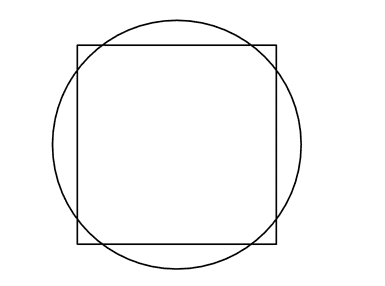
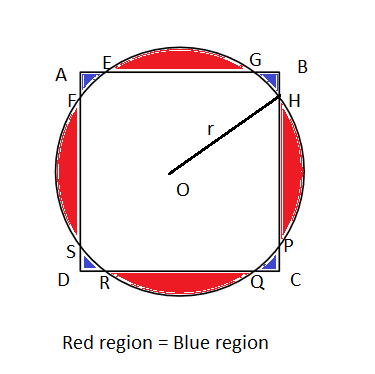
A square with side length 2 and a circle share the same center. The total area of the regions that are inside the circle and outside the square is equal to the total area of the regions that are outside the circle and inside the square. What is the radius of the circle?
$\frac{5}{\sqrt \pi}$
$ \frac{2}{\sqrt \pi} $
$\sqrt \pi$
Key Concepts
Geometry
Cube
square
Check the Answer
Answer: $ \frac{2}{\sqrt \pi} $
AMC-8 (2005) Problem 25
Pre College Mathematics
Try with Hints
The total area of the regions that are inside the circle and outside the square is equal to the total area of the regions that are outside the circle and inside the square
Can you now finish the problem ..........
Region within the circle and square be \(x\) i.e In other words, it is the area inside the circle and the square
The area of the circle -x=Area of the square - x
can you finish the problem........
Given that The total area of the regions that are inside the circle and outside the square is equal to the total area of the regions that are outside the circle and inside the square
Let the region within the circle and square be \(x\) i.e In other words, it is the area inside the circle and the square .
Let r be the radius of the circle
Therefore, The area of the circle -x=Area of the square - x
Try this beautiful problem from Geometry based on the Area of a Circle.
Area of Circle | AMC-8, 2008 | Problem 25
Margie's winning art design is shown. The smallest circle has radius 2 inches, with each successive circle's radius increasing by 2 inches. Approximately what percent of the design is black?
$44$
$42$
$45$
Key Concepts
Geometry
Area
Circle
Check the Answer
Answer:$42$
AMC-8, 2008 problem 25
Pre College Mathematics
Try with Hints
Area of the square is \(\pi (r)^2\),where \(r\)=radius of the circle
Can you now finish the problem ..........
Find the total area of the black region........
can you finish the problem........
Given that The smallest circle has radius 2 inches, with each successive circle's radius increasing by 2 inches .
The radius of the 1st circle is 2, So the area is \(\pi(2)^2\)=4\(\pi\) sq.unit
The radius of the 2nd circle is 4, So the area is \(\pi(4)^2\)=16\(\pi\) sq.unit
The radius of the 3rd circle is 6 So the area is \(\pi(6)^2\)=36\(\pi\) sq.unit
The radius of the 4th circle is 8, So the area is \(\pi(8)^2\)=64\(\pi\) sq.unit
The radius of the 5th circle is 10, So the area is \(\pi(10)^2\)=100\(\pi\) sq.unit
The radius of the 6th circle is 12, So the area is \(\pi(12)^2\)=144\(\pi\) sq.unit
Therefore The entire circle's area is 144\(\pi\)
The area of the black regions is \((100\pi-64\pi)+(36\pi-16\pi)+4\pi=60\pi \)sq.unit
The percentage of the design that is black is \((\frac{60\pi}{144\pi} \times 100)\%=(\frac{5}{12} \times 100) \% \approx 42\%\)
Area of square and circle | AMC 8, 2011|Problem 25
Try this beautiful problem from Geometry based on Ratio of the area of square and circle.
Area of the star and circle - AMC-8, 2011 - Problem 25
A circle with radius 1 is inscribed in a square and circumscribed about another square as shown. Which fraction is closest to the ratio of the circle's shaded area to the area between the two squares?
$\frac{3}{2}$
$\frac{1}{2}$
$1$
Key Concepts
Geometry
Circle
Square
Check the Answer
Answer:$\frac{1}{2}$
AMC-8 (2011) Problem 25
Pre College Mathematics
Try with Hints
Join the diagonals of the smaller square (i.e GEHF)
Can you now finish the problem ..........
The circle's shaded area is the area of the smaller square(i.e. GEHF) subtracted from the area of the circle
and The area between the two squares is Area of the square ABCD - Area of the square EFGH
can you finish the problem........
Given that the Radius of the circle with centre O is 1.Therefore The area of the circle is \(\pi (1)^2\)=\(\pi\) sq.unit
The diameter of the circle is 2 i.e \(EF=BC=2\) unit
The area of the big square i.e \(ABCD=2^2=4\) sq.unit
\(OE=OH=1\) i.e \(EH=\sqrt{(1^2+1^2)}=\sqrt 2\)
Therefore the area of the smaller square is \((\sqrt 2)^2=2\)
The circle's shaded area is the area of the smaller square(i.e. GEHF) subtracted from the area of the circle =\(\pi\) - 2
The area between the two squares is Area of the square ABCD - Area of the square EFGH=4-2=2 sq.unit
The ratio of the circle's shaded area to the area between the two squares is \( \frac{\pi - 2}{2} \approx \frac{3.14-2}{2} = \frac{1.14}{2} \approx \frac{1}{2}\)
Rolling ball Problem | Semicircle |AMC 8- 2013 -|Problem 25
Try this beautiful problem from Geometry based on a rolling ball on a semicircular track.
A Ball rolling Problem from AMC-8, 2013
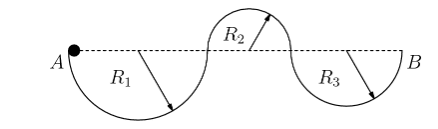
A ball with diameter 4 inches starts at point A to roll along the track shown. The track is comprised of 3 semicircular arcs whose radii are \(R_1=100\) inches ,\(R_2=60\) inches ,and \(R_3=80\) inches respectively. The ball always remains in contact with the track and does not slip. What is the distance the center of the ball travels over the course from A to B?
\( 235 \pi\)
\( 238\pi\)
\( 240 \pi\)
Key Concepts
Geometry
circumference of a semicircle
Circle
Check the Answer
Answer:\( 238 \pi\)
AMC-8, 2013 problem 25
Pre College Mathematics
Try with Hints
Find the circumference of semicircle....
Can you now finish the problem ..........
Find the total distance by the ball....
can you finish the problem........
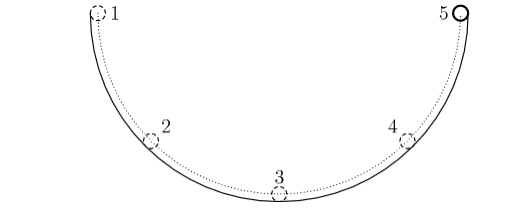
The radius of the ball is 2 inches. If you think about the ball rolling or draw a path for the ball (see figure below), you see that in A and C it loses \(2\pi \times \frac{2}{2}=2\pi\) inches each, and it gains \(2\pi\) inches on B .
So, the departure from the length of the track means that the answer is
Try this beautiful problem from Geometry based on the radius of a semi circle and tangent of a circle.
AMC-8(2017) - Geometry (Problem 22)
In the right triangle ABC,AC=12,BC=5 and angle C is a right angle . A semicircle is inscribed in the triangle as shown.what is the radius of the semi circle?
$\frac{7}{6}$
$\frac{10}{3}$
$\frac{9}{8}$
Key Concepts
Geometry
congruency
similarity
Check the Answer
Answer:$\frac{10}{3}$
AMC-8(2017)
Pre College Mathematics
Try with Hints
Here O is the center of the semi circle. Join o and D(where D is the point where the circle is tangent to the triangle ) and Join OB.
Can you now finish the problem ..........
Now the $\triangle ODB $and $\triangle OCB$ are congruent
can you finish the problem........
Let x be the radius of the semi circle
Now the $\triangle ODB$ and $\triangle OCB$ we have
OD=OC
OB=OB
$\angle ODB$=$\angle OCB$= 90 degree`
so $\triangle ODB$ and $\triangle OCB$ are congruent (by RHS)
BD=BC=5
And also $\triangle ODA$ and $\triangle BCA$ are similar....
Try this beautiful problem from Geometry based on the radius and tangent of a circle.
SMO 2013 - Geometry (Problem 25)
As shown in the figure below ,circles $C_1 $and$ C_2$ of radius 360 are tangent to each other , and both tangent to the straight line l.if the circle$ C_3$ is tangent to $C_1$ ,$C_2$ and l ,and circle$ C_4 $is tangent to$ C_1$,$C_3$ and l ,find the radius of$ C_4$
30
35
40
Key Concepts
Geometry
Pythagoras theorm
Distance Formula
Check the Answer
Answer:40
SMO -Math Olympiad-2013
Pre College Mathematics
Try with Hints
Let R be the radius of $C_3$
$C_2E$ =360-R
$C_3E=360$
$C_2C_3$=360+R
Using pythagoras theorm ....
$ (360-R)^2+360^2=(360+R)^2$
i.e R=90
Can you now finish the problem ..........
Let the radius of$ C_4$ be r
then use the distacce formula and tangent property........
Magic Squares are infamous; so famous that even the number of letters on its Wikipedia Page is more than that of Mathematics itself. People hardly talk about Magic Rectangles.
Ya, Magic Rectangles! Have you heard of it? No, right? Not me either!
So, I set off to discover the math behind it.
Does there exist a Magic Rectangle?
First, we have to write the condition mathematically.
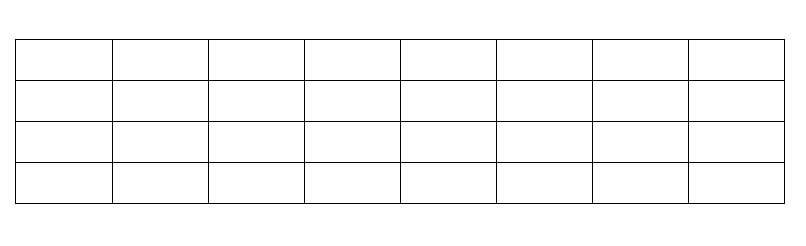
Take a table of dimension $latex m $ x $latex n $. Now fill in the tables with positive integers so that the sum of the rows, columns, and diagonals are equal. Does there exist such a rectangle?
Let's start building it from scratch.
Now let's check something else. Let's calculate the sum of the elements of the table in two different ways.
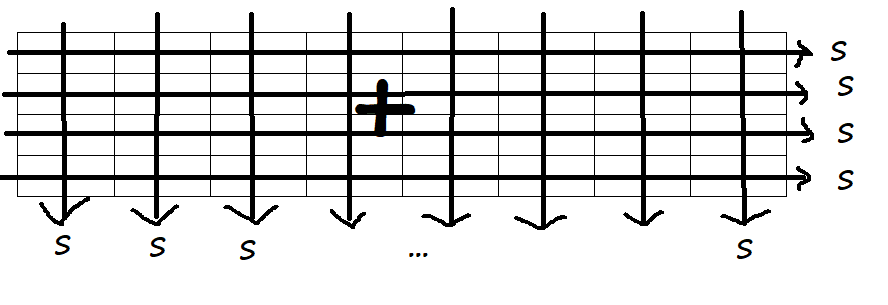
Let's say the column, row and diagonal sum be $latex S $. There are $latex m $ rows and $latex n $ columns.
Row - wala Viewpoint
The Rows say the sum of the elements of the table is $latex S.m $. See the picture below.
Column - wala Viewpoint
The Rows say the sum of the elements of the table is $latex S.n $. See the picture below.
Now, magically it comes that the $latex S.m = S.n $. Therefore the number of rows and columns must be equal.
Edit 1: Look into the comments for a nice observation that if we allowed integers, and the common sum is 0, then we may not have got the result. Also we need to define the sum of the entries of a diagonal of a rectangle.