Limit of a Sequence | IIT JAM 2018 | Problem 2

Try this beautiful problem from IIT JAM 2018 which requires knowledge of Real Analysis (Limit of a Sequence).

Limit of a Sequence - IIT JAM 2018 (Problem 2)


Let $a_n=\frac{b_{n+1}}{b_n}$ where $b_1=1, b_2=1$ and $b_{n+2}=b_n+b_{n+1}$ , Then $\lim\limits_{n \to \infty} a_n$ is

  • $\frac{1-\sqrt5}{2}$
  • $\frac{1+\sqrt5}{2}$
  • $\frac{1+\sqrt3}{2}$
  • $\frac{1-\sqrt3}{2}$

Key Concepts


Real Analysis

Sequence of Reals

Limit of a Sequence

Check the Answer


Answer: $\frac{1+\sqrt5}{2}$

IIT JAM 2018 (Problem 2)

Advanced Calculus by Patrick Fitzpatrick

Try with Hints


Given that, $a_n=\frac{b_{n+1}}{b_n}$

$\Rightarrow \lim\limits_{n \to \infty} a_n = \lim\limits_{n \to \infty} \frac{b_{n+1}}{b_n}= \mathcal{L} $ (say)

Now we know that , $\lim\limits_{n \to \infty} a_n= \lim\limits_{n \to \infty} a_{n+1} $

$\Rightarrow \mathcal{L}=\lim\limits_{n \to \infty} a_{n+1}$

Can you find an equation on $\mathcal{L}$ from which the value of $\mathcal{L}$ can be obtained.

$\mathcal{L}= \lim\limits_{n \to \infty } a_{n+1}$

$= \lim\limits_{n \to \infty} \frac{b_{n+2}}{b_{n+2}}$

$=\lim\limits_{n\to \infty} \frac{b_{n+1}+b_n}{b_{n+1}}$ [By the given recurrence relation]

$=\lim\limits_{n\to \infty} \left(1+\frac{b_n}{b_{n+1}}\right)$

$=1+\lim\limits_{n \to \infty} \frac{b_n}{b_{n+1}}$

$=1+\frac{1}{\lim\limits_{n\to\infty}\frac{b_{n+1}}{b_n}}$

$=1+\frac{1}{\mathcal{L}}$

Now the value of $\mathcal{L}$ can be easily obtained

i.e., $\mathcal{L}=1+\frac{1}{\mathcal{L}}$

$\Rightarrow \mathcal{L}^2-\mathcal{L}-1=0$

$\Rightarrow \mathcal{L}=\frac{1\pm \sqrt{5}}{2}$

$\Rightarrow \mathcal{L}=\frac{1+\sqrt{5}}{2}$ [Since $a_n>0$] [ANS]

Subscribe to Cheenta at Youtube


Definite Integral | IIT JAM 2018 | Problem 4

Try this beautiful problem from IIT JAM 2018 which requires knowledge of the properties of Definite integral.

Properties of Definite Integral -IIT JAM2018 (Problem 4)


Let $a$ be positive real number. If $f$ is a continuous and even function defined on the interval $[-a,a]$, then $\displaystyle\int_{-a}^a \frac{f(x)}{1+e^x} \mathrm d x$ is equal to :-

  • $\displaystyle\int_0^a f(x) \mathrm d x$
  • $2\displaystyle\int_0^a \frac{f(x)}{1+e^x}\mathrm d x$
  • $2\displaystyle\int_0^a f(x) \mathrm d x$
  • $2a\displaystyle\int_0^a \frac{f(x)}{1+e^x}\mathrm d x$

Key Concepts


Definite Integral

Properties of definite Integral

Even function / Odd function

Check the Answer


Answer: $ \displaystyle\int_0^a f(x) \mathrm d x $

IIT JAM 2018, Problem 4

Definite and Integral calculus : R Courant

Try with Hints


In this first I will give you the properties we need to solve this problem :

Property 1 : $\displaystyle\int_a^b f(x) \mathrm d x = \displaystyle\int_a^b f(a+b-x) \mathrm d x $

[Where $f$ is continuous on $[a,b]$]

Property 2 : If $f$ is an even function i.e., $f(x)=f(-x)$ then

$ \displaystyle\int_{-a}^{a} f(x) \mathrm d x = 2 \displaystyle\int_{0}^{a} f(x) \mathrm d x $

Can you drive it from here !!!! Give it a try !!!

Let $I=\displaystyle\int_{-a}^a \frac{f(x)}{1+e^x} \mathrm d x \quad \ldots (i)$

$\Rightarrow I= \displaystyle\int_{-a}^a \frac{f(a-a-x)}{1+e^{(a-a-x)}} \mathrm d x $

[Since, $f$ is continuous then $\displaystyle\int_{a}^b f(x) \mathrm{d}x = \displaystyle\int_{a}^b f(a+b-x) \mathrm{d} x $]

$\Rightarrow I= \displaystyle\int_{-a}^a \frac{f(-x)}{1+e^{-x}} \mathrm d x$

$\Rightarrow I= \displaystyle\int_{-a}^a \frac{f(x)}{1+\frac{1}{e^x}} \mathrm d x$ [Since $f(x)$ is even]

$\Rightarrow I= \displaystyle\int_{-a}^a \frac{e^x.f(x)}{1+e^{x}} \mathrm d x \quad \ldots (ii) $

Adding $(i)$ and $(ii)$ we can get some interesting result !!!

Adding $(i)$ and $(ii)$ we get ,

$2I= \displaystyle\int_{-a}^a \frac{f(x)}{1+e^{x}} \mathrm d x + \displaystyle\int_{-a}^a \frac{e^x .f(x)}{1+e^{x}} \mathrm d x$

$\Rightarrow 2I = \displaystyle\int_{-a}^a \frac{[f(x)+e^x.f(x)]}{1+e^{x}} \mathrm d x$

$\Rightarrow 2I = \displaystyle\int_{-a}^a \frac{f(x)[1+e^x]}{[1+e^{x}]}$

$ \Rightarrow 2I= \displaystyle\int_{-a}^a f(x) \mathrm d x$

$\Rightarrow 2I = 2\displaystyle\int_0^a f(x) \mathrm d x $ [Since $f(x) $ is even ]

$\Rightarrow I = \displaystyle\int_0^a f(x) \mathrm d x $ [ANS]

Subscribe to Cheenta at Youtube


Limit of a Function of two variables

Limit of a two variable Function|IIT JAM 2016 |Problem 6


Find the value of $\lim\limits_{(x,y) \to (2,-2)} \frac{\sqrt{x-y}-2}{x-y-4}$ is

  • $0$
  • $\frac14$
  • $\frac13$
  • $\frac12$

Key Concepts


Function of Several Variables

Limit of a function of several variables

Check the Answer


Answer: $\textbf{(B)} \frac14$

IIT JAM 2016 (Problem 6)

Function of several variables: Fleming, Wendell H

Try with Hints


So, this problem has double limit. But we will not consider this first i.e., first try to solve the above limit without seeing $(x,y) \to (2,-2)$ , just like we used to do in our school days!!!

Here also we cannot put $x,y$ directly, as it will become undefined.

Now,

$\lim\limits_{(x,y) \to (2,-2)} \frac{(x-y)-4}{(x-y-4)(\sqrt{x-y}+2)}$ [Multiplied by $\sqrt{x-y}+2$ on numerator and denominator ]

Now again, try to simplify the above limit !!!

After simplifying,

We have,

$\lim\limits_{(x,y) \to (2,-2)} \frac{1}{\sqrt{x-y}+2}$ [ Since $(x,y) \to (2,-2) \Rightarrow x-y-4 \ne 0$]

Now in this part we will use the limits, i.e., $(x,y) \to (2,-2)$

$\Rightarrow \frac{1}{\sqrt{2+2}+2}=\frac14$[ANS]

Subscribe to Cheenta at Youtube


Triple Integral | IIT JAM 2016 | Question 15

Question 15 - Triple Integral (IIT JAM 2016)


If the triple integral over the region bounded by the planes $2x+y+z=4$ $x=0$ $y=0$ $z=0$ is given by $\int\limits_0^2\int\limits_0^{\lambda(x)}\int\limits_0^{\mu(x,y)}\mathrm d z\mathrm d y\mathrm d x$ then the function $\lambda(x)-\mu(x,y)$ is

  • $x+y$
  • $x-y$
  • $x$
  • $y$

Key Concepts


Real Analysis

Integral Calculus

Triple Integral

Check the Answer


Answer: $\textbf{(B)} \quad y$

IIT JAM 2016, Question No. 15

Differential and Integral Calculus: R Courant

Try with Hints


Here we are given with triple integral over the region bounded by the planes $2x+y+z=4, x=0, y=0$ and $z=0$

Now we our aim here is to find $\lambda (x) $ and $\mu(x,y)$. Now we will approach this problem by find the volume of $(x,y,z)$ based on $2x+y+z=4$ can you do this ??? (With the given information x=0, y=0, z=0)

$2x+y+z=4$

$\Rightarrow z=4-2x-y$

$\Rightarrow 2x+y=4$ [as $z=0$]

$\Rightarrow y=4-2x$

Again,

$2x+y+z=4$

Now as $y=z=0$ we have $2x=4$

Therefore $x=2$

Now can you use this to move forward with this problem ?

So our triple integral become,

$\int_0^2\int_0^{(4-2x)}\int_0^{(4-2x-y)}\mathrm d z\mathrm d y\mathrm dx$

On compairing $\lambda(x)=4-2x$ and $\mu(x,y)=4-2x-y$

Therefore $\lambda(x)-\mu(x,y)=4-2x-4+2x+y=y$ (ANS)

Subscribe to Cheenta at Youtube


Relation Mapping (IIT JAM 2014)

Question 33 - Relation-Mapping (IIT JAM 2014)


A beautiful problem involving the concept of relation-mapping from IIT JAM 2014.

Let $f:(0,\infty)\to \mathbb R$ be a differentiable function such that $f'(x^2)=1-x^3$ for all $x>0$ and $f(1)=0$. Then $f(4)$ equals

  • $\frac{-47}{5}$
  • $\frac{-47}{10}$
  • $\frac{-16}{5}$
  • $\frac{-8}{5}$

Key Concepts


Relation/Mapping

Differentiation

Integration

Check the Answer


Answer: (A) $ \frac{-47}{5}$

Try with Hints


The above problem can be done in many ways we will try to solve this by the simplest method.

Now, as the function is given as $f'(x^2)=1-x^3$

So first try to change this $x^3$ into $x^2$. Try this. It's very easy !!!

To change $x^3$ into $x^2$ we can easily do

$f'(x^2)=1-(x^2)^{\frac32}$

Now we have to find the value of $f(4)$ so we have to change the second degree term, i.e., $x^2$ into some linear form. Can you cook this up ???

Let us assume $x^2=y$

i.e., $f'(y)=1-y^{\frac32}$

Now you know from previous knowledge that integration is also known as anti-derivative. So $f'(y)$ can be changed into $f(y)$ by integrating it with respect to $y$. Try to do this integration and we are half way done !!!

On integrating both side w.r.t $y$ we get :

$f(y)=y-\frac25y^{\frac52}+c$, (where $c$ is a integrating constant.)

Now we find the value to $c$

We know $f(1)=0$

$\Rightarrow c=-\frac35$

i.e., $f(y)=y-\frac25y^{\frac52}-\frac35$

Can you find the answer now ?

Now simply, putting $y=4$

we get $f(4)=4-\frac25(4)^{\frac52}-\frac35 \\=4-\frac{64}{5}-\frac35 \\= \frac{20-67}{5} \\= -\frac{47}{5}$

Subscribe to Cheenta at Youtube


Cyclic Groups in TIFR Entrance

Concept - Cyclic Groups


Let's discuss the concept of Cyclic Groups.

A cyclic group G is a group that can be generated by a single element. In particular, if $ G = \{ a, b, c, d, .. \} $, $ * $ is the group operation and $ a $ is a generating element, then if we compute $a $ , $a*a$, , $a*a*a $, etc. we will be able to create all members of the set G.

Get motivated - Problem from TIFR Entrance


Suppose G is a cyclic group with 60 elements. How many generators are there?


More on Cyclic Group at Cheenta Youtube


AMC 10A 2020 Problem 18: Parity

What is Parity?


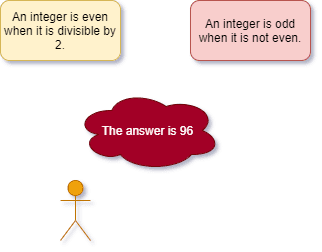
In mathematics, parity is the property of an integer's inclusion in one of two categories: even or odd. An integer is even if it is divisible by two and odd if it is not even .

Try the problem


Let $( \textbf a, \textbf b, \textbf c, \textbf d)$ be an ordered quadruple of not necessarily distinct integers, each one of them in the set ${0,1,2,3}$ For how many such quadruples is it true that $ \textbf a\cdot \textbf d - \textbf b\cdot \textbf c$ is odd?

$\textbf{(A) } 48 \qquad \textbf{(B) } 64 \qquad \textbf{(C) } 96 \qquad \textbf{(D) } 128 \qquad \textbf{(E) } 192$

2020 AMC 10A Problem-18

Parity

4 out of 10

Mathematics Circle

Knowledge Graph


Parity-Knowledge Graph

Use some hints


We need exactly one term to be odd, one term to be even. Because of symmetry,let us set $\textbf a \textbf d$ to be odd and $\textbf b \textbf c$ to be even,then multiple by $2$.

Now can you complete the sum using odd and even property?

See If  $\textbf a \textbf d$ is odd, then both $\textbf a$ and $\textbf  d$ must be odd, therefore there are $2$.$2$=$4$ possibilities for $\textbf a \textbf d$.

now consider $\textbf b \textbf c$, we can say that $\textbf b \textbf c$ is even,then there are $2$.$4$=$8$ possibilities for $\textbf b \textbf c$ . However, $\textbf b$ can be odd.in that case $2$.$2$=$4$ more possibilities for $\textbf b \textbf c$. Thus there are $8$+$4$=$12$ ways for us to choose $\textbf b \textbf c$ and also $4$ ways are there to choose $\textbf a \textbf d$.

Considering symmetry, to $\textbf a \textbf d $- $\textbf b \textbf c$ be odd,there are $12$.$4$.$2$ = $96$ quadruples .So, the answer is $96$.

Subscribe to Cheenta at Youtube


AHSME 1970 - Probability - Problem 31

What is Probability?


Probability is a branch of mathematics that deals with calculating the likelihood of a given event's occurrence, which is expressed as a number between $1$ and $0$. ... Each coin toss is an independent event; the outcome of one trial has no effect on subsequent ones.This Problem has taken from AHSME 1970.

Try the problem

If the number is selected at random from the set of all five-digit numbers in which the sum of the digits is equal to $43$, what is the probability that the number will be divisible by $11$?

$\textbf{(A)} \quad \frac25   \quad \textbf{(B)} \quad \frac15 \quad \textbf{(C)} \quad \frac25 \quad \textbf{(D)} \quad \frac{1}{11} \quad \textbf{(E)} \quad \frac{1}{15}$


AHSME 1970 Problem 31

Probability

3 out of 10

Mathematics Circle

Knowledge Graph


AHSME 1970 Problem-knowledge graph

Use some hints


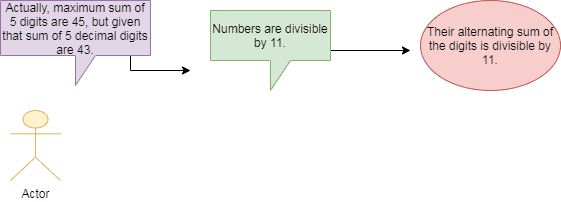
we know the maximum sum of $5$ decimal digits is $45$. To obtain sum of the digits, $43$ we should allow either one $7$ or two \(8\). There are five integers of the first kind $79999, 97999, 99799, 99979, 99997$,one $7$ is here of each integers. And $10$ integers of the second kind $ 88999, 89899, 89989, 89998, 98899, 98989, 98998, 99889, 99898, 99988$, two $8$ are here of each integers.

Numbers are divisible by \(11\). It means their alternating sum of digits are divisible by $11$. There are two numbers of the first kind that satisfies this criterion. They are $97999$ and $99979$. Indeed, $9 - 7 + 9 - 9 + 9 = 11$, and
\(9 - 9 + 9 - 7 + 9 = 11\).

Of the second kind, only one number $98989$ is divisible by $11$. Indeed ,$ 9 - 8 + 9 - 8 + 9 = 11$.

Out of the total of $15$ numbers, three are divisible by $11$. The probability of this event is $3/15 = 1/5$.

Subscribe to Cheenta at Youtube


Sequence and Series: IIT JAM 2016 Problem 24

Sequence and series of real numbers


A sequence of real numbers is an one to one mapping from $\mathbb{N}$ (the set of natural numbers) to a subset of $\mathbb{R}$(the set of all real numbers).

Sum of the terms of a real sequence sequence is called a series.

Try the problem


IIT JAM 2016, PROBLEM 24

Find the sum of the series $\displaystyle\sum_{n=2}^{\infty} \frac{(-1)^n}{n^2+n-2}$.

$\textbf{(A)}\quad \frac13\ln 2-\frac{5}{18}\quad \textbf{(B)}\quad \frac13\ln 2-\frac{5}{6}\quad \textbf{(C)}\quad \frac23\ln 2-\frac{5}{18}\quad \textbf{(D)}\quad \frac23\ln 2-\frac{5}{6}\quad$

Knowledge Graph


Sequence of real numbers-knowledge graph

Use some hints


This problem is a very basic one, this problem can easily be solved by step by step solution. The steps are:

Step 1 : First we will ignore the summation part. We will factorize the denominator, because we are going step by step so our aim is to simplify the given problem first.

Step 2: After factorizing the the denominator we will reach to a position where we have to use partial fraction to go forward.

Step 3: In this step we will take care of the $(-1)^n$ part, like how it will affect the series.

Step 4: After taking care of the $(-1)^n$ we will now expand the summation (breaking it into infinite sum).

Step 5 : So after $4$ steps we are halfway done now just the last simplification is left we will use the value

$\ln 2= 1-\frac{1}{2}+\frac{1}{3}-\frac{1}{4}+\ldots$

to simplify it further.

Now try to solve the entire problem by following these steps !!!

Let us see how to execute STEP 1 .

$\displaystyle\sum_{n=2}^{\infty} \frac{ (-1)^n }{ n^2+n-2 }$, here we are only concerned with the denominator part so,

$\frac{1}{n^2+n-2}=\frac{1}{(n+2)(n-1)}$

So we have successfully factorized the denominator. Now you can reach to the part where we have to use the concept of partial fraction!!!

Let us execute STEP 2 now.

After factorizing the denominator in HINT 1 we get

$\displaystyle\sum_{n=2}^{\infty} \frac{(-1)^n}{(n+2)(n-1)}$

Now our aim here is to seperate $(n+2)$ and $(n-1)$ so we can do this by using partial fraction.

$\frac{1}{(n+2)(n-1)}=\frac{A}{n+2}+\frac{B}{(n-1)}$

$\Rightarrow A(n-1)+B(n+2)=1$

Now taking $\underline{n=1}$ we get

$A(1-1)+B(1+2)=1$

$B=\frac{1}{3}$

Again taking $\underline{n=-2}$, we get:

$A(-2-1)+B(-2+2)=1$

therefore, $A=-\frac{1}{3}$

So we get, $\frac{1}{(n+2)(n-1)}=\frac{1}{3}[\frac{1}{n-1}-\frac{1}{n+2}]$

So our aim here is successful we have separated $(n+2)$ and $(n-1)$ . Now can you proceed further ???

Now after using partial fraction we get.

$\displaystyle\sum_{n=2}^{\infty} (-1)^n\frac{1}{3}[\frac{1}{n-1}+\frac{1}{n+2}]$

Now we will execute STEP 4 i.e., we will take care of the $(-1)^n$ and at the same time we will execute STEP 4 i.e, we will split it into the infinite sum.

$\frac{1}{3}\displaystyle\sum_{n=2}^{\infty} [\frac{1}{n-1}+\frac{1}{n+2}](-1)^n$

$\Rightarrow \frac{1}{3}[(1-\frac{1}{4})-(\frac{1}{2}-\frac{1}{5})+(\frac13-\frac16)\ldots]$

$\Rightarrow \frac13[(1-\frac12+\frac13-\frac14\ldots)+(-\frac14+\frac15-\frac16\ldots)]$

Now after this can you applying the formula of '$\ln 2$' to finish the problem!!

Now only STEP 5 is left to execute. So we will use the infinite series of $\ln 2$.

$\frac13[(1-\frac12+\frac13-\frac14\ldots)+(-\frac14+\frac15-\frac16\ldots)]$

$=\frac13[\ln 2+\ln 2-(1-\frac12+\frac13)]$

$=\frac13(2\ln 2-\frac56)$

$=\frac23 \ln 2 - \frac{5}{18}$

Hence the anser is C.

Introduction to Real Analysis : Robert G. Bartle & Donald R. Sherbert.


Subscribe to Cheenta at Youtube


Eigen Values of a Matrix : IIT JAM 2016 Problem Number 13

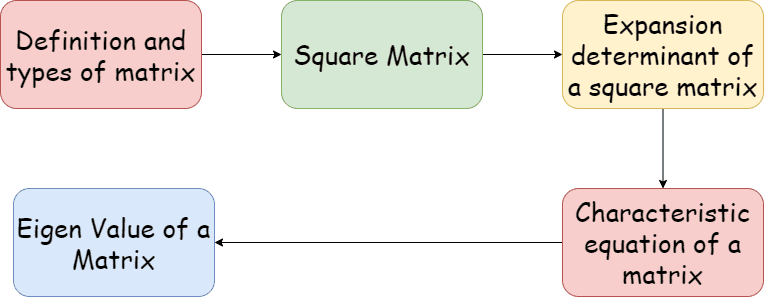
What are Eigen Values of a Matrix?


The Eigen values of a matrix are the roots of its characteristic equation.

Try the problem from IIT JAM 2016


The largest eigen value of the matrix

$A = \begin{bmatrix}
1 & 4 & 16 \\[0.3em]
4 & 16 & 1 \\[0.3em]
16 & 1 & 4 \\
\end{bmatrix}$ is

$\textbf{(A)}\qquad 16\qquad \textbf{(B)}\qquad 21\qquad \textbf{(C)}\qquad 48\qquad \textbf{(D)}\qquad 64\qquad $

IIT JAM 2016 Problem Number 13

Finding the largest eigen value of a matrix

6 out of 10

Higher Algebra : S K Mapa

Knowledge Graph- Eigen values of a matrix


Eigen value of matrix knowledge graph

Use some hints


In order to find the largest eigen value of the given matrix we have to find all the eigen values of the given matrix, then we can find the largest among them. Now it is very easy to find the eigen values. Give it a try!!!

Now the process of rank starts with finding the characteristics polynomial of the given matrix, i.e., $\textbf{ det }(A-\lambda I)=0$. We have to find the value of this $\lambda $ which is the eigen value. Now it is very easy to find the determinant of $(A-\lambda I)$. Try to cook this up.

So, now let's do some calculation.

$ \textbf{det}(A-\lambda I) = \left| \begin{matrix}
1-\lambda & 4 & 16 \\[0.3em]
4 & 16-\lambda & 1 \\[0.3em]
16 & 1 & 4 -\lambda \\
\end{matrix} \right| =0 $

Now we are half way done just our calculation part remains.

$|A-\lambda I|=(1-\lambda)[64-20 \lambda + \lambda ^2-1]-4[16-4 \lambda -16]+16[4-256+16 \lambda]=0$

$\Rightarrow \quad (1- \lambda )( \lambda ^2-20 \lambda +63)+16 \lambda +256 \lambda -4032=0$

$\Rightarrow \quad \lambda ^2-20 \lambda +63 - \lambda ^3+20 \lambda ^2-63 \lambda +272 \lambda -4032=0$

$\Rightarrow \quad - \lambda ^3+21 \lambda ^2+189 \lambda -3969=0$

$ \Rightarrow \quad \lambda ^3-21 \lambda ^2-189 \lambda +3969=0 $

$\Rightarrow \quad(\lambda-21)(\lambda^2-189)=0$

Therefore $\lambda=21, \quad -13.747727, \quad 13.747727$

So from here we can clearly see

$\lambda=21$ is the largest among all the eigen values.

Subscribe to Cheenta at Youtube