Try this beautiful Problem based on Vieta's Formula from AMC 10A, 2021 Problem 14.
Vieta's Formula | AMC 10A 2021, Problem 14
All the roots of the polynomial $z^{6}$-$10 z^{5}$+$A z^{4}$+$B z^{3}$+$C z^{2}$+$D z+16$ are positive integers, possibly repeated. What is the value of $B$ ?
-88
-80
-64
-41
-40
Key Concepts
Vieta's Formula
Polynomial
Roots of the polynomial
Suggested Book | Source | Answer
Problem-Solving Strategies by Arthur Engel
AMC 10A 2021 Problem 14
-88
Try with Hints
Find out the degree of the given polynomial.
We know, Degree of polynomial= Number of roots of that polynomial.
Apply Vieta's Formula on the given polynomial.
By Vieta's Formula, the sum of the roots is 10 and product of the roots is 16.
Since there are 6 roots for this polynomial. By trial and check method find the roots.
Roots of cubic equation | AMC-10A, 2010 | Problem 21
Try this beautiful problem from Algebra based Roots of the cubic equation.
Roots of cubic equation - AMC-10A, 2010- Problem 21
The polynomial \(x^3-ax^2+bx-2010\) has three positive integer roots. What is the smallest possible value of \(a\)?
\(98\)
\(78\)
\(83\)
\(76\)
\(90\)
Key Concepts
Algebra
Vieta's Relation
roots of the equation
Check the Answer
Answer: \(78\)
AMC-10A (2010) Problem 19
Pre College Mathematics
Try with Hints
The given equation is \(x^3-ax^2+bx-2010\).we have to find out the smallest possible value of \(a\).From Vieta's Relation we know that if \(r_1,r_2,r_3\) are the roots of equation \(ax^3+bx^2+cx+d=0\) then \(r_1 +r_2+r_3= -\frac{b}{a}\) and \(r_1 r_2 r_3=-\frac{d}{a}\)
can you finish the problem........
Therefore \(a\) is the sum of the three roots of the polynomial \(x^3-ax^2+bx-2010\). and \(2010\) is the product of the three integer roots.Now the factors of \(2010\) =\(2 \times 3 \times 5 \times 67\).there are only three roots to the polynomial so out of four roots we have to choose three roots such that two of the four prime factors must be multiplied so that we are left with three roots. To minimize \(a\), \(2\) and \(3\) should be multiplied,
Try this beautiful problem from Geometry based on cubical box.
Cubical Box - AMC-10A, 2010- Problem 20
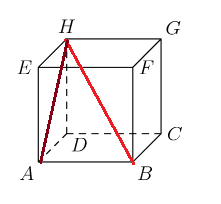
A fly trapped inside a cubical box with side length $1$ meter decides to relieve its boredom by visiting each corner of the box. It will begin and end in the same corner and visit each of the other corners exactly once. To get from a corner to any other corner, it will either fly or crawl in a straight line. What is the maximum possible length, in meters, of its path?
\(4\sqrt 5+3\sqrt 2\)
\(4\sqrt 5+3\sqrt 2\)
\(4\sqrt 3+4\sqrt 2\)
\(7\sqrt 3+4\sqrt 2\)
\(4\sqrt 3+7\sqrt 2\)
Key Concepts
Geometry
Cubical
Pythagoras
Check the Answer
Answer: \(4\sqrt 3+4\sqrt 2\)
AMC-10A (2010) Problem 20
Pre College Mathematics
Try with Hints
Given that "A fly trapped inside a cubical box with side length \(1\) meter decides to relieve its boredom by visiting each corner of the box. It will begin and end in the same corner and visit each of the other corners exactly once".................................Therefore we may say that from a corner to any other corner the straight path will be \(A \to G \to B \to H \to C \to E \to D \to F \to A\)
can you finish the problem........
The distance of an interior diagonal in this cube is \(\sqrt 3\) ( i.e \(HB\)) and the distance of a diagonal on one of the square faces is \(\sqrt 2\) ( i.e \(HA\))
can you finish the problem........
Now the fly visits each corner exactly once, it cannot traverse such a line segment twice. Also, the cube has exactly four such diagonals, so the path of the fly can contain at most four segments of length.Therefore the maximum distance traveled is \(4\sqrt 3+4\sqrt 2\)