Arjun Gupta won gold and bronze in IMO

Arjun Gupta is one of the brightest young minds, who has made remarkable achievements in the world of Math Olympiads.

Arjun’s mathematical story includes success in the IOQM 2023 and RMO 2023, where his performance placed him among the top math talents in India. With focused preparation and strong mentorship at Cheenta, he went on to qualify for the INMO (Indian National Mathematical Olympiad) — a highly competitive stage. His success at INMO led him to the prestigious INMO Training Camp (INMOTC), where India’s most promising young mathematicians train for international excellence.

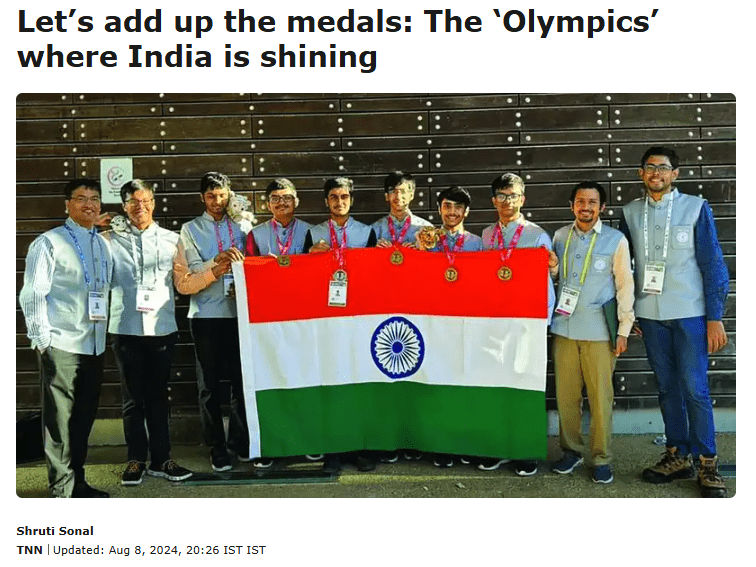
Arjun reached one of the highest school-level math competitions by representing India at the International Mathematical Olympiad (IMO). He won both bronze and gold medal at the IMO, which placed him among the world’s top young mathematicians from India.

Arjun’s love for problem-solving also led him to the Sharygin Geometrical Olympiad 2022, an international contest that focuses on deep geometrical thinking.

In 2025, Arjun achieved another goal by gaining admission to Cambridge University, along with three other Cheenta students who were accepted into Cambridge University.

But Arjun’s talent doesn’t stop at mathematics. He is also an internationally accomplished chess player. In his own words:

“Apart from Math, I love Chess such that I represented India twice in the World Youth Chess Championship category besides winning other Asian and National Chess Competitions.”

His achievements in IMO were recognized widely, including a special feature in the Times of India, celebrating Cheenta students' contributions to the world of Olympiads. Here is the link of the article.

https://timesofindia.indiatimes.com/lets-add-up-the-medals-the-olympics-where-india-is-shining/articleshow/112375379.cms

Math Olympiad awardee conducts Russian styled Math Circles in Sundarbans

Souradip Das, a student of Cheenta Academy, has made remarkable achievements in the world of Mathematics Olympiad. Souradip has secured impressive ranks in prestigious competitions like IOQM 2024, RMO 2023, IOQM 2023, and the AMC (American Math Competition) 10-12. His consistent hard work and dedication have placed him among the top young mathematicians, and his success is a true reflection of his passion for the subject.

But Souradip's contributions go beyond his own achievements. He is also a key mentor in the Math Circle program at Cheenta Academy. This initiative aims to bring the world of mathematics to students from rural areas in the Sundarbans, a region where access to quality education can be limited. Souradip has been a guiding light for these students, helping them discover their love for mathematics and nurturing their skills.

As a mentor, Souradip not only teaches mathematical concepts but also inspires his students to think critically and approach problems with confidence. His dedication to the 'Math Circle' program has had a profound impact on many young minds, encouraging them to pursue their academic dreams despite the challenges they face.

In addition to his mentoring, Souradip has also created a Math Circle Diary, documenting his experiences and the journey of the program. This diary serves as an inspiring resource for both students and teachers, capturing the stories, struggles, and successes of the students in the Math Circle. Through this diary, Souradip shares valuable insights into the impact of the program, as well as the importance of making mathematics accessible to all students, no matter their background.

Souradip’s story is an inspiring example of how talent, combined with a strong sense of community and responsibility, can make a real difference.

Counting Chains with Casework in Combinatorics: A Problem from the RMO 2024

In this exploration, we dive into a combinatorial problem from the 2024 Regional Math Olympiad (RMO) in India, centered on counting specific number sequences, called "chains." Using a function \ (f(n) \), defined as the number of chains that start at 1 and end at \( n \) with each previous number dividing the next, the problem applies strategic casework to calculate \( f(2^m \cdot 3) \).

See the Question

We want to determine:
\(f(2^m \cdot 3)\)
where each chain is a sequence that:

  1. Begins at 1 and ends at \( 2^m \cdot 3 \),
  2. Has each term dividing the next.

Concepts Used:

  1. Combinatorial Casework: Breaking down problems by considering specific scenarios helps in counting complex structures systematically.
  2. Binomial Theorem: Key in calculating possible combinations, where the sum of binomial coefficients up to \( n \) equals \( 2^n \).

Watch the Video

Solution Outline:

The solution involves structured casework using the position of the first appearance of 3 as a "switch" to organize sub-cases.

Understanding Chains

Casework on Position of 3:

Applying Binomial Coefficients:

Final Answer:

By organizing cases and summing possibilities, we obtain the final count:
\[2^{m-1} \cdot (m + 2)\]

This problem exemplifies the effectiveness of casework in combinatorics, teaching a methodical approach to counting sequences. Through strategic splitting and summing, it provides a beautiful solution to a challenging problem in combinatorial mathematics.

Mastering Geometry with Apollonius Theorem and Cosine Rule: A Problem from the RMO 2005

In this insightful video, we explore various geometric concepts through a problem from the RMO 2005 (Regional Math Olympiad). The focus of the problem is a convex quadrilateral, and through this, several important geometric theorems and techniques are applied.

Watch The Video

Here's what we cover:

This problem elegantly ties together theorems like Apollonius' theorem, the midpoint theorem, and the cosine rule, providing students with multiple tools to tackle complex geometry problems.

14 Cheenta students cracked the Regional Math Olympiad 2023

In 2023, 14 out of 27 students from Cheenta Academy cracked the prestigious Regional Math Olympiad. In this post, we will share some of their success stories and learning strategies.

The Regional Mathematics Olympiad (RMO) and the Indian National Mathematics Olympiad (INMO) are prestigious contests in India for students under 20, aiming to identify exceptional mathematical talent. Participants solve challenging math problems in these stages, with INMO serving as a platform to recognize top problem solvers and offer opportunities for further training and representation in international competitions like the IMO.

Achieving success in the Regional Mathematics Olympiad (RMO) and aiming for the Indian National Mathematics Olympiad (INMO) is a remarkable feat, requiring dedication, strategic preparation, and a strong foundation in mathematical problem-solving. Let's learn about the RMO Success stories from Aharshi Roy and Nandagovind Anurag, students who excelled in RMO, valuable perspectives emerged on their journey, methodologies, and recommended strategies for aspirants.

Aharshi Roy's Experience and Recommendations

Aharshi, an RMO qualifier, shared his journey primarily focused on preparing for INMO. He highlighted the significance of the initial one-year period dedicated to subjective Olympiad training. His advice encompassed the following key points:

Watch the full video to learn more about his experience and RMO Strategies

Nandagovind Anurag's Strategic Insights

Nandagovind's journey, starting just ten months before RMO, showcased the importance of strategic preparation and subject specialization. His key takeaways included:

Watch the full video to learn more about his experience and RMO Strategies.

Final Thoughts

The shared experiences and insights from Aharshi Roy and Nandagovind Anurag offer a comprehensive view of successful RMO strategies. Their emphasis on strategic preparation, resource selection, specialized focus, and diverse problem-solving techniques provides aspiring Olympiad participants with valuable guidance.

In the realm of Olympiad Mathematics, beyond formulas and theorems, lies the art of thinking creatively, exploring diverse approaches, and persistently tackling problems—a fundamental aspect highlighted by these champions.

FERMAT POINT

ABC is a Triangle and P be a Fermat Point Inside it.draw three equilateral triangle based on the three sides i.e$\triangle ABA'$, $\triangle ACC'$, $\triangle BCB'$ respectively.Join $AB'$,$BC'$ and$CA'$ .Show that $ AB'$,$BC'$ and $CA'$ pass through a single piont i.e they are concurrent.

Fermat Point

Key Concepts


Rotation

Geometry

shortest distance

Check the Answer


Regional Math Olympiad, India

Challenges and thrills of pre college mathematics

Try with Hints


Rotation:

ABC is a Triangle . Let P Be any point join $AP,BP$ and $CP$. Now if we rotate the $\triangle ABP$ about the point at B $ 60 ^{\circ} $ anti clockwise we will get $\triangle BP'A'$.

SHORTEST DISTANCE:

Join the point P and P'.Now In the triangle BPP' we have

BP-BP'

$\angle PBP'=60 ^{\circ} $, SO $\triangle BPP' $ is a equilateral triangle. so $BP=BP'=PP'$

and also $AP'=AP$ (Length remain unchange after Rotation).

So from the point $A'$ to $C$ the path is $A'P'+PP'+PC$.This path will be Shortest distance if $A'P'+PP'+PC$ i.e A'C be a straight line. and also $AP+PB+AB=A'P'+PP'+PC$

the shortest path betwween two points is a straight line and so $ PA+PB+PC$ reaches its minimum if and only if the point $p$ and $P'$ lie on the line $A'C$

By symmetry it follows that $ P $ must also lie on the line $BC'$ and $AB'$.

So the point of intersection of these lines is a fermat point of a $\triangle ABC$.

EQUILATERAL TRIANGLE :

Now the triangle $AA'B$ we have

$A'B=AB$ (length remain unchange due to rotation)

$\angle A'BA =60^{\circ}$. so the triangle $AA'B $ is a equilateral triangle .

similarly for the other two triangles $AC'C$ and $BB'C$

Subscribe to Cheenta at Youtube


Number Theory, Ireland MO 2018, Problem 9

[et_pb_section fb_built="1" _builder_version="3.22.4"][et_pb_row _builder_version="3.25"][et_pb_column type="4_4" _builder_version="3.25" custom_padding="|||" custom_padding__hover="|||"][et_pb_text _builder_version="3.27.4" text_font="Raleway|300|||||||" text_text_color="#ffffff" header_font="Raleway|300|||||||" header_text_color="#e2e2e2" background_color="#0c71c3" custom_padding="20px|20px|20px|20px" border_radii="on|5px|5px|5px|5px" box_shadow_style="preset3"]

Understand the problem

[/et_pb_text][et_pb_text _builder_version="4.0" text_font="Raleway||||||||" background_color="#f4f4f4" custom_margin="10px||10px" custom_padding="10px|20px|10px|20px" box_shadow_style="preset2"]The sequence of positive integers $a_1, a_2, a_3, ...$ satisfies $a_{n+1} = a^2_{n} + 2018$ for $n \ge 1$.
Prove that there exists at most one $n$ for which $a_n$ is the cube of an integer.

[/et_pb_text][/et_pb_column][/et_pb_row][et_pb_row _builder_version="3.25"][et_pb_column type="4_4" _builder_version="3.25" custom_padding="|||" custom_padding__hover="|||"][et_pb_accordion open_toggle_text_color="#0c71c3" _builder_version="3.22.4" toggle_font="||||||||" body_font="Raleway||||||||" text_orientation="center" custom_margin="10px||10px" hover_enabled="0"][et_pb_accordion_item title="Source of the problem" open="on" _builder_version="4.0" hover_enabled="0"]

Ireland MO 2018, Problem 9 [/et_pb_accordion_item][et_pb_accordion_item title="Topic" _builder_version="4.0" hover_enabled="0" open="off"]Number Theory [/et_pb_accordion_item][et_pb_accordion_item title="Difficulty Level" _builder_version="4.0" hover_enabled="0" open="off"]8/10 [/et_pb_accordion_item][et_pb_accordion_item title="Suggested Book" _builder_version="4.0" hover_enabled="0" open="off"]Excursion in Mathematics by Bhaskaryacharya Prathisthan [/et_pb_accordion_item][/et_pb_accordion][et_pb_text _builder_version="3.27.4" text_font="Raleway|300|||||||" text_text_color="#ffffff" header_font="Raleway|300|||||||" header_text_color="#e2e2e2" background_color="#0c71c3" custom_margin="48px||48px" custom_padding="20px|20px|20px|20px" border_radii="on|5px|5px|5px|5px" box_shadow_style="preset3"]

Start with hints

[/et_pb_text][et_pb_tabs active_tab_background_color="#0c71c3" inactive_tab_background_color="#000000" _builder_version="3.22.4" tab_text_color="#ffffff" tab_font="||||||||" background_color="#ffffff" hover_enabled="0"][et_pb_tab title="Hint 0" _builder_version="3.22.4"]Do you really need a hint? Try it first!

[/et_pb_tab][et_pb_tab title="Hint 1" _builder_version="4.0" hover_enabled="0"], wIt is so important to know and use the modulo technqiue at the right time.  We will use the modulo technique, i.e. we will see the problem through the lens of modulo some number. What is that number? If you visit this website, you will understand that to handle cubes modulo something is 9. So, we will deal the whole equation modulo 9.  

[/et_pb_tab][et_pb_tab title="Hint 2" _builder_version="4.0" hover_enabled="0"]

Definition: kth power residue of a number n is the complete residue system modulo n. For eg: Quadratic Residue (2nd power) of 4 is {0,1}.

We will use these ideas here.   [/et_pb_tab][et_pb_tab title="Hint 3" _builder_version="4.0" hover_enabled="0"]Let $a_k$ be the smallest integer which is a cube; let $a_k=a^3$. Note that, $a_{k+1}=a^6+2018$.  Now, the modulo picture comes in. Starting from this cube. We will observe the sequence modulo 9. Case 1: \( a_k = 0\) mod 9 Then, the sequence modulo 9 will be  $0 \mapsto 2 \mapsto 6 \mapsto 2 \mapsto \dots$ Hence, there are no further cubes possible as the cubic residues of 9  are {0,1,-1}. [/et_pb_tab][et_pb_tab title="Hint 4" _builder_version="4.0" hover_enabled="0"]Case 2: \( a_k = 1,-1\) mod 9 Then, the sequence modulo 9 will be  $\pm 1 \mapsto 3 \mapsto 2 \mapsto 6 \mapsto 2 \mapsto \dots$ Hence, there are no further cubes possible as the cubic residues of 9  are {0,1,-1}. QED [/et_pb_tab][/et_pb_tabs][et_pb_text _builder_version="3.27.4" text_font="Raleway|300|||||||" text_text_color="#ffffff" header_font="Raleway|300|||||||" header_text_color="#e2e2e2" background_color="#0c71c3" custom_margin="48px||48px" custom_padding="20px|20px|20px|20px" border_radii="on|5px|5px|5px|5px" box_shadow_style="preset3"]

Watch video

[/et_pb_text][et_pb_code _builder_version="3.26.4"]
[/et_pb_code][et_pb_text _builder_version="3.27.4" text_font="Raleway|300|||||||" text_text_color="#ffffff" header_font="Raleway|300|||||||" header_text_color="#e2e2e2" background_color="#0c71c3" min_height="12px" custom_margin="50px||50px" custom_padding="20px|20px|20px|20px" border_radii="on|5px|5px|5px|5px" box_shadow_style="preset3"]

Connected Program at Cheenta

[/et_pb_text][et_pb_blurb title="Math Olympiad Program" url="https://cheenta.com/matholympiad/" url_new_window="on" image="https://cheenta.com/wp-content/uploads/2018/03/matholympiad.png" _builder_version="3.23.3" header_font="||||||||" header_text_color="#e02b20" header_font_size="48px" link_option_url="https://cheenta.com/matholympiad/" link_option_url_new_window="on"]

Math Olympiad is the greatest and most challenging academic contest for school students. Brilliant school students from over 100 countries participate in it every year. Cheenta works with small groups of gifted students through an intense training program. It is a deeply personalized journey toward intellectual prowess and technical sophistication.[/et_pb_blurb][et_pb_button button_url="https://cheenta.com/matholympiad/" url_new_window="on" button_text="Learn More" button_alignment="center" _builder_version="3.23.3" custom_button="on" button_bg_color="#0c71c3" button_border_color="#0c71c3" button_border_radius="0px" button_font="Raleway||||||||" button_icon="%%3%%" background_layout="dark" button_text_shadow_style="preset1" box_shadow_style="preset1" box_shadow_color="#0c71c3"][/et_pb_button][et_pb_text _builder_version="3.27.4" text_font="Raleway|300|||||||" text_text_color="#ffffff" header_font="Raleway|300|||||||" header_text_color="#e2e2e2" background_color="#0c71c3" custom_margin="50px||50px" custom_padding="20px|20px|20px|20px" border_radii="on|5px|5px|5px|5px" box_shadow_style="preset3"]

Similar Problems

[/et_pb_text][et_pb_post_slider include_categories="9" _builder_version="3.22.4"][/et_pb_post_slider][et_pb_divider _builder_version="3.22.4" background_color="#0c71c3"][/et_pb_divider][/et_pb_column][/et_pb_row][/et_pb_section]
Inequality, Israel MO 2018, Problem 3

[et_pb_section fb_built="1" _builder_version="3.22.4"][et_pb_row _builder_version="3.25"][et_pb_column type="4_4" _builder_version="3.25" custom_padding="|||" custom_padding__hover="|||"][et_pb_text _builder_version="3.27.4" text_font="Raleway|300|||||||" text_text_color="#ffffff" header_font="Raleway|300|||||||" header_text_color="#e2e2e2" background_color="#0c71c3" custom_padding="20px|20px|20px|20px" border_radii="on|5px|5px|5px|5px" box_shadow_style="preset3"]

Understand the problem

[/et_pb_text][et_pb_text _builder_version="4.0" text_font="Raleway||||||||" background_color="#f4f4f4" custom_margin="10px||10px" custom_padding="10px|20px|10px|20px" box_shadow_style="preset2"]Determine the minimal and maximal values the expression $\frac{|a+b|+|b+c|+|c+a|}{|a|+|b|+|c|}$ can take, where $a,b,c$ are real numbers.[/et_pb_text][/et_pb_column][/et_pb_row][et_pb_row _builder_version="3.25"][et_pb_column type="4_4" _builder_version="3.25" custom_padding="|||" custom_padding__hover="|||"][et_pb_accordion open_toggle_text_color="#0c71c3" _builder_version="3.22.4" toggle_font="||||||||" body_font="Raleway||||||||" text_orientation="center" custom_margin="10px||10px"][et_pb_accordion_item title="Source of the problem" open="on" _builder_version="4.0"]Israel MO 2018, Problem 3[/et_pb_accordion_item][et_pb_accordion_item title="Topic" _builder_version="4.0" open="off"]Algebra, Inequality[/et_pb_accordion_item][et_pb_accordion_item title="Difficulty Level" _builder_version="4.0" open="off"]6/10[/et_pb_accordion_item][et_pb_accordion_item title="Suggested Book" _builder_version="4.0" open="off"]Excursion in Mathematics by Bhaskarcharya Prathisthan[/et_pb_accordion_item][/et_pb_accordion][et_pb_text _builder_version="3.27.4" text_font="Raleway|300|||||||" text_text_color="#ffffff" header_font="Raleway|300|||||||" header_text_color="#e2e2e2" background_color="#0c71c3" custom_margin="48px||48px" custom_padding="20px|20px|20px|20px" border_radii="on|5px|5px|5px|5px" box_shadow_style="preset3"]

Start with hints

[/et_pb_text][et_pb_tabs active_tab_background_color="#0c71c3" inactive_tab_background_color="#000000" _builder_version="3.22.4" tab_text_color="#ffffff" tab_font="||||||||" background_color="#ffffff"][et_pb_tab title="Hint 0" _builder_version="3.22.4"]Do you really need a hint? Try it first!

[/et_pb_tab][et_pb_tab title="Hint 1" _builder_version="4.0"]Given the expressions, what inequality comes to your mind first? The triangle inequality right? |x| + |y| \( \geq \) |x+y|. Can you use this inequality to get a maximum bound?[/et_pb_tab][et_pb_tab title="Hint 2" _builder_version="4.0"]Maximum Bound: Observe that the maximum bound is got by the triangle inequality as explained. $|a+b| \le |a|+|b|$
$|b+c| \le |b|+|c|$  
$|a+c| \le |a|+|c|$ We get, $\frac{|a+b|+|b+c|+|c+a|}{|a|+|b|+|c|} \le\frac{|a|+|b|+|b|+|c|+|a|+|c|}{|a|+|b|+|c|}=2$ Never forget to mention the equality case: a = b = c is the equality case.  [/et_pb_tab][et_pb_tab title="Hint 3" _builder_version="4.0"]What about the minimum inequality? The idea is that you can observe that keeping the denominator constant, can you reduce the numerator. Let's take the case of the |a| = |b| = |c| = 1. Now, the expression is maximized when a = b = c = 1 or -1. So, obviously one must be positive or two must be negative or vice-versa. In either case, we get \( \frac{2}{3} \). Okay, then maybe we need to deal with the signs and stuff to get a hold on the minimum. Let's fix the signs of a,b,c then, we can break the bonds of the modulus. Let's proceed to the next hint.

[/et_pb_tab][et_pb_tab title="Hint 4" _builder_version="4.0"]Let $a$, $b$, and $c$ be arbitrary real numbers, not all of them equal $0$. By flipping signs, we can assume that at least two of $a$, $b$, and $c$ are non-negative. Actually, without loss of generality, we can assume that $a, b\geq 0$. \( 3|a + b| + 3|b + c| + 3|c + a| \geq 3a + 3b + 3|b+c| + 3|a+c| \geq 2(a+b) + (a + |a + c|) + (b + |b + c|) \) \( = 2(|a| + |b|) + (|-a| + |a + c|) + (|-b| + |b + c|) \geq 2(|a| + |b|) + |c| + |c| = 2|a| + 2|b| + 2|c| \) We have proved that the minimum possible value of $\frac{|a+b|+|b+c|+|c+a|}{|a|+|b|+|c|}$ is $\frac{2}{3}$. The minimum is $\frac{2}{3}$, which is attained for $a = b = 1$$c = -1$.  

[/et_pb_tab][/et_pb_tabs][et_pb_text _builder_version="3.27.4" text_font="Raleway|300|||||||" text_text_color="#ffffff" header_font="Raleway|300|||||||" header_text_color="#e2e2e2" background_color="#0c71c3" custom_margin="48px||48px" custom_padding="20px|20px|20px|20px" border_radii="on|5px|5px|5px|5px" box_shadow_style="preset3"]

Watch video

[/et_pb_text][et_pb_code _builder_version="3.26.4"]
[/et_pb_code][et_pb_text _builder_version="3.27.4" text_font="Raleway|300|||||||" text_text_color="#ffffff" header_font="Raleway|300|||||||" header_text_color="#e2e2e2" background_color="#0c71c3" min_height="12px" custom_margin="50px||50px" custom_padding="20px|20px|20px|20px" border_radii="on|5px|5px|5px|5px" box_shadow_style="preset3"]

Connected Program at Cheenta

[/et_pb_text][et_pb_blurb title="Math Olympiad Program" url="https://cheenta.com/matholympiad/" url_new_window="on" image="https://cheenta.com/wp-content/uploads/2018/03/matholympiad.png" _builder_version="3.23.3" header_font="||||||||" header_text_color="#e02b20" header_font_size="48px" link_option_url="https://cheenta.com/matholympiad/" link_option_url_new_window="on"]

Math Olympiad is the greatest and most challenging academic contest for school students. Brilliant school students from over 100 countries participate in it every year. Cheenta works with small groups of gifted students through an intense training program. It is a deeply personalized journey toward intellectual prowess and technical sophistication.[/et_pb_blurb][et_pb_button button_url="https://cheenta.com/matholympiad/" url_new_window="on" button_text="Learn More" button_alignment="center" _builder_version="3.23.3" custom_button="on" button_bg_color="#0c71c3" button_border_color="#0c71c3" button_border_radius="0px" button_font="Raleway||||||||" button_icon="%%3%%" background_layout="dark" button_text_shadow_style="preset1" box_shadow_style="preset1" box_shadow_color="#0c71c3"][/et_pb_button][et_pb_text _builder_version="3.27.4" text_font="Raleway|300|||||||" text_text_color="#ffffff" header_font="Raleway|300|||||||" header_text_color="#e2e2e2" background_color="#0c71c3" custom_margin="50px||50px" custom_padding="20px|20px|20px|20px" border_radii="on|5px|5px|5px|5px" box_shadow_style="preset3"]

Similar Problems

[/et_pb_text][et_pb_post_slider include_categories="9" _builder_version="3.22.4"][/et_pb_post_slider][et_pb_divider _builder_version="3.22.4" background_color="#0c71c3"][/et_pb_divider][/et_pb_column][/et_pb_row][/et_pb_section]

Number Theory - Dutch MO 2015, Problem 4

[et_pb_section fb_built="1" _builder_version="3.22.4"][et_pb_row _builder_version="3.25"][et_pb_column type="4_4" _builder_version="3.25" custom_padding="|||" custom_padding__hover="|||"][et_pb_text _builder_version="3.27.4" text_font="Raleway|300|||||||" text_text_color="#ffffff" header_font="Raleway|300|||||||" header_text_color="#e2e2e2" background_color="#0c71c3" custom_padding="20px|20px|20px|20px" border_radii="on|5px|5px|5px|5px" box_shadow_style="preset3"]

Understand the problem

[/et_pb_text][et_pb_text _builder_version="4.0" text_font="Raleway||||||||" background_color="#f4f4f4" custom_margin="10px||10px" custom_padding="10px|20px|10px|20px" hover_enabled="0" box_shadow_style="preset2"]Find all pairs of prime numbers $(p, q)$ for which $7pq^2 + p = q^3 + 43p^3 + 1$ [/et_pb_text][/et_pb_column][/et_pb_row][et_pb_row _builder_version="3.25"][et_pb_column type="4_4" _builder_version="3.25" custom_padding="|||" custom_padding__hover="|||"][et_pb_accordion open_toggle_text_color="#0c71c3" _builder_version="3.22.4" toggle_font="||||||||" body_font="Raleway||||||||" text_orientation="center" custom_margin="10px||10px" hover_enabled="0"][et_pb_accordion_item title="Source of the problem" open="on" _builder_version="4.0" hover_enabled="0"]Dutch MO 2015 Problem 4 [/et_pb_accordion_item][et_pb_accordion_item title="Topic" _builder_version="4.0" hover_enabled="0" open="off"]Number Theory [/et_pb_accordion_item][et_pb_accordion_item title="Difficulty Level" _builder_version="4.0" hover_enabled="0" open="off"]5/10 [/et_pb_accordion_item][et_pb_accordion_item title="Suggested Book" _builder_version="4.0" hover_enabled="0" open="off"]Challenges and Thrills in Pre College Mathematics [/et_pb_accordion_item][/et_pb_accordion][et_pb_text _builder_version="3.27.4" text_font="Raleway|300|||||||" text_text_color="#ffffff" header_font="Raleway|300|||||||" header_text_color="#e2e2e2" background_color="#0c71c3" custom_margin="48px||48px" custom_padding="20px|20px|20px|20px" border_radii="on|5px|5px|5px|5px" box_shadow_style="preset3"]

Start with hints

[/et_pb_text][et_pb_tabs active_tab_background_color="#0c71c3" inactive_tab_background_color="#000000" _builder_version="4.0" tab_text_color="#ffffff" tab_font="||||||||" background_color="#ffffff" hover_enabled="0"][et_pb_tab title="Hint 0" _builder_version="4.0" hover_enabled="0"]Do you really need a hint? Try it first!

[/et_pb_tab][et_pb_tab title="Hint 1" _builder_version="4.0" hover_enabled="0"]This Diophantine Equation may seem a bit difficult to handle and will force you to try various techniques like making modulo 7, modulo p, modulo q as p and q are given as primes. But, let's go through the basic techniques for handling it. So what is it? Checking the parity of p and q in the given equation. [/et_pb_tab][et_pb_tab title="Hint 2" _builder_version="4.0" hover_enabled="0"]Som check that if both p and q are odd primes, then the LHS will be even but the RHS will be odd, which is a contradiction.  Hence the only way it can happen that one of them must be even i.e. 2. [/et_pb_tab][et_pb_tab title="Hint 3" _builder_version="4.0" hover_enabled="0"]Now, things seem to be under control. We have two cases, p = 2 and q = 2. For p = 2, we get the equation \( q^3 - 14q^2 = -343 \). This implies that q must divide \( 343 = 7^3\). Hence q can be only 7. This gives rise to the solution (2,7). The next hint offers the other case. [/et_pb_tab][et_pb_tab title="Hint 4" _builder_version="4.0" hover_enabled="0"]For  q = 2. we get \(43p^3 - 29p + 9 = 0\). How to solve this? Clearly apply the same idea. Observe that if p = odd the LHS will be odd which can't be 0. Hence, p must be 2, but it doesn't satisfy the equation. The only solution is (2,7). [/et_pb_tab][/et_pb_tabs][et_pb_text _builder_version="3.27.4" text_font="Raleway|300|||||||" text_text_color="#ffffff" header_font="Raleway|300|||||||" header_text_color="#e2e2e2" background_color="#0c71c3" custom_margin="48px||48px" custom_padding="20px|20px|20px|20px" border_radii="on|5px|5px|5px|5px" box_shadow_style="preset3"]

Watch video

[/et_pb_text][et_pb_code _builder_version="3.26.4"]
[/et_pb_code][et_pb_text _builder_version="3.27.4" text_font="Raleway|300|||||||" text_text_color="#ffffff" header_font="Raleway|300|||||||" header_text_color="#e2e2e2" background_color="#0c71c3" min_height="12px" custom_margin="50px||50px" custom_padding="20px|20px|20px|20px" border_radii="on|5px|5px|5px|5px" box_shadow_style="preset3"]

Connected Program at Cheenta

[/et_pb_text][et_pb_blurb title="Math Olympiad Program" url="https://cheenta.com/matholympiad/" url_new_window="on" image="https://cheenta.com/wp-content/uploads/2018/03/matholympiad.png" _builder_version="3.23.3" header_font="||||||||" header_text_color="#e02b20" header_font_size="48px" link_option_url="https://cheenta.com/matholympiad/" link_option_url_new_window="on"]

Math Olympiad is the greatest and most challenging academic contest for school students. Brilliant school students from over 100 countries participate in it every year. Cheenta works with small groups of gifted students through an intense training program. It is a deeply personalized journey toward intellectual prowess and technical sophistication.[/et_pb_blurb][et_pb_button button_url="https://cheenta.com/matholympiad/" url_new_window="on" button_text="Learn More" button_alignment="center" _builder_version="3.23.3" custom_button="on" button_bg_color="#0c71c3" button_border_color="#0c71c3" button_border_radius="0px" button_font="Raleway||||||||" button_icon="%%3%%" background_layout="dark" button_text_shadow_style="preset1" box_shadow_style="preset1" box_shadow_color="#0c71c3"][/et_pb_button][et_pb_text _builder_version="3.27.4" text_font="Raleway|300|||||||" text_text_color="#ffffff" header_font="Raleway|300|||||||" header_text_color="#e2e2e2" background_color="#0c71c3" custom_margin="50px||50px" custom_padding="20px|20px|20px|20px" border_radii="on|5px|5px|5px|5px" box_shadow_style="preset3"]

Similar Problems

[/et_pb_text][et_pb_post_slider include_categories="9" _builder_version="3.22.4"][/et_pb_post_slider][et_pb_divider _builder_version="3.22.4" background_color="#0c71c3"][/et_pb_divider][/et_pb_column][/et_pb_row][/et_pb_section]

Polynomial Functional Equation - Random Olympiad Problem

[et_pb_section fb_built="1" _builder_version="3.22.4" fb_built="1" _i="0" _address="0"][et_pb_row _builder_version="3.25" _i="0" _address="0.0"][et_pb_column type="4_4" _builder_version="3.25" custom_padding="|||" custom_padding__hover="|||" _i="0" _address="0.0.0"][et_pb_text _builder_version="3.27.4" text_font="Raleway|300|||||||" text_text_color="#ffffff" header_font="Raleway|300|||||||" header_text_color="#e2e2e2" background_color="#0c71c3" custom_padding="20px|20px|20px|20px" border_radii="on|5px|5px|5px|5px" box_shadow_style="preset3" _i="0" _address="0.0.0.0"]

Understand the problem

[/et_pb_text][et_pb_text _builder_version="3.27.4" text_font="Raleway||||||||" background_color="#f4f4f4" custom_margin="10px||10px" custom_padding="10px|20px|10px|20px" box_shadow_style="preset2" _i="1" _address="0.0.0.1"]Find all the real Polynomials P(x) such that it satisfies the functional equation: $latex P(2P(x)) = 2P(P(x)) + P(x)^{2} \forall real x $.

[/et_pb_text][/et_pb_column][/et_pb_row][et_pb_row _builder_version="3.25" _i="1" _address="0.1"][et_pb_column type="4_4" _builder_version="3.25" custom_padding="|||" custom_padding__hover="|||" _i="0" _address="0.1.0"][et_pb_accordion open_toggle_text_color="#0c71c3" _builder_version="3.22.4" toggle_font="||||||||" body_font="Raleway||||||||" text_orientation="center" custom_margin="10px||10px" _i="0" _address="0.1.0.0"][et_pb_accordion_item title="Source of the problem" open="on" _builder_version="3.29.2" _i="0" _address="0.1.0.0.0"]

Unknown [/et_pb_accordion_item][et_pb_accordion_item title="Topic" _builder_version="3.29.2" _i="1" _address="0.1.0.0.1" open="off"]Functional Equation, Polynomials[/et_pb_accordion_item][et_pb_accordion_item title="Difficulty Level" _builder_version="3.29.2" _i="2" _address="0.1.0.0.2" open="off"]7/10[/et_pb_accordion_item][et_pb_accordion_item title="Suggested Book" _builder_version="3.29.2" _i="3" _address="0.1.0.0.3" open="off"]Excursion in Mathematics  Challenges and Thrills in Pre College Mathematics[/et_pb_accordion_item][/et_pb_accordion][et_pb_text _builder_version="3.27.4" text_font="Raleway|300|||||||" text_text_color="#ffffff" header_font="Raleway|300|||||||" header_text_color="#e2e2e2" background_color="#0c71c3" custom_margin="48px||48px" custom_padding="20px|20px|20px|20px" border_radii="on|5px|5px|5px|5px" box_shadow_style="preset3" _i="1" _address="0.1.0.1"]

Start with hints

[/et_pb_text][et_pb_tabs active_tab_background_color="#0c71c3" inactive_tab_background_color="#000000" _builder_version="3.29.2" tab_text_color="#ffffff" tab_font="||||||||" background_color="#ffffff" hover_enabled="0" _i="2" _address="0.1.0.2"][et_pb_tab title="Hint 0" _builder_version="3.22.4" _i="0" _address="0.1.0.2.0"]Do you really need a hint? Try it first!

[/et_pb_tab][et_pb_tab title="Hint 1" _builder_version="3.29.2" _i="1" _address="0.1.0.2.1"]Well, it is really good that the information polynomial is given! You should use that. What is the first thing that you check in a Polynomial Identity? Degree! Yes, check whether the degree of the Polynomial on both the LHS and RHS are the same or not. Yes, they are both the same $latex n^2 $.  But did you observe something fishy?  [/et_pb_tab][et_pb_tab title="Hint 2" _builder_version="3.29.2" _i="2" _address="0.1.0.2.2"]Now rewrite the equation as $latex P(2P(x)) - 2P(P(x)) = P(x)^{2}$. Do the Degree trick now... You see it right? Yes, on the left it is $latex n^2 $ and on the RHS it is $latex 2n $. So, there are two cases now... Figure them out!

[/et_pb_tab][et_pb_tab title="Hint 3" _builder_version="3.29.2" _i="3" _address="0.1.0.2.3"]

Case 1: $latex 2n = n^2 $... i.e. P(x) is either a quadratic or a constant function. Case 2:  $latex P(2P(x)) - 2P(P(x)) $ has coefficient zero till $latex x^2n$. We will study case 1 now. Case 1: $latex 2n = n^2$... i.e. P(x) is either a quadratic or a constant function. $latex P(2P(x)) - 2P(P(x)) = P(x)^{2}$ = $latex P(2y) - 2P(y) = y^{2}$ where $latex y = P(x) $. Now, expand using $latex P(x) = ax^2 + bx +c$, it gives $latex 2ay^2 -c = y^2 $... Now find out all such polynomials satisfying this property. For e.g. $latex \frac{x^2}{2}$ is a solution. If P(x) is constant, prove that $latex P(x) = 0 / \frac{-1}{2} $.  [/et_pb_tab][et_pb_tab title="Hint 4" _builder_version="3.29.2" _i="4" _address="0.1.0.2.4"]Case 2: $latex P(2y) - 2P(y) = y^{2}$. Assume a general form of P(x) = $latex $and show that P(x) must be quadratic or lesser degree by comparing coefficients as you have a quadratic on RHS and n degree polynomial of the LHS.  Now, we have already solved it for quadratic or less degree.  [/et_pb_tab][et_pb_tab title="Techniques Revisited" _builder_version="3.29.2" _i="5" _address="0.1.0.2.5"]

[/et_pb_tab][et_pb_tab title="Food for Thought" _builder_version="3.29.2" hover_enabled="0" _i="6" _address="0.1.0.2.6"] [/et_pb_tab][/et_pb_tabs][et_pb_text _builder_version="3.27.4" text_font="Raleway|300|||||||" text_text_color="#ffffff" header_font="Raleway|300|||||||" header_text_color="#e2e2e2" background_color="#0c71c3" custom_margin="48px||48px" custom_padding="20px|20px|20px|20px" border_radii="on|5px|5px|5px|5px" box_shadow_style="preset3" _i="3" _address="0.1.0.3"]

Watch video

[/et_pb_text][et_pb_code _builder_version="3.26.4" _i="4" _address="0.1.0.4"]https://apis.google.com/js/platform.js
[/et_pb_code][et_pb_text _builder_version="3.27.4" text_font="Raleway|300|||||||" text_text_color="#ffffff" header_font="Raleway|300|||||||" header_text_color="#e2e2e2" background_color="#0c71c3" min_height="12px" custom_margin="50px||50px" custom_padding="20px|20px|20px|20px" border_radii="on|5px|5px|5px|5px" box_shadow_style="preset3" _i="5" _address="0.1.0.5"]

Connected Program at Cheenta

[/et_pb_text][et_pb_blurb title="Math Olympiad Program" url="https://cheenta.com/matholympiad/" url_new_window="on" image="https://cheenta.com/wp-content/uploads/2018/03/matholympiad.png" _builder_version="3.23.3" header_font="||||||||" header_text_color="#e02b20" header_font_size="48px" link_option_url="https://cheenta.com/matholympiad/" link_option_url_new_window="on" _i="6" _address="0.1.0.6"]

Math Olympiad is the greatest and most challenging academic contest for school students. Brilliant school students from over 100 countries participate in it every year. Cheenta works with small groups of gifted students through an intense training program. It is a deeply personalized journey toward intellectual prowess and technical sophistication.[/et_pb_blurb][et_pb_button button_url="https://cheenta.com/matholympiad/" url_new_window="on" button_text="Learn More" button_alignment="center" _builder_version="3.23.3" custom_button="on" button_bg_color="#0c71c3" button_border_color="#0c71c3" button_border_radius="0px" button_font="Raleway||||||||" button_icon="%%3%%" background_layout="dark" button_text_shadow_style="preset1" box_shadow_style="preset1" box_shadow_color="#0c71c3" _i="7" _address="0.1.0.7"][/et_pb_button][et_pb_text _builder_version="3.27.4" text_font="Raleway|300|||||||" text_text_color="#ffffff" header_font="Raleway|300|||||||" header_text_color="#e2e2e2" background_color="#0c71c3" custom_margin="50px||50px" custom_padding="20px|20px|20px|20px" border_radii="on|5px|5px|5px|5px" box_shadow_style="preset3" _i="8" _address="0.1.0.8"]

Similar Problems

[/et_pb_text][et_pb_post_slider include_categories="9" _builder_version="3.22.4" _i="9" _address="0.1.0.9"][/et_pb_post_slider][et_pb_divider _builder_version="3.22.4" background_color="#0c71c3" _i="10" _address="0.1.0.10"][/et_pb_divider][/et_pb_column][/et_pb_row][/et_pb_section]