ISI BStat BMath Entrance 2018 - Objective Problems and Answers

ISI BStat BMath Entrance 2018 Objective

I.S.I - 2018
ANSWER KE
Y


1.[A]2.[D]3.[D]4.[D]5.[B]
6.[B]7.[A]8.[A]9.[A]10.[B]
11.[B]12.[A]13.[C]14.[B]15.[C]
16.[C]17.[A]18.[C]19.[B]20.[B]
21.[B]22.[C]23.[B]24.[B]25.[C]
26.[B]27.[A]28.[D]29.[D]30.[C]

Question : 01

Let $0<x<\frac{1}{6}$ be a real number. When a certain biased dice is rolled, a particular face $F$ occurs with probability $\frac{1}{6}-x$ and its opposite face occurs with probability $\frac{1}{6}+x$; the other four faces occur with probability $\frac{1}{6}$. Recall that opposite faces sum to 7 in any dice. Assume that the probability of obtaining the sum 7 when two such dice are rolled is $\frac{13}{96}$. Then, the value of $x$ is:

(A) $\frac{1}{8}$
(B) $\frac{1}{12}$
(C) $\frac{1}{24}$
(D) $\frac{1}{27}$

Question : 02

An office has 8 officers including two who are twins. Two teams, Red and Blue, of 4 officers each are to be formed randomly. What is the probability that the twins would be together in the Red team?

(A) $\frac{1}{5}$
(B) $\frac{3}{7}$
(C) $\frac{1}{4}$
(D) $\frac{3}{14}$

Question : 03

Suppose Roger has 4 identical green tennis balls and 5 identical red tennis balls. In how many ways can Roger arrange these 9 balls in a line so that no two green balls are next to each other and no three red balls are together

(A) 8
(B) 9
(C) 11
(D) 12

Question : 04

The number of permutations $\sigma$ of $1,2,3,4$ such that $|\sigma(i)-i|<2$ for every $1 \leq i \leq 4$ is

(A) 2
(B) 3
(C) 4
(D) 5

Question : 05

Let $f(x)$ be a degree 4 polynomial with real coefficients. Let $z$ be the number of real zeroes of $f$. and $e$ be the number of local extrema (i.e., local maxima or Minima ) of $f$. Which of the following is a possible $(z, e)$ pairs?

(A) $(4,4)$
(B) $(3,3)$
(C) $(2,2)$
(D) $(0,0)$

Question : 06

A number is called a palindrome if it reads the same backward or forward. For example, 112211 is a palindrome. How many 6-digit palindromes are divisible by 495 ?

(A) 10
(B) 11
(C) 30
(D) 45

Question : 07

Let $A$ be a square matrix of real numbers such that $A^4=A$. Which of the following is true for every such A ?

(A) $\quad \operatorname{det}(A) \neq-1$
(B) $A$ must be invertiible.
(C) $A$ can not be invertiible.
(D) $A^2+A+I=0$ where $I$ denotes the identity matrix.

Question : 08

Consider the real-valued function $h:{0,1, \ldots, 100} \rightarrow R$ such that $h(0)=5, h(100)=20$ and satisfying $h(i)=\frac{1}{0}(h(i+1)+h(i-1))$, for every $i=1,2, \ldots, 99$. Then, the value of $h(1)$ is :

(A) 5.15
(B) 5.5
(C) 6
(D) 6.15

Question : 09

An up-right path is a sequence of points $a_0=\left(x_0, y_0\right), a_1=\left(x_1, y_1\right), \cdots$ such that $a_{i+1}-a_i$ is either $(1,0)$ or $(0,1)$. The number of up-right paths from $(0,0)$ to $(100,100)$ which pass through $(1,2)$ is

(A) $3\binom{197}{99}$
(B) $3\binom{100}{50}$
(C) $2\binom{197}{98}$
(D) $3\binom{197}{100}$

Question : 10

Let $f(x)=\frac{1}{2} x \sin x-(1-\cos x)$. The smallest positive integer $k$ such that $\lim _{x \rightarrow 0} \frac{f(x)}{x^k} \neq 0$ is :

(A) 3
(B) 4
(C) 5
(D) 6

Question : 11

Nine students in a class gave a test for 50 marks. Let $S_1 \leq S_2 \leq \ldots \leq S_5 \leq \ldots \leq S_8 \leq S_9$ denote their ordered scores. Given that $S_1=20$ and $\sum_{i=1}^9 S_1=250$, let $m$ be the smallest value that $S_5$ can take and $M$ be the largest value that $S_5$ can take. Then the pair $(m, M)$ is given by?

(A) $(20,35)$
(B) $(20,34)$
(C) $(25,34)$
(D) $(25,30)$

Question : 12

Let 10 red balls and 10 white balls be arranged in a straight line such that 10 each are on either side of a central mark. The number of such symmetrical arrangements about the central mark is

(A) $\frac{10!}{5!5!}$
(B) 10 !
(C) $\frac{10!}{5!}$
(D) 2.10 !

Question : 13

If $z=x+i y$ is a complex number such that $\left|\frac{z-i}{z+i}\right|<1$, then we must have

(A) $x>0$
(B) $x<0$
(C) $y>0$
(D) $y<0$

Question : 14

Let $S=\{x-y |x, y \text{ are real numbers with} x^2+y^2=1\}$. Then maximum number in the set $S$ is

(A) 1
(B) $\sqrt{2}$
(C) $2 \sqrt{2}$
(D) $1+\sqrt{2}$

Question : 15

In a factory, 20 workers start working on a project of packing consignments. They need exactly 5 hours to pack one consignment. Every hour 4 new workers joint the existing workforce. It is mandatory to would relive a worker after 10 hours. Then the number of consignments that would be packed in the initial 113 hours is

(A) 40
(B) 50
(C) 45
(D) 52

Question : 16

Let $A B C D$ be a rectangle with its shorter side $a>0$ units and perimeter $2 s$ units. Let $P Q R S$ be any rectangle such that vertices $A, B, C$ and $D$ respectively lie on the lines $P Q, Q R, R S$ and $S P$. Then the maximum area of such a rectangle $P Q R S$ in square units is given by

(A) $s^2$
(B) $2 a(s-a)$
(C) $\frac{s^2}{2}$
(D) $\frac{5}{2} a(s-a)$

Question : 17

The number of pairs of integers $(x, y)$ satisfying the equation $x y(x+y+1)=5^{2018}+1$ is

(A) 0
(B) 2
(C) 1009
(D) 2018

Question : 18

Let $p(n)$ be the number of digits when $8^n$ is written in base 6 , and let $q(n)$ be the number of digits when $6^n$ is written in base 4 . For example, $8^2$ in base 6 is 144 , hence $p(2)=3$. Then $\lim _{n \rightarrow \infty} \frac{p(n) q(n)}{n^2}$ equals:

(A) 1
(B) $\frac{4}{3}$
(C) $\frac{3}{2}$
(D) 2

Question : 19

For a real number $\alpha$, let $S_\alpha$ denote the set of those real numbers $\beta$ that satisfy $\alpha \sin (\beta)=\beta \sin (\alpha)$. Then which of the following statements is true?

(A) For any $\alpha, S_\alpha$ is an infinite set
(B) $\quad S_\alpha$ is finite set if and only if $\alpha$ is not an integer multiple of $\pi$
(C) There are infinitely many numbers $\alpha$ for which $S_\alpha$ is the set of all real numbers
(D) $\quad S_\alpha$ is always finite

Question : 20

If $A=\left(\begin{array}{ll}1 & 1 \ 0 & i\end{array}\right)$ and $A^{2018}=\left(\begin{array}{ll}a & b \ c & d\end{array}\right)$, then $a+d$ equals :

(A) $1+i$
(B) 0
(C) 2
(D) 2018

Question : 21

Let $f: R \rightarrow R$ and $g: R \rightarrow R$ be two functions. Consider the following two statements :
$P(1)$ : If $\lim_{x \rightarrow 0} f(x)$ exists and $\lim{x \rightarrow 0} f(x) g(x)$ exists, then $\lim _{x \rightarrow 0} g(x)$ must exist.
$P(2)$ : If $f, g$ are differentiable with $f(x)<g(x)$ for every real number $x$, then $f^{\prime}(x)<g^{\prime}(x)$ for all $x$
Then, which one of the following is a correct statement?

(A) Both $P(1)$ and $P(2)$ are true.
(B) Both $P(1)$ and $P(2)$ are false.
(C) $\quad P(1)$ is true and $P(2)$ is false.
(D) $\quad P(1)$ is false and $P(2)$ is true.

Question : 22

The number of solutions of the equation $\sin (7 x)+\sin (3 x)=0$ with $0 \leq x \leq 2 \pi$ is :

(A) 9
(B) 12
(C) 15
(D) 18

Question : 23

A bag contains some candies, $\frac{2}{5}$ of them are made of white chocolate and remaining $\frac{3}{5}$ are made of dark chocolate. Out of the white chocolate candies, $\frac{1}{3}$ are wrapped in red paper, the rest are wrapped in blue paper. Out of the dark chocolate candles, $\frac{2}{3}$ are wrapped in red paper, the rest wrapped in blue paper. If a randomly selected candy from the bag is found to be wrapped in red paper, then what is the probability that it is made up of dark chocolate?

(A) $\frac{2}{3}$
(B) $\frac{3}{4}$
(C) $\frac{3}{5}$
(D) $\frac{1}{4}$

Question : 24

A party is attended by twenty people. In any subset of four people, there is at least one person who knows the other three (we assume that if $X$ knows $Y$, then $Y$ knows $X$ ). Suppose there are three people in the party who do not know each other. How many people in the party know everyone?

(A) 16
(B) 17
(C) 18
(D) Cannot be determined from the given data.

Question : 25

The sum of all natural numbers $a$ such that $a^2-16 a+67$ is a perfect square is :

(A) 10
(B) 12
(C) 16
(D) 22

Question : 26

The sides of a regular hexagon $A B C D E F$ are extended by doubling them (for example, $B A$ extends to $B A^{\prime}$ with $\left.B A^{\prime}=2 B A\right)$ to form a bigger regular hexagon $A^{\prime} B^{\prime} C^{\prime} D^{\prime} F^{\prime} F^{\prime}$ as in the figure
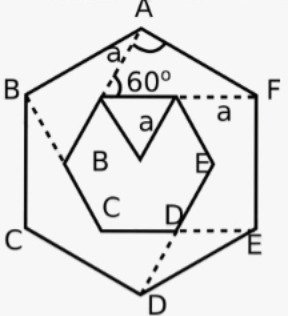
Then the ratio of the areas of the bigger to the smaller hexagon is:

(A) 2
(B) 3
(C) $2 \sqrt{3}$
(D) $\pi$

Question : 27

Between 12 noon and 1 PM, there are two instants when the hour hand and the minute hand of a clock are at right angles. The difference in minutes between these two instants is:

(A) $32 \frac{8}{11}$
(B) $30 \frac{8}{11}$
(C) $32 \frac{5}{11}$
(D) $30 \frac{5}{11}$

Question : 28

For which values of $\theta$, with $0<\theta<\frac{\pi}{2}$, does the quadratic polynomial in $t$ given by $t^2+4 t \cos \theta+\cot \theta$ have repeated roots?

(A) $\frac{\pi}{6}$ or $\frac{5 \pi}{18}$
(B) $\frac{\pi}{6}$ or $\frac{5 \pi}{12}$
(C) $\frac{\pi}{12}$ or $\frac{5 \pi}{18}$
(D) $\frac{\pi}{12}$ or $\frac{5 \pi}{12}$

Question : 29

Let $\alpha, \beta, \gamma$ be complex numbers which are the vertices of an equilateral triangle. Them, we must have :

(A) $\alpha+\beta+\gamma=0$
(B) $\alpha^2+\beta^2+\gamma^2=0$
(C) $\alpha^2+\beta^2+\gamma^2+\alpha \beta+\beta \gamma+\gamma \alpha=0$
(D) $\quad(\alpha-\beta)^2+(\beta-\gamma)^2+\left(\gamma-\alpha^2\right)=0$

Question : 30

Assume that $n$ copies of unit cubes are glued together side by side to form a rectangular solid block. If the number of unit cubes that are completely invisible is 30 , then the minimum possible value of $n$ is :

(A) 204
(B) 180
(C) 140
(D) 84

ISI BStat - BMath Entrance 2023, Problem 2, Hints and Solution

In this problem we use mathematical induction and trigonometric manipulations. Finally we also compute the limit of the resulting sequence.

Question

Let $a_0=\frac{1}{2}$ and $a_n$ be defined inductively by $a_n=\sqrt{\frac{1+a_{n-1}}{2}}$, $n \geq 1.$
1. Show that for $n=0,1,2, \dots a_n=cos\theta_n$ for some $0<\theta_n<\pi/2$ and determine $\theta_n$.
2. Using (a) or otherwise, calculate $lim_{n \to \infty} 4^n\left(1-a_n\right)$

Hint 1

Using Inductive hypothesis and basic trigonometry, try to deduce the $n$-th term of the sequence.

Hint 2

Deduce the limit after substituting the $n$-th term that is found previously.

Final Solution

Part a

Here $a_o =\frac{1}{2}=cos\frac{\pi}{3}=cos\theta_{0}$(say).
Now, Suppose $a_{n-1}=cos \theta_{n-1}$ where $0<\theta_n<\frac{\pi}{2}$.
Now, $a_n=\sqrt{\frac{1+a_{n-1}}{2}}$
$=\sqrt{\frac{1+cos \theta_{n-1}}{2}}$
$=\sqrt{\frac{2cos^{2} \theta_{n-1}}{2}}$
$=cos \frac{\theta_{n-1}}{2}$
So, $\theta_n=\frac{\theta_{n-1}}{2}$
Again, $\theta_n=\frac{\theta_{n-1}}{2}=\frac{\theta_{n-2}}{2^{2}}$=...=$\frac{\theta_{0}}{2^{n}}$.
So, $\theta_n=\frac{\pi}{3.2^{n}}$.

Part b

$\lim_{n\to\infty}  4^n\left(1-a_n\right)$

$ =\lim_{n\to\infty}2^{2n}.\{1-cos\frac{\pi}{3.2^{n}}\} $

$ =\lim_{n\to\infty}2^{2n}.2sin^{2}\frac{\pi}{3.2^{n+1}}$

$ = \lim_{\frac{1}{2^{n+1}} \to 0} \left(\frac{sin\frac{\pi}{3.2^{n+1}} }{\frac{\pi}{3.2^{n+1}}}\right)^{2} . \left(\frac{\pi}{3}\right)^{2} $

$=\frac{1}{2}.\frac{{\pi}^2}{9}$

$=\frac{{\pi}^2}{18}.$

ISI 2018 Subjective Problem 8 , A Problem from Matrix

Try this beautiful Subjective Matrix Problem appeared in ISI Entrance - 2018.

Problem

\(a_{i j} \in\{1,-1\}\) for all \(1 \leq i,j \leq n\).

Suppose that


\[a_{k 1}=1 \text { for all } 1 \leq k \leq n \]

 and k=1nakiakj=0 for all ij


Show that \(n\) is a multiple of \(4 \).


Key Concepts


Algebra

Matrix


Suggested Book | Source | Answer


Suggested Book: IIT mathematics by Asit Das Gupta

Source of the Problem: ISI UG Entrance - 2018 , Subjective problem number - 8

Try with Hints...

Hint 1:
We have \(a_{k 1}=1 \forall k=1,2, \ldots, n\).
Now,
\[\sum_{k=1}^{n} a_{k 1} a_{k 2}=0 \]

\[\Rightarrow \sum_{k=1}^{n} a_{k 2}=0\]

Similarly,
\[ \sum_{k=1}^{n} a_{k 3}=0\]
Hence proceed.

Hint 2: 

As \(a_{i j}=+1\) or \(-1\)
so number of \(+1^{\prime} s\) and \(-1^{\prime} s\) are same in every column.
Therefore \(n\) must be even . \((n=2 m\) say \()\)
Proceed to work with the following:

\[\sum_{k=1}^{n} a_{k 2} a_{k 3}=0\]

Hint 3
Observe in column 2,
\[\prod_{k=1}^{n} a_{k 2}=(1)^{m}(-1)^{m}=(-1)^{m} \ldots \ldots(1)\]

Similarly in column 3,
\[\prod_{k=1}^{n} a_{k 3}=(-1)^{m} \ldots \ldots(2)\]

And we also have

\[\sum_{k=1}^{n} a_{k 2} a_{k 3}=0 \ldots \ldots\]
So proceed.

Hint 4:
Obviously,
Hence, \(m\) of the \(a_{k 2} a_{k 3}\) are \(+1^{\prime}\) s and \(m\) of them are \(-1\) 's.
Now
\[\prod_{k=1}^{n} a_{k 2} a_{k 3}=(1)^{m}(-1)^{m}=(-1)^{m} \ldots(4)\]

Hint 5:
But,
\[\prod_{k=1}^{n} a_{k 2} a_{k 3}=\prod_{k=1}^{n} a_{k 2} \Pi_{k=1}^{n} a_{k 3}\]
we get by (1) and (2)
\[=(-1)^{m}(-1)^{m}=1 \ldots \ldots(5)\]

Hint 6:
Comparing (4) and (5),
we get \((-1)^{m}=1\)
Hence, \(m\) is even .
Therefore, \(n\) is obviously a multiple of 4 .

ISI Entrance Program at Cheenta

Subscribe to Cheenta at Youtube


Cheenta YouTube Channel

ISI 2015 Subjective Problem 8 | A Problem from Sequence

Try this beautiful Subjective Sequence Problem appeared in ISI Entrance - 2015.

Problem

(b) For any integer \(k>0\), give an example of a sequence of \(k\) positive integers whose reciprocals are in arithmetic progression.

Key Concepts


Sequence

Arithmetic Progression

Suggested Book | Source | Answer


IIT Mathemathematics by Asit Dasgupta

ISI UG Entrance - 2015 , Subjective problem number - 8

Try to prove using the following hints.

Try with Hints


Assume , \(d\) is the common difference for the given AP.

Therefore,

\( d = \frac{1}{m_2} - \frac{1}{m_1} \leq \frac{1}{m_1+1} - \frac{1}{m_1} = d' (say)\)

[Equality holds when , \(m_2 = m_1 + 1 \) ]

Hence proceed.

Now , \( \frac{1}{m_k} = \frac{1}{m_1} + d(k-1) \leq \frac{1}{m_1} + d'(k-1)\)

Notice that till now we haven't used \(m_1 < m_2 < \ldots < m_k\) are positive integers.

So , \(\frac{1}{m_k} > 0 \).

Therefore , \(\frac{1}{m_1} + d'(k-1) > 0 \).

Now use \( d' = \frac{1}{m_1+1} - \frac{1}{m_1} \).

\[\frac{1}{m_1} + d'(k-1) > 0 \]

\[\Rightarrow \frac{1}{m_1} + ( \frac{1}{m_1+1} - \frac{1}{m_1})(k-1) > 0 \]

Proceed with the above inequality and get \(m_1 + 2 > k .\)

As \(m_1 < m_2 < \ldots < m_k\) ,

so \(\frac{1}{m_1}, \frac{1}{m_2}, \ldots, \frac{1}{m_k}\)

is a decreasing \(AP.\)

Think about the LCM of \(m_1 < m_2 < \ldots < m_k\) .

Then you proceed.

Suppose , \(L = LCM(m_1 < m_2 < \ldots < m_k).\)

Now multiply \(L\) with all the reciprocals

i.e. with \(\frac{1}{m_1}, \frac{1}{m_2}, \ldots, \frac{1}{m_k}.\)

Then observe the pattern and try get such a sequence.

E.g. if \(k=5\)

Take \(5,4,3,2,1\) and \(LCM(5,4,3,2,1)=60\).

So the AP : \(\frac{5}{60},\frac{4}{60} , \frac{3}{60} , \frac{2}{60}, \frac{1}{60}\)

with common difference \(\frac{1}{60}.\)

ISI Entrance Program at Cheenta

Subscribe to Cheenta at Youtube


ISI 2019 Subjective Problem 2 | Removable Discontinuity

Try this beautiful Subjective Calculus Problem appeared in ISI Entrance - 2019.

Problem

Let \(f:(0, \infty) \rightarrow \mathbb{R}\) be defined by
\[
f(x)=\lim _{n \rightarrow \infty} \cos ^{n}\left(\frac{1}{n^{x}}\right)
\]
(a) Show that \(f\) has exactly one point of discontinuity.
(b) Evaluate \(f\) at its point of discontinuity.


Key Concepts


Calculus


Limit , Continuity


Suggested Book | Source | Answer


Suggested Reading: IIT mathematics by Asit Das Gupta

Source of the Problem: ISI UG Entrance - 2019 , Subjective problem number - 2

Try with Hints


Hint 1:

Observe that,

we have \(\frac{1}{n^x} \rightarrow 0 \)

as x∈(0,) and n→∞.

So the indeterminate form of the given limit is \(1^{\infty}.\)

Hint 2:

\[f(x)=\lim _{n \rightarrow \infty} \cos ^{n}\left(\frac{1}{n^{x}}\right)\]


\[=e^{\lim _{n \rightarrow \infty} n \log \cos \left(\frac{1}{n^{x}}\right)}\]


=elimn→∞nlog[1−2sin2(12nx)]

\[=e^{\lim _{n \rightarrow \infty}\frac{ n \log [1-2 \sin ^{2}(\frac{1}{2 n^{x}})]}{-2 \sin ^{2}(\frac{1}{2 n^{x}})}(-2 \sin ^{2}(\frac{1}{2 n^{x}}))}\]

Hint 3:

As we have \(\frac{1}{n^x} \rightarrow 0 \) ,

\[lim_{n\rightarrow \infty}-2 \sin ^{2}\left(\frac{1}{2 n^{x}}\right)=0.\]

And we have the standard result :

\[lim_{x \rightarrow 0}\frac{log(1+x)}{x} = 1 \]

Hint 4:

Therefore ,

\[f(x)=e^{\lim _{n \rightarrow \infty} n [-2 \sin ^{2}(\frac{1}{2 n^{x}})]}\]

\[f(x)=e^{\lim _{n \rightarrow \infty} -2n [\frac{ \sin ^{2}(\frac{1}{2 n^x})}{(\frac{1}{2 n^{x}})^2}](\frac{1}{2 n^{x}})^2}\]

And here again,

\(lim_{n \rightarrow \infty}\frac{1}{2n^x} \rightarrow 0 .\)

So \(f(x)\) reduces to ,

\[ f(x) = e^{\lim _{n \rightarrow \infty}-2n (\frac{1}{2 n^{x}})^2}\]

\[f(x)=e^{-\frac{1}{2} \lim _{n \rightarrow \infty} n^{1-2 x}}\]

Hint 5:

Therefore ,

\[ f(x) = \Bigg{\{}{\begin{matrix}
0 & , & x < \frac{1}{2}\\
e^{-\frac{1}{2}} & ,& x= \frac{1}{2} \\1 & , & x> \frac{1}{2}
\end{matrix}}\]

Discontinuity at \(x= \frac{1}{2}\)


ISI Entrance Program at Cheenta

Subscribe to Cheenta at Youtube


ISI 2018 Objective Problem 8 | A Problem from Sequence

Try this beautiful Objective Sequence Problem appeared in ISI Entrance - 2018.

Problem

Consider the real valued function \(h:\{0,1,2, \ldots, 100\} \longrightarrow \mathbb{R}\) such that \(h(0)=5, h(100)=20\) and satisfying \(h(i)=\frac{1}{2}(h(i+1)+h(i-1))\), for every \(i=1,2, \ldots, 99\). Then the value of \(h(1)\) is:

(A) \(5.15\)
(B) \(5.5\)
(C) \(6\)
(D) \(6.15.\)


Key Concepts


Sequence

Arithmetic Progression

Suggested Book | Source | Answer


IIT mathematics by Asit Das Gupta

ISI UG Entrance - 2018 , Objective problem number - 8

(B) \(5.15\)

Try with Hints


Observe the following,

\(2 h(i)=h(i-1)+h(i+1)\)

\(2h(1) = h(0) + h(2) \)

\(2h(2) = h(1) + h(3) \)

and so on.

Therefore we have the following,

\(h(i+1)-h(i)=h(i)-h(i-1).\)

Means

\(h(0) , h(1) , h(2) , \ldots \ldots ,h(100) \) are in Arithmetic Progression.

\(h(0) \) and \( h(100)\) are the first and last terms of the AP.

Common difference

\[=\frac{h(100) - h(0)}{100}\]

\[=\frac{20 - 5}{100}= 0.15\]

Therefore ,

\(h(1) = h(0) + 0.15 = 5.15\)

ISI Entrance Program at Cheenta

Subscribe to Cheenta at Youtube


ISI 2021 Objective Problem 23 I A Problem from Limit

Try this beautiful Objective Limit Problem appeared in ISI Entrance - 2021.

Problem

Let us denote the fractional part of

a real number \(x\) by \(\{x\}.\)

(Note \({x}=x-[x]\) where \([x]\)

is the integer part of \(x\).)

Then
\[
\lim _{n \rightarrow \infty}{(3+2 \sqrt{2})^{n}}.
\]

(A) equals 0
(B) equals 1
(C) equals \(\frac{1}{2}\)
(D) does not exist


Key Concepts


Fractional part of a real number

Greatest Integer function

Suggested Book | Source | Answer


IIT mathematics by Asit Das Gupta

ISI UG Entrance - 2021 , Objective problem number - 23

(B) equals 1

Try with Hints


Try to find the fractional part of \((3+2 \sqrt{2})^{n} = N \)(Let) .

\(\bullet \) Observe \((3+2 \sqrt{2})^{n} + (3-2 \sqrt{2})^{n}\) is an integer.

\(\bullet \) And use \( 0 < (3-2 \sqrt{2}) < 1.\)

\(\bullet \) Obviuosly \(0<(3-2 \sqrt{2})^{n}<1.\)

\(\bullet \) Also assume , \(p=(3-2 \sqrt{2})^{n}.\)

\(\bullet \) As \(N+p = integer = [N] + \{N\} + p ,\)

so \( \{N\} + p = integer - [N]= integer.\)

\(\bullet \) Hence proceed.

\(\bullet \) It is very easy to find that \( \{N\} + p =1.\)

∙ Therefore ,

$\lim _{n \rightarrow \infty}(3+2 \sqrt{2})^{n}$

=limn→∞{N}=limn→∞(1p)=1

[As,limn→∞p=limn→∞(3−22)n=0]

ISI Entrance Program at Cheenta

Subscribe to Cheenta at Youtube


ISI 2021 Subjective Problem 5 I A Problem from Polynomials

Try this beautiful Subjective Problem from Polynomials appeared in ISI Entrance - 2021.

Problem


Let \(a_{0}, a_{1}, \ldots, a_{19} \in \mathbb{R}\) and
\[
P(x)=x^{20}+\sum_{i=0}^{19} a_{i} x^{i} x \in \mathbb{R}
\]
If \(P(x)=P(-x)\) for all \(x \in \mathbb{R}\) and

\(P(k)=k^{2}\), for all \(k=0,1,2, \ldots, 9\)

then find
\[
\lim _{x \rightarrow 0} \frac{P(x)}{\sin ^{2} x}.\]


Key Concepts


Monic Polynomial

Even Polynomial

Degree of a Polynomial

Suggested Book | Source | Answer


An Excursion in Mathematics (Chapter - 2.1)

ISI Entrance - 2021 , Subjective problem number - 5

\(1-(9 !)^{2}\)

Try with Hints


\(\bullet \) Recall the Fundamental Theorem of Algebra i.e. every polynomial \(P(z)\) of degree \(n\) has \(n\) values \(z_{i}\) (some of them possibly degenerate) for which \(P\left(z_{i}\right)=0\).

\(\bullet \) And apply it to construct the polynomial.

\(\bullet \) Observe \(P(0) =0\) i.e. \(0\) is a root of \(P(x) .\)

To construct \(Q(x)\) use followings:

\(Q(x)\) has 19 roots and those are 0 and \(\pm 1, \pm 2, \ldots, \pm 9\).

As \(P(x)\) is monic and of degree 20 , so \(Q(x)\) is also. Hence all factors of \(Q(x)\) are like \((x+a)\).

Therefore,
\[Q(x)=x(x-1)(x+1)(x-2) \]

\[\ldots (x-9)(x+9) \times(x+c)
\]
(Observe extra \((x+c)\) is multiplied to make the degree of \(Q(x)\) to be 20 .)

\(\bullet\) As

\[Q(x)=x(x-1)(x+1)(x-2) \]

\[\ldots (x-9)(x+9) \times(x+c)\]

\(\bullet \)

\[
P(x)=x(x-1)(x+1)(x-2) \]

\[\ldots (x-9)(x+9) \times(x+c)+x^{2} .\]

\[\Rightarrow P(x)=x^{2}(x^{2}-1)(x^{2}-4) \]

\[\ldots (x^{2}-81)+x^{2}\]

\(\bullet \) Have you noticed the coefficients of all odd exponents of \(x\) in \(P(x) \) are \(0?\)

\(\bullet \) Recall we are given that \(P(x)=P(-x)\) for all \(x \in R\) means that \(P(x)\) is an even function and so all odd degree coefficients are 0 . That is, \(a_{i}=0\) for \(i=1,3,5, \ldots, 17,19\).

\(\bullet \) Therefore,

\[P(x)=x^{2}(x^{2}-1)(x^{2}-4) \]

\[\ldots(x^{2}-81)+x^{2} .\]

\[\Rightarrow \frac{P(x)}{x^{2}}=(x^{2}-1)(x^{2}-4)\]

\[ \ldots(x^{2}-81)+1 .\]

\[\Rightarrow \lim _{x \rightarrow 0} \frac{P(x)}{x^{2}}\]

\[=(-1)(-4) \ldots(-81)+1\]

ISI Entrance Program at Cheenta

Subscribe to Cheenta at Youtube


B.Math 2009 Objective Paper| Problems & Solutions

Problem 1: 

The domain of definition of $f(x)=-\log \left(x^{2}-2 x-3\right)$ is

(a) $(0, \infty)$
(b) $(-\infty,-1)$
(c) $(-\infty,-1) \cup(3, \infty)$
(d) $(-\infty,-3) \cup(1, \infty)$

Problem 2:

$A B C$ is a right-angled triangle with the right angle at B. If $A B=7$ and $B C=24$, then the length of the perpendicular from $B$ to $A C$ is

(a) $12.2$
(b) $6.72$
(c) $7.2$
(d) $3.36$

Problem 3:

If the points $\mathbf{z_{1}}$ and $\mathbf{z_{2}}$ are on the circles $|\mathbf{z}|=2$ and $|\mathbf{z}|=3$ respectively and the angle included between these vectors is $60^{\circ}$, then $\left|\left(\mathbf{z_{1}}+\mathbf{z_{2}}\right) /\left(\mathbf{z_{1}}-\mathbf{z_{2}}\right)\right|$ equals

(a) $\sqrt{(19 / 7)}$
(b) $\sqrt{19}$
(c) $\sqrt{7}$
(d) $\sqrt{133}$

Problem 4: 

Let $\mathbf{a}, \mathbf{b}, \mathbf{c}$ and $\mathbf{d}$ be positive integers such that $\log \mathrm{a}(\mathbf{b})=\mathbf{3 / 2}$ and
$\log (\mathrm{d})=5 / 4 .$ If $\mathrm{a}-\mathrm{c}=9$, then $b-d$ equals


(a) 55

(b) 23
(c) 89
(d) 93

Problem 5 :

$1-x-e^{-x}>0$ for :
(a) All $\mathbf{x} \in \mathbf{R}$.
(b) No $\mathbf{x} \in \mathbf{R}$.
(c) $x>0$.
(d) $x<0 .$

Problem 6 :

If $P(x)=a x^{2}+b x+c$ and $Q(x)=-a x^{2}+b x+c$ where $a c \neq 0$, then the equation $\mathbf{P}(\mathbf{x}) Q(\mathbf{x})=0$ has :
(a) Only real roots.
(b) No real roots.
(c) At least two real roots.
(d) Exactly two real roots.

Problem 7:

$\lim \mid \sqrt{\left(x^{2}+x\right)-x \mid}$ as x $\rightarrow \infty$ is equal to
(a) $1 / 2$
(b) 0
(c) $\infty$
(d) 2

Problem 8:

$\mathrm{lim}\left(\mathrm{n} / 2^{\mathrm{n}}\right) \Sigma \sin \left(\mathrm{jn} / 2^{n}\right)$ where $j$ runs from 1 to $2^{n}$ as $n \rightarrow \infty$ is equal
(a) 0
(b) $\Pi$
(c) 2
(d) 1

Problem 9:

Let f: $\mathbf{R} \rightarrow \mathbf{R}$ is given by $\mathbf{f}(\mathbf{x})=\mathbf{x}(\mathbf{x}-\mathbf{1})(\mathbf{x}+\mathbf{1})$. Then,
(a) $f$ is $1-1$ and onto
(b) $\mathbf{f}$ is neither $\mathbf{1}-\mathbf{1}$ nor onto
(c) $f$ is $1-1$ but not onto
(d) $f$ is onto but not $1-1$

Problem 10:

The last digit of $22^{22}$ is :
(a) $2$
(b) $4$
(c) $6$
(d) $0$

Problem 11:

The average scores of $10$ students in a test is $25$. The lowest score is $20$. Then the highest score is at most
(a) $100$
(b) $30$
(c) $70$
(d) $75$

Problem 12:

The coefficient of $t^{3}$ in the expansion of $\{(1-t^{6}) /(1-t)\}^{3}$ is
(a) $10$
(b) $12$
(c) $8$
(d) $9$

problem 13:

Let $p_{n}(x), n \geq 0$ be polynomials defined by $p_{0}(x)=1, p_{1}(x)=x$ and

${P_{n}}(x)=x p_{n-1}(x)- p_{n-2}(x)$ for $n \geq 2$. Then $\mathbf{p}_{10}(\mathbf{x})$ equals


(a) $0$
(b) $10$
(c) $1$
(d) $-1$

Problem 14:

Suppose $A, B$ are matrices satisfying $A B+B A=0$. Then $A^{2} B^{5}$ is equal to
(a) 0
(b) $\mathrm{B}^{2} \mathrm{~A}^{5}$
(c) $-\mathrm{B}^{2} \mathrm{~A}^{5}$
(d) $A B$

Problem 15:

The number of terms in the expansion of $(x+y+z+w)^{2 0 0 9}$
is

(a) $2009_\mathrm{C_{4}}$

(b) $2013 _\mathrm{C_{4}}$
(c) $2012_\mathrm{ C_{3}}$
(d) $(2010)^{4}$

Problem 16:

If $\mathbf{a}, \mathbf{b}, \mathbf{c}$ are positive real numbers satisfying $\mathbf{a b}+\mathbf{b c}+\mathbf{c a}=\mathbf{1 2}$,

then the maximum value of $\mathrm{abc}$ is
(a) 8
(b) 9
(c) 6
(d) 12

Problem 17:

If at least $90$ percent students in a class are good in sports, and at least $80$ percent are good in music and at least $70$ percent are good in studies, then the percentage of students who are good in all three is at least
(a) $25$
(b) $40$
(c) $20$
(d) $50$

Problem 18:

If $\cot \{\sin ^{-1} \sqrt{(13 / 17)}\}=\sin (\tan ^{-1} \theta).$, then $\theta$ is

(a) $2 / \sqrt{17}$
(b) $\sqrt{(} 13 / 17)$
(c) $\sqrt{(2 / \sqrt{13})}$
(d) 2/3

Problem 19:

Let $f(t)=(t+1) /(t-1) .$ Then $f(f(2010))$ equals
(a) $2011 / 2009$
(b) 2010
(c) $2010 / 2009$
(d) None of the above

Problem 20:

If each side of a cube is increased by $60 \%$, then the surface area of the cube increased by
(a) $156 \%$
(b) $160 \%$
(c) $120 \%$
(d) $240 \%$

Problem 21:

If $\mathbf{a}>\mathbf{2}$, then

(a) $\log {e}(a)+\log {a}(10)<0$

(b) $\log {e}(a)+\log {a}(10)>0$
(c) $e^{a}<1$
(d) None of the above is true.

Problem 22:

The number of complex numbers w such that $|\mathbf{w}|=1$ and imaginary part of $\mathrm{w}^{4}$ is 0 , is
(a) 4
(b) 2
(c) 8
(d) Infinite

Problem 23:

Let $f(x)=csin(x)$ for all $x \in R .$ Suppose $f(x)=\sum f(x+k n) / 2^{k}$
(summation is running from $\mathbf{k}=1$ to $\mathbf{k}=\infty)$ for all $\mathbf{x} \in \mathbf{R}$. Then
(a) $c=1$
(b) $c=0$
(c) $c<0$
(d) $c=-1$

Problem 24:

The number of points at which the function $f(x)=\max (1+x, 1-$ $x$ ) if $x<0$ and $f(x)=\min \left(1+x, 1+x^{2}\right)$ if $x \geq 0$ is not differentiable, is
(a) 1
(b) 0
(c) 2
(d) None of the above.

Problem 25:

The greatest value of function $f(x)=\sin ^{2}(x) \cos (x)$

(a) $2 / 3 \sqrt{3}$
(b) $\sqrt{(2 / 3)}$
(c) $2 / 9$
(d) $\sqrt{2} / 3 \sqrt{3}$

problem 26:

Let $g(t)=\int\left(x^{2}+1\right)^{10} d x$ (integration running from $-10$ to $\left.t\right)$ for all $\mathbf{t} \geq-10$. Then
(a) $g$ is not differentiable.
(b) $\mathbf{g}$ is constant.
(c) $\mathbf{g}$ is increasing in $(-10, \infty)$.
(d) $\mathbf{g}$ is decreasing in $(-10, \infty)$.

Problem 27:

Let $\mathbf{p}(\mathbf{x})$ be a continuous function which is positive for all $\mathbf{x}$ and $\int p(x) d x=c \int p{(x+4) / 2} d x$ (first integration is running from 2 to 3 and second integration running from 0 to 2). Then
(a) $c=4$
(b) $c=1 / 2$
(c) $c=1 / 4$
(d) $c=2$

Problem 28:

Let $\mathrm{f}:[0,1] \rightarrow(1, \infty)$ be a continuous function. Let $g(x)=1 / x$ for $x>0$. Then, the equation $f(x)=g(x)$ has
(a) No solution.
(b) All points in $(0,1]$ as solutions.
(c) At least one solution.
(d) None of the above.

Problem 29:

Let $0 \leq \theta, \Phi<2 n$ be two angles. Then the equation $\sin \theta+\sin \phi=\cos \theta+\cos \Phi$
(a) Determines $\Theta$ uniquely in terms of $\Phi$
(b) Gives two value of $\Theta$ for each value of $\boldsymbol{\Phi}$
(c) Gives more than two values of $\Theta$ for each value of $\Phi$
(d) None of the above.

Problem 30:

Ten players are to pay a tennis tournament. The number of pairings for the first round is

(a) $10 ! / 2^{5} 5 !$
(b) $2^{10}$
(c) $10_{C _{2}}$
(d) $10_{\mathrm{P}_{2}}$

Parallelogram - CMI Entrance, 2019 - Problem 4

What is Parallelogram?


parallelogram is a quadrilateral with opposite sides parallel (and therefore opposite angles equal). A quadrilateral with equal sides is called a rhombus, and a parallelogram whose angles are all right angles is called a rectangle.

Try the problem


\begin{equation}
\begin{array}{l}
{\text { 4. Let } A B C D \text { be a parallelogram. Let } O \text { be a point in its interior such that } \angle A O B+} \\
{\angle D O C=180^{\circ} . \text { Show that } \angle O D C=\angle O B C \text { . }}
\end{array}
\end{equation}

CMI Entrance, 2019

Parallelogram

6 out of 10

Challenging Problems in Geometry

Use some hints


First construct AP and BP parallel to DO and CO respectively. Basically translate triangle DOC to triangle APB with DC and AB as parallel bases respectively. Notice that product of the fractions is 1. Can you use this fact to compute the geometric mean of the fractions?

Now using angle manipulations by spotting the required parallelograms and show that APBO is cyclic quadrilateral.

Now using Hint 2 and the fact that PBCO is a parallelogram arrive at the proof.

After implementing Hint 3 by spotting the parallelogram PBCO, notice that the the diagonal OB forms the the alternate interior angles i.e. angle POB and angle OBC which will be equal to each other as PB is parallel to OC since PBCO is a parallelogram. Since angle POB is equal to angle PAB (angle POB and angle PAB share the same arc AB and hence are equal to each other), which again itself is equal to angle ODC as AP is parallel to DO as we translated triangle DOC to triangle APB. Hence, angle ODC = angle PAB = angle POB = angle OBC. Hence we are done.

Subscribe to Cheenta at Youtube